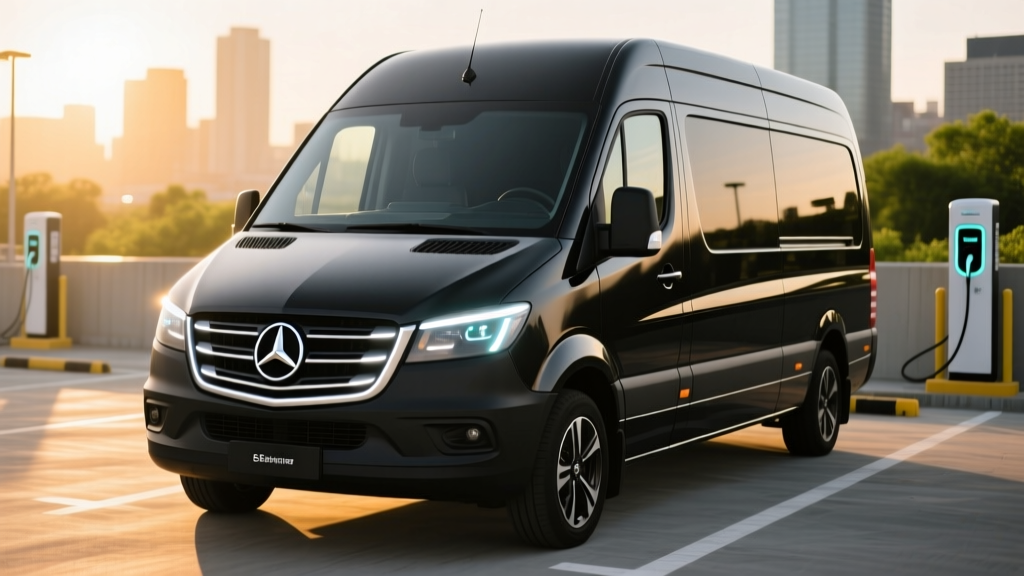
Quick Verdict: Is the Electric Mercedes Sprinter Right for Your Fleet?
The 2026 electric Mercedes Sprinter (eSprinter) is best suited for last-mile delivery, urban service routes, and shuttle operations with predictable daily mileage under 200 miles and access to overnight depot charging. With a 113 kWh usable battery (LFP chemistry), a WLTP-estimated range of ~280 miles (expect 180–220 miles real-world with cargo and highway driving), and peak DC fast charging at 115 kW (10–80% in approximately 42 minutes), the eSprinter eliminates diesel fuel and maintenance costs while qualifying for the IRS §45W Commercial Clean Vehicle Credit of up to $40,000 for qualified commercial vehicles. Base pricing starts around $72,000 before incentives. It is not a fit for long-haul routes exceeding 250 miles/day, operations without depot charging infrastructure, or extreme cold-climate use without preconditioning.
2026 eSprinter Specifications at a Glance
| Specification | 2026 eSprinter (113 kWh Battery) |
|---|---|
| Battery Capacity (Usable) | 113 kWh (LFP chemistry) |
| WLTP Range Estimate | ~280 miles (450 km) |
| Real-World Range (Loaded, Mixed) | 180–220 miles |
| Real-World Range (Highway, Cold) | 140–170 miles |
| Motor Output | 201 hp (150 kW) / 302 lb-ft torque |
| 0–60 mph (Unloaded) | ~12.5 seconds |
| Max DC Fast Charge Rate | 115 kW peak |
| 10–80% DC Fast Charge | ~42 minutes |
| Level 2 AC Charge Rate | 11 kW (onboard charger) |
| Level 2 Full Charge Time | ~11 hours (0–100%) |
| Max Payload | ~2,624 lbs (varies by config) |
| Cargo Volume (170" WB High Roof) | 533 cu ft |
| Base MSRP (Cargo Van 150" WB) | ~$72,000 |
| Commercial Clean Vehicle Credit (§45W) | Up to $40,000 |
| Battery Warranty | 8 years / 100,000 miles (70% capacity retention) |
Note: Range figures use WLTP testing, which tends to be more optimistic than EPA estimates. Mercedes-Benz has not published an official EPA range figure for the US-market eSprinter as of early 2026. Real-world range varies significantly with payload, ambient temperature, driving speed, and route topography.
Range Reality: What the WLTP Number Doesn't Tell You
WLTP Sticker: ~280 miles
Real-World (Urban Delivery, Moderate Load): 200–220 miles
Real-World (Highway 65+ mph, Loaded): 160–180 miles
Real-World (Cold Weather, Below 30°F, Highway): 140–160 miles
The eSprinter's 113 kWh LFP (lithium iron phosphate) battery provides a large energy buffer, but commercial van efficiency is heavily affected by aerodynamics, weight, and speed. At 70 mph on the highway, the eSprinter consumes roughly 2.5–2.8 kWh per mile when loaded, yielding approximately 170–190 miles of range. In stop-and-go urban delivery, regenerative braking recovers significant energy, pushing efficiency closer to 2.0–2.2 kWh per mile and extending range to 210–240 miles.
LFP chemistry trades some energy density for longevity and thermal stability. Unlike NMC (nickel manganese cobalt) packs, LFP batteries tolerate daily 100% charging without accelerated degradation — a significant advantage for fleet operations where vehicles charge to full every night. LFP also eliminates cobalt, which simplifies supply-chain compliance for federal tax credits.
Cold-weather note: LFP batteries are more sensitive to cold than NMC. Below 20°F, expect 25–35% range loss without preconditioning. The eSprinter's heat pump and battery thermal management system mitigate this, but depot managers in northern climates should plan routes conservatively and precondition vehicles while still plugged in.
Charging Infrastructure: What Your Depot Needs
| Charging Level | Power (kW) | Miles Added per Hour | Best Use Case |
|---|---|---|---|
| Level 1 (120V) | ~1.4 kW | ~3–4 mi/hr | Emergency/top-off only |
| Level 2 (240V, 48A) | 11 kW | ~28–32 mi/hr | |
| DC Fast Charging | 115 kW peak | ~150+ mi/hr (10–80%) |
For fleet operations, Level 2 overnight charging is the primary refueling method. An 11 kW onboard charger means a full 0–100% charge takes approximately 11 hours — ideal for overnight depot schedules. Most commercial electricians recommend installing 60A circuits with 48A Level 2 EVSE (Electric Vehicle Supply Equipment) units per vehicle bay.
Depot charging cost estimate:
| Item | Per-Vehicle Bay Cost Range |
|---|---|
| Commercial Level 2 EVSE (48A, hardwired) | $800–$1,500 |
| Electrical panel upgrade (if needed, 200A+ service) | $2,000–$8,000 |
| Conduit, wiring, labor (50-ft run) | $1,500–$3,500 |
| Permitting & inspection | $300–$800 |
| Total per bay (no panel upgrade) | $2,600–$5,800 |
| Total per bay (with panel upgrade) | $4,600–$13,800 |
For a 10-vehicle fleet, budget $30,000–$60,000 for charging infrastructure before utility demand-charge considerations. Consult your local utility about commercial EV charging tariffs — some offer off-peak rates below $0.08/kWh, while demand charges can add $10–$20 per kW of peak draw. Smart charging software (e.g., charge management platforms that stagger vehicle charging) can significantly reduce demand charges.
The eSprinter uses a CCS1 connector for DC fast charging in North America. At a 115 kW DC station, the charge curve peaks near 115 kW from roughly 10–40% SoC, then tapers to ~80 kW through 60%, and further to ~40 kW above 80%. This tapering is normal for lithium batteries and protects cell longevity. Plan for 42 minutes for a 10–80% session, not the "peak kW" marketing figure.
eSprinter vs Diesel Sprinter: Total Cost of Ownership
The core buying decision comes down to total cost of ownership (TCO). Here's a 5-year / 125,000-mile comparison based on a delivery fleet driving 25,000 miles/year:
| Cost Category | 2026 eSprinter (Electric) | 2026 Sprinter 2500 Diesel |
|---|---|---|
| Base MSRP | ~$72,000 | ~$52,000 |
| Federal Tax Credit (§45W) | −$40,000 | $0 |
| Net Purchase Price | ~$32,000 | ~$52,000 |
| Fuel/Energy (125K miles) | $5,000–$7,500 | $18,750–$22,500 |
| Maintenance (5 years) | $2,000–$3,500 | $6,000–$9,000 |
| Depot Charging Install (amortized) | $4,000–$6,000 | $0 |
| Insurance (5 years, est.) | $9,000–$12,000 | $7,500–$10,000 |
| Estimated 5-Year TCO | $52,000–$61,000 | $84,250–$93,500 |
| Cost Per Mile | $0.42–$0.49 | $0.67–$0.75 |
Key assumptions: Electricity at $0.12/kWh average (commercial off-peak), diesel at $4.00/gallon, 19 MPG combined for diesel Sprinter (per fueleconomy.gov class estimates), 2.2 kWh/mile for eSprinter. Maintenance savings reflect elimination of oil changes, fuel filters, DEF fluid, transmission service, and reduced brake wear from regenerative braking. Actual costs vary by region, utility rates, and route profile.
The eSprinter's TCO advantage is heavily dependent on the §45W commercial credit. Without it, the math narrows considerably. Per IRS guidelines, the §45W credit applies to qualified commercial clean vehicles with a GVWR under 14,000 lbs (the eSprinter qualifies), with the credit equal to the lesser of 15% of the vehicle's basis (30% if no gas/diesel equivalent exists) or the incremental cost over a comparable ICE vehicle, capped at $7,500 for vehicles under 14,000 lbs GVWR and up to $40,000 for heavier vehicles. The eSprinter's GVWR places it in the higher-credit tier. Consult a tax professional for your specific eligibility.
Common Misconceptions About the Electric Sprinter
| Myth | Fact |
|---|---|
| "The eSprinter can't handle a full day's route." | With 180–220 real-world miles, it covers most urban last-mile and service routes. Routes exceeding 250 miles/day still require diesel or mid-day DC fast charging. |
| "Electric vans can't carry heavy payloads." | The eSprinter offers ~2,624 lbs payload (varies by configuration). Payload reduces range, but not dramatically for typical parcel delivery loads of 500–1,500 lbs. |
| "The battery will need expensive replacement in a few years." | LFP chemistry is rated for 3,000+ charge cycles with minimal degradation. The 8-year/100,000-mile battery warranty guarantees 70% capacity retention. Most fleet batteries outlast the vehicle's service life. |
| "Charging takes too long for commercial use." | Overnight Level 2 charging at the depot covers daily needs. DC fast charging (10–80% in 42 min) handles mid-day top-offs if needed. Fleet scheduling adapts to charge windows. |
| "The tax credit is $7,500 like consumer EVs." | Commercial vehicles under §45W can qualify for up to $40,000 depending on GVWR and incremental cost calculations. The eSprinter typically qualifies for a credit well above the consumer §30D cap. |
| "Cold weather makes it unusable." | Range drops 25–35% in sub-30°F weather. With depot preconditioning and route planning, the eSprinter remains functional in cold climates — but fleet managers must budget for reduced winter range. |
What First-Time Commercial EV Buyers Should Know
Transitioning a fleet from diesel to electric involves more than swapping vehicles. Here are the operational realities no brochure mentions:
1. Utility lead times are real. Upgrading commercial electrical service for a multi-bay charging depot can take 6–18 months depending on your utility. Begin infrastructure planning before ordering vehicles.
2. Route analysis comes first. GPS-log your current fleet routes for 30 days. Identify daily mileage, idle time, and payload weights. Any route consistently under 200 miles/day is an eSprinter candidate. Routes with wide variance or occasional 300+ mile days may need a mixed fleet.
3. Drivers need training. Regenerative braking changes driving behavior. The eSprinter's regen is moderate — not true one-pedal driving like some passenger EVs — but drivers should learn to anticipate stops and lift off the accelerator early to maximize energy recovery and reduce brake wear.
4. Telematics integration matters. The eSprinter's Mercedes PRO connect platform provides State of Charge monitoring, range prediction, and charge scheduling. Integrate this with your fleet management software to optimize charging windows and avoid peak demand charges.
5. Residual values are still uncertain. Commercial EV residual values after 5–7 years remain less predictable than diesel Sprinters, which have strong resale markets. Factor conservative residual estimates into lease-vs-buy analyses.
Decision Framework: Should You Buy the eSprinter?
Choose the electric Mercedes Sprinter if:
- Your routes average under 200 miles/day with predictable patterns
- You have (or can install) overnight depot Level 2 charging
- You operate primarily in urban or suburban environments with stop-and-go driving
- Your business qualifies for the §45W Commercial Clean Vehicle Credit
- You want to eliminate diesel fuel, DEF, and powertrain maintenance costs
- Local emissions regulations or customer ESG requirements favor zero-tailpipe-emission vehicles
Stick with the diesel Sprinter if:
- Your daily routes regularly exceed 250 miles or are highly variable
- You operate in extreme cold (consistent sub-10°F) without heated depot facilities
- Your depot cannot accommodate electrical upgrades for Level 2 charging within your timeline
- You need maximum payload capacity on every run (diesel Sprinter payload is slightly higher)
- Your business cannot utilize the §45W tax credit (non-taxable entities should explore §45W direct-pay or point-of-sale transfer options)
- You tow frequently — the eSprinter's towing capacity is limited compared to diesel
Consider a mixed fleet if:
- 80% of your routes are under 200 miles but 20% are long-haul
- You're piloting electrification before full commitment
- Utility infrastructure upgrades are phased over multiple years
Frequently Asked Questions
What is the real-world range of the electric Mercedes Sprinter?
The eSprinter's WLTP-rated range is approximately 280 miles with the 113 kWh LFP battery. In real-world commercial use with moderate cargo loads and mixed driving, expect 180–220 miles. Highway driving at 65+ mph reduces this to 160–180 miles, and cold weather (below 30°F) can bring it down to 140–160 miles. Route profile matters enormously: stop-and-go urban delivery maximizes regenerative braking and range, while sustained highway speeds drain the battery faster due to aerodynamic drag.
How long does it take to charge the eSprinter?
On a Level 2 charger (240V, 48A, 11 kW), a full 0–100% charge takes approximately 11 hours — designed for overnight depot charging. On a DC fast charger, the eSprinter peaks at 115 kW and charges from 10–80% in approximately 42 minutes. The charge curve tapers significantly above 80% to protect battery health, so charging to 100% on DC fast charging is not time-efficient and generally unnecessary for daily operations.
Does the eSprinter qualify for the $7,500 EV tax credit?
Not the consumer §30D credit — but it may qualify for the §45W Commercial Clean Vehicle Credit, which can provide a significantly larger credit. For vehicles with GVWR under 14,000 lbs, the credit is capped at $7,500; for heavier vehicles, it can reach up to $40,000. The eSprinter's specific GVWR configuration determines the applicable tier. The credit amount is based on the incremental cost of the EV over a comparable diesel vehicle or a percentage of the vehicle basis. Tax-exempt organizations may be eligible for direct-pay provisions. Always consult a tax professional and review current IRS guidance before making purchase decisions.
What battery chemistry does the eSprinter use, and why does it matter?
The 2026 eSprinter with the 113 kWh battery uses LFP (lithium iron phosphate) chemistry. LFP offers longer cycle life (3,000+ cycles), better thermal stability (lower fire risk), and no cobalt dependency compared to NMC (nickel manganese cobalt). The trade-off is lower energy density (heavier pack for the same capacity) and reduced cold-weather performance. For fleet use, LFP is generally advantageous: you can charge to 100% daily without accelerated degradation, and the battery is likely to outlast the vehicle's useful service life.
How does the eSprinter compare to the Ford E-Transit and Rivian EDV?
The eSprinter offers the largest battery (113 kWh vs. the E-Transit's 68 kWh usable) and the longest range among large electric cargo vans, but at a higher base price. The Ford E-Transit starts around $55,000 with ~126 miles of EPA range — better suited for shorter urban routes at a lower entry cost. The Rivian EDV (Commercial Delivery Van) is primarily built for Amazon but is expanding availability. For fleets needing maximum range and willing to invest in the larger battery, the eSprinter leads; for shorter, cost-sensitive routes, the E-Transit remains competitive.
What maintenance does the eSprinter require?
Significantly less than a diesel Sprinter. There are no oil changes, fuel filters, DEF fluid refills, transmission fluid services, or exhaust system repairs. Regenerative braking reduces brake pad wear, often extending brake service intervals to 80,000+ miles. Remaining maintenance includes cabin air filter replacement, windshield washer fluid, tire rotation, brake fluid checks, coolant system service, and periodic battery health diagnostics. Budget $400–$700/year in maintenance vs. $1,200–$1,800/year for diesel.
Can the eSprinter handle towing?
The eSprinter has a rated towing capacity of up to 5,000 lbs (braked trailer), which is lower than the diesel Sprinter's ~7,500 lbs. Towing significantly reduces range — expect a 30–50% reduction depending on trailer weight and aerodynamics. If your operation requires frequent heavy towing, the diesel Sprinter remains the more practical choice.