Quick Answer: Is an Electric Mercedes Worth It?
An electric Mercedes delivers luxury EV performance with EPA ranges between 230 and 390 miles depending on the model, DC fast-charging from 170 to 200 kW, and starting MSRPs from roughly $53,000 (EQB) to over $105,000 (EQS). Real-world ownership costs are lower than equivalent gas Mercedes sedans and SUVs when you factor in fuel savings and reduced maintenance, but higher insurance premiums, faster depreciation, and limited federal tax-credit eligibility offset some gains. If you have reliable home Level 2 charging and drive under 300 miles between stops, the EQE sedan offers the best balance of range, price, and daily usability in the 2026 lineup.
The 2026 Electric Mercedes Lineup at a Glance
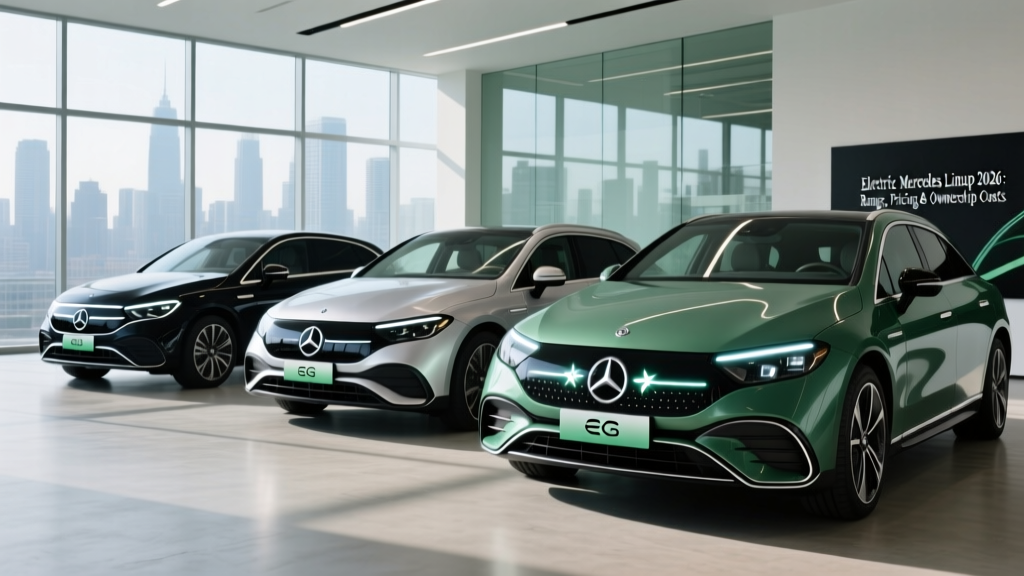
Mercedes-Benz currently sells several battery-electric vehicles (BEVs) in the US under the EQ sub-brand. The lineup spans a compact SUV, a mid-size sedan, and a full-size luxury sedan. Here is how the core models compare on the specs that matter most to buyers.
| Spec | 2026 EQB 300 4MATIC | 2026 EQE 350+ Sedan | 2026 EQS 450+ Sedan |
|---|---|---|---|
| EPA Range | ~230 mi | ~330 mi | ~390 mi |
| Battery (usable kWh) | 66.5 kWh (NMC) | 90.6 kWh (NMC) | 108.4 kWh (NMC) |
| Peak DC Fast Charge | 100 kW | 170 kW | 200 kW |
| 10–80% DC Charge Time | ~32 min | ~31 min | ~31 min |
| Level 2 Charge Rate | 7.2 kW | 9.6 kW | 9.6 kW |
| Horsepower | 225 hp | 288 hp | 355 hp |
| 0–60 mph | 7.7 sec | 6.2 sec | 5.9 sec |
| Starting MSRP | ~$53,050 | ~$74,900 | ~$105,550 |
| Battery/Powertrain Warranty | 8 yr / 100,000 mi | 8 yr / 100,000 mi | 8 yr / 100,000 mi |
Real-world range caveat: EPA estimates assume a mix of city and highway driving at moderate temperatures. Expect highway-only range to drop 10–15% below the sticker figure, and cold-weather driving (below 32°F) can reduce range by 20–30% due to cabin heating and battery resistance. The EQS 450+ with its 390-mile EPA rating will realistically deliver 310–340 miles on a warm-weather highway trip and potentially 260–280 miles in freezing conditions.
Real-World Range Expectations:
- EQB 300: EPA 230 mi → expect ~190–210 mi highway, ~160–175 mi in cold weather
- EQE 350+: EPA 330 mi → expect ~280–300 mi highway, ~230–260 mi in cold weather
- EQS 450+: EPA 390 mi → expect ~330–350 mi highway, ~270–300 mi in cold weather
Electric Mercedes vs Gas Equivalents: Cost and Efficiency
Buying an electric Mercedes means trading higher upfront cost for lower operating expenses. To see whether the math works, compare the EQE 350+ sedan against its closest internal-combustion sibling, the E 350 sedan.
| Factor | 2026 EQE 350+ (BEV) | 2026 E 350 Sedan (Gas) |
|---|---|---|
| Starting MSRP | ~$74,900 | ~$60,000 |
| EPA Efficiency | 94 MPGe (36 kWh/100 mi) | 28 MPG combined |
| Fuel/Energy Cost per Mile | ~$0.048 (home charging at $0.17/kWh) | ~$0.125 (gas at $3.50/gal) |
| Annual Fuel Cost (12,000 mi) | ~$576 | ~$1,500 |
| Annual Maintenance Estimate | ~$400 | ~$900 |
| Annual Insurance (avg.) | ~$2,800 | ~$2,200 |
| Federal Tax Credit (§30D) | Up to $7,500 (if eligible) | $0 |
The EQE costs roughly $14,900 more at the sticker, but saves about $1,424 per year on fuel and maintenance combined. That payback takes roughly 10.5 years without a tax credit or about 5 years if you qualify for the full $7,500 federal §30D credit and apply it at point of sale. Insurance, however, typically runs $500–$800 more per year on the EV, narrowing the gap.
Real Ownership Costs: 5-Year Breakdown
Luxury EV ownership involves more than sticker price and fuel savings. Here is a realistic 5-year / 60,000-mile cost-of-ownership estimate for the EQE 350+ versus the E 350 gas sedan.
| Cost Category (5 yr) | EQE 350+ | E 350 Gas |
|---|---|---|
| Purchase Price (base MSRP) | $74,900 | $60,000 |
| Federal Tax Credit | –$7,500 (if eligible) | $0 |
| Effective Purchase | $67,400 | $60,000 |
| Energy/Fuel (60,000 mi) | $2,880 | $7,500 |
| Maintenance | $2,000 | $4,500 |
| Insurance | $14,000 | $11,000 |
| Estimated Depreciation (5 yr) | ~$35,000 (47%) | ~$25,000 (42%) |
| Home Charger Install (one-time) | $800–$2,000 | $0 |
| Total 5-Year Cost | ~$121,080 | ~$108,000 |
The EV still costs more over five years, primarily due to steeper depreciation (luxury EVs have depreciated faster than gas counterparts in recent years) and higher insurance. However, the gap narrows significantly if you plan to keep the car 8–10 years, since the EQE's lower maintenance and fuel costs compound while depreciation flattens.
Charging cost note: The $0.048/mile figure assumes 80%+ home Level 2 charging at a national-average residential rate of ~$0.17/kWh. Public DC fast charging at Electrify America or EVgo typically costs $0.40–$0.55/kWh, pushing the per-mile cost to $0.14–$0.20 — comparable to or exceeding gas. If you cannot charge at home, the EV's cost advantage shrinks considerably.
Charging Realities: Home Setup and Public Networks
Mercedes EQ vehicles use the CCS1 connector for DC fast charging and the J1772 connector for Level 2 AC charging, though Mercedes has announced a transition to the NACS (Tesla-style) connector on future models. For 2026 models, plan on CCS/J1772 compatibility. If you need Tesla Supercharger access, a CCS-to-NACS adapter (approximately $200–$400) may be required depending on network agreements.
| Charging Level | Power (kW) | Miles Added per Hour | Typical Use Case |
|---|---|---|---|
| Level 1 (120V household) | 1.4 kW | ~3–5 mi/hr | Emergency/overnight trickle |
| Level 2 (240V home) | 7.2–9.6 kW | ~22–35 mi/hr | Daily home charging |
| DC Fast (public) | 100–200 kW | ~180–350 mi/hr (peak) | Road trips, quick top-ups |
Home Level 2 Installation: What to Budget
A 240V Level 2 home charger (such as the Mercedes-Benz Home Wallbox or a ChargePoint Home Flex) is essential for practical daily ownership. Installation costs vary widely based on your electrical panel and the distance from panel to garage.
| Item | Typical Cost Range |
|---|---|
| Level 2 Charger Hardware | $400–$750 |
| Electrician Labor (standard install) | $500–$1,500 |
| Permit / Inspection | $50–$200 |
| Electrical Panel Upgrade (if needed) | $1,500–$3,500 |
| Total (no panel upgrade) | $950–$2,450 |
| Total (with panel upgrade) | $2,450–$5,950 |
The EQE and EQS accept 9.6 kW on Level 2, meaning a full charge from 10–100% takes about 9.5–11 hours. Most owners plug in nightly and wake up with a full battery. The EQB's 7.2 kW onboard charger is slower but adequate for its smaller 66.5 kWh battery.
DC Fast Charging and the Charge Curve
Peak DC charge rates (170 kW for the EQE, 200 kW for the EQS) are only sustained briefly, typically between 10–30% state of charge. Above 50%, the charge curve tapers significantly, and above 80% it drops to under 50 kW to protect battery longevity. This is why Mercedes (and the industry) quote 10–80% times rather than 0–100%. On a road trip, plan your stops around the 10–80% window for the fastest turnaround — roughly 31 minutes for both the EQE and EQS at a capable 350 kW station. Charging from 80–100% can add another 25–40 minutes.
Federal Tax Credit Eligibility: The §30D Reality for Mercedes
The IRS §30D clean vehicle credit offers up to $7,500 for qualifying new EVs, but eligibility depends on several factors that frequently exclude imported luxury vehicles.
§30D Requirements Checklist (2026)
- MSRP Cap: Vans, SUVs, and pickup trucks: ≤$80,000. Sedans and other vehicles: ≤$55,000. The EQE sedan (~$74,900) and EQS sedan (~$105,550) exceed the $55,000 sedan cap and do NOT qualify. The EQB SUV (~$53,050) may qualify if other criteria are met.
- Buyer Income Cap: AGI ≤$300,000 (joint), ≤$225,000 (head of household), ≤$150,000 (single).
- Battery Sourcing: Critical minerals and battery components must meet phased-in domestic/free-trade-partner thresholds that tighten each year.
- Assembly: Final assembly must occur in North America. Most Mercedes EQ models are assembled in Germany, which disqualifies them from §30D.
- Point-of-Sale Transfer: If eligible, the credit can be transferred to the dealer at purchase to reduce the sale price directly.
Bottom line: As of 2026, most electric Mercedes models do not qualify for the $7,500 federal credit due to MSRP caps and non-North-American assembly. The EQB is the most likely candidate, but verify its assembly location and battery sourcing on the IRS qualified vehicle list before relying on the credit. State and local incentives may still apply — check AFDC's state incentive database for your jurisdiction.
Common Misconceptions About Electric Mercedes Ownership
| Myth | Fact |
|---|---|
| "The battery will need a $20,000 replacement in 5 years." | NMC batteries in Mercedes EQ vehicles are warrantied for 8 years/100,000 miles at ≥70% capacity. Industry data shows average degradation of ~5–8% over 5 years under normal use. Full replacement is rare and typically covered if premature. |
| "I can charge at any Tesla Supercharger." | As of 2026, Mercedes EQ vehicles use CCS1 connectors. Tesla Supercharger access requires a CCS-to-NACS adapter and may be limited to select stations. The public CCS network (Electrify America, EVgo, ChargePoint) remains the primary fast-charging option. |
| "The EQS goes 390 miles no matter what." | The 390-mile EPA figure is a combined-cycle estimate. Highway driving at 75 mph yields ~330–350 miles. In sub-freezing weather, expect 270–300 miles. Preconditioning the battery while plugged in helps mitigate cold-weather losses. |
| "EVs cost more to maintain because of the battery." | BEVs have no oil changes, no spark plugs, no transmission fluid, and regenerative braking extends brake pad life significantly. Annual maintenance is typically 40–60% less than an equivalent gas vehicle. |
| "Level 2 driver-assist means the car drives itself." | Mercedes Drive Pilot is an SAE Level 2 system (Level 3 in limited, approved geofenced areas in Nevada and California at speeds up to 40 mph). You must remain attentive and ready to take over at all times outside those specific conditions. |
Decision Framework: Which Electric Mercedes Fits You?
Choose the EQB 300 if:
- You need a compact luxury SUV with optional third-row seating
- Your daily driving is under 150 miles round-trip
- You want the most affordable entry into the electric Mercedes lineup (~$53,000)
- You have reliable home Level 2 charging
- The §30D tax credit matters to you (most likely EQ model to qualify)
Choose the EQE 350+ if:
- You want the best balance of range (330 mi EPA), performance, and price in a mid-size luxury sedan
- You regularly drive 200–300 miles between charging stops
- You value a quieter, smoother ride than the gas E-Class with comparable interior space
- You can absorb the ~$75,000 starting price without relying on federal tax credits
Choose the EQS 450+ if:
- Maximum range (390 mi EPA) and flagship luxury are your top priorities
- You take frequent road trips and want fewer charging stops
- Budget exceeds $100,000 and depreciation is less of a concern
- You want Mercedes' most advanced MBUX Hyperscreen and driver-assist technology
Skip the electric Mercedes (for now) if:
- You lack access to home or workplace Level 2 charging — public-only charging erases the cost advantage and adds daily friction
- You regularly drive in extreme cold (below 0°F) where 30%+ range loss makes the EQB impractical for longer commutes
- You need to tow more than 1,650 lbs — current EQ models have limited towing ratings compared to gas SUVs
- You plan to sell within 3 years — luxury EV depreciation remains steeper than gas equivalents
What First-Time EV Buyers Should Know Before Purchasing
If this is your first electric vehicle, a few ownership realities differ sharply from the gas-car experience:
Home charging is non-negotiable for convenience. Relying solely on public charging is feasible but adds 30–60 minutes per week of active charging time and costs 3–4x more per mile than home charging. Before purchasing, confirm your garage or parking space can support a 240V/40A circuit. A licensed electrician should assess your panel capacity — a 200-amp service panel is typically sufficient, but older homes with 100-amp panels may need an upgrade.
Plan road trips around charging, not just range. The EQE's 330-mile EPA range sounds ample, but at highway speeds with climate control running, you will realistically cover 280–300 miles before needing to stop. Use the Mercedes me app or A Better Routeplanner to map charging stops in advance, and always have a backup station in case your primary stop is offline or occupied.
Preconditioning matters. Both battery performance and charging speed improve when the battery is at optimal temperature (around 70–80°F). Set your departure time in the Mercedes me app while plugged in at home, and the car will warm or cool the battery and cabin using grid power rather than battery power — preserving range and enabling faster DC charging upon departure.
Tire costs are higher. EVs are heavier and deliver instant torque, which accelerates tire wear by 20–30% compared to gas vehicles. Budget $1,200–$1,800 for a set of premium EV-rated tires every 25,000–35,000 miles.
Frequently Asked Questions
Does Mercedes still make the EQC and EQA?
The EQC was discontinued in the US market and the EQA was never officially sold here. For 2026, the EQB is the entry-level electric SUV, while the EQE and EQS sedans (and their SUV variants where available) form the core of the US lineup. Mercedes is also launching newer models on its dedicated EV architecture — check Mercedes-Benz USA for the latest availability.
How long does a Mercedes EQ battery last?
Mercedes warranties the high-voltage battery for 8 years or 100,000 miles, whichever comes first, against capacity loss below 70% of original. Real-world data from similar NMC battery packs suggests 85–92% capacity retention at 100,000 miles under normal use. Full battery replacement outside of warranty, if needed, is estimated at $15,000–$25,000 depending on the model, though this is rare.
Can I charge an electric Mercedes at a Tesla Supercharger?
As of 2026, Mercedes EQ vehicles use the CCS1 connector. Access to Tesla's Supercharger network requires a compatible CCS-to-NACS adapter, and availability depends on Tesla's open-network agreements. The broader CCS network — Electrify America, EVgo, ChargePoint — remains the primary DC fast-charging option for Mercedes owners.
Is the Mercedes Drive Pilot system self-driving?
No. Mercedes Drive Pilot operates as an SAE Level 2 driver-assistance system in most conditions, requiring your full attention. In specific geofenced areas of Nevada and California, Drive Pilot is approved for SAE Level 3 operation at speeds up to 40 mph on divided highways, meaning you may divert your attention under defined conditions — but you must still be prepared to resume control when prompted. This is not Level 4 or Level 5 autonomous driving.
What happens if I run out of charge on the road?
Mercedes me Connect includes roadside assistance that can dispatch a flatbed tow to the nearest charging station. Unlike a gas car, there is no "bring you a few gallons" option — you must be towed. This makes conservative range planning essential, especially in rural areas with sparse DC fast-charging infrastructure.