Quick Answer: Are Electric Material Handlers Worth It?
Electric material handlers—battery-powered forklifts, pallet jacks, and warehouse equipment—are now cost-competitive with internal combustion (IC) alternatives for most indoor warehouse operations. A typical 5,000-lb electric forklift costs $35,000–$45,000 upfront (vs. $25,000–$32,000 for propane), but saves $8,000–$15,000 over five years through lower fuel and maintenance costs. Lithium-ion models charge in 1–2 hours and eliminate battery-swapping downtime. They're best suited for indoor or covered operations with access to Level 2 or DC charging; outdoor yards in extreme cold still favor IC models.
What Are Electric Material Handlers?
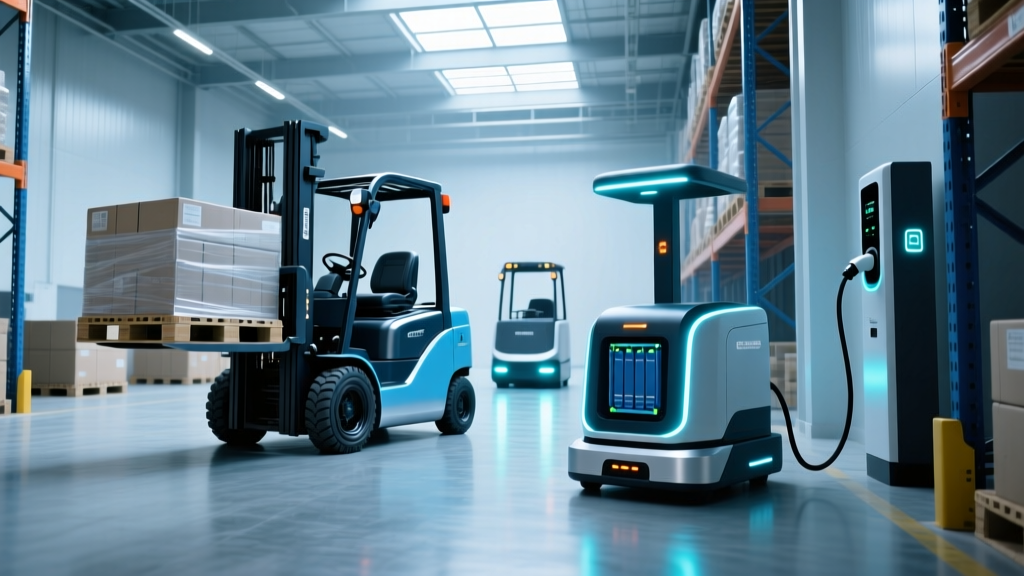
Electric material handlers encompass a range of warehouse and logistics equipment powered by electric motors and battery packs rather than diesel, propane (LPG), or gasoline engines. The category includes:
- Electric counterbalance forklifts (3,000–12,000 lb capacity)
- Electric pallet jacks (walk-behind and rider models)
- Reach trucks for narrow-aisle high-racking
- Order pickers and turret trucks
- Electric tow tractors and burden carriers
The shift from lead-acid to lithium-ion (Li-ion) batteries has been the defining change in this segment. Li-ion packs offer opportunity charging (top-ups during breaks without battery degradation), zero maintenance watering, and consistent power delivery throughout a shift—advantages that are pushing adoption past 65% of new forklift sales in North America as of 2025, according to the Industrial Truck Association.
Electric vs. Propane/Diesel: The Real Cost Breakdown
The purchase price gap between electric and IC material handlers is real, but total cost of ownership (TCO) tells a different story. Here's a five-year comparison based on a standard 5,000-lb capacity sit-down counterbalance forklift running a single 8-hour shift, 250 days per year:
| Cost Category | Li-Ion Electric | Propane (LPG) | Lead-Acid Electric |
|---|---|---|---|
| Purchase price (base) | $38,000 | $28,000 | $30,000 + $6,000 battery |
| Fuel/energy (5 years) | $4,200 | $18,500 | $4,200 |
| Maintenance (5 years) | $2,800 | $11,200 | $5,400 |
| Battery replacement | $0 (lasts 8–10 yr) | N/A | $6,000 (year 4) |
| Charging infrastructure | $3,500 | $0 | $4,500 (ventilation + swap equipment) |
| 5-Year Total | $48,500 | $57,700 | $50,100 |
| Cost per operating hour | $4.85 | $5.77 | $5.01 |
Key takeaway: Li-ion electric forklifts cost roughly $9,200 less than propane over five years on a single shift. On multi-shift operations, savings compound because opportunity charging eliminates the need for multiple battery sets or refueling downtime.
Battery Specs, Charging Times, and Shift Coverage
Understanding battery capacity and charging speed is critical for fleet planning. Electric material handlers use two dominant battery chemistries:
| Spec | Lithium-Ion (Li-ion) | Lead-Acid |
|---|---|---|
| Typical capacity (5,000-lb forklift) | 24–48 kWh | 18–25 kWh (600–1,200 Ah at 24V) |
| Shift coverage (single charge) | 6–8 hours | 6–8 hours |
| Full charge time | 1–2 hours (DC fast charge) | 8 hours + 8 hours cool-down |
| Opportunity charging | Yes, no degradation penalty | No, reduces battery life |
| Cycle life | 2,500–3,500 cycles | 1,000–1,500 cycles |
| Maintenance | None | Weekly watering, equalization charges |
| Weight | Lighter (requires ballast) | Heavy (acts as counterweight) |
| Lifespan | 8–10 years | 3–5 years |
Most Li-ion electric forklifts use CCS1 or proprietary DC connectors rated at 10–25 kW for fast charging. A 40 kWh pack charging at 20 kW reaches 80% in roughly 90 minutes. Many facilities install Level 2 chargers (7–19 kW) at break areas so operators can top up during lunch—this is the opportunity-charging model that eliminates multi-battery swap systems.
Real-World Ownership Considerations
Before switching a fleet to electric material handlers, these practical factors determine success:
Charging Infrastructure and Electrical Capacity
A fleet of five Li-ion forklifts charging simultaneously at 20 kW each demands 100 kW of electrical capacity. Many older warehouses have 200-amp panels (roughly 48 kW at 240V) that require a panel upgrade to 400–600 amps, costing $8,000–$25,000 depending on utility connection requirements. Work with a licensed electrician and your utility provider early—demand charges and transformer upgrades can add 6–12 weeks to project timelines.
Cold-Weather Performance
Li-ion batteries lose 15–25% of usable capacity at 32°F (0°C) and up to 40% below 14°F (-10°C). For unheated warehouses or cold-storage facilities, specify forklifts with integrated battery heating systems (available from Toyota, Crown, and Hyster). These thermal management systems consume 1–2 kWh but maintain charge rate and runtime. Facilities operating below freezing should still evaluate IC models for outdoor yard work.
Duty Cycle and Multi-Shift Operations
Single-shift operations (8 hours or less) are ideal for electric: one charge covers the shift, and overnight charging at off-peak electricity rates ($0.06–$0.12/kWh in most industrial zones) keeps fuel costs minimal. Multi-shift operations benefit most from Li-ion opportunity charging—15–20 minute top-ups during breaks sustain the pack without dedicated battery rooms.
Indoor Air Quality and Noise
This is where electric material handlers win unconditionally. Propane forklifts emit CO, NOx, and particulates indoors, requiring ventilation systems and air-quality monitoring. Electric models produce zero local emissions and operate at 65–75 dB (vs. 85–95 dB for IC), reducing worker fatigue and OSHA compliance burden.
Incentives, Tax Credits, and Fleet Electrification Programs
Federal and state incentives can close the upfront price gap significantly. Under the IRS §45W Commercial Clean Vehicle Credit, businesses purchasing qualifying electric material handlers may claim up to $40,000 per unit (for vehicles with GVWR over 14,000 lb) or $7,500 for lighter units, subject to domestic battery sourcing and final-assembly requirements. Additionally, many utilities offer EV charging infrastructure rebates covering 50–100% of charger installation costs for commercial fleets.
Decision Framework: Should You Go Electric?
Choose electric material handlers if:
- Operations are primarily indoors or under cover
- You run 1–2 shifts and can install opportunity charging
- Local electricity rates are below $0.15/kWh
- You want to eliminate indoor emissions and ventilation costs
- You plan to keep equipment 5+ years (TCO advantage)
- Your facility has or can upgrade to sufficient electrical capacity
Stick with propane/diesel if:
- Operations are primarily outdoors in sub-freezing climates
- You need high-speed continuous operation across 3+ shifts without charging breaks
- Electrical upgrades are cost-prohibitive (remote sites, limited grid access)
- Equipment is used fewer than 500 hours/year (upfront cost harder to justify)
- You frequently exceed rated capacity or run heavy attachments
Common Misconceptions About Electric Material Handlers
| Myth | Fact |
|---|---|
| "Electric forklifts are underpowered." | Modern Li-ion models deliver full torque from 0 RPM and match IC lift speeds. Toyota's 8FBE25U handles 5,000 lbs with equivalent cycle times to propane counterparts. |
| "Batteries won't last a full shift." | A 40 kWh Li-ion pack covers 6–8 hours of typical warehouse duty. Opportunity charging during breaks extends this indefinitely for multi-shift ops. |
| "Battery replacement will cost a fortune." | Li-ion packs are warrantied for 5–10 years / 10,000+ hours and rarely need replacement within the forklift's service life. Lead-acid batteries, by contrast, cost $4,000–$8,000 and last 3–5 years. |
| "Charging infrastructure is too expensive." | A single 20-kW DC charger costs $8,000–$15,000 installed. For a 5-unit fleet, that's $2,000–$3,000 per forklift—recouped within 2 years through fuel savings. |
| "Electric only works for light-duty." | Electric container handlers, loaded container movers (90,000+ lb capacity), and heavy-duty yard tractors are in active production from Hyster, Kalmar, and Taylor. |
What First-Time Buyers Need to Know
If you're transitioning from IC to electric material handlers for the first time, these steps will prevent costly mistakes:
- Audit your duty cycle. Track lift hours, travel distance, and load weights per shift. This determines battery kWh requirements. Most dealers offer free fleet assessments.
- Get an electrical site survey. Before ordering chargers, have a licensed electrician evaluate panel capacity, conduit runs, and utility demand charges. Budget $3,500–$25,000 for infrastructure depending on fleet size.
- Request a demo unit. Run an electric forklift in your actual environment for 2–4 weeks. Validate shift coverage, charge times, and operator acceptance before committing.
- Compare total cost, not sticker price. Factor in fuel, maintenance, battery replacement, ventilation (for IC indoors), and available tax credits. A DOE Alternative Fuels Data Center calculator can help model your specific scenario.
- Plan charger placement strategically. Position chargers near break rooms, loading docks, or traffic bottlenecks where operators naturally pause—this makes opportunity charging habitual rather than disruptive.
Frequently Asked Questions
How long do electric forklift batteries last?
Lithium-ion forklift batteries are rated for 2,500–3,500 charge cycles, which translates to 8–10 years of single-shift use. Most manufacturers (Toyota, Raymond, Crown, Hyster) warranty Li-ion packs for 5 years or 10,000 operating hours with a minimum 70% capacity retention. Lead-acid batteries last 1,000–1,500 cycles (3–5 years).
Can I charge electric material handlers on a standard outlet?
No. Most industrial electric forklifts require 240V Level 2 (7–19 kW) or DC fast charging (10–25 kW). Small electric pallet jacks with onboard chargers (1–2 kW) can plug into standard 120V outlets, but full-size forklifts need dedicated charging circuits installed by a licensed electrician.
Do electric forklifts qualify for federal tax credits?
Possibly. Under IRS §45W (Commercial Clean Vehicle Credit), qualifying electric forklifts with a GVWR under 14,000 lb may receive up to $7,500; heavier units up to $40,000. Eligibility depends on battery component sourcing and final assembly requirements that change annually. Consult a tax professional and check current IRS guidance before relying on credit amounts.
What happens if the battery dies mid-shift?
With Li-ion opportunity charging, this shouldn't happen—15-minute top-ups during breaks maintain adequate charge. If a pack does deplete, a 20-kW DC charger restores roughly 50% capacity in 45 minutes. Most modern units also provide clear state-of-charge displays and low-battery warnings at 20% and 10% remaining.
Are electric material handlers suitable for cold storage?
Yes, with caveats. Li-ion chemistry loses capacity below freezing, so specify models with battery thermal management (heating pads or liquid heating). These systems maintain pack temperature and charge acceptance. Companies like Crown and Toyota offer purpose-built cold-storage electric forklifts rated for -20°F (-29°C) environments. Operating costs still beat propane in cold storage because you eliminate combustion-related moisture and ventilation issues.