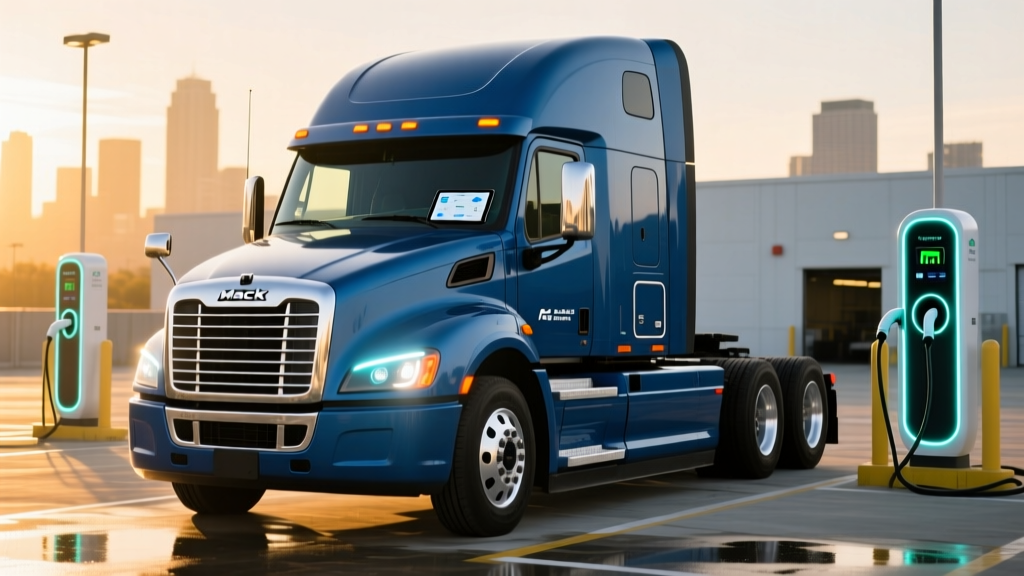
Quick answer: Mack's electric truck lineup — the Mack LR Electric (refuse) and Mack MD Electric (medium-duty box truck) — targets vocational and regional-haul fleets, not individual consumers. Expect 150–230 miles of real-world range depending on model and duty cycle, 240–376 kWh battery packs, and DC fast charging from 20–80% in roughly 60–90 minutes at 150–250 kW. Purchase prices typically run $300,000–$450,000+ before incentives, but fuel and maintenance savings can yield payback in 5–8 years for high-utilization routes. These are Class 6–8 commercial vehicles sold through Mack dealers with fleet financing — not retail consumer trucks.
Who Should Consider an Electric Mack Truck?
Mack's battery-electric trucks serve a narrow but growing segment: municipal waste haulers, regional distribution fleets, and urban delivery operators running predictable, hub-based routes under 200 miles per day. The Mack LR Electric is purpose-built for refuse collection — a stop-start duty cycle where regenerative braking recovers substantial energy. The Mack MD Electric fills the Class 6/7 box-truck role for last-mile and regional freight.
If your operation involves long-haul trucking, irregular routes exceeding 250 miles, or depots without access to high-power electrical infrastructure, an electric Mack is not the right fit today. For those use cases, diesel or renewable diesel remains the pragmatic choice. The decision hinges on route predictability, depot charging feasibility, and daily mileage ceilings — not ideology.
Mack Electric Truck Lineup: Specs at a Glance
| Spec | Mack LR Electric (Refuse) | Mack MD Electric (Medium-Duty) |
|---|---|---|
| Vehicle Class | Class 8 | Class 6 / Class 7 |
| Battery Capacity | 376 kWh (NMC lithium-ion) | 240 kWh (NMC lithium-ion) |
| EPA / Estimated Range | ~150 miles (refuse cycle) | ~230 miles (delivery cycle) |
| Motor Output | 448 hp (continuous) / 334 kW | 260 hp (continuous) / 194 kW |
| Peak Torque | 4,270 lb-ft at wheels | ~2,500 lb-ft at wheels |
| DC Fast Charge (peak) | Up to 250 kW (CCS1) | Up to 150 kW (CCS1) |
| 20–80% Charge Time | ~60–75 min at 250 kW | ~75–90 min at 150 kW |
| GVWR | 72,000 lbs (with trailer) | 26,000–33,000 lbs |
| Typical Base Price | ~$400,000–$450,000+ | ~$300,000–$350,000+ |
| Battery Warranty | 5 years / unlimited miles (performance guarantee) | 5 years / unlimited miles (performance guarantee) |
Note: Exact pricing varies by configuration, body upfit, and dealer negotiation. Mack does not publish consumer-facing MSRPs the way light-duty automakers do — contact your regional Mack dealer for a build-and-quote.
Range Reality: EPA Estimates vs. Vocational Duty Cycles
Heavy-duty electric trucks don't carry EPA window stickers like a Tesla Model Y. Range is instead measured against specific duty cycles — refuse collection for the LR, urban delivery for the MD. Mack's published figures reflect these operational profiles, not highway cruising.
Real-world range expectations:
- Mack LR Electric: ~150 miles in a typical refuse route with frequent stops and regenerative braking recovery. In cold climates (below 20°F), expect a 15–25% reduction due to battery thermal management loads and cabin heating — plan for ~115–130 effective miles.
- Mack MD Electric: ~230 miles in a stop-and-go delivery cycle. Highway-heavy routes at sustained 65 mph will see closer to 160–180 miles due to aerodynamic drag and reduced regen opportunity.
Fleet planners should spec routes at 70–75% of published range to account for payload variance, weather, terrain, and battery aging over the vehicle's 8–12 year service life. A route requiring 180 miles of daily coverage is not a safe fit for the MD Electric's 230-mile estimate once degradation and winter losses are factored in.
Charging Infrastructure: What Depots Actually Need
Charging a 376 kWh battery pack is fundamentally different from plugging in a consumer EV. Depot infrastructure is often the largest barrier to adoption — and the most underestimated cost.
| Charging Method | Power (kW) | Mack LR Electric (376 kWh) | Mack MD Electric (240 kWh) |
|---|---|---|---|
| Level 2 AC (depot overnight) | 19.2 kW (single port) | ~19.5 hours (0–100%) | ~12.5 hours (0–100%) |
| Level 2 AC (dual-port capable) | 38.4 kW (2 × 19.2) | ~10 hours (0–100%) | ~6.5 hours (0–100%) |
| DC Fast Charge (CCS1) | 150 kW | ~2.5 hours (0–100%) | ~1.6 hours (0–100%) |
| DC Fast Charge (CCS1) | 250 kW | ~1.5 hours (0–100%) | N/A (MD caps at ~150 kW) |
Key charging insight: DC fast charging at peak kW is not sustained across the entire session. The charge curve tapers significantly above 80% state of charge to protect battery health. A 250 kW peak rate might average 160–180 kW over the full session. Fleet operators planning mid-day top-ups should budget for this taper.
Depot electrical requirements:
- A single 150 kW DC fast charger requires a 480V three-phase supply with dedicated transformer capacity.
- Deploying 5+ chargers may require a utility service upgrade costing $150,000–$500,000+ depending on local grid capacity and trenching distance.
- Utility demand charges can add $5,000–$15,000/month for high-power depots — negotiate time-of-use or EV-specific commercial rates with your utility early in the planning process.
- Lead times for utility upgrades in many markets run 12–24 months. Start this conversation before ordering trucks.
Total Cost of Ownership: Electric Mack vs. Diesel
The purchase price of an electric Mack is 2–3× that of a comparable diesel truck. The ownership case rests on fuel displacement, maintenance reduction, and incentive stacking over a 10–12 year lifecycle.
| Cost Category (Annual, per truck) | Mack LR Electric | Mack LR Diesel (baseline) |
|---|---|---|
| Purchase Price (amortized over 10 yrs) | $40,000–$45,000/yr | $18,000–$22,000/yr |
| Energy/Fuel | $8,000–$14,000/yr (electricity) | $25,000–$35,000/yr (diesel) |
| Maintenance | $3,000–$5,000/yr | $10,000–$15,000/yr |
| DEF / Emissions Equipment | $0 | $1,500–$2,500/yr |
| Insurance | $4,000–$6,000/yr (higher replacement cost) | $3,000–$4,500/yr |
| Estimated Annual Operating Total | $55,000–$70,000 | $57,500–$79,000 |
The crossover point where electric TCO undercuts diesel typically arrives in years 5–8, depending on local diesel prices, electricity rates, annual mileage, and incentive availability. High-utilization trucks running 5–6 days per week reach payback faster.
Federal and state incentives for commercial EVs:
- The Commercial Clean Vehicle Credit (IRC §45W) provides up to $40,000 for qualifying Class 8 trucks — this is separate from the consumer §30D credit and has different sourcing and eligibility rules. Confirm current-year qualification with your tax advisor and reference IRS guidance on §45W.
- Many states and air quality management districts offer additional vouchers — California's CARB clean-fleet programs, for example, can stack $50,000–$120,000+ per truck in heavily impacted zones.
- Utility make-ready programs may cover 50–100% of depot electrical infrastructure costs in certain service territories.
Common Misconceptions About Electric Mack Trucks
| Myth | Fact |
|---|---|
| "Electric trucks can't handle heavy payloads." | The Mack LR Electric carries a Class 8 GVWR of 72,000 lbs. Battery weight reduces available payload vs. diesel by roughly 3,000–4,000 lbs, but most refuse and delivery routes are volume-limited, not weight-limited. |
| "Battery replacement will bankrupt the fleet." | Mack's battery warranty guarantees a minimum capacity threshold (typically 70–80% retention) for 5 years. NMC packs in vocational use show ~2–3% annual degradation in moderate climates. Full pack replacement at end of life (year 10–12) is a real cost ($80,000–$150,000), but it's budgeted over the vehicle lifecycle — similar to a diesel engine rebuild. |
| "Charging takes too long for fleet operations." | Most refuse and delivery trucks operate on a single-shift cycle, returning to depot with 20–40% SoC. Overnight Level 2 charging (8–10 hours) fully replenishes the pack. Mid-day DC fast charging is available for multi-shift operations. |
| "Electric trucks don't work in cold weather." | Cold weather reduces range 15–25% and increases charge times. Fleets in northern climates spec routes conservatively and use depot pre-conditioning (plugged-in battery/cabin heating) to mitigate losses. Mack's thermal management system actively heats the pack during charging. |
Decision Framework: Is an Electric Mack Right for Your Fleet?
Choose the Mack LR Electric if:
- Your refuse routes are under 120 miles/day with depot return every night
- Your municipality or corporate ESG mandate requires zero tailpipe emissions
- You have access to (or can install) depot charging with 480V three-phase power
- Your state/air district offers stacking incentives that bring net purchase cost below $250,000
- Noise ordinances favor electric operation (the LR Electric is dramatically quieter at residential stops)
Choose the Mack MD Electric if:
- Your delivery/distribution routes are under 175 miles/day, primarily urban or suburban
- You operate in a city with emerging low-emission zones or diesel restrictions
- Daily fuel spend per truck exceeds $80 and your electricity rate is under $0.15/kWh
- You can secure utility infrastructure support with a 12–18 month planning window
Stick with diesel (or evaluate hydrogen fuel-cell options) if:
- Routes regularly exceed 250 miles or lack predictable depot returns
- Your depot has no feasible path to 480V three-phase power (rural or constrained urban sites)
- You operate in extreme cold (sustained below 0°F) where range loss exceeds 30%
- Annual truck mileage is under 15,000 miles — the fuel savings won't offset the purchase premium within a reasonable payback window
First-Time Electric Fleet Buyer Checklist
Transitioning a fleet from diesel to battery-electric involves more parallel workstreams than most operators anticipate. Here's what to tackle before signing a purchase order:
- Route audit: GPS-log every truck for 30 days. Identify daily miles, stop frequency, idle time, and peak payload. Exclude routes that exceed 75% of the target truck's real-world range.
- Utility engagement: Contact your commercial utility account rep to assess transformer capacity, upgrade timelines, and EV-specific rate schedules. Request a make-ready infrastructure study.
- Charger procurement: Select CCS1-compatible DC fast chargers (150–250 kW) from established providers — FreeWire, ABB, ChargePoint, or Tritium — and Level 2 depot chargers for overnight replenishment.
- Incentive mapping: Layer federal §45W credits, state vouchers, air-district grants, and utility rebates. Many programs have application deadlines and fleet-composition requirements.
- Driver and technician training: Mack offers EV-specific operator and maintenance training through its dealer network. High-voltage system servicing requires certified technicians — plan for this lead time.
- Telematics integration: Monitor state of charge, energy consumption per mile, and charge-session completion rates from day one to validate your route-spec assumptions.
Frequently Asked Questions
Can an individual buy a Mack LR Electric for personal use?
No. Mack sells the LR Electric and MD Electric through its commercial dealer network to fleet operators, municipalities, and waste-hauling companies. There is no consumer retail channel. If you're looking for a personal electric pickup, consider the Ford F-150 Lightning, Rivian R1T, or Chevrolet Silverado EV.
What's the battery chemistry, and does it affect longevity?
Both the LR Electric and MD Electric use NMC (nickel manganese cobalt) lithium-ion cells. NMC offers higher energy density than LFP (lithium iron phosphate), which is critical for packaging enough capacity in a heavy-duty chassis. The trade-off is slightly faster degradation and higher material cost. In vocational use with daily partial cycles (20–90% SoC rather than 0–100%), NMC packs typically retain 75–85% capacity after 8 years.
How does the Mack LR Electric compare to the Peterbilt 520EV or Autocar E-ACX?
All three target the Class 8 electric refuse segment. The Mack LR Electric leads in battery capacity (376 kWh vs. Peterbilt's ~282–376 kWh depending on config) and benefits from Mack's integrated powertrain (motor, transmission, and thermal management designed in-house). The Autocar E-ACX competes primarily on price and customization. Real-world route testing and dealer support depth in your region should drive the final decision — spec sheets alone don't tell the full story.
What happens if a battery pack fails out of warranty?
Out-of-warranty pack replacement costs are significant — estimated at $80,000–$150,000 depending on configuration and future cell pricing. Most fleet operators budget for this as a lifecycle cost, similar to a diesel engine overhaul at 400,000+ miles. Some third-party firms are beginning to offer module-level repair (replacing individual degraded modules rather than the entire pack) at 30–50% lower cost, though Mack-authorized service is required to maintain any remaining warranty coverage.
Does the federal EV tax credit apply to commercial Mack trucks?
Not the consumer §30D credit. Commercial fleets may qualify for the IRC §45W Commercial Clean Vehicle Credit, which provides up to $40,000 for vehicles over 14,000 lbs GVWR that meet battery-component and critical-mineral sourcing requirements. This credit is claimed by the business entity, not an individual. Consult a tax professional and review current IRS §45W guidance before projecting incentive revenue.