What Are Electric LSV Vehicles?
Electric Low-Speed Vehicles (LSVs) are federally regulated, street-legal neighborhood electric vehicles limited to a top speed of 25 mph and a maximum gross vehicle weight of 3,000 lbs. Under FMVSS 500, they must include headlamps, turn signals, seat belts, a VIN, and a windshield — but they are not required to meet the full crash-test standards of a standard passenger car. In 2026, popular electric LSV models range from roughly $8,500 to $22,000 before incentives, offer 30–80 miles of real-world range on lead-acid or lithium-ion battery packs, and charge from a standard 120V household outlet in 6–10 hours.
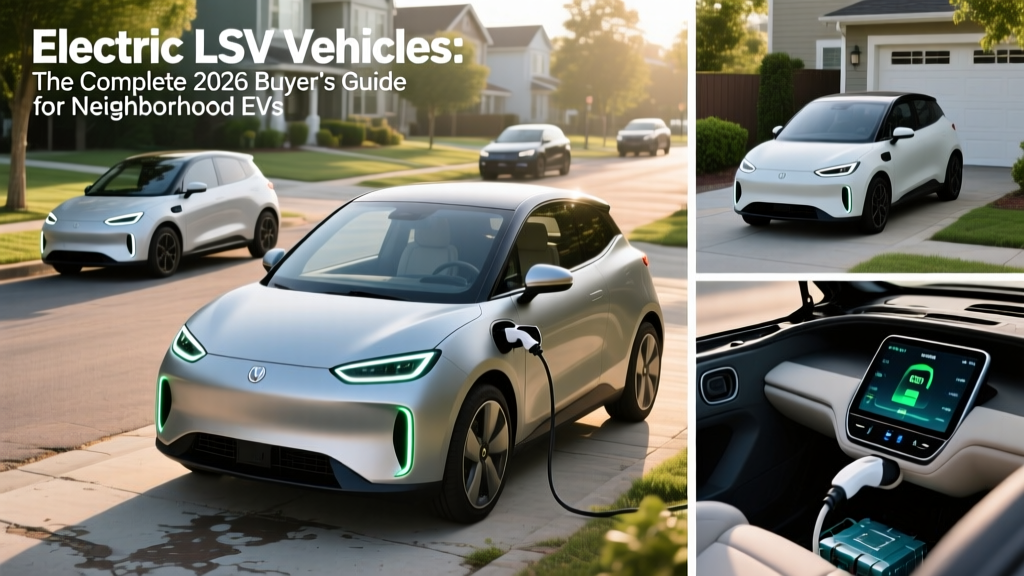
If you've seen compact, boxy electric carts cruising through gated communities, college campuses, or beach towns, you've likely spotted an electric LSV. These vehicles occupy a unique regulatory niche: they're street-legal on roads with posted speed limits up to 35 mph (and in some states, up to 45 mph with local approval), but they cost a fraction of a full-size EV like a Nissan Leaf or Chevrolet Bolt. For the right use case — short neighborhood errands, retirement communities, resort towns, or large private properties — an electric LSV can eliminate fuel costs entirely while requiring nothing more than a standard wall outlet to charge.
But LSVs are not a replacement for a conventional car. They lack airbags, crumple zones, highway capability, and climate control in most cases. This guide breaks down exactly what electric LSV vehicles can and cannot do in 2026, what they cost to buy and operate, and how to decide whether one belongs in your driveway.
LSV vs. Full-Size EV vs. Gas Golf Cart: What's the Difference?
Before committing to an LSV, it's essential to understand where these vehicles sit in the broader transportation landscape. The confusion between golf carts, LSVs, Neighborhood Electric Vehicles (NEVs), and full-size EVs leads to costly mistakes at the dealership.
| Attribute | Electric LSV (LSV/NEV) | Gas Golf Cart | Full-Size EV (e.g., Chevy Bolt) |
|---|---|---|---|
| Federal Regulation | FMVSS 500 | Not street-legal (unless modified) | FMVSS full compliance |
| Top Speed | 25 mph (some states allow 35 mph) | 15–19 mph | 90–120+ mph |
| Street-Legal Requirements | VIN, headlamps, signals, belts, windshield, mirrors | None (off-road only by default) | Full DOT compliance |
| Typical Range | 30–80 miles | 50–80 miles (gas tank) | 200–350+ miles (EPA) |
| Crash Safety (Airbags, Crumple Zones) | Not required | Not required | Required |
| Highway Use | Prohibited (roads >35 mph posted) | Prohibited | Full use |
| Climate Control | Rare (some enclosed models) | None | Standard |
| Base Price (2026) | $8,500–$22,000 | $7,000–$14,000 | $28,000–$55,000+ |
| Charging / Fueling | 120V outlet (6–10 hrs) | Gasoline (8–10 gal tank) | Level 2 / DC fast charge |
| Federal EV Tax Credit (§30D) | Generally not eligible* | N/A | Up to $7,500 (eligibility varies) |
*The IRS §30D clean vehicle credit applies to vehicles that meet specific battery sourcing, MSRP caps, and manufacturer requirements. Most LSVs fall outside the credit's intended scope because they do not meet the minimum battery capacity threshold of 7 kWh for four-wheeled vehicles, or they fail critical-mineral and battery-component sourcing rules. Always verify current-year eligibility at irs.gov or with a tax professional.
Real-World Costs: Purchase, Charging, and Maintenance
One of the strongest arguments for electric LSV vehicles is their rock-bottom operating cost. But the total cost picture depends heavily on battery chemistry, local electricity rates, and how often you drive.
Purchase Price Breakdown (2026 Models)
- Entry-level (lead-acid battery, open-air): $8,500–$12,000 — Brands like Club Car (Onward LSV), E-Z-GO (Express LSV), and various Chinese imports fall here. Lead-acid packs are heavier, degrade faster (2–4 year lifespan), and deliver 30–40 miles of range.
- Mid-tier (lithium-ion, enclosed or semi-enclosed): $13,000–$17,000 — Upgraded lithium packs extend range to 50–80 miles, reduce weight by ~100 lbs, and last 7–10 years. Models like the GEM e2/e4 (Polaris) and the AYRO Bravo sit in this range.
- Premium (lithium, fully enclosed, AC/heat): $18,000–$22,000+ — Enclosed cabs with basic climate control, upgraded interiors, and larger battery packs. The GEM e6 and some specialty LSVs from Arcimoto (if still in production) push toward this ceiling.
Charging Cost vs. Gasoline
| Metric | Electric LSV (Lithium) | Gas Golf Cart | Chevy Bolt EV (Comparison) |
|---|---|---|---|
| Battery / Tank Capacity | 8–15 kWh usable | 8–10 gallon tank | 65 kWh usable |
| Full "Fill-Up" Cost | $1.04–$2.40 (at $0.13–$0.16/kWh) | $28–$35 (at $3.50/gal) | $8.45–$11.70 (at $0.13–$0.18/kWh) |
| Cost Per Mile | $0.02–$0.04 | $0.12–$0.18 | $0.04–$0.06 |
| Annual Cost (3,000 miles/yr) | $60–$120 | $360–$540 | $120–$180 |
| 5-Year Energy Cost | $300–$600 | $1,800–$2,700 | $600–$900 |
Charging an LSV is as simple as plugging in a phone charger. Most LSVs come with a standard NEMA 5-15 (120V) onboard charger rated at 1.0–1.5 kW. A full charge from empty takes 6–10 hours depending on battery size. There is no need for a Level 2 home charger installation — and no associated $500–$2,000 electrician bill.
Maintenance
Electric LSVs have dramatically fewer moving parts than gas carts or full-size vehicles:
- No oil changes, spark plugs, air filters, or exhaust systems.
- Brake wear: Regenerative braking (where equipped) extends pad life. Expect brake service every 3–5 years vs. 2–3 years on gas carts.
- Battery replacement: Lead-acid packs cost $800–$1,500 to replace every 2–4 years. Lithium packs cost $2,000–$4,500 but last 7–10+ years. This is the single largest long-term cost variable.
- Tires, suspension, and 12V battery: Standard wear items; budget $200–$400/year.
Insurance
LSV insurance is typically cheaper than auto insurance — often $150–$400/year depending on state requirements, coverage level, and driver history. Many insurers (Progressive, State Farm, Nationwide) offer LSV-specific policies. Some states only require liability coverage; others mandate PIP or uninsured motorist coverage. Check with your state DMV for minimum requirements.
Range, Charging, and Battery: The Numbers That Matter
Unlike full-size EVs rated by the EPA on fueleconomy.gov, LSVs don't carry official EPA range stickers. Manufacturers provide estimated ranges based on ideal conditions (flat terrain, 70°F, single occupant, 15 mph). Real-world range is almost always lower.
Real-World Range Reality Check
Manufacturer claim: 50 miles (typical mid-tier lithium LSV)
Expect in practice:
- Summer, flat terrain, 15 mph: ~40–48 miles
- Highway-adjacent roads at 25 mph: ~30–38 miles
- Cold weather (below 40°F): ~25–35 miles (lithium); ~15–22 miles (lead-acid)
- Hilly terrain or full passenger load: reduce range by 15–25%
Battery Chemistry: Lead-Acid vs. Lithium-Ion
| Factor | Lead-Acid (Flooded or AGM) | Lithium-Ion (LFP or NMC) |
|---|---|---|
| Energy Density | 30–50 Wh/kg | 120–200 Wh/kg |
| Weight (typical pack) | 250–400 lbs | 80–150 lbs |
| Cycle Life | 300–600 cycles | 1,500–3,000+ cycles |
| Usable Lifespan | 2–4 years | 7–10+ years |
| Depth of Discharge | ~50% recommended | 80–100% usable |
| Cold-Weather Performance | Poor (significant range loss below 40°F) | Moderate (LFP better than NMC in cold) |
| Replacement Cost | $800–$1,500 | $2,000–$4,500 |
| Maintenance | Flooded requires water topping; AGM is sealed | None |
The verdict: If you plan to keep the LSV for more than 3 years, lithium-ion pays for itself through longer life, lighter weight, better range, and zero maintenance. Lead-acid only makes sense for very tight budgets or very low annual mileage (under 500 miles/year).
Where Can You Legally Drive an LSV?
Federal law (FMVSS 500) sets the baseline for LSVs, but state and local regulations determine where you can actually drive. This is where many buyers get tripped up.
Federal Baseline
- LSVs may operate on roads with posted speed limits of 35 mph or less.
- States may allow LSVs on roads up to 45 mph if a local government approves.
- LSVs may cross higher-speed roads at intersections.
State-by-State Variation
As of 2026, all 50 states have some form of LSV legislation, but rules vary widely:
- Florida, Arizona, Texas, California: Extensive LSV-friendly infrastructure. Many municipalities have designated LSV lanes or low-speed corridors. Florida in particular has thousands of LSVs in retirement communities like The Villages.
- New York, Massachusetts: More restrictive. Some municipalities ban LSVs entirely or limit them to private property.
- Registration and titling: Most states require LSV registration, a VIN, and a title — just like a regular car. You'll need proof of insurance.
- Driver's license: Required in nearly all states. A standard driver's license is sufficient; no special endorsement needed.
Before purchasing, contact your local DMV and check your city or county ordinances. The NHTSA maintains federal LSV standards, but local enforcement is what determines your daily driving experience.
Safety: What LSVs Don't Protect You From
Critical Safety Limitations
LSVs are not crash-tested to the same standards as passenger vehicles. They do not have:
- Airbags
- Crumple zones or reinforced safety cages
- Anti-lock brakes (on most models)
- Electronic stability control
- Side-impact protection
In a collision with a full-size vehicle traveling at 35+ mph, an LSV occupant faces significantly higher injury risk. LSVs are safest when used strictly within their intended environment: low-speed residential roads, private communities, and campuses. Never take an LSV onto a highway, arterial road, or any road where traffic routinely exceeds the posted limit.
Decision Framework: Is an Electric LSV Right for You?
Choose an Electric LSV If:
- Your daily driving is under 20 miles and entirely on roads posted 35 mph or less.
- You live in a retirement community, gated neighborhood, beach town, or college campus where LSVs are common and infrastructure supports them.
- You want a second or third vehicle for short errands, not a primary car.
- You have access to a standard 120V outlet near where you park (garage, carport, or covered driveway).
- Your climate is mild — or you're willing to accept reduced winter range and no cabin heating (unless you buy an enclosed model).
- You want near-zero fuel and maintenance costs and don't mind a 25 mph speed limit.
Choose a Full-Size EV or PHEV Instead If:
- You need to drive on roads posted above 35 mph regularly.
- You need highway capability for commuting or road trips.
- You carry children — the lack of airbags and crash protection makes LSVs a poor choice for families as a primary vehicle.
- You live in a region with harsh winters and need cabin heating and reliable cold-weather range.
- You need cargo space beyond a few grocery bags.
- You want to qualify for the §30D federal tax credit (up to $7,500) — most LSVs don't qualify.
Choose a Gas Golf Cart If:
- You only drive on private property (golf courses, large estates, farms) and don't need street legality.
- Your budget is under $8,000 and you don't want to invest in lithium batteries.
- You need more range than an LSV provides but still at low speeds — a gas cart can refuel in 2 minutes and go 50–80 miles.
Common Misconceptions About Electric LSV Vehicles
| Myth | Fact |
|---|---|
| "LSVs are just golf carts." | Golf carts are not street-legal by default. LSVs are federally regulated motor vehicles that require registration, insurance, and a VIN. They have different safety equipment requirements and higher top speeds (25 mph vs. 15–19 mph). |
| "I can drive my LSV on any road." | LSVs are restricted to roads posted at 35 mph or below (45 mph in some states with local approval). Driving on highways or high-speed arterials is illegal and extremely dangerous. |
| "Electric LSVs qualify for the $7,500 tax credit." | Most LSVs do not meet the §30D battery capacity, sourcing, or MSRP requirements. Always verify on irs.gov before assuming eligibility. |
| "I need a special charger installed." | Nearly all LSVs charge from a standard 120V household outlet. No Level 2 installation or panel upgrade is needed. |
| "LSVs are safe because they're slow." | Low speed reduces risk but doesn't eliminate it. LSVs lack airbags and crumple zones. A collision with a 4,000-lb SUV at 25 mph can still cause serious injury. |
| "The battery will last forever." | Lead-acid batteries last 2–4 years; lithium lasts 7–10+ years. All batteries degrade. Budget for at least one battery replacement over a 10-year ownership period. |
Top Electric LSV Models to Consider in 2026
Here are several well-established models worth test-driving, with approximate 2026 pricing and key specs:
- Club Car Onward LSV (4-passenger): ~$12,500–$16,000 depending on battery option. Available with lithium upgrade. One of the most widely serviced brands in the US. Range: ~30 mi (lead-acid) / ~50 mi (lithium).
- E-Z-GO Express LSV (4- or 6-passenger): ~$11,000–$15,500. Strong dealer network. Optional ELiTE lithium battery system. Range: ~30–55 mi depending on config.
- GEM e2 / e4 / e6 (Polaris): ~$14,000–$22,000. One of the most car-like LSVs with optional fully enclosed cab, doors, and heater. Range: ~30–50 mi (lead-acid) / ~50–80 mi (lithium upgrade).
- AYRO Bravo / ONSCR (Austin, TX-based): ~$10,000–$14,000. Compact 2-seat design popular for urban delivery and campus use. Lithium standard. Range: ~40–60 mi.
- Various Chinese imports (Kandi, Luyuan, etc.): $7,000–$10,000. Significantly cheaper but verify FMVSS 500 compliance, VIN validity, and parts/service availability before purchasing. Some imports have been found non-compliant with federal standards.
FAQ: Electric LSV Vehicles
Do I need a driver's license to operate an LSV?
Yes, in nearly every state. An LSV is a registered motor vehicle, so a valid driver's license is required. Some states may allow restricted licenses or permits for community-specific use, but this is rare.
Can I drive an LSV at night?
Yes. FMVSS 500 requires LSVs to have headlamps, tail lamps, turn signals, and reflectors — making them legal for nighttime operation on qualifying roads. However, visibility is limited compared to a full-size car, so drive defensively.
How long does it take to charge an electric LSV?
Using the included 120V charger (1.0–1.5 kW), a full charge from near-empty takes 6–10 hours depending on battery capacity. Most owners plug in overnight, similar to charging a phone. There is no DC fast-charging capability on LSVs.
Can I install air conditioning or heating in an LSV?
Some enclosed models (like the GEM e-series with full cab) offer basic heater/defroster options. Aftermarket 12V heaters and fans exist, but true A/C is rare and adds significant battery drain. If climate control is essential, look for a fully enclosed LSV from the factory.
Are electric LSV vehicles eligible for any tax credits or incentives?
The federal §30D clean vehicle credit is generally not available for most LSVs due to battery capacity and sourcing requirements. However, some states and local utilities offer rebates for neighborhood electric vehicles. Check your state energy office and local utility for current programs. Always confirm eligibility with a tax professional.
What happens if my LSV battery dies mid-trip?
Unlike a gas cart that can be refueled in minutes, a dead LSV battery means a tow or a long wait. Most LSVs have a range indicator — treat it like a gas gauge and recharge before you're below 20%. Some lithium-equipped models offer a small reserve buffer, but don't rely on it.
Can I modify an LSV to go faster than 25 mph?
Technically, some aftermarket speed controllers can increase top speed — but doing so reclassifies the vehicle. Once modified above 25 mph, the vehicle no longer qualifies as an LSV under FMVSS 500 and must meet full passenger-car safety standards (which it won't). This makes the modification illegal for street use and voids most insurance coverage.
How do I register and insure an LSV?
Registration follows a process similar to a standard vehicle: bring the Manufacturer's Certificate of Origin (MCO) or title, proof of insurance, and your driver's license to your local DMV. You'll receive a license plate and registration. Insurance is available from major carriers; expect $150–$400/year for liability and collision coverage.
Electric LSV vehicles fill a genuine niche: ultra-low-cost, ultra-low-speed transportation for environments where a full-size car is overkill. They won't replace your commuter vehicle, but as a second or third vehicle for neighborhood errands, campus transit, or community living, they offer compelling economics — especially when you choose lithium batteries and charge from a standard wall outlet. Just go in with clear eyes about the safety limitations, range constraints, and regulatory boundaries, and an LSV can be one of the most cost-efficient vehicles you'll ever own.