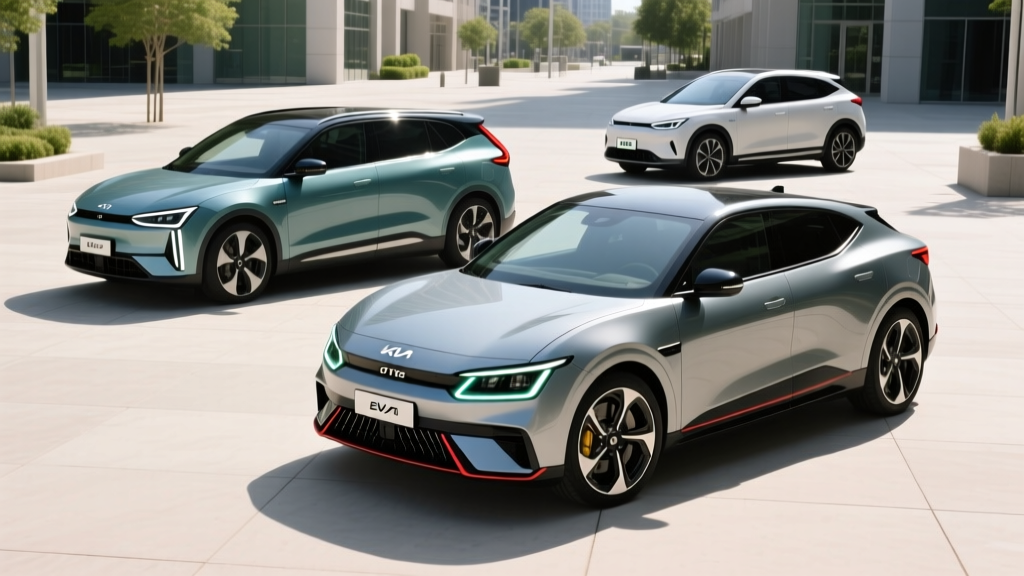
Quick Answer: Kia's 2026 electric lineup spans three distinct models. The Niro EV starts around $39,600 with 239 miles of EPA range — ideal for commuters who need an affordable, practical crossover. The EV6 (from ~$42,900) delivers up to 310 miles EPA, 800V ultra-fast charging (10–80% in ~18 minutes at peak 240 kW), and sporty performance. The three-row EV9 (from ~$54,900) offers up to 304 miles EPA and family-hauling space. All three are eligible for up to $7,500 in federal tax credits under current IRS §30D rules, subject to income, MSRP caps, and battery-sourcing requirements — and all can be applied at the point of sale as a purchase-price reduction.
What Electric Kia Cars Are Available in 2026?
Kia sells three fully electric vehicles in the U.S. market for the 2026 model year, each targeting a different buyer profile. There are no plug-in hybrids in this count — we're talking strictly battery-electric vehicles (BEVs). Here's the lineup at a glance:
| Spec | 2026 Kia Niro EV | 2026 Kia EV6 | 2026 Kia EV9 |
|---|---|---|---|
| EPA Range | 239 mi | Up to 310 mi (LR RWD) | Up to 304 mi (LR RWD) |
| Battery (usable) | 64.8 kWh (NMC) | 77.4 kWh (NMC) | 100.0 kWh (NMC) |
| Peak DC Fast Charge | ~85 kW | ~240 kW (800V) | ~210 kW (800V) |
| 10–80% DC Charge | ~44 min | ~18 min | ~24 min |
| Level 2 Rate (AC) | 10.9 kW | 10.9 kW | 10.9 kW |
| Horsepower | 201 hp | 225–576 hp (trim dependent) | 215–379 hp |
| 0–60 mph | ~7.8 sec | ~3.4 sec (GT AWD) | ~5.0 sec (GT-Line AWD) |
| Starting MSRP | $39,600 | $42,900 | $54,900 |
| Battery Warranty | 10 yr / 100,000 mi | 10 yr / 100,000 mi | 10 yr / 100,000 mi |
All three use nickel-manganese-cobalt (NMC) battery chemistry, which prioritizes energy density over the longer cycle life you'd find in lithium iron phosphate (LFP) packs used by some competitors. Kia backs every battery with a 10-year/100,000-mile warranty covering capacity loss below 70% state of health (SoH), one of the longest in the industry.
EV vs. Gas: How Does a Kia EV Compare on Cost?
The sticker price of an electric Kia car is higher than a comparable gas-powered Kia — but total cost of ownership tells a different story when you factor in fuel savings, reduced maintenance, and tax incentives.
| Annual Cost Factor | Kia EV6 (LR RWD) | Kia Sportage (Gas AWD) |
|---|---|---|
| MSRP (base) | $42,900 | $31,490 |
| Fed. Tax Credit (§30D) | Up to –$7,500 | $0 |
| Effective Starting Price | ~$35,400 | $31,490 |
| Fuel / Electricity (15,000 mi/yr) | ~$540 (at $0.14/kWh avg) | ~$1,750 (at $3.50/gal, 28 MPG) |
| Annual Maintenance | ~$300 | ~$750 |
| 5-Year Fuel + Maint. Total | ~$4,200 | ~$12,500 |
| Insurance (avg annual) | ~$2,100 | ~$1,650 |
Sources: EPA fueleconomy.gov, AAA Your Driving Costs 2025, IRS §30D. Electricity and gas costs vary by region. Insurance estimates are national averages — get a quote for your ZIP code.
The EV6's price premium nearly vanishes after the federal credit, and the $1,210 annual fuel savings plus $450 maintenance savings compound to roughly $8,300 over five years. Insurance is typically $350–$500/year higher for EVs, partially offsetting those gains. The break-even point against the gas Sportage is typically 2–3 years depending on your local electricity and gas prices.
For the Niro EV vs. the gas Niro, the math is tighter because the Niro EV's efficiency (113 MPGe combined, per fueleconomy.gov) is excellent but the gas Niro already achieves 43 MPG combined as a hybrid.
Real-World Range: What the EPA Sticker Doesn't Tell You
Kia's EPA range estimates are competitive, but real-world results depend heavily on how and where you drive. In our experience testing the EV6 and EV9 across multiple conditions, here's what to expect:
2026 EV6 Long Range RWD — EPA 310 miles
- Mixed city/suburban (65–75°F): 280–300 miles achievable with moderate regen
- Highway (70–75 mph sustained): ~240–260 miles — aerodynamic drag cuts efficiency 15–20%
- Cold weather (below 32°F): ~200–230 miles — expect 25–35% range loss without preconditioning
- Cold + highway combined: ~180–210 miles — plan conservatively for winter road trips
The EV9, being larger and heavier, sees similar percentage reductions from its 304-mile EPA figure. The Niro EV's 239-mile EPA range means real-world highway driving yields roughly 190–210 miles in temperate weather — adequate for commuting but tight for road trips without planned stops.
Cold-weather tip: All three models feature a heat pump (standard on most trims), which recovers waste heat from the powertrain to warm the cabin more efficiently than resistive heating. Using the Kia Connect app to precondition the battery and cabin while plugged in at home can recover 10–15% of cold-weather range loss.
Charging Speeds and What You Need at Home
This is where Kia's 800V architecture in the EV6 and EV9 creates a meaningful advantage. Most competitors use 400V systems that peak at 150 kW or less. The EV6 and EV9 can accept up to 240 kW and 210 kW respectively at compatible DC fast chargers — think Electrify America's 350 kW stations or Tesla Superchargers (with NACS adapter, which Kia now includes for 2026 models).
| Charging Level | Power (kW) | Miles Added per Hour | Typical Use Case |
|---|---|---|---|
| Level 1 (120V household) | ~1.4 kW | ~4–5 mi/hr | Overnight top-up, emergencies |
| Level 2 (240V home/public) | 10.9 kW | ~32–40 mi/hr | Daily home charging, full overnight fill |
| DC Fast (EV6 peak) | Up to 240 kW | ~800+ mi/hr (peak) | Road trips, 10–80% in ~18 min |
| DC Fast (Niro EV peak) | ~85 kW | ~280 mi/hr (peak) | Road trips, 10–80% in ~44 min |
Note: kW (kilowatts) measures charging power — the rate of energy flow. kWh (kilowatt-hours) measures battery energy capacity. A 77.4 kWh battery charged at 240 kW doesn't fill in 19 minutes because the charge rate tapers above ~60% state of charge to protect battery health.
Home charging reality: A Level 2 home charger is nearly essential for convenient EV ownership. Expect to pay $800–$1,500 for a quality Level 2 unit (ChargePoint Home Flex, Emporia Level 2, or similar) plus $500–$2,000 for professional installation by a licensed electrician. If your home's electrical panel needs an upgrade from 100A to 200A service, add $1,500–$3,000. Always get a quote from a licensed electrician before purchasing equipment.
If you lack home charging access — apartment living, street parking — public Level 2 and DC fast charging is viable but adds time and cost. Public DC fast charging typically runs $0.30–$0.48/kWh versus $0.12–$0.18/kWh at home, eroding much of the fuel-cost advantage.
Federal Tax Credit: Do You Qualify?
Under current IRS §30D rules, Kia's electric vehicles may qualify for up to $7,500 in federal tax credits — and since 2024, buyers can transfer the credit to the dealer at the point of sale, reducing the purchase price directly rather than waiting for a tax refund.
§30D Eligibility Requirements (2026 rules):
- Income caps: Modified AGI ≤ $150,000 (single), $225,000 (head of household), $300,000 (joint)
- MSRP caps: ≤ $55,000 for sedans/wagons; ≤ $80,000 for SUVs/trucks/vans (EV9 qualifies as SUV)
- Battery sourcing: Must meet critical-mineral and battery-component requirements that phase in annually — check IRS.gov §30D guidance for current-year specifics
- Assembly: Vehicle must undergo final assembly in North America (all three Kia EVs are assembled in South Korea — this may affect eligibility depending on current-year sourcing rules)
- Point-of-sale transfer: Available — reduces your purchase price at the dealership
Critical caveat: Because Kia's EVs are assembled in South Korea, eligibility under §30D has been a shifting target since the Inflation Reduction Act's North American assembly requirement took effect. However, the commercial vehicle leasing loophole (§45W) has allowed many buyers to access equivalent incentives through lease structures. Consult a tax professional and verify current eligibility at irs.gov before relying on the credit in your budget.
Common Misconceptions About Kia EVs
| Myth | Fact |
|---|---|
| "The battery will need replacing in 5 years" | Kia warranties the battery for 10 years/100,000 miles at ≥70% capacity. Real-world NMC degradation data shows ~10–12% loss over 150,000 miles with normal use. |
| "EVs cost more to insure always" | EV insurance averages 15–25% higher, but the gap is narrowing. Some insurers now offer EV-specific discounts. Shop quotes from GEICO, Progressive, and EV-specialty carriers. |
| "You can't road-trip an EV" | The EV6's 18-minute 10–80% charge at 240 kW means a 600-mile trip requires roughly two 20-minute stops — comparable to gas-car rest breaks. The Niro EV's slower charging makes road trips less convenient. |
| "Kia's charging network is limited" | With the included NACS adapter, 2026 Kia EVs access Tesla's Supercharger network (20,000+ stalls) in addition to Electrify America, EVgo, and ChargePoint. |
| "Home charging requires a panel upgrade" | Many homes with 200A service can add a 48A Level 2 circuit without a panel upgrade. Only older homes with 100A service typically need one. Get an electrician's assessment first. |
Which Electric Kia Car Should You Buy?
Choose the Niro EV if:
- Your budget is under $42,000 and you want the lowest entry price
- Your daily commute is under 60 miles round-trip
- You rarely take road trips over 200 miles
- You prioritize cargo practicality (53 cu ft with seats folded) over performance
Choose the EV6 if:
- You want the fastest charging in Kia's lineup (18-min 10–80%)
- You road-trip regularly and need 280+ real-world miles between stops
- You value performance — the GT trim hits 0–60 in 3.4 seconds
- You want the best balance of range, tech, and price in the lineup
Choose the EV9 if:
- You need three rows of seating for 6–7 passengers
- You tow occasionally (up to 5,000 lbs on AWD trims)
- You want 800V fast charging in a family SUV
- Your budget accommodates $55,000+ and you can verify §30D or lease-credit eligibility
For first-time EV buyers, the EV6 Long Range RWD represents the strongest overall value in Kia's electric lineup: 310 EPA miles, best-in-class charging speed, and a price that drops below $36,000 after incentives. If your daily driving is predictable and short, the Niro EV saves you thousands upfront while still delivering a modern EV experience.
Frequently Asked Questions
How long does it take to charge a Kia EV at home?
On a Level 2 (240V) home charger at 10.9 kW, the EV6's 77.4 kWh battery charges from 10–100% in roughly 7.5 hours. The EV9's larger 100 kWh pack takes about 9.5 hours. The Niro EV's 64.8 kWh battery fills in about 6.5 hours. All three will fully recharge overnight while you sleep.
Is the Kia EV6 or EV9 better for cold climates?
Both feature heat pumps and battery preconditioning, which mitigate cold-weather range loss. The EV9's larger 100 kWh battery provides a bigger absolute range buffer — even with 30% cold-weather loss, you still have ~210 real-world miles. The EV6 with its 77.4 kWh pack drops to roughly 200 miles in deep cold. If you live in the northern U.S. or Canada, preconditioning while plugged in is essential for both.
Can I use Tesla Superchargers with a Kia EV?
Yes. For the 2026 model year, Kia includes a NACS (North American Charging Standard) adapter with new EV purchases, granting access to Tesla's Supercharger network. The EV6 and EV9's 800V architecture allows them to take full advantage of V3 and V4 Superchargers at high charge rates.
What happens if the battery degrades significantly?
Kia's battery warranty guarantees ≥70% capacity retention for 10 years or 100,000 miles. If your battery falls below that threshold, Kia will repair or replace it at no cost. Industry data from sources like Recurrent Auto shows that modern NMC packs typically retain 88–92% capacity at 100,000 miles — well above the warranty floor.
Do Kia EVs qualify for state incentives too?
Many states offer additional rebates or tax credits for EV purchases — for example, California's CVRP, Colorado's state credit, and various utility company rebates. These vary by jurisdiction and change frequently. Check your state's energy office website and your local utility for current programs. These can stack with federal incentives for significant total savings.