The Short Answer on Electric Kenworth Trucks
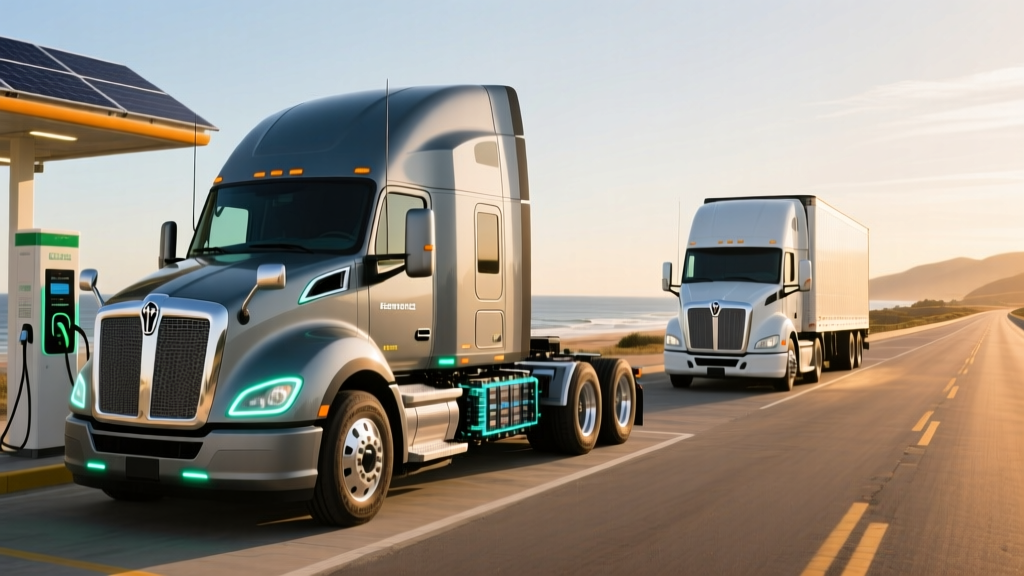
The electric Kenworth lineup in 2026 centers on two production models: the Kenworth T680E (Class 8 day-cab/regional-haul) and the Kenworth K270E / K370E (Class 5–7 straight trucks for delivery and vocational work). The T680E offers up to ~150 miles of range from a ~396 kWh NMC battery pack and can peak at ~200 kW DC fast charging (10–80% in roughly 75–90 minutes). The K270E delivers up to ~130 miles from a smaller pack and charges at up to ~150 kW. These trucks cost roughly 2.5× to 3× their diesel equivalents upfront, but fleet operators running predictable, sub-150-mile routes with depot charging can see fuel and maintenance savings that close the gap within 3–5 years — especially with federal and state incentive stacking.
Kenworth's Electric Lineup: What's Actually Available in 2026
Kenworth (a PACCAR company) doesn't sell electric trucks to consumers the way Tesla sells a Model Y. These are commercial vehicles ordered through dealer networks with long lead times, often customized to fleet specifications. Here's what's in production and delivering:
| Spec | Kenworth T680E (Class 8) | Kenworth K270E (Class 5) | Kenworth K370E (Class 7) |
|---|---|---|---|
| GVWR | 80,000 lbs (tractor) | ~26,000 lbs | ~33,000–54,000 lbs |
| Battery Chemistry | NMC (nickel manganese cobalt) | NMC | NMC |
| Battery Capacity (usable) | ~396 kWh | ~169 kWh | ~282 kWh |
| EPA-Claimed Range | Up to ~150 mi (depending on config) | Up to ~130 mi | Up to ~130 mi |
| Peak DC Fast Charge | ~200 kW (CCS1) | ~150 kW (CCS1) | ~150 kW (CCS1) |
| 10–80% Charge Time | ~75–90 min | ~60–75 min | ~70–85 min |
| Motor Output | ~470 hp (continuous) / ~670 hp (peak) | ~300 hp | ~350 hp |
| Estimated Base Price | $350,000–$420,000+ | $180,000–$230,000 | $250,000–$310,000 |
| Warranty (battery) | 5 yr / 500,000 mi (varies by fleet agreement) | 5 yr / 300,000 mi | 5 yr / 300,000 mi |
Source: Kenworth T680E official page; specs vary by configuration and battery option. Confirm with your Kenworth dealer for exact build specs.
Real-World Range vs. the Sticker: What Fleet Operators Actually See
Published range figures for electric Class 8 trucks are highly configuration-dependent. A T680E running a lightly loaded box-van route on flat terrain at 45 mph will get closer to its 150-mile claim. But real-world fleet data from early adopters tells a more nuanced story:
Range Reality Check: Kenworth T680E
Sticker range: ~150 miles (ideal conditions, partial load)
Real-world highway (loaded, 60–65 mph): ~100–120 miles
Cold weather (below 32°F, loaded): ~80–100 miles (20–35% reduction)
Mountainous terrain (loaded): ~85–110 miles depending on grade
The biggest range killers for electric semis are payload weight, sustained highway speed (aerodynamic drag scales with the square of velocity), and cold temperatures which increase battery internal resistance and demand cabin/defrost heating. Fleets operating in Minnesota winters or over Donner Pass should plan around the worst-case figure, not the best-case.
Regenerative braking helps significantly in stop-and-go drayage and urban delivery — some port-drillage operators report exceeding their expected range because regen recovers energy on every deceleration. This is where the K270E and K370E shine: delivery routes with 40+ stops per day are ideal for electric straight trucks.
Charging Infrastructure: The Real Bottleneck for Electric Kenworths
You cannot charge a 396 kWh T680E battery on a standard public ChargePoint station. Commercial electric trucks require dedicated depot charging infrastructure, and this is where most fleet electrification projects stall.
| Charging Level | Power (kW) | Approx. Time (T680E, 10–80%) | Infrastructure Needed |
|---|---|---|---|
| Level 2 (AC, depot overnight) | 19.2–40 kW | 8–14 hours (full charge overnight) | Commercial AC charger, 480V 3-phase |
| DC Fast (depot or public) | 150–200 kW | ~75–90 minutes (10–80%) | Dedicated DC cabinet, utility upgrade likely |
| DC Megawatt (future MCS) | 500+ kW (not yet available for Kenworth) | ~25–35 min (projected) | MCS connector, major utility infrastructure |
Depot charging cost breakdown (typical fleet install):
- Single 150 kW DC fast charger (hardware): $80,000–$130,000
- Electrical site work (transformer, switchgear, trenching): $50,000–$200,000+ depending on utility distance
- Utility demand charges & possible panel/transformer upgrade: $30,000–$150,000+
- Permitting and engineering: $10,000–$30,000
- Total per-charger installed cost: $170,000–$510,000 (heavily site-dependent)
Fleets installing 5–10 chargers simultaneously see per-unit costs drop due to shared trenching and switchgear, but the total capital outlay is substantial. This is why most electric Kenworth deployments are backed by utility make-ready programs, state incentive funds (like California's HVIP or New York's Truck Voucher Incentive Program), or federal EPA Clean School Bus / Clean Ports grants.
Total Cost of Ownership: Electric Kenworth vs. Diesel
The upfront price shock is real — a diesel T680 starts around $140,000–$180,000, while the T680E can exceed $380,000. But TCO analysis over a 5–7 year fleet lifecycle tells a different story for the right use case.
| Cost Factor | T680E (Electric) | T680 (Diesel) |
|---|---|---|
| Purchase Price (est.) | $380,000 | $160,000 |
| Federal / State Incentives | –$40,000 to –$120,000 (IRA commercial credit + state) | $0 |
| Net Effective Purchase | $260,000–$340,000 | $160,000 |
| Fuel / Energy (per mile, avg.) | $0.18–$0.30/mi (electricity at $0.08–$0.14/kWh) | $0.55–$0.75/mi (diesel at $3.80–$4.50/gal, 6.5 mpg) |
| Fuel Savings per Year (60,000 mi/yr) | $22,000–$30,000/yr savings for electric | |
| Maintenance (per mile) | $0.06–$0.10/mi (no oil, DEF, fewer brake jobs) | $0.15–$0.22/mi |
| Maintenance Savings per Year | $5,400–$7,200/yr savings for electric | |
| Depot Charging Infrastructure (amortized) | $5,000–$15,000/yr per truck | $0 |
| Estimated 5-Year TCO (net of incentives) | $450,000–$560,000 | $530,000–$620,000 |
Assumptions: 60,000 miles/year, regional-haul duty cycle, electricity at $0.11/kWh avg, diesel at $4.10/gal. Incentive amounts vary dramatically by state and program year. Consult your fleet accountant and check IRS commercial clean vehicle credit rules (IRC §45W, up to $40,000 for heavy trucks).
The breakeven point typically arrives around year 3–4 for fleets running 50,000+ miles per year with depot charging — assuming incentives cover a meaningful portion of the upfront delta. Without incentives, breakeven stretches to year 5–7 or may not occur before battery replacement risk enters the picture.
Incentives and Tax Credits: What Fleets Can Actually Claim
The §30D consumer credit that passenger-EV buyers know does not apply to Class 8 trucks. Instead, commercial fleets look to:
- IRC §45W Commercial Clean Vehicle Credit: Up to $40,000 for vehicles over 14,000 lbs GVWR (30% of cost basis or the incremental cost over a comparable ICE vehicle, whichever is less). Subject to sourcing and domestic-content requirements that evolve annually. Verify current-year rules on irs.gov.
- State voucher programs: California HVIP, New York NYTVIP, New Jersey ZE-MIP, and others can stack $50,000–$120,000+ on top of federal credits for eligible fleets. These programs have limited funding windows and application queues.
- EPA Clean Heavy-Duty Vehicles Program: Funded under the Inflation Reduction Act, providing grants for Class 6–8 zero-emission truck replacements, particularly for school buses, drayage, and municipal fleets.
- Utility make-ready programs: Many investor-owned utilities (PG&E, SCE, ConEdison, National Grid) cover 50–100% of electrical infrastructure costs for depot charging — sometimes $100,000+ per site.
A fleet in California stacking §45W + HVIP + utility make-ready can reduce a T680E's net cost to within $50,000–$80,000 of a diesel equivalent, radically accelerating the TCO payback.
Decision Framework: Should Your Fleet Go Electric Kenworth?
Choose the Electric Kenworth T680E or K270E/K370E if:
- Your daily route is under 120 miles (T680E) or under 100 miles (K270E/K370E) with a return-to-base pattern
- You have depot space for dedicated charging infrastructure or can partner with a utility on make-ready
- You operate in a state with strong incentive programs (CA, NY, NJ, CO, WA, OR) that stack with federal credits
- Your duty cycle is stop-and-go (drayage, delivery, refuse) where regenerative braking maximizes efficiency
- You face regulatory mandates (CARB Advanced Clean Fleets rule, port drayage requirements, municipal zero-emission procurement targets)
- You run 50,000+ miles per year, making the per-mile fuel savings substantial enough to close the upfront gap
Stick with Diesel (or Wait) if:
- Your routes regularly exceed 200+ miles without a mid-route charging opportunity
- You operate long-haul or irregular OTR routes where public DC fast charging for Class 8 is still extremely sparse
- You run in extreme cold climates (sustained sub-zero °F) without heated depot storage
- You lack depot access and depend entirely on street parking or shared lots (no charging infrastructure path)
- Your annual mileage is under 30,000 — the fuel savings won't justify the capital premium before the truck's useful life ends
Common Misconceptions About Electric Kenworth Trucks
| Myth | Fact |
|---|---|
| "Electric semis can't pull heavy loads." | The T680E is rated for 80,000 lbs GCW and delivers peak torque instantly from 0 RPM. Drayage operators report it outperforms diesel off the line. The limitation is range under heavy load, not tractive effort. |
| "You can charge at any public EV station." | No. Class 8 trucks need CCS1 connectors rated for 200+ kW, adequate physical clearance, and commercial billing accounts. Most public passenger-car chargers physically cannot accommodate a semi tractor. |
| "The battery will need replacing in 5 years." | NMC packs in commercial trucks are warrantied for 5 years / 300,000–500,000 miles at 70–80% capacity retention. Degradation curves from early-adopter fleets show ~10–15% loss at 300,000 miles with proper thermal management and charge-window management (20–80% SoC daily). |
| "Electric trucks are zero-emission everywhere." | Tailpipe emissions are zero. Upstream emissions depend on your grid mix — a depot in coal-heavy Wyoming produces more lifecycle CO₂ than one on California's renewable-heavy grid. Most fleets still see a 50–75% lifecycle GHG reduction vs. diesel. |
| "Maintenance is zero." | Maintenance is reduced, not eliminated. No oil changes, no DEF fluid, no diesel particulate filter, far less brake wear (regen handles most deceleration). But tires, suspension, HVAC, coolant loops, and 12V systems still require service. |
What First-Time Electric Truck Buyers Need to Know
If your fleet is evaluating its first electric Kenworth, here's the operational homework that separates successful deployments from expensive mistakes:
- Instrument your existing routes. Before ordering, GPS-log your current diesel trucks for 30–60 days. Record daily miles, stop frequency, payload weights, idle time, and ambient temperature. This data tells you which routes are EV-viable today and which aren't.
- Talk to your utility early. A 200 kW DC charger draws roughly the same peak power as 40–50 homes. Your local distribution feeder may need upgrading, which can take 6–18 months and $100,000+. Initiate this conversation before you order trucks.
- Plan for charge management software. If you're running 5+ trucks on shared chargers, you need software (e.g., ChargePoint Fleet, EV Connect, AmpControl) to schedule charging, manage demand charges, and precondition batteries for optimal charge speed.
- Train your drivers. Electric trucks drive differently — instant torque, one-pedal regen, no engine braking feel. A 2-hour driver orientation reduces regen-related tire wear and maximizes range.
- Budget for infrastructure, not just trucks. A common mistake: budgeting $400K for the truck and $0 for the charger. The charger + install can equal 30–60% of the truck cost.
Frequently Asked Questions
How long does it take to fully charge an electric Kenworth T680E?
On a 200 kW DC fast charger, expect roughly 2.5–3 hours for a 10–100% session (charging slows significantly above 80% to protect battery health). On a 40 kW Level 2 depot charger, a full charge takes 8–10 hours — ideal for overnight turnaround. Most fleets charge to 80% daily and do a full 100% charge only once a week for cell balancing.
Does the electric Kenworth qualify for the $7,500 federal EV tax credit?
No. The §30D consumer credit caps at $7,500 and applies to light-duty personal vehicles. Class 8 trucks like the T680E are eligible for the IRC §45W Commercial Clean Vehicle Credit, which provides up to $40,000 — but with its own sourcing, domestic-content, and cost-basis rules. Consult a tax professional and verify at irs.gov.
Can the T680E handle long-haul routes (300+ miles)?
Not in its current configuration. With ~100–150 miles of real-world range and no public megawatt-charging network for Class 8 trucks, the T680E is a regional-haul and drayage truck. Long-haul electric trucking will require either battery swaps, hydrogen fuel cells (Kenworth's T680 FCEV is in development), or a mature megawatt charging system (MCS) corridor — none of which are broadly available in 2026.
What happens to the battery at end of life?
PACCAR and Kenworth work with battery recycling partners (typically Redwood Materials or Li-Cycle) for end-of-life NMC packs. At 70–80% capacity retention, retired truck batteries often enter "second life" stationary storage applications before final recycling. Battery replacement cost for a T680E pack is estimated at $100,000–$160,000 out of warranty — a significant factor in 10-year TCO modeling.
Is the Kenworth T680E available for individual owner-operators?
Technically yes, but practically it's difficult. Order slots prioritize fleet customers with charging infrastructure already in place. Individual owner-operators face the additional challenge of depot charging access, higher commercial insurance, and the need for route predictability. Most T680E units go to fleets of 10+ trucks.