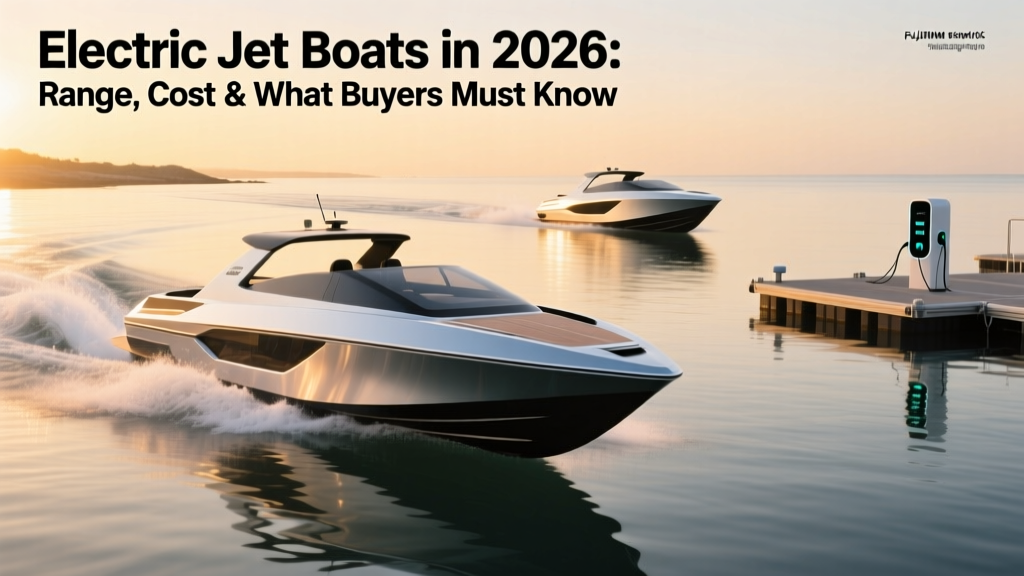
Quick answer: As of 2026, fully electric jet boats remain a niche, early-adopter category — not a mainstream replacement for gas-powered jet boats. Current production electric jet boats (from makers like Pure Watercraft and Rand Sea) typically offer 40–90 minutes of continuous runtime on a single charge, with battery packs ranging from 20 kWh to 45 kWh. Pricing starts around $25,000 and climbs past $55,000 for larger models. If your use case is short, predictable outings on calm water with access to shore power, an electric jet boat can deliver near-silent operation and minimal maintenance. For extended lake days, towing sports, or remote waterways without charging infrastructure, a gas jet boat or a marine hybrid remains the practical choice.
This guide applies an EV-analyst lens to the electric jet boat market — the same data-driven approach we use for electric cars. We'll cover battery specs, real-world runtime, charging logistics, total cost of ownership, and a clear decision framework to help you determine whether going electric on the water makes sense for you.
What Is an Electric Jet Boat — and How Does It Differ From a Gas Model?
An electric jet boat replaces the internal-combustion engine (typically a 150–300 HP gasoline inboard or outboard) with a battery pack and electric motor driving a waterjet pump. The propulsion principle is identical: an impeller draws water in and expels it at high velocity through a steerable nozzle. The difference is the power source.
Key distinctions include:
- Energy source: Lithium-ion battery packs (typically NMC chemistry for marine applications due to energy density requirements) instead of a fuel tank.
- Power delivery: Electric motors provide instant torque with no throttle lag, unlike gas engines that need to spool up.
- Noise and vibration: Electric jet boats operate at roughly 60–70 dB at cruising speed, compared to 85–95 dB for gas equivalents — a significant difference for wildlife-sensitive areas and conversation-quality outings.
- Maintenance: No oil changes, spark plugs, impeller rebuilds tied to engine hours, or winterization of cooling systems. The waterjet pump itself still requires periodic inspection.
However, the trade-off is stark: energy density. Gasoline contains roughly 33.7 kWh of energy per gallon. Even accounting for the ~25% thermal efficiency of a gas marine engine, that yields about 8.4 kWh of usable mechanical energy per gallon — from a fuel tank that weighs about 6 lbs per gallon. A 40 kWh lithium marine battery pack, by contrast, weighs 600–800 lbs and delivers 40 kWh of usable energy. This physics reality is the single biggest constraint on electric jet boat design.
Real-World Runtime and Range: What the Numbers Actually Mean
Unlike cars, boats don't have an EPA range sticker. Marine range depends heavily on speed, hull design, water conditions, and passenger load. Here's what current 2026 production electric jet boats deliver:
| Use Case | Speed | Power Draw | Runtime (40 kWh Pack) | Approx. Distance |
|---|---|---|---|---|
| Trolling / no-wake | 3–5 mph | 2–4 kW | 10–16 hours | 30–80 miles |
| Cruising | 15–20 mph | 12–18 kW | 2–3 hours | 30–55 miles |
| Sport / towing | 30–40 mph | 45–80 kW | 25–45 minutes | 15–30 miles |
| Top speed (WOT) | 45–55 mph | 100+ kW | 12–20 minutes | 10–18 miles |
Real-world caveat: These figures assume calm, flat water with a moderate load (2–3 passengers). Choppy conditions, strong currents, headwinds, and heavy loads can reduce runtime by 20–35%. Cold water and cold ambient temperatures (below 50°F) reduce lithium battery efficiency by roughly 10–15%, similar to EV range loss in winter driving.
Charging an Electric Jet Boat: Shore Power, Speeds, and Logistics
Charging infrastructure for electric boats is far less developed than for electric cars. Here's what buyers need to understand:
| Level | Power | Source | Charge Time (40 kWh Pack, 10–100%) | Availability |
|---|---|---|---|---|
| Level 1 (120V) | 1.4–1.9 kW | Standard household outlet | 22–30 hours | Universal but impractical for full recharge |
| Level 2 (240V) | 7.2–11.5 kW | Marina pedestal, home EV charger, dryer outlet | 4–6 hours | Growing at marinas; standard for home dock |
| DC Fast Charge | 25–50 kW (rare) | Specialized marine DC stations | 45–90 minutes | Very limited; a handful of marinas in WA, CA, FL |
Home charging is essential. Most electric jet boat owners charge at their dock or trailer storage location using a 240V Level 2 connection. If you store your boat on a trailer at home, a standard NEMA 14-50 outlet (the same used for home EV charging) delivers ~9.6 kW and can fully recharge a 40 kWh pack in roughly 4.5 hours. Installation of a 240V/50A circuit typically costs $800–$2,500 depending on panel capacity and run distance — hire a licensed electrician for this work.
Marina charging is the weak link. While some forward-thinking marinas have installed 240V pedestals for electric boats, the vast majority of public boat launches offer no charging whatsoever. Unlike the EV road-trip network (Tesla Superchargers, Electrify America), there is no national marine DC fast-charging network in 2026. This makes trip planning critical: you need to know your destination has shore power, or your outing must fit within your battery's runtime.
Cost Breakdown: Electric Jet Boat vs. Gas Jet Boat
The upfront price of an electric jet boat is higher, but operating costs are substantially lower. Here's a realistic five-year comparison:
| Cost Category | Electric Jet Boat (40 kWh) | Gas Jet Boat (200 HP) |
|---|---|---|
| Purchase price (base) | $38,000–$55,000 | $28,000–$42,000 |
| Fuel / electricity (5 years) | $1,200–$2,000 (at $0.14/kWh avg) | $9,000–$13,500 (at $4.00/gal, 8–12 GPH) |
| Engine maintenance (5 years) | $200–$500 (jet pump service) | $3,000–$5,500 (oil, plugs, impeller, winterization) |
| Insurance (annual avg) | $600–$1,100/yr | $500–$900/yr |
| Battery replacement reserve | $8,000–$15,000 (year 8–12) | Engine rebuild: $5,000–$10,000 (year 8–12) |
| Estimated 5-year total | $44,000–$65,000 | $44,000–$67,000 |
Key takeaway: Over five years, total costs converge. The electric jet boat's higher purchase price is offset by dramatically lower fuel and maintenance costs. The break-even point typically arrives around year 3–4 for owners who use their boat 80+ hours annually. Below 50 hours/year, the gas boat's lower purchase price dominates.
Tax credit note: The federal §30D clean vehicle credit applies to qualified electric vehicles — and under current IRS guidance, this generally means highway-capable vehicles with four wheels. Electric boats do not currently qualify for the §30D credit. However, some states (notably California and Washington) have offered marine electrification rebates through clean-air or clean-water programs. Check your state's environmental agency for current programs. Additionally, the commercial energy deduction may apply if the boat is used in a commercial operation — consult a tax professional.
Battery Longevity, Chemistry, and Replacement Costs
Marine electric jet boats predominantly use NMC (nickel-manganese-cobalt) lithium-ion cells because the energy density requirement is severe — every pound matters on a planing hull. This differs from some stationary and automotive applications where LFP (lithium iron phosphate) chemistry is gaining ground due to its longer cycle life and lower cost.
| Attribute | NMC (Typical Marine) | LFP (Emerging Marine) |
|---|---|---|
| Energy density | 200–260 Wh/kg | 140–180 Wh/kg |
| Cycle life (to 80% capacity) | 1,000–2,000 cycles | 3,000–5,000 cycles |
| Weight for 40 kWh pack | ~155–200 kg (340–440 lbs) | ~220–285 kg (485–630 lbs) |
| Cost per kWh (2026) | $140–$180 | $100–$130 |
| Thermal stability | Good (requires active BMS) | Excellent (inherently safer) |
| Marine suitability | Preferred for planing hulls | Better for displacement hulls / pontoons |
Degradation reality: Expect an NMC marine pack to retain roughly 80–85% of original capacity after 5–7 years of typical use (100–150 hours/year). That means your 40 kWh pack effectively becomes a 32–34 kWh pack — reducing cruising runtime from 2.5 hours to about 2 hours. Most marine battery manufacturers warrant their packs for 5 years or a specified cycle count, with a capacity retention threshold of 70–80%.
Replacement cost: A full 40 kWh marine-grade NMC pack replacement runs $8,000–$15,000 in 2026, including labor and BMS integration. This is comparable to replacing a gas marine engine at end-of-life. Plan for this as a long-term ownership cost.
Common Misconceptions About Electric Jet Boats
| Myth | Fact |
|---|---|
| "Electric boats can't go fast." | Current models reach 40–55 mph. Instant electric torque provides strong acceleration. The limitation is sustained high-speed runtime, not top speed. |
| "You'll get stranded on the water." | Possible if you ignore your state of charge — identical to running out of gas. Responsible planning (80/20 rule: use 80% of capacity, keep 20% reserve) prevents this. Most marine battery management systems enforce a reserve buffer. |
| "The battery will die in a few years." | NMC marine packs are rated for 1,000–2,000 full cycles. At 100 hours/year with partial discharges, that translates to 10–15 years before significant degradation. |
| "Charging takes too long." | A Level 2 (240V) charge from 20% to 100% takes 3–4 hours. For most lake-use patterns (morning outing, charge during lunch, afternoon outing), this is workable. Overnight charging is trivial. |
| "Electric boats qualify for the $7,500 federal tax credit." | They do not. §30D applies to on-road vehicles. Some state and local marine incentives exist — check your jurisdiction. |
Decision Framework: Should You Buy an Electric Jet Boat?
Choose an electric jet boat if:
- Your typical outing is under 2.5 hours at cruising speed, or under 45 minutes of sport/towing use
- You have reliable 240V shore power at your dock, home, or storage location
- You boat primarily on small-to-medium lakes, calm rivers, or protected bays
- You value silent operation for fishing, wildlife observation, or conversation
- You want to eliminate gas, oil, and engine maintenance from your boating routine
- You boat in areas with noise restrictions or emission-sensitive waterways (some lakes are beginning to mandate electric-only)
Stick with a gas jet boat (or wait) if:
- You regularly boat for 4+ hours without shore-power access
- You need sustained high-speed towing (wakeboarding, waterskiing) for extended sessions
- You trailer your boat to remote lakes without charging infrastructure
- Your budget is under $30,000 — the gas market offers far more options at this price point
- You operate in cold climates where battery efficiency drops and you can't charge between sessions
What First-Time Electric Jet Boat Buyers Should Know
If you're seriously considering an electric jet boat, here's a practical pre-purchase checklist:
- Audit your typical outing. Track your last 10 trips: duration, average speed, peak speed, and distance. If 80%+ of your trips fit within a 40 kWh pack's runtime, electric is viable.
- Confirm charging access. Before ordering, verify that your dock, marina, or storage location can support a 240V/50A circuit. Get a quote from an electrician. If your marina doesn't offer shore power, ask management about their plans — marina electrification is accelerating.
- Understand the warranty. Marine battery warranties vary. Ask specifically: What is the capacity retention guarantee? At what cycle count or time period? What is excluded (water intrusion, improper storage, deep discharge)?
- Test in real conditions. If possible, demo the boat on the water you'll actually use. Runtime estimates change with your local conditions — current, wind, altitude (water density), and temperature all matter.
- Factor in insurance. Electric boats can carry higher insurance premiums due to battery replacement cost and limited repair-network availability. Get quotes before committing.
- Plan for winter storage. Lithium batteries should not be stored at 100% or 0% state of charge for extended periods. Most marine BMS systems manage this, but confirm your manufacturer's storage protocol — typically 40–60% SoC in a temperature-controlled environment.
Frequently Asked Questions
How fast can an electric jet boat go?
Current 2026 production electric jet boats reach top speeds of 40–55 mph depending on hull design, motor output (typically 80–200 HP equivalent), and battery pack size. However, sustained top-speed runtime is limited to 12–20 minutes before the battery depletes. Cruising speeds of 15–25 mph are far more practical for extending runtime.
Can I tow a water-skier or wakeboarder with an electric jet boat?
Yes, but with runtime trade-offs. Towing requires sustained high power (40–80 kW), which drains a 40 kWh pack in roughly 30–45 minutes of continuous towing. For a 15–20 minute ski session followed by cruising, it works well. For an all-day towing session, a gas jet boat remains the better tool.
What happens if the battery runs out on the water?
The boat stops — just like running out of gas. Modern marine battery management systems provide clear state-of-charge warnings and typically enforce a 5–10% reserve buffer. Responsible operators follow the same practice as gas boaters: plan your outing within your fuel/energy budget and maintain a reserve. Some operators carry a portable marine generator as a range extender for remote trips.
Are electric jet boats safe in saltwater?
Marine-grade electric systems are sealed and rated for saltwater environments (IP67 or higher for battery enclosures). However, saltwater accelerates corrosion of all metal components. Rinse the boat thoroughly after saltwater use, and follow the manufacturer's anti-corrosion maintenance schedule. Electric systems themselves are not inherently more or less saltwater-compatible than gas systems — the hull and fittings are the primary concern.
Where can I buy an electric jet boat in 2026?
The market is still small. Brands like Pure Watercraft (Seattle, WA), Rand Sea (various), and a handful of custom builders offer production models. Availability is limited compared to the gas jet boat market. Expect lead times of 3–6 months for custom orders. Major marine retailers are beginning to carry electric models, but the dealer network is thin — verify service and warranty support in your area before purchasing.