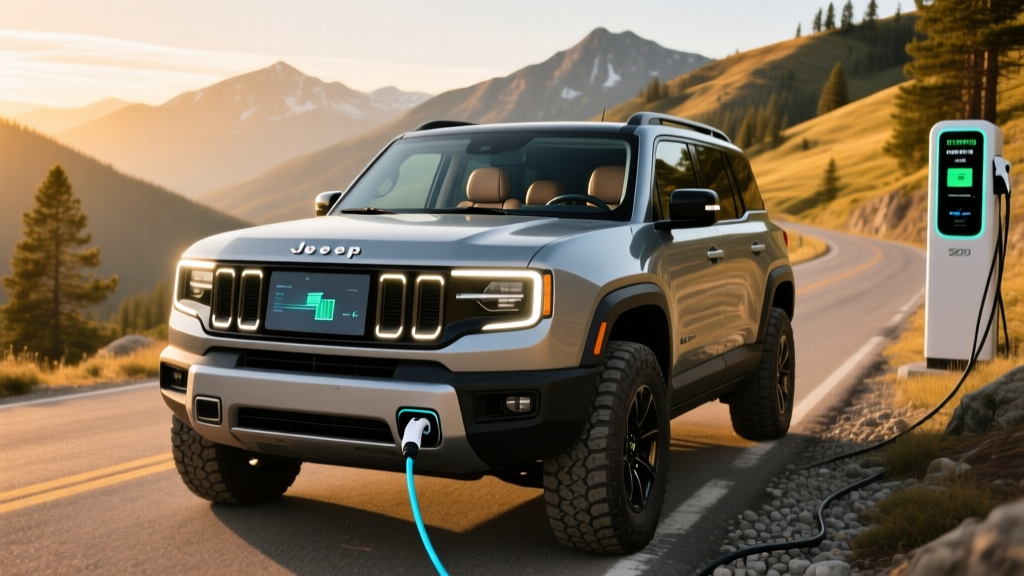
The Jeep brand has built its reputation on rugged, trail-capable SUVs that sip fuel only when absolutely necessary. The electric Jeep Recon is Stellantis's bid to prove that battery-electric propulsion doesn't have to mean sacrificing off-road chops. Built on the STLA Medium platform shared with the Dodge Charger Daytona and future Alfa Romeo EVs, the 2026 Recon arrives as a boxy, Wrangler-inspired midsize SUV with dual-motor all-wheel drive, a detachable roof, and Jeep's Selec-Terrain traction management — all powered by an 85 kWh battery pack.
But the real questions for EV buyers are practical ones: How far can it actually go on a charge? How fast does it recharge on a road trip? And does it qualify for the federal tax credit? We've dug into the preliminary specs, EPA filings, and Jeep's official disclosures to give you the full picture before the Recon hits dealer lots.
Quick Verdict: Who the Electric Jeep Recon Is For
The Recon occupies a narrow but compelling niche: buyers who want genuine off-road capability in an EV package and are willing to accept some efficiency trade-offs to get it. Think of it as the electric spiritual successor to the Wrangler 4xe — but fully battery-electric, with more interior refinement and a lower center of gravity thanks to its skateboard-style battery pack.
It's not the most aerodynamic or efficiency-focused EV in its price bracket. If your priority is maximum highway range per dollar, a Hyundai Ioniq 5 or Tesla Model Y will deliver more miles per kWh. But if you need ground clearance, all-terrain tires, and the ability to tackle rocky trails on weekends while commuting on electrons during the week, the Recon has very few direct competitors.
Range, Battery, and Efficiency
The 2026 Recon is equipped with an 85 kWh usable battery pack using NMC (nickel manganese cobalt) chemistry. Jeep has targeted a 300+ mile EPA-estimated range for the base configuration, though final EPA certification numbers will be confirmed closer to launch. Given the Recon's boxy aerodynamic profile, all-terrain tire options, and approximately 5,000-pound curb weight, efficiency will be a weak point compared to sleeker crossover competitors.
EPA Estimate: ~300 miles (preliminary, final certification pending)
Real-World Highway (70 mph): Expect 240–265 miles. The Recon's flat windshield, upright stance, and all-terrain tires create significant aerodynamic drag at highway speeds.
Cold Weather (below 30°F): Expect 210–240 miles. NMC chemistry loses 15–25% range in freezing temperatures, and the Recon's large frontal area compounds energy demands for cabin heating. A heat pump is standard, which helps mitigate losses compared to resistive heating.
Off-Road/Low-Speed Trail Use: Range is less of a concern at low speeds — expect efficient energy use on trails where regenerative braking recovers energy on descents.
In terms of efficiency, anticipate roughly 85–95 MPGe combined (approximately 35–39 kWh per 100 miles). That's noticeably thirstier than the Ioniq 5's 114 MPGe or the Model Y's 122 MPGe, but it's in line with similarly shaped off-road-oriented vehicles. For context, the Wrangler 4xe achieves around 49 MPGe in electric mode, so the Recon represents a significant efficiency improvement over Jeep's plug-in hybrid offering.
Charging Speed: DC Fast Charging and Home Level 2
Charging speed is where the STLA Medium platform shows its engineering. The Recon supports DC fast charging at up to 175 kW on a CCS1 connector (with NACS adapter compatibility expected for Tesla Supercharger access by late 2026). Jeep claims a 10–80% charge in approximately 27 minutes under optimal conditions — meaning a preheated battery at a capable 350 kW charger.
| Level | Power | Speed | Notes |
|---|---|---|---|
| Level 1 (120V) | 1.4 kW | ~3–4 mi/hr | Emergency/trickle only; full charge in 60+ hours |
| Level 2 (240V, 48A) | 11.5 kW | ~28–32 mi/hr | Full charge overnight (~9 hrs); requires 60A circuit |
| DC Fast Charge | Up to 175 kW peak | ~150 mi in 20 min | 10–80% in ~27 min; tapers significantly above 80% |
Charging curve reality check: Like all EVs, the Recon won't sustain its peak 175 kW rate throughout the session. Expect peak rates between 10–40% state of charge, tapering to roughly 80–100 kW between 40–60%, and dropping further to 40–50 kW above 70%. This is why manufacturers quote 10–80% times rather than 0–100%. Plan road-trip charging stops for 25–35 minutes to reach 80%, then move on — the final 20% takes disproportionately longer.
For home charging, the Recon's onboard charger accepts up to 11.5 kW on Level 2. With a hardwired 48-amp Level 2 station on a dedicated 60-amp circuit, you'll add roughly 30 miles of range per hour of charging. A full overnight charge from 10% to 100% takes approximately 9 hours. If your home electrical panel is a 100-amp service, you may need a panel upgrade (typically $1,500–$3,000) to support a 60-amp dedicated circuit — factor this into your budget.
Performance and Drivetrain
The 2026 Recon comes standard with a dual-motor all-wheel-drive powertrain producing an estimated 400+ horsepower. Jeep hasn't released a final 0–60 mph time, but the STLA Medium platform's performance targets suggest a 0–60 time in the low-to-mid 5-second range — quick for a 5,000-pound SUV, though not sports-car territory like the Dodge Charger Daytona on the same platform.
| Spec | Value |
|---|---|
| Battery (usable) | 85 kWh, NMC chemistry |
| EPA Range (est.) | ~300+ miles (final cert. pending) |
| Drivetrain | Dual-motor AWD |
| Horsepower | ~400+ hp |
| 0–60 mph | ~5.0–5.5 sec (est.) |
| Max DC Fast Charge | 175 kW (CCS1; NACS adapter planned) |
| 10–80% DCFC Time | ~27 minutes |
| Level 2 Charge Rate | 11.5 kW (48A) |
| Efficiency (est.) | ~85–95 MPGe / 35–39 kWh/100mi |
| Ground Clearance | ~8.5 inches (est.) |
| Towing Capacity | TBD — likely 3,500 lbs |
| Base MSRP | ~$52,595 (est.) |
| Battery Warranty | 8 yr / 100,000 mi (min. 70% capacity retention) |
Off-road hardware is where the Recon differentiates itself from every other EV in its class. Jeep has confirmed Selec-Terrain traction management with modes for Sand, Mud, Snow, and Rock. The SUV will offer available all-terrain tires, underbody skid plates, and a tow-hook package. The low center of gravity from the floor-mounted battery pack gives it a stability advantage over the Wrangler on side slopes, while the instant torque from dual electric motors provides precise low-speed trail control without the lurching of a traditional automatic transmission.
One notable feature: Jeep has indicated the Recon will include a power-operated retractable roof panel, echoing the open-air experience of the Wrangler. This is a segment-first for EVs and a genuine lifestyle differentiator, though expect some compromise in structural rigidity and cabin noise compared to a fixed-roof design.
Interior, Cargo, and Technology
The Recon is a midsize two-row SUV, and interior dimensions place it in the same ballpark as the Jeep Grand Cherokee. Expect approximately 41 inches of front legroom and 38 inches of rear legroom, with cargo volume around 30–35 cubic feet behind the second row and roughly 65–70 cubic feet with the rear seats folded. Jeep hasn't confirmed a front trunk (frunk), and given the STLA Medium platform's packaging priorities, any frunk space is likely to be modest — perhaps 2–4 cubic feet for storing charging cables.
On the technology front, the Recon will ship with Stellantis's latest Uconnect 5 infotainment system on a 12.3-inch touchscreen, wireless Apple CarPlay and Android Auto, over-the-air update capability, and an available head-up display. Driver-assistance features will include adaptive cruise control with stop-and-go, lane-keeping assist, automatic emergency braking, and a 360-degree camera system — useful both in parking lots and on tight trails.
Important note on driver assist: The Recon's ADAS features are SAE Level 2, meaning they provide steering and speed assistance but require the driver to remain fully engaged and supervising at all times. This is not autonomous or "self-driving" capability.
- Aerodynamic efficiency penalty: The boxy design and available all-terrain tires will reduce highway range significantly versus crossover-style EVs.
- No confirmed frunk: Cargo versatility may lag competitors with dedicated front-trunk storage.
- Retractable roof trade-offs: Expect more wind noise at highway speeds and potential long-term seal maintenance versus a fixed roof.
- Charging connector transition: Early 2026 models may ship with CCS1; NACS adapter availability timeline is not yet firm.
Pricing, Trim Levels, and Federal Tax Credit
Jeep has not released final MSRP figures, but based on the STLA Medium platform's cost structure and the Recon's positioning between the Wrangler 4xe and Grand Cherokee 4xe, expect pricing to start around $52,595 for the base Sport trim, with a mid-level Limited around $58,000 and a fully loaded Trailhawk (the off-road-focused trim) approaching $64,000 before destination charges.
| Trim | Est. MSRP | §30D Credit (if eligible) | Effective Price |
|---|---|---|---|
| Sport | ~$52,595 | Up to $7,500 | ~$45,095 |
| Limited | ~$58,000 | Up to $7,500 | ~$50,500 |
| Trailhawk | ~$64,000 | Up to $7,500 | ~$56,500 |
Federal tax credit eligibility (§30D): The Recon's eligibility for the full $7,500 credit depends on several factors that buyers must verify at the time of purchase. Under current IRS rules, the key requirements include:
- MSRP cap: SUVs must have an MSRP at or below $80,000. All Recon trims should clear this threshold comfortably.
- Buyer income cap: Adjusted gross income must not exceed $150,000 (single), $225,000 (head of household), or $300,000 (joint filers).
- Battery component sourcing: A percentage of battery components must be manufactured or assembled in North America, and critical minerals must meet sourcing thresholds. These percentages increase annually. Stellantis's North American manufacturing footprint gives the Recon a plausible path to eligibility, but final determination depends on the specific battery cell supply chain at time of production.
- Point-of-sale transfer: Eligible buyers can transfer the credit to the dealer at purchase, reducing the purchase price directly rather than waiting for a tax refund.
We strongly recommend consulting a tax professional and checking the latest fueleconomy.gov listings before purchasing to confirm the specific trim and build date qualifies.
Warranty and Long-Term Ownership
Stellantis is expected to offer the Recon with an 8-year/100,000-mile battery and powertrain warranty, consistent with the industry standard for EV battery coverage and aligned with the minimum requirements under federal emissions-related warranty provisions. The warranty will likely guarantee a minimum of 70% battery capacity retention over that period — meaning if the battery degrades below 70% of its original 85 kWh capacity within 8 years or 100,000 miles, Stellantis would repair or replace it.
For context, NMC battery chemistry typically degrades at roughly 1.5–2.5% per year under normal use conditions, meaning a well-maintained Recon battery should retain approximately 85–90% of its original capacity after 5 years. Key factors that accelerate degradation include frequent DC fast charging above 150 kW, regularly charging to 100% and leaving the vehicle at full state of charge for extended periods, and extreme heat exposure. For daily driving, setting the charge limit to 80–85% and preconditioning the battery before fast charging will maximize long-term battery health.
The basic vehicle warranty is expected to be 3 years/36,000 miles, which is average for the segment but less generous than Hyundai/Kia's 5-year/60,000-mile basic coverage.
Pros, Cons, and Competition
- Genuine off-road capability in an EV — Selec-Terrain, skid plates, all-terrain tire options
- Open-air retractable roof — unique in the EV segment
- Dual-motor AWD with instant torque for precise trail control
- 300+ mile range adequate for most daily and weekend use
- 175 kW DC fast charging keeps road-trip stops reasonable
- Under $80,000 MSRP — likely eligible for $7,500 federal credit
- Boxy aero and A/T tires will cut real-world highway range to ~240–265 mi
- Efficiency of ~85–95 MPGe trails crossover rivals by 20–30%
- No confirmed frunk — cargo versatility may disappoint
- Retractable roof may increase cabin noise and long-term maintenance
- Trailhawk trim approaching $64K before options
- CCS1-to-NACS adapter timeline uncertain for early buyers
The Recon's most direct competitor is the Ford Bronco — but Ford has not committed to a fully electric Bronco for 2026, making the Recon effectively unique in the off-road EV space. Cross-shopping buyers will also consider the Rivian R1S (more capable but starting above $75,000), the Jeep Wrangler 4xe (PHEV, not fully electric, but proven trail hardware), and the Hyundai Ioniq 5 (far more efficient but zero off-road pretensions).
Choose the Recon if: You need a daily-drivable EV that can handle genuine off-road trails on weekends, you value the open-air roof experience, and you're willing to trade 40–60 miles of highway range versus a crossover EV to get it.
Look elsewhere if: Your driving is 95%+ on pavement and your priority is maximum range per dollar. The Ioniq 5, Model Y, or Chevrolet Equinox EV will deliver significantly more real-world miles per kWh and lower charging costs over time.
Frequently Asked Questions
What is the real-world range of the electric Jeep Recon?
Jeep targets a 300+ mile EPA estimate, but real-world highway driving at 70 mph will likely yield 240–265 miles due to the Recon's boxy aerodynamics and available all-terrain tires. In freezing weather, expect 210–240 miles. City and trail driving at lower speeds will be closer to or even exceed the EPA figure thanks to regenerative braking.
How fast does the Jeep Recon charge?
On a DC fast charger, the Recon peaks at 175 kW and can charge from 10–80% in approximately 27 minutes under optimal conditions. At home on a Level 2 (240V, 48A) station, it charges at 11.5 kW, adding roughly 30 miles of range per hour — enough for a full overnight charge in about 9 hours.
Does the electric Jeep Recon qualify for the $7,500 federal tax credit?
It's expected to qualify, but eligibility depends on several factors under IRS §30D rules: your income must be below the cap ($150K single / $300K joint), the MSRP must be under $80,000 (all trims should qualify), and the battery must meet North American sourcing thresholds for components and critical minerals. Confirm eligibility at purchase via fueleconomy.gov and consult a tax professional.
Is the electric Jeep Recon worth buying vs. the Rivian R1S or Wrangler 4xe?
If budget is a primary concern, the Recon at ~$52,595 (before credits) undercuts the R1S by $20,000+ while still offering genuine off-road hardware. However, the R1S offers more range, faster charging, and a third row. Versus the Wrangler 4xe, the Recon gives you fully electric operation (no gas engine maintenance) with more interior refinement, but the Wrangler 4xe remains the more proven and modifiable off-road platform today.
When will the electric Jeep Recon be available to buy?
The 2026 Recon is expected to begin production and reach dealerships in late 2025 or early 2026. Reservation and pre-order availability varies by dealer. As of this writing, final EPA certification and MSRP figures are still pending — specs in this review are based on Jeep's preliminary disclosures and STLA Medium platform data.
Note: All specifications in this article are based on preliminary manufacturer disclosures and STLA Medium platform data as of early 2026. Final EPA certification, MSRP, and tax credit eligibility should be confirmed with fueleconomy.gov and your dealer before purchase.