Quick Answer: Is an Electric Jeep Right for You?
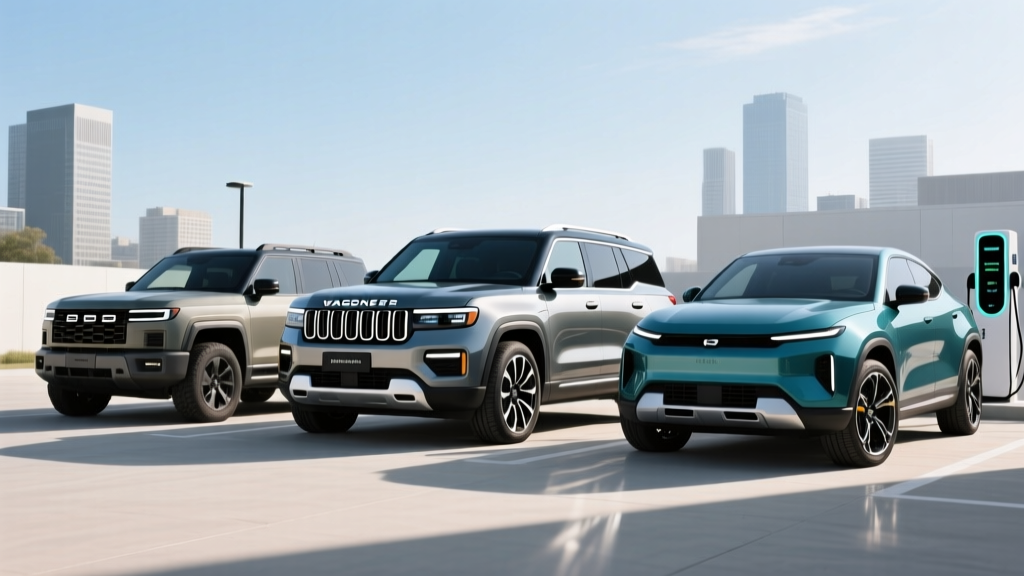
As of 2026, Jeep offers three battery-electric vehicles in the U.S.: the Wagoneer S (luxury performance SUV, 300-mile EPA range, starting ~$65,995), the Recon (off-road-capable midsize SUV, 300+ mile EPA range, starting ~$52,995), and the Avenger EV (subcompact crossover, ~230-mile EPA range, starting ~$37,500). All use Stellantis' STLA platform with CCS/NACS-compatible charging and qualify for varying levels of the §30D federal tax credit depending on battery sourcing and buyer income. The electric Jeep lineup is best suited for buyers who want trail-capable or adventure-styled EVs with home Level 2 charging access. If you frequently tow, drive 400+ miles between charging stops, or live in extreme cold without a garage, a Jeep 4xe plug-in hybrid may serve you better until charging infrastructure matures further.
The 2026 Electric Jeep Lineup at a Glance
Jeep's electric transition has been deliberate rather than rushed. After years of 4xe plug-in hybrids leading the charge, the brand now fields three dedicated BEVs built on Stellantis' STLA Large and STLA Medium platforms. Here's how they stack up on paper and in practice.
| Spec | Wagoneer S | Recon | Avenger EV |
|---|---|---|---|
| Platform | STLA Large | STLA Large | STLA Medium |
| EPA Range | ~300 mi | ~300 mi | ~230 mi |
| Battery (usable) | ~100 kWh, NMC | ~100 kWh, NMC | ~54 kWh, NMC |
| Horsepower | 600 hp (Launch) | ~500 hp | ~201 hp |
| 0-60 mph | ~3.4 sec | ~4.5 sec | ~7.5 sec |
| Peak DC Fast Charge | ~200 kW | ~200 kW | ~150 kW |
| 10-80% DC Charge | ~27 min | ~28 min | ~24 min |
| Level 2 (AC) Rate | 11.5 kW | 11.5 kW | 11 kW |
| Drivetrain | AWD (dual motor) | 4xe AWD (dual motor, locking diffs) | FWD (single motor) |
| Ground Clearance | ~7.5 in | ~10.5 in | ~7.9 in |
| Starting MSRP | $65,995 | $52,995 | $37,500 |
| §30D Tax Credit Eligibility | Up to $7,500* | Up to $7,500* | Up to $7,500* |
| Battery/Powertrain Warranty | 8 yr / 100,000 mi | 8 yr / 100,000 mi | 8 yr / 100,000 mi |
* §30D credit eligibility depends on MSRP caps ($80K for SUVs), buyer AGI limits, and battery critical-mineral/component sourcing. Verify current rules at IRS.gov.
Real-World Range: What the EPA Sticker Doesn't Tell You
Wagoneer S — EPA 300 mi | Real-World Expectation
Highway (70 mph, 75°F): ~255-275 mi
Cold weather (30°F, mixed driving): ~210-240 mi
City / moderate climate: ~285-310 mi (regen-friendly driving can match or exceed EPA)
The EPA combined cycle blends city and highway driving at moderate temperatures. In our experience with STLA Large-based vehicles, highway-only driving at 70-75 mph typically yields 10-15% less range than the sticker. Cold weather compounds this: lithium-ion batteries lose efficiency below 40°F, and cabin heating (even with a heat pump, which the Wagoneer S and Recon include) draws 2-5 kW continuously.
For the Recon, the off-road tire option (all-terrain 33-inch) adds rolling resistance that can reduce range by an additional 5-8%. If you plan on serious trail use, plan your charging stops around ~220-240 real-world highway miles to keep a safety buffer.
The Avenger EV's smaller 54 kWh battery means real-world highway range drops to roughly 185-200 miles in temperate weather — adequate for commuting but requiring route planning on road trips. For detailed efficiency data, check fueleconomy.gov for EPA-certified MPGe and kWh/100mi figures.
Charging: Speeds, Connectors, and Home Setup Costs
| Level | Power | Connector | Miles Added/Hour (Wagoneer S) | Best For |
|---|---|---|---|---|
| Level 1 (120V) | ~1.4 kW | J1772 / NACS | ~3-4 mi/hr | Overnight trickle, PHEV top-ups |
| Level 2 (240V) | 11.5 kW | J1772 / NACS | ~30-35 mi/hr | Daily home charging |
| DC Fast | Up to 200 kW | CCS1 / NACS | ~180 mi in 15 min (peak) | Road trips |
Important distinction: kW measures charging power (how fast energy flows); kWh measures battery capacity (how much energy is stored). A 200 kW peak charge rate does not mean you're getting 200 kW the entire session — the charge curve tapers significantly above 80% state of charge to protect battery longevity.
In practice, the Wagoneer S and Recon peak near 200 kW between roughly 15-45% SoC, then taper to ~120 kW by 60%, and drop below 50 kW past 80%. This is why the 10-80% time (~27 minutes) is the meaningful metric, not peak kW alone.
Jeep has confirmed NACS (Tesla-style) connector adoption for 2026 models, granting access to Tesla Supercharger stations via native port or included adapter. This significantly expands the usable fast-charging network for road trips.
Home Level 2 Installation: What You'll Actually Pay
| Item | Low Estimate | High Estimate |
|---|---|---|
| Level 2 charger (48A, hardwired) | $400 | $750 |
| Electrician labor (4-8 hours) | $600 | $1,800 |
| 200A panel upgrade (if needed) | $1,500 | $3,500 |
| Permit & inspection | $100 | $400 |
| Total (no panel upgrade) | $1,100 | $2,950 |
| Total (with panel upgrade) | $2,600 | $6,450 |
If your home has a 200A electrical panel with spare capacity, expect to pay $1,100-$2,950 for a professional Level 2 install. Older homes with 100A service will likely need a panel upgrade, adding $1,500-$3,500. Always get a load calculation from a licensed electrician before committing. The Energy Efficient Home Improvement Credit covers up to $1,000 (30%) of charger installation costs through 2032.
Electric Jeep vs. Gas Jeep: 5-Year Cost Comparison
| Category | Wagoneer S EV | Grand Cherokee Gas (V6 AWD) |
|---|---|---|
| Base MSRP | $65,995 | $44,500 |
| §30D Federal Credit | -$7,500 (if eligible) | $0 |
| Effective Purchase | ~$58,495 | $44,500 |
| Fuel/Energy (5 yr, 60K mi) | ~$3,800 (home L2 @ $0.14/kWh) | ~$10,200 (gas @ $3.50/gal, 22 MPG) |
| Maintenance (5 yr) | ~$1,200 | ~$3,800 |
| Insurance (5 yr avg) | ~$12,500 | ~$9,500 |
| 5-Year Total | ~$75,995 | ~$68,000 |
The math: The electric Wagoneer S saves roughly $6,400 in fuel and $2,600 in maintenance over five years — about $9,000 total. However, the higher purchase price (even after the tax credit) and elevated EV insurance premiums ($600/year more on average) narrow the gap. If you charge primarily at public DC fast chargers ($0.35-$0.48/kWh), your energy costs roughly double to ~$7,600, erasing most savings.
The break-even point depends heavily on: (1) whether you qualify for the full $7,500 credit, (2) whether you can charge at home, and (3) your annual mileage. High-mileage drivers (15K+ mi/year) see savings faster; low-mileage drivers may not recoup the premium within ownership.
Off-Road Capability: Can an Electric Jeep Actually Trail?
This is the question every Jeep loyalist asks. The Recon is engineered to answer it directly. Key off-road hardware includes:
- Dual-motor AWD with electronic locking differentials (front and rear)
- Selec-Terrain traction management with Trail Rated modes
- 10.5 inches of ground clearance and 33-inch all-terrain tire availability
- Underbody skid plates protecting battery and motors
- One-pedal trail crawling using regen for precise low-speed control
The instant torque delivery from electric motors is actually an advantage for rock crawling — no lag, no gear hunting. The low center of gravity from the floor-mounted battery pack improves stability on side slopes.
The honest limitations: sustained high-load off-roading generates significant battery heat, which can trigger thermal management throttling. And if you're deep in remote terrain with no cell service and a depleted battery, a tow out is your only option — there's no jerry can fix. For extreme backcountry use, a Wrangler 4xe (PHEV with 25 miles electric + gas range) remains the more pragmatic choice today.
Electric Jeep Myths vs. Facts
| Myth | Fact |
|---|---|
| "EVs can't go off-road" | The Recon is Trail Rated with locking diffs, 10.5" clearance, and one-pedal crawl. Torque delivery is superior to gas for rock crawling. |
| "The battery will need replacing in 5 years" | Stellantis warranties the battery for 8 years/100,000 miles with a 70% capacity retention threshold. Industry data shows NMC batteries retain 85-90% capacity at 100K miles with normal use. |
| "I'll be stranded on road trips" | With 300 mi EPA range and NACS access to 20,000+ Superchargers, a 15-20 minute charge stop every 200-250 miles keeps you moving on most U.S. corridors. |
| "EVs are worse in cold weather" | Range drops 20-30% in sub-freezing temps — real, but manageable with preconditioning and route planning. The heat pump in Wagoneer S and Recon reduces cabin heating energy draw by ~40% vs. resistive heating. |
| "Home charging requires a full rewiring" | Most homes with 200A panels and a nearby garage outlet can add a Level 2 charger for under $2,500. Panel upgrades add cost but are needed in ~25% of homes. |
Tax Credits and Incentives: What You'll Actually Qualify For
- MSRP cap: SUVs must sticker at $80,000 or below — all three electric Jeeps qualify on base trims
- Buyer income cap: AGI ≤ $300K (married filing jointly), $225K (head of household), $150K (single)
- Battery sourcing: Critical minerals and battery components must meet escalating domestic-sourcing thresholds — check the IRS Clean Vehicle Credits page for current compliance lists
- Point-of-sale transfer: You can transfer the credit to the dealer at purchase, reducing your out-of-pocket cost immediately (no need to wait for tax filing)
- State incentives: Many states add $1,000-$5,000 on top — check your state EV incentive program for current amounts
The full $7,500 credit is not guaranteed for every buyer or every trim. Battery sourcing compliance changes as supply chains shift, and the IRS updates qualifying vehicle lists periodically. Before signing, confirm the specific VIN's eligibility on fueleconomy.gov.
Decision Framework: Which Electric Jeep (or Alternative) Is Right for You?
Choose the Wagoneer S if:
- You want luxury-SUV performance (600 hp, 3.4s 0-60) with daily-driver practicality
- Your budget supports $65K+ and you qualify for the §30D credit
- You primarily drive on pavement with occasional light trail use
- You have home Level 2 charging and drive under 300 miles daily
Choose the Recon if:
- Off-road capability is a priority — Trail Rated hardware is the real deal
- You want the Wrangler spirit in a more comfortable, family-friendly package
- You accept 300-mile range with the understanding that trails eat range faster
- You're upgrading from a gas Wrangler or Grand Cherokee and want to go electric
Choose the Avenger EV if:
- You want the most affordable entry into the Jeep EV lineup (~$37,500)
- Your driving is primarily urban/suburban commuting under 50 miles daily
- You don't need AWD or serious off-road capability
- Range of ~230 miles (real-world ~185-200 highway) fits your patterns
Stick with a Jeep 4xe PHEV (Wrangler/Grand Cherokee) if:
- You regularly tow over 3,500 lbs (EV towing slashes range 40-50%)
- You take multi-day backcountry trips far from charging infrastructure
- You can't install home charging and public infrastructure in your area is sparse
- You live in extreme cold (-20°F territory) where range loss compounds significantly
First-Time EV Buyer Checklist
If this is your first electric vehicle, these practical steps will determine whether ownership is seamless or frustrating:
- Confirm home charging feasibility before purchasing. Get an electrician's load calculation on your panel. If you rent or live in a condo without charging access, weigh public charging costs and convenience honestly.
- Install Level 2 before delivery day. Relying on Level 1 (120V) for a 100 kWh battery means 70+ hours for a full charge — not viable for daily use.
- Download charging network apps (Tesla, Electrify America, EVgo, ChargePoint) and create accounts before your first road trip. Plug & Charge compatibility varies by network.
- Learn to precondition. Warming the battery while plugged in (via the Jeep app) before fast charging or cold-weather departure preserves range and improves charge speed.
- Budget for insurance. EV premiums run 15-25% higher than equivalent gas vehicles. Get quotes before committing — the difference can be $500-$1,000/year.
- Plan for 80% daily charging. NMC batteries last longest when kept between 20-80% SoC for daily use. Set your charge limit in the vehicle app and only charge to 100% before long trips.
Electric Jeep FAQ
Can I tow with an electric Jeep?
The Recon is rated for up to ~3,500 lbs towing. However, towing cuts EV range dramatically — expect a 40-50% reduction, dropping real-world range to 140-170 miles between charges. For frequent heavy towing, a Grand Cherokee 4xe or gas model remains more practical.
How long will the battery last?
Stellantis warranties the battery pack for 8 years or 100,000 miles, guaranteeing at least 70% original capacity. Based on industry NMC degradation data, expect ~88-92% capacity retention at 100,000 miles with normal charging habits (20-80% daily, minimal DC fast charging). Full battery replacement costs are estimated at $12,000-$18,000 out of warranty, though individual module repair may cost significantly less.
Is the electric Jeep good in snow?
Yes — dual-motor AWD provides instant torque to all four wheels, and the low center of gravity improves stability. Cold-weather range loss (20-30%) is real but manageable with preconditioning and heat pump use. The Recon's available winter/AT tires and Selec-Terrain snow mode make it a strong winter vehicle.
Do electric Jeeps qualify for the $7,500 tax credit?
All three models meet the MSRP cap for SUVs ($80,000). However, the full credit depends on your income (AGI limits apply), battery critical-mineral sourcing compliance, and your tax liability. Verify eligibility for the specific VIN at fueleconomy.gov before purchase. The credit can be transferred to the dealer at point of sale.
What happens if the battery fails out of warranty?
Full pack replacement is estimated at $12,000-$18,000 depending on the model. However, most degradation is gradual, and catastrophic failure after warranty is statistically rare. Many shops now offer individual module replacement at $1,500-$3,000 per module rather than a full pack swap. Third-party EV battery repair networks are growing.
Can I charge an electric Jeep at a Tesla Supercharger?
Yes. 2026 electric Jeep models come with a NACS charge port or an included CCS-to-NACS adapter, enabling access to Tesla's Supercharger network — over 20,000 stalls in North America. This is a significant advantage for road-trip charging reliability.