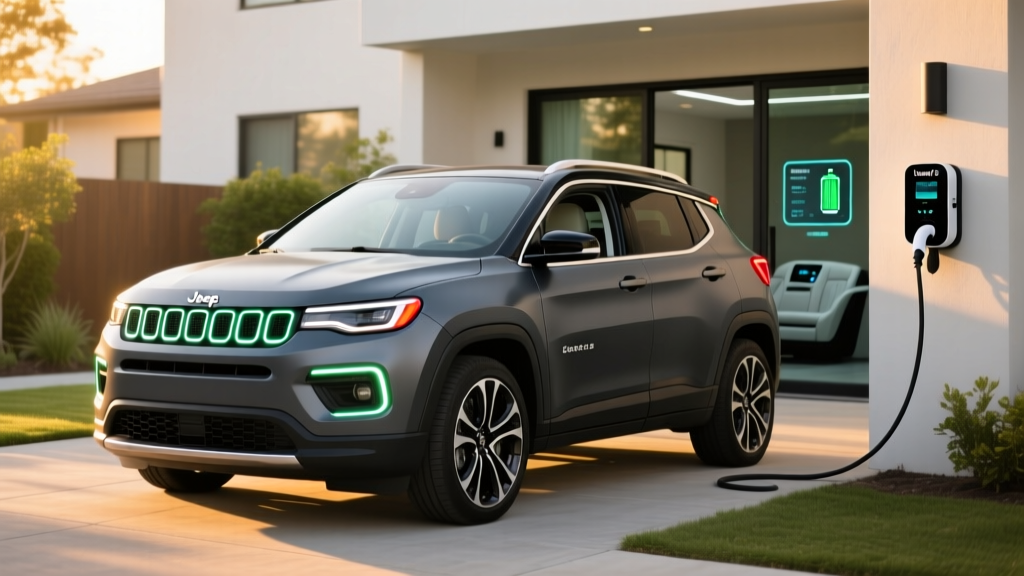
Quick Answer: As of early 2026, Jeep has not yet released a fully electric Jeep Compass in the United States. Stellantis has confirmed that an all-electric Compass is in development for global markets, built on the STLA Medium platform, but U.S. availability, EPA range, and pricing remain unannounced. If you're searching for an electric Jeep Compass today, the closest electrified Jeep options are the Wrangler 4xe and Grand Cherokee 4xe plug-in hybrids (PHEVs). This guide covers what we know about the upcoming EV, compares it against current alternatives, and provides a decision framework so you're ready when it launches.
What We Know About the Electric Jeep Compass So Far
Stellantis has been vocal about electrifying its Jeep lineup under the "Dare Forward 2030" strategy. The next-generation Jeep Compass, expected to ride on the STLA Medium platform, is slated to offer both battery-electric and internal-combustion variants depending on the market. In Europe, a fully electric Compass has been previewed through concept vehicles, with production targeted for the mid-2020s timeframe.
For the U.S. market, however, Jeep has prioritized larger vehicles first. The Jeep Recon (an all-electric off-roader on STLA Large) and the Wagoneer S (STLA Large, launching 2024-2025) have taken the EV spotlight. The electric Compass for North America remains in the announced/expected category — not yet available for purchase.
Preliminary specs (global, unconfirmed for U.S.):
- Platform: STLA Medium (shared with Peugeot e-3008, upcoming Dodge Charger variants)
- Battery options: ~73 kWh and ~98 kWh usable (NMC chemistry expected)
- Estimated WLTP range: Up to ~435 miles (98 kWh pack) — expect ~15-20% less under EPA testing
- DC fast charging: Up to ~160 kW peak (preliminary)
- Drivetrain: FWD and AWD configurations expected
These figures are based on STLA Medium vehicles already revealed in Europe. U.S.-spec models typically receive different tuning, battery sourcing, and EPA certification, so final numbers will differ.
Current Electrified Jeep Alternatives: 4xe PHEVs
If you need an electrified Jeep today, the plug-in hybrid (PHEV) 4xe models are your options. Here's how they stack up:
| Spec | Wrangler 4xe (2025) | Grand Cherokee 4xe (2025) | Gas Compass (2025) |
|---|---|---|---|
| Powertrain | 2.0L turbo PHEV | 2.0L turbo PHEV | 2.0L turbo I4 |
| Combined HP | 375 hp | 375 hp | 200 hp |
| Electric-only range | ~22 mi (EPA) | ~25 mi (EPA) | N/A |
| Battery (usable) | ~15.4 kWh (NMC) | ~15.4 kWh (NMC) | N/A |
| EPA MPGe (elec+gas) | 49 MPGe | 56 MPGe | N/A |
| Gas-only MPG (combined) | ~20 MPG | ~23 MPG | ~27 MPG |
| Level 2 charge time (0-100%) | ~2.5 hrs (7.2 kW) | ~2.5 hrs (7.2 kW) | N/A |
| 0-60 mph | ~6.0 sec | ~6.3 sec | ~7.8 sec |
| Starting MSRP | ~$51,795 | ~$60,495 | ~$33,595 |
| §30D tax credit eligible | No (MSRP/income caps vary) | No (exceeds SUV MSRP cap) | N/A |
| Battery warranty | 8 yr / 100k mi | 8 yr / 100k mi | N/A |
Sources: fueleconomy.gov, Jeep.com official specifications.
The 4xe PHEVs give you roughly 22-25 miles of pure electric driving — enough for short commutes — before the gas engine kicks in. They're heavier, more expensive, and far less efficient than a purpose-built BEV, but they eliminate range anxiety entirely and offer Jeep's trail-rated capability.
Projected Ownership Costs: Electric Compass vs. Gas Compass
While we don't have final U.S. pricing for an electric Jeep Compass, we can model expected costs using STLA Medium siblings as proxies (the Peugeot e-3008 and Alfa Romeo Junior start around €40,000-€48,000 in Europe, translating roughly to $42,000-$50,000 USD before incentives).
| Cost Category (5-Year Estimate) | Electric Compass (Projected BEV) | Gas Compass (2025 AWD) |
|---|---|---|
| Purchase price (MSRP est.) | $42,000-$48,000 | $33,595-$38,000 |
| Federal tax credit (§30D, if eligible) | Up to -$7,500* | $0 |
| Effective purchase price | $34,500-$40,500 | $33,595-$38,000 |
| Fuel/energy (15,000 mi/yr × 5 yr) | $3,000-$4,500 (home charging) | $8,500-$10,000 |
| Maintenance (5 yr) | $1,500-$2,000 | $3,000-$4,000 |
| Insurance (avg. 5 yr) | $7,500-$9,000 | $6,000-$7,500 |
| Estimated 5-year total cost | $46,500-$56,000 | $51,095-$59,500 |
*The IRS §30D clean vehicle credit has strict requirements: buyer AGI caps ($150k single / $300k joint), vehicle MSRP cap ($80,000 for SUVs), and battery critical-mineral/component sourcing rules that change annually. Eligibility is NOT guaranteed — verify on IRS.gov and with a tax professional before purchasing.
The EV's fuel and maintenance savings are significant — roughly $5,000-$7,500 over five years — but higher insurance premiums (typically 15-25% more for EVs) and a higher sticker price narrow the gap. If you qualify for the full $7,500 credit and charge primarily at home, the EV wins on total cost. If you don't qualify and rely on expensive public DC fast charging, the gas Compass may break even or cost less.
Real-World Charging and Range Considerations
Based on the STLA Medium platform's ~73 kWh and ~98 kWh battery options, here's what U.S. buyers should realistically expect:
Projected EPA range: ~250 miles (73 kWh pack) / ~330 miles (98 kWh pack)
Real-world highway (70-80 mph): Expect ~210-230 mi / ~275-300 mi
Cold weather (below 32°F): Reduce by 20-35% depending on cabin heating — potentially as low as ~165 mi for the smaller pack
Charging speed expectations:
| Charging Level | Power (kW) | Speed (miles of range per hour) | Use Case |
|---|---|---|---|
| Level 1 (120V outlet) | ~1.4 kW | ~4-5 mi/hr | Emergency / overnight trickle |
| Level 2 (240V home) | ~7.7-11.5 kW | ~25-38 mi/hr | Daily home charging (full overnight) |
| DC Fast Charge (projected) | Up to ~160 kW peak | ~10-80% in ~30 min | Road trips, public stations |
Here's a critical nuance many buyers miss: peak kW is not sustained kW. A 160 kW peak charge rate typically tapers significantly above 50-60% state of charge (SoC). The 10-80% time of ~30 minutes assumes optimal battery preconditioning and a capable charger. In cold weather without preconditioning, that same session could stretch to 45+ minutes.
Home charging access is the make-or-break factor. If you have a garage or dedicated parking spot where a Level 2 (240V) charger can be installed, daily EV ownership is seamless — you wake up with a "full tank" every morning. Installation costs typically run $800-$2,500 for a straightforward setup (charger unit + electrician + permit), but can exceed $4,000-$5,000 if your electrical panel needs an upgrade from 100A to 200A service.
If you live in an apartment, rely on street parking, or lack access to a dedicated circuit, you'll depend on public charging infrastructure. While the NACS/CCS charging networks are expanding rapidly (Tesla Superchargers now open to non-Tesla EVs via adapter, Electrify America, EVgo), public charging is more expensive ($0.30-$0.50/kWh vs. $0.12-$0.18/kWh at home) and less convenient.
Common Misconceptions About Electric Jeeps
| Myth | Fact |
|---|---|
| "An electric Jeep can't off-road." | Electric motors deliver instant torque at zero RPM — ideal for rock crawling. The Jeep Recon EV is designed as trail-rated. The Compass, however, is a crossover, not a hardcore off-roader regardless of powertrain. |
| "EV batteries need replacing every few years." | Modern NMC and LFP batteries are warrantied for 8 years / 100,000 miles at 70% capacity retention minimum. Data from fleet studies shows average degradation of ~10-15% over 8 years under normal use. Full replacement ($8,000-$15,000+) is rare and typically only needed after 15+ years or extreme abuse. |
| "I'll save $7,500 no matter what." | The §30D credit has AGI income caps, MSRP caps, and battery-sourcing requirements that change yearly. Many EVs lose partial or full credit eligibility as sourcing rules tighten. Always verify on IRS.gov before committing. |
| "EPA range is what I'll actually get." | EPA range is a laboratory estimate. Highway driving at 75+ mph, cold weather, hilly terrain, and aggressive acceleration can each reduce range 15-35%. Plan trips using 70-80% of the EPA figure for safety. |
| "Public charging is just as easy as gas stations." | DC fast charging takes 25-45 minutes (vs. 5 minutes for gas), chargers can be out of service, and rural charging deserts still exist. For road trips, route planning with apps like A Better Routeplanner is essential. |
Decision Framework: Should You Wait or Buy Now?
Choose to WAIT for the electric Jeep Compass if:
- You want a compact electric SUV with Jeep styling and don't need a vehicle immediately
- You have reliable home Level 2 charging access (garage, driveway, or workplace charger)
- Your daily commute is under 60 miles round-trip, making even the smaller battery pack sufficient
- You're willing to wait potentially until 2027 for U.S. availability and want to see final EPA certification, pricing, and §30D eligibility
- You prioritize lower running costs over a lower purchase price
Choose a CURRENT alternative if:
- Gas Compass AWD ($33,595+): You need an affordable compact crossover now, lack home charging, drive under 12,000 miles/year, or live in a region with limited public charging infrastructure
- Wrangler 4xe ($51,795+): You want Jeep's off-road capability with some electric commuting, can charge at home, and accept the higher price and lower electric-only range
- Grand Cherokee 4xe ($60,495+): You need a larger family SUV with electric-only school-run capability and don't mind the premium pricing
- Competitor BEV (Hyundai Ioniq 5, Tesla Model Y, Ford Mustang Mach-E): You want a proven electric SUV today with established charging networks, verified EPA range (260-330+ mi), and known tax-credit eligibility
What First-Time EV Buyers Must Know
If the electric Jeep Compass ends up on your shortlist when it launches, here's your pre-purchase checklist:
- Confirm home charging feasibility first. Get a quote from a licensed electrician for a Level 2 (240V, 40-48A) charger installation before you order the car. A NEMA 14-50 outlet or hardwired wall connector is standard. Budget $1,000-$2,500 for a straightforward install, or more if your panel needs upgrading.
- Verify §30D tax credit eligibility at the point of sale. Starting in 2024, the credit can be transferred to the dealer as a point-of-sale discount, reducing your out-of-pocket cost immediately. But the vehicle must meet battery-sourcing requirements, and your income must fall under IRS caps. Confirm the specific VIN's eligibility on the IRS clean vehicle portal.
- Understand kW vs. kWh. Kilowatts (kW) measure power — how fast you can charge. Kilowatt-hours (kWh) measure energy — how much the battery holds. A 73 kWh battery charged at 11.5 kW (Level 2) takes about 6.5 hours from empty to full. At 160 kW (DC fast charge), you'd add ~80% in roughly 30 minutes. Don't confuse the two.
- Budget for higher insurance. EV insurance premiums run 15-25% higher than comparable gas vehicles due to higher repair costs and battery replacement risk. Get quotes from your insurer before purchasing.
- Plan for winter if you live in a cold climate. Battery range drops 20-35% in freezing temperatures. A heat pump (if equipped) helps, but preconditioning the battery while plugged in is the single best thing you can do to preserve range and charging speed in winter.
- Download route-planning apps. A Better Routeplanner, PlugShare, and the automaker's own navigation will become essential tools for road trips. The STLA Medium platform is expected to support NACS (Tesla-style) connectors, which would unlock the Supercharger network — a major advantage if confirmed for the U.S. model.
Frequently Asked Questions
Is there an all-electric Jeep Compass available in the U.S. right now?
No. As of early 2026, Jeep does not sell a fully electric Compass in the United States. An EV version based on the STLA Medium platform is in development for global markets, but U.S. availability, pricing, and EPA-certified specifications have not been announced. The closest electrified Jeeps currently available are the Wrangler 4xe and Grand Cherokee 4xe plug-in hybrids.
How much will the electric Jeep Compass cost?
U.S. pricing has not been confirmed. Based on STLA Medium platform siblings in Europe and competitive positioning against the Hyundai Ioniq 5, Ford Mustang Mach-E, and Tesla Model Y, a reasonable estimate is $42,000-$52,000 depending on trim and battery size. Federal §30D tax credit eligibility (up to $7,500) could reduce effective cost, but eligibility depends on income caps, MSRP caps, and battery-sourcing rules that must be verified per IRS guidelines.
Will the electric Compass be good off-road?
The Compass has always been a crossover, not a hardcore off-roader like the Wrangler. An electric version would offer instant electric torque and potentially precise low-speed control, but ground clearance, approach/departure angles, and underbody protection will determine real capability. Expect "Trail Rated" to remain reserved for the Recon EV and Wrangler line.
What connector will the U.S. electric Jeep Compass use — NACS or CCS?
Stellantis has indicated that future North American EVs will adopt the NACS (Tesla-style) connector, aligning with the industry-wide shift. This would give the electric Compass access to Tesla Superchargers (the most reliable and widespread DC fast-charging network in the U.S.) without an adapter. Final connector specification for the U.S. Compass has not been officially confirmed.
Should I buy a gas Jeep Compass now or wait for the EV?
If you need a vehicle today, lack home charging access, or your budget is under $35,000, the gas Compass is a practical choice. If you can wait 12-24 months, have home charging, and want lower running costs, the EV could be worth the wait. In the meantime, consider test-driving competitor BEVs (Ioniq 5, Model Y, Mach-E) to understand whether electric ownership fits your lifestyle.
How does a PHEV like the Wrangler 4xe compare to a full EV?
A PHEV gives you ~22-25 miles of electric-only range for short commutes, then seamlessly switches to gas. You never experience range anxiety, but you carry the weight and complexity of two powertrains, and fuel economy once the battery depletes is mediocre (20-23 MPG combined). A full BEV has lower running costs, zero tailpipe emissions, fewer moving parts, and a smoother driving experience — but requires charging access and route planning for longer trips.