The Short Answer on Electric Infiniti
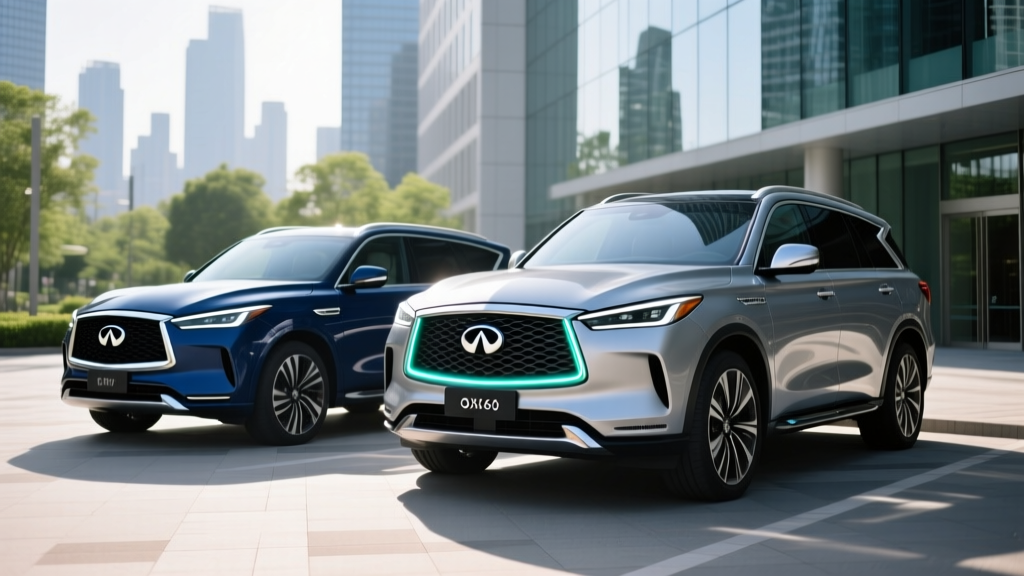
As of the 2026 model year, Infiniti does not sell a fully electric vehicle in the United States. The brand's electrified lineup consists of hybrid models — most notably the QX60 hybrid (and available QX80 mild-hybrid) — but no battery-electric (BEV) model has reached production. Infiniti's parent company Nissan has signaled future EV plans, including concepts previewing electric luxury crossovers, but no pricing, EPA range, or on-sale date has been confirmed. If you need a premium EV today from a Japanese luxury brand, you'll be looking at Lexus (RZ 450e), Acura (ZDX), or cross-shopping Genesis and BMW.
What Infiniti Actually Offers in 2026
Infiniti's current showroom is dominated by internal-combustion vehicles, but the brand has quietly expanded hybrid options. Here's what's available or announced for the 2026 model year:
| Model | Powertrain | Combined MPG | 0-60 mph | Starting MSRP |
|---|---|---|---|---|
| QX60 Hybrid (AWD) | 2.0L VC-Turbo + mild-hybrid assist | ~24 MPG combined | ~7.1 sec | ~$53,200 |
| QX80 (2026 refresh) | 3.5L twin-turbo V6 + 48V mild-hybrid | ~19 MPG combined | ~6.2 sec | ~$83,000 |
| Q50 / QX50 / QX55 | ICE only (VC-Turbo) | 23-28 MPG combined | 5.0-7.3 sec | $42,000-$52,000 |
None of these qualify as plug-in hybrids (PHEV) or full EVs. The 48V mild-hybrid system in the QX60 and QX80 provides minor efficiency gains — typically 1-2 MPG improvement and smoother stop/start — but offers no electric-only driving range and no plug-in capability. For context, a comparable plug-in hybrid like the Lexus TX 500h+ delivers roughly 33 miles of electric-only range and 35 MPG combined once the battery depletes.
Infiniti's EV Roadmap: What's Been Announced
Nissan's broader corporate strategy, called "The Arc," targets a significant EV push by 2030, with solid-state battery technology under development. Infiniti is expected to inherit EV versions of upcoming Nissan platforms, but the timeline has slipped multiple times:
- 2021-2023: Infiniti announced plans for a dedicated EV platform and previewed concepts (QX Inspiration, QX60 EV concepts)
- 2024-2025: Plans were scaled back amid slower-than-expected EV adoption; Nissan refocused on hybrids first
- 2026: No production EV confirmed. Industry reports suggest a possible reveal of an electric luxury crossover (potentially a QX60-sized EV on a shared Nissan/Infiniti platform) for the 2027-2028 timeframe
- Solid-state batteries: Nissan has a pilot production line running, targeting 2028-2029 for commercial deployment — potentially in an Infiniti model
If an Infiniti EV launches around 2028: Based on current industry trajectories and Nissan's stated battery targets, expect 280-350 miles EPA range, 150-250 kW DC fast charging capability, and a starting MSRP likely in the $55,000-$70,000 range for a luxury crossover. These are preliminary estimates — nothing is confirmed.
Cost Comparison: Infiniti Hybrid vs. Competing EVs
Since there's no electric Infiniti to price directly, here's how the current QX60 Hybrid stacks up against electric and plug-in-hybrid alternatives in the luxury midsize crossover segment. This comparison uses a 5-year/75,000-mile ownership window.
| Cost Factor | Infiniti QX60 Hybrid AWD | Lexus TX 500h+ PHEV | BMW iX xDrive50 (EV) |
|---|---|---|---|
| Base MSRP | $53,200 | $75,050 | $87,250 |
| Federal Tax Credit (§30D) | $0 (not a BEV/PHEV with sufficient battery) | $0-$7,500 (battery sourcing dependent) | $0-$7,500 (MSRP/income caps apply) |
| 5-Year Fuel/Energy Cost | ~$9,400 (gas at $3.50/gal, 24 MPG) | ~$5,800 (mix of electricity + gas) | ~$4,200 (electricity at $0.16/kWh) |
| 5-Year Maintenance (est.) | ~$3,200 | ~$2,800 | ~$2,100 |
| 5-Year Insurance (avg.) | ~$10,500 | ~$11,200 | ~$13,500 |
| Estimated 5-Year Depreciation | ~$22,000 | ~$28,000 | ~$35,000 |
| 5-Year Total Cost of Ownership | ~$98,300 | ~$94,850 | ~$110,050 |
Sources: fueleconomy.gov for MPG/MPGe data; IRS §30D guidelines for tax credit eligibility. Insurance and depreciation are estimates based on industry averages for the segment.
The QX60 Hybrid wins on upfront price and depreciation, but the Lexus PHEV narrows the gap through lower fuel costs and potential tax credit eligibility. The BMW iX offers a true EV experience but commands a steep premium. For buyers specifically loyal to the Infiniti brand, the hybrid saves roughly $1,200 over five years compared to the non-hybrid QX60 — a modest gain that may not justify any price premium on the hybrid trim.
EV vs. Hybrid vs. Gas: Which Infiniti Buyer Are You?
Without a full EV in the lineup, Infiniti shoppers face a narrower decision tree. Here's a practical framework:
Choose the Infiniti QX60 Hybrid if:
- You want a three-row luxury crossover and brand loyalty matters
- You lack reliable home charging access (apartment, street parking, no garage panel capacity)
- Your annual mileage is under 12,000 miles (fuel savings from electrification shrink at low mileage)
- You want to avoid range anxiety on frequent long road trips through areas with sparse DC fast charging
- Your budget is firm around $50,000-$60,000
Choose a competing EV (BMW iX, Genesis Electrified GV70, Mercedes EQB) if:
- You have Level 2 home charging (240V, 32-48A circuit) and drive under 250 miles daily
- You want the lowest per-mile energy cost (~$0.04-$0.06/mile vs. ~$0.14-$0.18/mile for gas)
- You qualify for the full $7,500 federal tax credit (income under $150K single / $300K joint; vehicle MSRP under $80K for SUVs)
- You value instant torque, one-pedal driving, and near-silent operation
- You're willing to accept higher upfront cost for lower running costs and zero tailpipe emissions
Choose a competing PHEV (Lexus TX 500h+, Volvo XC90 Recharge) if:
- You want electric-only commuting (25-35 miles) but gas flexibility for road trips
- You can charge at home overnight but also take 400+ mile trips monthly
- You want to hedge against charging-infrastructure gaps in your region
Common Misconceptions About Infiniti and EVs
| Myth | Fact |
|---|---|
| "Infiniti has an electric SUV you can buy now." | False. As of 2026, no Infiniti BEV or PHEV is on sale in the US. The QX60 and QX80 use mild-hybrid systems that cannot plug in and offer no electric-only range. |
| "The Infiniti mild-hybrid qualifies for the $7,500 EV tax credit." | False. The IRS §30D credit requires a minimum 7 kWh battery capacity with plug-in capability. Mild-hybrid 48V systems (typically under 1 kWh, no plug) do not qualify. |
| "Nissan Leaf technology will power the next Infiniti EV." | Unlikely. The Leaf uses an aging 40/62 kWh battery platform with CHAdeMO charging. Future Infiniti EVs are expected to use Nissan's next-gen platform with NACS (Tesla-style) charging and higher energy-density batteries. |
| "I should wait for an electric Infiniti instead of buying now." | Risky strategy. No timeline is confirmed. If you need a vehicle in the next 12-18 months, current EVs from BMW, Genesis, Lexus, and Cadillac are available today with proven range and charging networks. |
Real-World Ownership Considerations
Whether you choose an Infiniti hybrid today or plan to switch to an EV later, these factors shape the ownership experience:
Home Charging Access
The single biggest determinant of EV satisfaction is reliable home charging. A Level 2 home charger (240V, 40A) adds roughly 25-30 miles of range per hour and costs $500-$2,500 to install depending on your electrical panel. If your home has a 200A panel with spare capacity, installation is straightforward. Older homes with 100A panels may need a $2,000-$5,000 panel upgrade — a cost that doesn't apply to hybrids.
Climate and Range
If you live in cold climates (regularly below 32°F), expect 20-35% range loss in winter for any future EV. A vehicle rated at 300 miles EPA may deliver only 200-240 real-world miles in January. Hybrids like the QX60 are less affected — MPG drops 5-10% in cold weather, not 30%.
Driving Patterns
EVs shine in stop-and-go city driving (regenerative braking recaptures energy) and suffer on sustained 75+ mph highway runs. If 80% of your driving is highway commuting at 70-80 mph, your real-world range will fall 15-25% below the EPA sticker. Hybrids maintain more consistent efficiency across driving conditions.
Tax Credit Realities
The federal §30D tax credit has strict 2026 requirements:
- Buyer AGI must be under $150,000 (single) or $300,000 (married filing jointly)
- SUV MSRP must be under $80,000; sedans under $55,000
- Battery components and critical minerals must meet North American sourcing thresholds (increasingly strict each year)
- Credit can be transferred to the dealer as a point-of-sale discount
Many luxury EVs partially or fully lose credit eligibility due to battery-sourcing rules. Always verify current eligibility on fueleconomy.gov before purchasing.
Frequently Asked Questions
Does Infiniti make any electric car in 2026?
No. Infiniti's 2026 US lineup includes only mild-hybrid and conventional gasoline vehicles. The brand has announced future EV intentions but has not confirmed a production model, release date, or pricing.
Will the Infiniti QX60 ever become a full EV or plug-in hybrid?
Industry reports suggest an electrified QX60 successor is in development, potentially arriving around 2028. Whether it will be a PHEV or full BEV has not been confirmed. Nissan's corporate strategy indicates both are under evaluation.
Should I buy a Nissan Ariya instead of waiting for an electric Infiniti?
The Nissan Ariya is Infiniti's corporate cousin and offers up to 304 miles EPA range, 130 kW DC fast charging, and a starting MSRP around $39,590. It qualifies for partial or full federal tax credit depending on trim and buyer eligibility. If you want a Nissan-platform EV today and don't need the Infiniti luxury badge, the Ariya is a practical alternative — though it lacks Infiniti's premium interior materials and dealer experience.
What luxury EV should I consider if I'm an Infiniti loyalist?
The closest competitors in spirit and segment are the Genesis Electrified GV70 (282 miles EPA, ~$66,000), BMW iX xDrive50 (324 miles EPA, ~$87,000), and Cadillac Lyriq (314 miles EPA, ~$58,000). The Genesis offers the closest match to Infiniti's value-oriented luxury positioning, while the Lyriq undercuts on price.
Does the Infiniti QX60 hybrid save money compared to the gas-only version?
The mild-hybrid QX60 saves approximately 1-2 MPG over the non-hybrid version, translating to roughly $200-$400 per year in fuel savings at 15,000 miles/year. If the hybrid trim carries a price premium over $2,000, the payback period extends beyond typical ownership. The hybrid's primary benefit is smoother acceleration and stop/start refinement, not dramatic fuel savings.