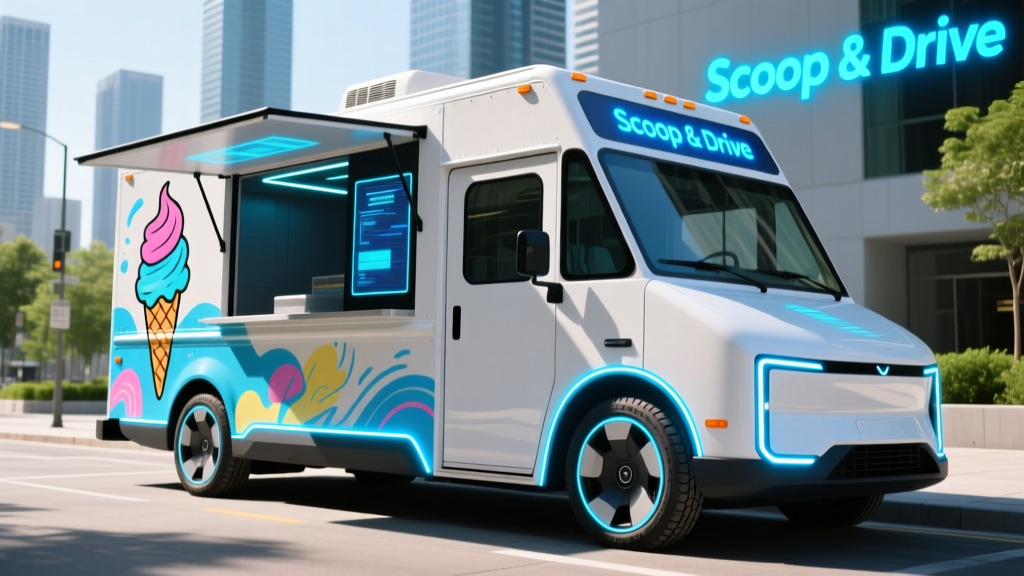
Quick Answer: An electric ice cream truck in 2026 typically costs between $85,000 and $140,000 upfront (depending on chassis and freezer configuration), offers 120–180 miles of real-world range on a full charge, and can save operators $8,000–$14,000 annually in fuel and maintenance compared to a diesel equivalent. Most models use 80–120 kWh LFP (lithium iron phosphate) battery packs, support DC fast charging at 50–80 kW (10–80% in roughly 60–90 minutes), and qualify for the IRS §30D or §45W commercial clean vehicle credit (up to $7,500 for vehicles under 14,000 lbs GVWR, or up to $40,000 for heavier classes). The business case works best for operators with predictable daily routes under 100 miles and access to overnight Level 2 depot charging.
Why Electric Ice Cream Trucks Are Gaining Traction
The traditional ice cream truck runs a diesel or gasoline engine that idles for hours to power compressor-based freezers. That idle time burns 0.5 to 1.0 gallons of fuel per hour, generates noise complaints in residential neighborhoods, and produces localized emissions — exactly where children gather. Electric ice cream trucks solve all three problems simultaneously: the traction battery powers both propulsion and the refrigeration system, idle noise drops to near zero, and tailpipe emissions disappear.
Several upfitting companies and commercial EV platforms now offer electric step vans and box trucks suitable for mobile food service. The most common base platforms in 2026 include the Ford E-Transit (for smaller operations) and medium-duty electric chassis from manufacturers like BrightDrop, Lightning eMotors, and SEA Electric. Each platform has different range, payload, and charging characteristics that directly affect whether the math works for your route.
Let's be direct: this is not a purchase for everyone. The upfront cost is substantially higher than a used diesel step van, charging infrastructure requires planning, and range limitations mean you need to understand your daily mileage with precision. But for operators who qualify, the total cost of ownership (TCO) over 5–7 years can be dramatically lower.
Specs That Matter: Range, Battery, and Charging
Unlike consumer EVs where 0–60 times and sleek interiors dominate the conversation, electric ice cream trucks live and die by three metrics: usable range under load, freezer energy draw, and depot charging time. Here is what the current landscape looks like:
| Platform | Battery (kWh) | Chemistry | EPA Est. Range | Real-World Range w/ Freezer | DC Fast Charge (kW) | 10–80% Time | Level 2 Rate | Base MSRP (Chassis Only) |
|---|---|---|---|---|---|---|---|---|
| Ford E-Transit (Low Roof, 130" WB) | 68 kWh usable | NMC | 126 mi | 75–95 mi | 115 kW peak | ~45 min | 11.3 kW | ~$48,000 |
| BrightDrop Zevo 400 | 110 kWh usable | NMC | 175 mi | 110–140 mi | 80 kW peak | ~75 min | 11.5 kW | ~$75,000 |
| Lightning eMotors (Class 4 Step Van) | 120 kWh usable | LFP | 150 mi | 100–130 mi | 60 kW peak | ~90 min | 19.2 kW | ~$95,000 |
| SEA Electric (E-450 Platform) | 140 kWh usable | LFP | 180 mi | 120–155 mi | 70 kW peak | ~85 min | 19.2 kW | ~$105,000 |
Real-World Range Warning: The EPA range figures above assume no auxiliary load. A commercial freezer system drawing 3–5 kW continuously can reduce effective range by 25–40%, especially in hot weather when compressors work hardest. Always plan routes against the "real-world range w/ freezer" column, not the EPA sticker. In summer heat above 90°F, expect an additional 10–15% range reduction from battery thermal management and increased freezer load.
The distinction between kW (power — how fast you charge) and kWh (energy — how much the battery holds) is critical here. A 68 kWh battery charged at 115 kW peak will not sustain that rate; the charge curve tapers significantly above 80% State of Charge (SoC) to protect battery health. Most operators charge overnight at Level 2 (11–19 kW), which fully replenishes the pack in 6–10 hours — perfectly suited to a daily route cycle.
EV vs Diesel: The Operating Cost Reality
The core financial question is whether the higher purchase price of an electric ice cream truck is offset by lower operating costs. Let's break this down with concrete numbers based on a typical urban/suburban route operator running 250 days per year:
| Cost Category | Diesel Step Van | Electric Ice Cream Truck | Annual Difference |
|---|---|---|---|
| Fuel / Energy (60 mi/day avg) | $7,500 (diesel @ $4.20/gal, 8 mpg incl. idle) | $2,200 (electricity @ $0.14/kWh, 2.0 kWh/mi incl. freezer) | +$5,300 savings (EV) |
| Freezer Fuel (idle hours) | $3,800 (0.7 gal/hr × 5 hr/day × 250 days) | $0 (included above in battery draw) | +$3,800 savings (EV) |
| Maintenance (oil, filters, DEF, brakes) | $3,200 | $800 (no oil/DEF, regen braking saves pads) | +$2,400 savings (EV) |
| Insurance | $2,800 | $3,400 (higher replacement cost) | −$600 (EV higher) |
| Depot Charging Install (amortized/5yr) | $0 | $1,600/yr ($8,000 install ÷ 5) | −$1,600 (EV higher) |
| Total Annual Operating Cost | $17,300 | $8,000 | $9,300 net savings (EV) |
At $9,300 in annual savings, the purchase price premium of roughly $40,000–$60,000 (electric vs used diesel) is recouped in approximately 4.3 to 6.5 years. For owner-operators who plan to run the truck for 7–10 years, the long-term economics are compelling. For seasonal operators in northern climates who run fewer than 150 days per year, the payback stretches considerably.
One frequently overlooked cost: diesel step vans lose significant resale value as emissions regulations tighten and cities implement clean-air zones. Electric commercial vehicles are expected to hold value better as municipalities mandate zero-emission commercial fleets in urban cores — a trend already underway in California, New York, and several European-influenced jurisdictions.
Tax Credits and Incentives: What You Actually Qualify For
The federal incentive landscape for commercial electric vehicles differs from consumer credits. Here is what applies in 2026:
- §30D Clean Vehicle Credit: Up to $7,500 for vehicles under 14,000 lbs GVWR used in business. Subject to MSRP caps, buyer income limits, and battery critical-mineral sourcing requirements. Check current rules at irs.gov.
- §45W Commercial Clean Vehicle Credit: Up to $7,500 for vehicles under 14,000 lbs, or up to $40,000 for vehicles over 14,000 lbs GVWR. This is the credit most medium-duty electric ice cream trucks qualify for. The vehicle must be used primarily in a trade or business. Battery sourcing requirements apply.
- State and Local Incentes: Many states offer additional rebates — California's HVIP program, for example, can provide $20,000–$60,000 for commercial zero-emission trucks. These vary widely by jurisdiction and funding availability. Consult your state energy office or a tax professional for current figures.
- Utility Charging Incentives: Some electric utilities offer commercial EV charging rebates covering 50–100% of Level 2 charger installation costs. Check with your local utility's commercial EV program.
The §45W credit is particularly valuable for heavier platforms. A Lightning eMotors or SEA Electric chassis with a GVWR above 14,000 lbs could qualify for up to $40,000 in federal credit — dramatically improving the business case. However, battery sourcing and critical-mineral requirements are strict and change annually. Always verify eligibility with your tax advisor before committing to a purchase.
Charging Infrastructure: Depot Setup and Real Costs
Most electric ice cream truck operators charge at a depot or home base overnight. Here is what a typical Level 2 commercial charging installation looks like:
| Component | Low Estimate | High Estimate | Notes |
|---|---|---|---|
| Commercial Level 2 Charger (19.2 kW, dual-port) | $2,500 | $5,500 | Networked units (ChargePoint, EVgo) cost more but enable fleet management |
| Electrical Panel Upgrade (200A service) | $1,500 | $4,000 | Required if existing panel lacks capacity; varies by local code |
| Wiring & Conduit (50-ft run) | $1,200 | $3,000 | Longer runs, trenching, or concrete cutting increase cost |
| Permits & Inspection | $300 | $800 | Varies by municipality |
| Electrician Labor | $2,000 | $4,500 | Licensed electrician required; commercial rates apply |
| Total | $7,500 | $17,800 | Average installations fall in the $8,000–$12,000 range |
For operators without depot access — those who park on-street or in shared lots — the equation is harder. Public DC fast charging at $0.30–$0.45/kWh erodes the fuel-cost advantage, and relying on public infrastructure introduces scheduling risk. If you cannot install a Level 2 charger at your base of operations, an electric ice cream truck may not be practical for your operation today.
One practical tip: preconditioning the battery (warming it to optimal temperature while still plugged in) before departing improves both range and regenerative braking efficiency, particularly in cold weather. Most commercial EV platforms support scheduled preconditioning through fleet management software.
Common Misconceptions About Electric Ice Cream Trucks
| Myth | Fact |
|---|---|
| "The freezer will drain the battery before the route is done." | A well-insulated commercial freezer draws 3–5 kW. Over a 6-hour route, that's 18–30 kWh — significant but accounted for in a 100+ kWh pack. Operators who right-size their battery to their route rarely run out. |
| "Electric trucks can't handle summer heat." | LFP batteries handle heat better than NMC and do not require as aggressive thermal management. However, freezer compressor load does increase in high ambient temperatures, reducing range. Plan for 10–15% summer range reduction. |
| "You'll spend all day charging." | Overnight Level 2 charging (8–10 hours) fully replenishes any platform listed above. DC fast charging at 50–80 kW can add 50–80 miles in 30 minutes during a midday break if needed. |
| "The battery will need replacing in 3 years." | Commercial LFP packs are rated for 3,000–5,000 full charge cycles before reaching 80% State of Health (SoH). At one cycle per day, that's 8–14 years of service. Most manufacturers warranty batteries for 8 years/100,000 miles with a 70% capacity retention threshold. |
| "It's the same as buying a Tesla and putting a freezer in it." | Consumer EVs are not designed for continuous high auxiliary loads. Commercial EV platforms integrate freezer power management into the vehicle's thermal and electrical systems. Retrofitting a consumer EV is not recommended. |
Decision Framework: Is an Electric Ice Cream Truck Right for You?
Choose an electric ice cream truck if:
- Your daily route is under 100 miles (including stops and idle time)
- You have access to overnight Level 2 charging at a depot or home base
- You operate 200+ days per year (maximizing fuel savings payback)
- You operate in a municipality with clean-air zone requirements or noise ordinances
- You plan to keep the vehicle 7+ years
- You qualify for §45W or state incentives that reduce the effective purchase price by $20,000+
Stick with diesel or consider a hybrid approach if:
- Your daily route exceeds 130 miles consistently
- You lack reliable overnight charging access
- You operate seasonally (fewer than 150 days/year)
- You need to tow or carry payloads exceeding the electric platform's rated capacity
- You plan to replace the vehicle within 3–4 years
First-Time Buyer Checklist
If you are transitioning from a diesel ice cream truck to electric for the first time, here is what to verify before signing a purchase order:
- Map your route mileage precisely — include all stops, idle time, and detour potential. Add 20% as a buffer. This is your minimum required real-world range.
- Get a site assessment from a licensed electrician for your depot charging location. Confirm panel capacity, wiring run distance, and local permit requirements before ordering a charger.
- Request a total-cost-of-ownership projection from the dealer or upfitter that includes your specific electricity rate, daily mileage, and operating days.
- Confirm tax credit eligibility with a tax professional before purchase — §45W sourcing requirements are specific and can change. Do not assume eligibility.
- Ask about battery warranty terms — specifically the capacity retention threshold (70%? 80%?) and what constitutes a warranty claim.
- Test the freezer integration — run the complete freezer system on battery power for a full simulated route day before accepting delivery.
- Verify the GVWR — this determines whether you qualify for the $7,500 or $40,000 federal credit tier, and affects CDL requirements in some states.
Frequently Asked Questions
How long does it take to charge an electric ice cream truck overnight?
On a standard Level 2 charger (11–19 kW), a full charge from 10% to 100% takes 6–10 hours depending on battery size. This is ideal for overnight depot charging between route days. A 19.2 kW charger replenishes roughly 50–65 miles of range per hour of charging.
Can the battery power the freezer all day without driving?
Yes. A 100 kWh battery can run a 4 kW commercial freezer for approximately 20+ hours continuously without any driving. Most operators use 18–30 kWh for freezer operation over a typical 6-hour selling route, leaving substantial battery for propulsion.
What happens to range in winter?
Expect 20–35% range reduction in freezing temperatures due to battery chemistry slowdown and cabin heating. LFP batteries are somewhat more resilient to cold than NMC, but both lose efficiency. Operators in northern climates should spec 20–30% more battery capacity than their summer routes require, or plan for midday opportunity charging.
Do electric ice cream trucks qualify for the $7,500 federal tax credit?
It depends on the vehicle's GVWR and your business structure. Vehicles under 14,000 lbs GVWR may qualify for the §30D credit (up to $7,500, subject to income and sourcing rules). Heavier vehicles qualify for §45W (up to $40,000). Both require the vehicle to be used primarily in a trade or business. Verify current eligibility at irs.gov and consult a tax professional.
What is the battery replacement cost if it degrades?
Commercial EV battery replacement costs range from $15,000 to $35,000 depending on pack size and chemistry. However, LFP packs rated at 3,000–5,000 cycles typically last 8–14 years in daily-use service before reaching 80% capacity. Most operators will sell or replace the vehicle before needing a battery swap. The federal warranty mandate requires 8 years/100,000 miles coverage on emission-related components, which courts and regulators have interpreted to include EV batteries.
Are there used electric ice cream trucks available?
The used market for purpose-built electric ice cream trucks is extremely limited as of 2026, since most platforms have only been in production for 3–5 years. Some operators purchase used electric step vans (e.g., retired delivery fleet vehicles) and contract with an upfitter to install freezer systems. This can reduce costs by 30–40% compared to new, but battery State of Health (SoH) assessment is critical — request a full battery diagnostic before purchasing any used commercial EV.