Quick Answer: Which Electric Hyundai Car Fits You?
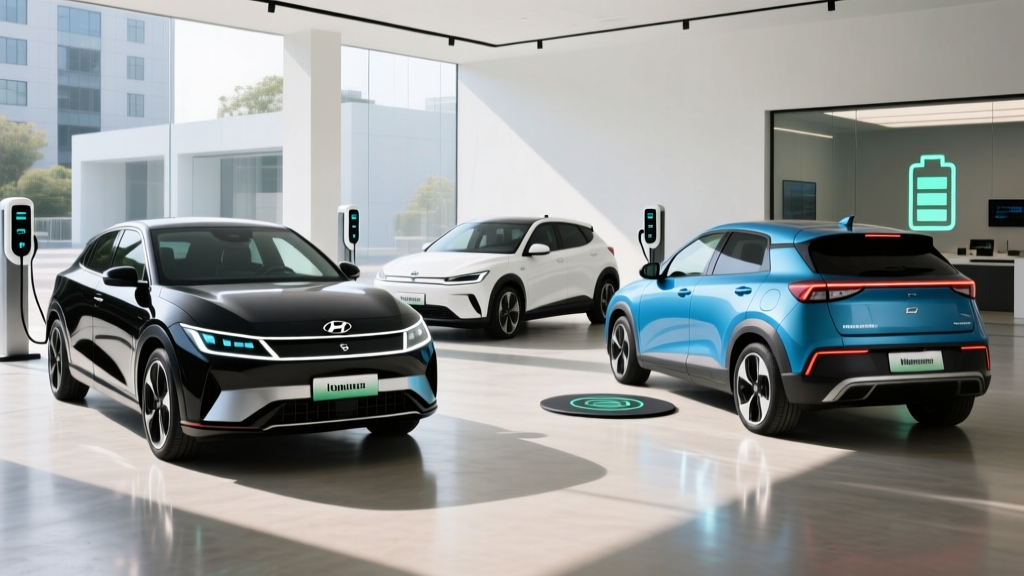
Hyundai's 2026 EV lineup spans three distinct models. The Kona Electric (starting ~$32,975) is the budget-friendly subcompact crossover with up to 261 miles of EPA range. The Ioniq 5 (~$42,600+) is the midsize crossover with 800V ultra-fast charging, up to 318 miles EPA, and available NACS port for Tesla Supercharger access. The Ioniq 6 (~$38,650+) is the aerodynamic sedan maximizing efficiency at up to 361 miles EPA. All three qualify for varying levels of the federal §30D tax credit depending on battery sourcing, your income, and MSRP caps — but eligibility shifts frequently, so verify on IRS.gov before purchasing.
The 2026 Hyundai EV Lineup at a Glance
Hyundai has committed heavily to electrification, and by the 2026 model year its battery-electric portfolio covers the most popular segments. Here's how the three core models stack up on the numbers that matter most:
| Spec | 2026 Kona Electric | 2026 Ioniq 5 | 2026 Ioniq 6 |
|---|---|---|---|
| Body Style | Subcompact Crossover | Midsize Crossover | Midsize Sedan |
| EPA Range (max config) | 261 mi | 318 mi (Long Range RWD) | 361 mi (SE Long Range RWD) |
| Battery (usable) | ~65 kWh (NMC) | ~84 kWh (NMC) | ~77.4 kWh (NMC) |
| Peak DC Fast Charge | ~100 kW | ~240 kW (800V) | ~240 kW (800V) |
| 10–80% DCFC Time | ~43 min | ~18 min | ~18 min |
| Level 2 Charge Rate | ~11 kW | ~11 kW | ~11 kW |
| 0–60 mph | ~6.8 sec | ~5.0 sec (AWD) | ~5.1 sec (AWD) |
| Horsepower | 201 hp | 320 hp (AWD) | 320 hp (AWD) |
| MPGe (combined, best) | ~116 MPGe | ~114 MPGe | ~140 MPGe |
| Starting MSRP | ~$32,975 | ~$42,600 | ~$38,650 |
| Battery/Powertrain Warranty | 10 yr / 100,000 mi | 10 yr / 100,000 mi | 10 yr / 100,000 mi |
Real-World Range Reality Check: EPA estimates assume mixed driving at moderate temperatures. On a 75-mph highway run in the Ioniq 5 AWD, expect roughly 260–280 miles from the 318-mile EPA sticker. In sub-freezing winter conditions, plan for 20–30% range reduction across all three models due to battery chemistry and cabin heating demands. The Ioniq 6's superior aerodynamics (0.21 Cd) give it a real-world highway advantage — owners regularly report 300+ miles at highway speeds in mild weather.
Electric Hyundai Cars vs. Gas and Hybrid Alternatives
The most common cross-shopping question: does a Hyundai EV actually save money versus a Tucson Hybrid or a gas-powered Kona? Let's run the numbers over a 5-year, 75,000-mile ownership period using national averages for electricity ($0.16/kWh) and gasoline ($3.40/gallon).
| Cost Category (5 yr / 75k mi) | Kona Electric SEL | Kona Gas SEL (AWD) | Tucson Hybrid SEL |
|---|---|---|---|
| Purchase Price (MSRP) | $34,475 | $28,650 | $33,450 |
| Est. Federal Tax Credit | Up to $3,750–$7,500* | $0 | $0 |
| Fuel / Electricity Cost | ~$2,300 | ~$7,600 | ~$4,900 |
| Maintenance (est.) | ~$1,200 | ~$3,200 | ~$2,800 |
| Insurance (avg.) | ~$8,500 | ~$7,200 | ~$7,600 |
| 5-Year Total (before credit) | ~$46,475 | ~$46,650 | ~$48,750 |
*Federal §30D credit eligibility depends on battery critical-mineral sourcing, your modified adjusted gross income, and MSRP caps. Verify current eligibility at IRS.gov and consult a tax professional. Point-of-sale transfer is available at participating dealers.
The data tells a clear story: the Kona Electric reaches cost parity with its gas sibling within about three years of average driving, even before factoring in the federal credit. The gap widens further if you charge primarily at home on off-peak electricity rates (often $0.08–$0.12/kWh). Where the EV falls behind is insurance — Hyundai EVs tend to carry 10–20% higher premiums due to battery replacement costs in collision claims.
Charging Speed: The Ioniq 5 and 6's Biggest Advantage
Not all EV charging architectures are equal. The Ioniq 5 and Ioniq 6 use Hyundai's E-GMP platform with 800-volt capability, which allows them to accept up to ~240 kW at compatible DC fast chargers. The Kona Electric uses a conventional 400V system topping out around 100 kW.
Here's what that means at a real-world charging stop:
| Charging Level | Kona Electric | Ioniq 5 / Ioniq 6 |
|---|---|---|
| Level 1 (120V / 12A) | ~1.4 kW → ~4 mi/hr | ~1.4 kW → ~4 mi/hr |
| Level 2 (240V / 48A) | ~11 kW → ~33 mi/hr | ~11 kW → ~36 mi/hr |
| DC Fast (peak) | ~100 kW → 10–80% in ~43 min | ~240 kW → 10–80% in ~18 min |
Charging curve reality: The 18-minute 10–80% figure for the Ioniq 5/6 assumes a 350 kW-capable charger (like Electrify America or newer EVgo stations) and battery preconditioning. The charge rate peaks near 240 kW up to roughly 55% state of charge, then tapers progressively — from 80–100% can take as long as the initial 10–80%. For road trips, plan stops around the 10–80% window to minimize time plugged in.
For 2026, Hyundai has been transitioning to the NACS (Tesla-style) charge port on new Ioniq models, granting native access to Tesla's Supercharger network — the largest and most reliable DC fast-charging network in the U.S. Kona Electric models may still ship with CCS; confirm port type with your dealer.
Real-World Ownership: What First-Time EV Buyers Should Know
Buying an electric Hyundai car involves considerations that don't exist with a gas vehicle. Here are the practical realities based on current ownership patterns:
Home Charging Is the Foundation
Over 80% of EV charging happens at home. A Level 2 home charger (240V, 40–48 amp circuit) will fully replenish any Hyundai EV overnight. Installation costs typically run $500–$2,000 if your electrical panel has capacity, but can climb to $3,000–$5,000+ if a panel upgrade (to 200A service) is needed. Always get a quote from a licensed electrician before committing to a purchase.
If you live in an apartment or lack dedicated parking with electrical access, public charging becomes your primary fueling method. That's feasible — but it's more expensive ($0.30–$0.55/kWh at DC fast chargers) and less convenient than gas. Be honest about your access before buying.
Cold Climate Considerations
All three Hyundai EVs use liquid-cooled NMC lithium-ion batteries with active thermal management and a heat pump (standard on Ioniq 5/6, available on Kona). The heat pump significantly reduces winter range loss compared to resistive heating. Still, in sustained sub-25°F weather, expect 20–30% range reduction. Preconditioning the battery while plugged in mitigates this and also improves DC fast-charge speeds in cold weather.
Maintenance Is Minimal — But Not Zero
EVs eliminate oil changes, spark plugs, timing belts, and exhaust system repairs. You'll still need tire rotations (EVs are heavier and wear tires faster due to instant torque), cabin air filter replacements, brake fluid checks, and windshield washer fluid. Hyundai's 10-year/100,000-mile battery and powertrain warranty is among the best in the industry, covering the battery if capacity drops below 70% of original.
Federal Tax Credit: What You Actually Qualify For
The §30D clean vehicle credit can reduce your effective purchase price by up to $7,500, but eligibility is a moving target. Here's the current checklist for new EV purchases:
- Income caps: Modified AGI must not exceed $150,000 (single), $225,000 (head of household), or $300,000 (joint filers)
- MSRP caps: Vans/SUVs/pickups ≤ $80,000; sedans/other ≤ $55,000 (all Hyundai EVs currently clear this)
- Battery sourcing: Increasing percentages of critical minerals and battery components must be sourced from the U.S. or free-trade-agreement countries — this requirement tightens annually
- Assembly: Vehicle must undergo final assembly in North America (all three Hyundai EVs sold in the U.S. qualify — the Ioniq 5 is built in Georgia)
- Point-of-sale transfer: You can transfer the credit to the dealer at purchase, reducing your out-of-pocket cost immediately rather than waiting for tax filing
Critical caveat: Battery sourcing requirements have disqualified some Hyundai trims in prior years, only for them to re-qualify after supply chain changes. Always verify the specific VIN's eligibility on fueleconomy.gov before signing paperwork.
Decision Framework: Which Electric Hyundai Car Should You Buy?
Choose the Kona Electric if: You want the lowest entry price, primarily drive in the city or suburbs, don't need ultra-fast road-trip charging, and value a compact footprint. It's the pragmatic first-EV choice for commuters covering under 40 miles daily with home charging.
Choose the Ioniq 5 if: You need crossover cargo space (53 cu ft with rear seats folded), want 800V fast charging for frequent road trips, value the available NACS port for Supercharger access, and have a household that needs a do-everything EV. The Long Range RWD at 318 miles EPA is the sweet spot for range and price.
Choose the Ioniq 6 if: You prioritize maximum range and efficiency above all else. Its 361-mile EPA rating (SE Long Range RWD) and 140 MPGe combined are the best in Hyundai's lineup. The trade-off is a lower roofline, less cargo room (~12.3 cu ft trunk), and a polarizing design. Best for long-distance commuters and sedan loyalists.
Skip all three and consider a Hyundai Tucson PHEV if: You lack reliable home charging access, regularly drive in remote areas with sparse charging infrastructure, or need to tow (the Tucson PHEV handles light towing; these EVs are not rated for it).
Common EV Misconceptions — Fact-Checked
| Myth | Fact |
|---|---|
| "EV batteries need replacing every few years" | NMC batteries in Hyundai EVs degrade roughly 1–2% per year under normal use. After 10 years, expect ~85–90% of original capacity. The 10-year/100,000-mile warranty covers drops below 70%. |
| "I'll never be able to take a road trip" | The Ioniq 5's 18-minute 10–80% DC fast charge means a 600-mile trip requires two ~20-minute stops — comparable to gas-station bathroom and food breaks. With NACS access, Supercharger coverage is extensive along major U.S. corridors. |
| "EVs are worse for the environment because of electricity generation" | Even on the U.S. average grid mix, an EV produces significantly fewer lifecycle emissions than a comparable gas car. As the grid decarbonizes, that advantage grows. Source: EPA Green Vehicles. |
| "Home charging will spike my electric bill" | Charging a Kona Electric from 0–100% at $0.13/kWh costs about $8.50 for 261 miles of range — equivalent to ~$0.033/mile. A gas Kona at 28 MPG combined and $3.40/gallon costs ~$0.121/mile. You'll save roughly $2,500+ in fuel over 5 years. |
| "EVs are slow and boring to drive" | The Ioniq 5 AWD hits 0–60 in ~5.0 seconds with 320 hp and instant torque. The Ioniq 5 N (performance variant) does it in ~3.4 seconds with up to 640 hp. EVs are inherently quick off the line. |
Frequently Asked Questions
Are electric Hyundai cars reliable?
Hyundai's EVs have demonstrated strong reliability in owner surveys and JD Power rankings. The E-GMP platform (Ioniq 5/6) has been in production since 2022 with minimal widespread issues. The 10-year/100,000-mile powertrain and battery warranty provides substantial long-term coverage. The main reported complaints center on 12V auxiliary battery drain (addressed via software updates) and occasional infotainment glitches — not drivetrain problems.
Can I charge a Hyundai EV at a Tesla Supercharger?
For 2026 model-year Ioniq 5 and Ioniq 6 vehicles equipped with the NACS charge port, yes — you can plug directly into Tesla Superchargers without an adapter. Older CCS-equipped models can use a Tesla-approved NACS-to-CCS adapter. Confirm your specific vehicle's port type with the dealer before purchase, as Hyundai has been mid-transition.
What happens if the battery degrades significantly?
Hyundai's battery warranty guarantees that the high-voltage battery will retain at least 70% of its original capacity for 10 years or 100,000 miles, whichever comes first. If it drops below that threshold, Hyundai will repair or replace the battery at no cost. Real-world data from high-mileage Hyundai EV owners suggests degradation is typically far less severe — most vehicles retain 88–92% capacity at 100,000 miles.
How much does it cost to install a home charger?
A quality Level 2 home charger (like a ChargePoint Home Flex or Emporia Level 2) costs $400–$700 for the unit. Professional installation by a licensed electrician typically adds $500–$1,500 if your panel has spare capacity and the run is short. A 200-amp panel upgrade, if needed, can add $1,500–$3,500. Some utilities and states offer rebates of $250–$1,000 for charger installation — check your local utility's EV programs.
Is the Ioniq 5 or Ioniq 6 better for road trips?
The Ioniq 6 wins on range (361 vs. 318 miles EPA), meaning fewer stops. But the Ioniq 5 wins on practicality — more cargo space, easier rear-seat access, and identical 18-minute fast-charging capability. For multi-day road trips with luggage and passengers, the Ioniq 5's crossover versatility usually edges out the sedan's range advantage. Both use 800V architecture, so charging speed is identical.