Quick Answer: What Is an Electric Hydrofoil Ferry?
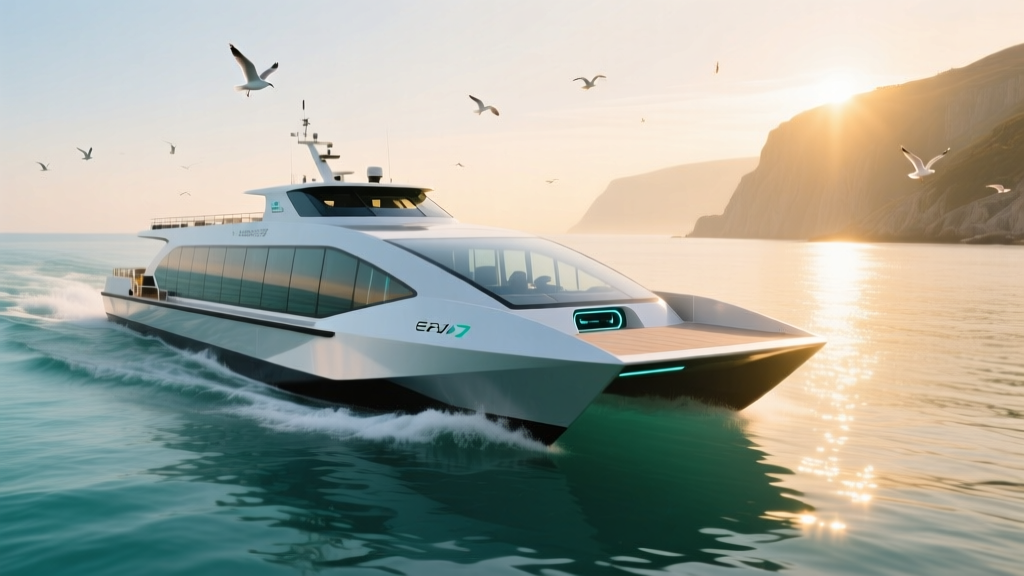
An electric hydrofoil ferry is a battery-electric passenger vessel that uses submerged hydrofoils to lift its hull above the water at speed, dramatically reducing drag and energy consumption. The most prominent production example is Sweden's Candela P-12, which carries 30 passengers at 25 knots (29 mph) with a 50-nautical-mile range on a ~254 kWh LFP battery pack. Compared to a conventional diesel ferry on the same route, an electric hydrofoil ferry cuts energy use by roughly 80% and eliminates wake wash, local exhaust emissions, and noise pollution. Purchase prices start near $3.0 million (USD equivalent) for a 30-passenger vessel, with per-passenger-mile operating costs that undercut diesel ferries on routes under 30 nautical miles.
Why Electric Hydrofoil Ferries Matter Now
The maritime sector has been slow to electrify because water resistance is punishing — pushing a displacement hull through water requires exponentially more energy as speed increases. Hydrofoils change that physics equation entirely. By lifting the hull clear of the surface, a foiling vessel reduces drag by up to 80%, making battery-electric propulsion viable at speeds and ranges that would require impractically large battery packs in a conventional hull.
Candela Technology, the Stockholm-based pioneer, launched its P-12 shuttle ferry after proving the concept with the C-8 leisure boat. The P-12 entered commercial service in Stockholm in 2024 and has since drawn interest from operators in cities including Berlin, New York, and Dubai. Competitors like Norway's Servosystem and Switzerland's Navier (now part of Stripe's co-founder Patrick Collison's portfolio) are developing rival platforms, though none have matched Candela's production volume as of early 2026.
For autoedgeview readers evaluating electrified transport broadly — whether personal EVs or fleet-scale solutions — the electric hydrofoil ferry represents the same core value proposition as a battery-electric car: higher upfront cost, dramatically lower operating cost, zero tailpipe (or tailstack) emissions, and a fundamentally different ride experience enabled by electric drivetrain characteristics.
Specs That Matter: Candela P-12 at a Glance
| Specification | Candela P-12 (2026 Production) |
|---|---|
| Passenger Capacity | 30 seated |
| Top Speed | 25 knots (29 mph) |
| Cruise Speed | 22 knots (25 mph) |
| Range (at cruise) | ~50 nautical miles (57 statute miles) |
| Battery Capacity | ~254 kWh (LFP chemistry) |
| Propulsion | Twin electric pod motors, ~240 kW combined peak |
| Foil System | Active flight-control, 3 carbon-fiber foils |
| Hull Material | Carbon-fiber composite |
| Length | 12 meters (39.4 ft) |
| Charging (DC fast) | CCS-compatible, ~150 kW peak, 20-80% in ~45 min |
| Wake | Negligible (hull flies above surface) |
| Base Price | ~€2.8M / ~$3.0M USD (varies by spec & delivery) |
| Warranty (battery) | 8 years / 50,000 operating hours (typical commercial terms) |
Real-world range caveat: The 50 NM figure assumes calm seas, moderate passenger load, and cruise speed. Headwinds, heavy chop, full passenger-plus-cargo loads, and cold-weather battery derating can reduce effective range by 15-25%. Operators planning routes should budget for ~38-42 NM usable range in mixed conditions — analogous to how EV road-trippers should plan around 70-80% of EPA range for highway driving.
Electric Hydrofoil Ferry vs. Diesel Ferry: The Numbers
The comparison that matters for fleet operators is cost per passenger-mile and total cost of ownership (TCO) over a typical 15-20 year vessel lifespan. Here's how a Candela P-12 stacks up against a comparable 30-passenger diesel catamaran on a 15 NM commuter route (round trip, 8 cycles per day):
| Metric | Electric Hydrofoil (P-12) | Diesel Catamaran (30-pax) |
|---|---|---|
| Energy/Fuel Cost Per Hour | ~$35-50 (electricity at $0.12/kWh) | ~$150-200 (diesel at $4.50/gal) |
| Energy Use Per Passenger-Mile | ~0.15 kWh | ~0.75 kWh equivalent |
| Annual Energy Cost (8 cycles/day, 260 days) | ~$65,000 | ~$275,000 |
| Maintenance (annual) | ~$25,000 (no engine oil, filters, exhaust) | ~$85,000 (diesel overhauls, transmissions) |
| Crew Required | 1 (captain + automated systems) | 2 (captain + engineer) |
| Wake Damage to Shoreline | Negligible | Significant (requires speed restrictions in some waterways) |
| Local Emissions | Zero | NOx, SOx, PM, CO2 |
| Noise (passenger cabin) | ~55 dB (conversation level) | ~75-80 dB |
| Purchase Price | ~$3.0M | ~$1.5-2.0M |
| Estimated 15-Year TCO | ~$5.2M | ~$7.8M |
The crossover point — where the electric hydrofoil's higher purchase price is offset by lower operating costs — typically arrives between years 4 and 6, depending on local electricity and diesel pricing, route length, and utilization rates. This mirrors the EV-vs-gas-car TCO crossover familiar to passenger vehicle buyers, just at a different scale and timeline.
Charging Infrastructure: What Dockside Power Looks Like
Docking an electric hydrofoil ferry is not as simple as pulling up to any pier. The P-12 requires a dedicated shore-power connection capable of delivering up to 150 kW DC via a CCS-type marine connector. Here's the practical breakdown:
Level-equivalent charging options:
| Charging Method | Power | Full Charge Time | Use Case |
|---|---|---|---|
| Shore AC (overnight) | 22 kW | ~12 hours | Depot charging between service days |
| DC Fast (turnaround) | 150 kW | ~1.5 hours (0-100%) | Between-route top-ups during service |
| DC Fast (partial) | 150 kW | ~45 min (20-80%) | Quick turnaround on high-frequency routes |
Operators typically install a dedicated 200-400A three-phase shore connection at the terminal dock. Electrical infrastructure upgrades can cost $150,000-$400,000 per dock depending on local grid capacity, transformer requirements, and cable runs — a non-trivial capital expense that parallels the panel-upgrade costs some EV owners face when installing home Level 2 chargers.
Charging-curve reality: Like all large battery packs, the P-12's charge rate tapers significantly above 80% state of charge. Operators optimizing turnaround times typically charge from 20-80% and swap vessels rather than waiting for a full charge — similar to how DC fast-charging road-trippers target the 10-80% window for maximum efficiency.
Real-World Ownership Considerations
Route Length and Utilization
The electric hydrofoil ferry excels on routes between 5 and 30 nautical miles with high passenger utilization. Below 5 NM, the energy savings over diesel shrink because the vessel spends a larger fraction of the trip accelerating to foiling speed. Above 35 NM, range constraints require either mid-route charging infrastructure (rare) or a second vessel for continuous service. The sweet spot is a 10-20 NM commuter route with 6-10 daily round trips — exactly the profile of urban waterway crossings in cities like Stockholm, Istanbul, and New York.
Climate and Sea State
The P-12's active flight-control system handles waves up to approximately 1.5 meters (5 feet), which covers most sheltered-waterway conditions. However, open-water routes with frequent swells above this threshold will force the vessel off-foil, dramatically increasing energy consumption and reducing range. Operators in regions with harsh winter conditions (Stockholm, Helsinki, Boston) should plan for 15-20% range reduction in cold months — the same battery-chemistry physics that reduce EV range in freezing temperatures apply here, compounded by denser cold water and winter sea states.
Home Charging Access — for the Operator
Unlike a personal EV, a commercial ferry doesn't go home at night. But the equivalent question — "Can I charge where I park?" — is equally critical. Dock-side charging requires the terminal operator (often a city transit authority) to invest in shore power. If your dock lacks three-phase electrical service, the installation timeline can stretch 12-18 months for utility upgrades, permitting, and marine-grade electrical work. This is the maritime analog of an apartment-dweller discovering they can't install a home charger.
Insurance and Classification
Marine insurance for electric hydrofoil vessels is still evolving. As of 2026, premiums are typically 10-20% higher than equivalent diesel vessels due to limited actuarial data on carbon-fiber hull repair costs, battery replacement scenarios, and foil-system failures. Classification societies (DNV, Lloyd's Register) have developed frameworks for battery-electric vessels, but underwriters are still building experience. Expect insurance to normalize as the fleet grows — similar to how EV insurance premiums have moderated as collision data has accumulated.
Common Misconceptions About Electric Hydrofoil Ferries
| Myth | Fact |
|---|---|
| "The batteries won't last in marine environments." | LFP batteries are sealed in IP67-rated enclosures. Candela warranties the pack for 8 years / 50,000 hours. Saltwater exposure risk is managed identically to electric ship propulsion systems already in service. |
| "Hydrofoils are fragile and break easily." | The carbon-fiber foils are engineered for continuous submerged operation and impact resistance. The P-12's flight-control system retracts foils for docking and shallow water. Foil replacements are scheduled maintenance, not emergency repairs. |
| "It's too slow to compete with diesel ferries." | At 25 knots, the P-12 matches or exceeds typical diesel commuter ferry speeds. On Stockholm's Slussen-Frihamnen route, it cut travel time from 55 minutes (diesel) to 25 minutes. |
| "The electricity comes from fossil fuels anyway." | Grid mix varies by region, but even on a fossil-heavy grid, the P-12's 80% energy reduction vs. diesel yields net CO2 savings. On grids with >50% renewables (Nordic countries, parts of the US), lifecycle emissions drop by 85-95%. |
| "It can't handle rough water." | The active foil system handles waves to ~1.5m. For open-ocean routes, this is a genuine limitation — but most urban ferry routes operate in sheltered waterways well within this envelope. |
Cost Breakdown: Purchase, Charging, Maintenance, Insurance
| Cost Category | Year 1 | Annual (Years 2-15) | 15-Year Total |
|---|---|---|---|
| Vessel Purchase | $3,000,000 | — | $3,000,000 |
| Dock Charging Infrastructure | $300,000 | $5,000 (maintenance) | $370,000 |
| Energy (Electricity) | $65,000 | $65,000 | $975,000 |
| Maintenance (hull, foils, systems) | $25,000 | $25,000 (rising to ~$40K by year 12) | $475,000 |
| Insurance | $55,000 | $50,000 (expected to decrease) | $775,000 |
| Crew (1 captain, benefits) | $95,000 | $95,000 (with inflation adjustments) | $1,520,000 |
| Battery Replacement (year 10 est.) | — | $350,000 (one-time) | $350,000 |
| Total | $3,540,000 | ~$240,000/yr | ~$7,465,000 |
For comparison, a diesel catamaran on the same route typically costs $1.75M to purchase but $425,000-$520,000 per year to operate, yielding a 15-year TCO of approximately $7.8-9.5M. The electric hydrofoil wins on total cost, but the operator must absorb higher upfront capital and infrastructure investment.
Decision Framework: Is an Electric Hydrofoil Ferry Right for Your Route?
Choose an electric hydrofoil ferry if:
- Your route is 5-30 nautical miles in sheltered or moderately exposed water
- You operate 6+ daily round trips with high passenger utilization (>60% capacity)
- Your dock can support (or be upgraded to) 150 kW shore power
- Local electricity costs are below $0.20/kWh (commercial rate)
- Wake restrictions or emissions regulations apply to your waterway
- Passenger experience (quiet, smooth, fast) is a competitive differentiator
- You can absorb higher upfront capital in exchange for lower operating costs after years 4-6
Stick with diesel (or wait) if:
- Your route exceeds 35 nautical miles one-way with no mid-route charging option
- You operate in open ocean with frequent swells above 1.5 meters
- Your dock has no viable path to three-phase high-capacity shore power
- Your utilization is low (<4 daily round trips) — the TCO advantage shrinks with fewer operating hours
- You need 50+ passenger capacity — current electric hydrofoil platforms max out around 30 passengers, though larger vessels are in development
What First-Time EV Buyers Should Know (Yes, Even for Ferries)
If you're a fleet operator or transit authority evaluating your first electric vessel, the same principles that apply to buying your first electric car apply here:
1. Range is real, but plan for the worst day, not the best. The 50 NM spec is your calm-summer-day number. Budget routes around 38-42 NM in mixed conditions and 30-35 NM in winter headwinds.
2. Charging infrastructure is half the project. The vessel is only as good as the dock that charges it. Engage your utility early — marine-grade electrical installations with permitting and utility coordination can take 12-18 months.
3. Battery degradation is manageable but real. LFP chemistry degrades more slowly than NMC, and Candela's thermal management system is designed for marine duty cycles. Expect ~85-90% state of health after 8 years of daily cycling. The battery warranty covers this, but plan for a mid-life replacement around year 10-12 at roughly $350,000.
4. The ride experience is the selling point. Passengers consistently rate the foiling experience — smooth, quiet, no wake rocking — as dramatically superior to diesel ferries. This isn't just an environmental choice; it's a service-quality upgrade that can drive ridership.
5. Training and crewing are simpler, not harder. Electric propulsion eliminates engine-room complexity. The P-12's flight-control system is automated (the captain monitors; the computer flies the vessel). Crew requirements drop from two to one on most routes.
Frequently Asked Questions
How long does it take to charge an electric hydrofoil ferry?
Using a 150 kW DC shore connection, the Candela P-12 charges from 20% to 80% in approximately 45 minutes. A full 0-100% charge takes about 1.5 hours. Overnight AC charging at 22 kW takes roughly 12 hours. Most operators use DC fast charging between route cycles and overnight AC for full replenishment.
Can an electric hydrofoil ferry operate in freezing conditions?
Yes, but with range penalties similar to electric cars. Battery performance decreases in cold weather (expect 15-20% range reduction below freezing), and icy conditions may require de-icing protocols for the foils. Candela's thermal management system actively heats the battery pack, but this draws from the pack's energy. Operators in Nordic climates successfully run these vessels year-round with adjusted schedules.
What happens if the battery fails at sea?
The P-12 has redundant battery modules — a single module failure does not disable the vessel. The system can limp to dock on remaining modules. Additionally, the vessel can settle onto its hull (non-foiling mode) and proceed at reduced speed. Marine classification societies require redundant propulsion and power systems for passenger vessels, and the P-12 meets DNV certification standards.
Are there government incentives for electric ferry purchases?
Unlike personal EVs covered by the IRS §30D tax credit, commercial electric vessels fall under different incentive programs. In the US, the EPA's Clean Ports Program and state-level clean-transportation grants (e.g., California's CARB funding, New York's Charge NY) can offset 20-40% of vessel and infrastructure costs. EU operators can access Horizon Europe and national maritime decarbonization funds. Specific eligibility varies by jurisdiction — consult your port authority and a grant specialist.
How does the Candela P-12 compare to Navier or other electric hydrofoil competitors?
As of early 2026, the Candela P-12 is the only electric hydrofoil ferry in series production with commercial deployments. Navier (US-based, backed by Stripe co-founder Patrick Collison) focuses on smaller autonomous-capable water taxis. Servosystem (Norway) is developing a competing platform but has not yet delivered production units. The P-12's 30-passenger capacity, 25-knot speed, and 50 NM range set the current benchmark. Larger platforms (50-100 passengers) are announced but not yet in service.
What is the battery replacement cost?
Based on current LFP pricing and Candela's modular pack design, a full battery replacement is estimated at $300,000-$400,000 (2026 USD). Most operators will not need this until year 10-12, as LFP chemistry typically retains 85-90% capacity after 3,000+ full charge cycles. The 8-year warranty covers premature degradation below the guaranteed threshold.
Sources: Candela Technology P-12 specifications, EPA Clean Ports Program, DNV classification standards for battery-electric vessels.