Quick Answer: An electric hydrofoil board (eFoil) uses a battery-powered propeller and a submerged hydrofoil wing to lift the board above the water. In 2026, mainstream eFoils range from roughly $4,000 for entry-level models to $15,000+ for premium carbon setups. Expect 45-90 minutes of ride time per charge from battery packs in the 1.5-3.0 kWh range, with full recharge times of 2-3 hours on standard AC power. They are not eligible for the federal §30D EV tax credit, which applies only to on-road motor vehicles.
If you've searched for an "electric hydrofoil board" and landed on an EV site, you're not alone. The eFoil market has exploded alongside the broader electrification wave, and the core technology — lithium-ion battery packs, brushless DC motors, and wireless throttle controllers — overlaps significantly with electric vehicles. At AutoEdgeView, we cover electrified transport of all kinds, and this guide applies the same data-driven rigor we bring to EV reviews to the eFoil category.
Below, we break down exactly what you need to know before spending thousands on an electric hydrofoil board: battery chemistry, real-world ride time, charging logistics, total cost of ownership, and how the top brands stack up.
What Is an Electric Hydrofoil Board?
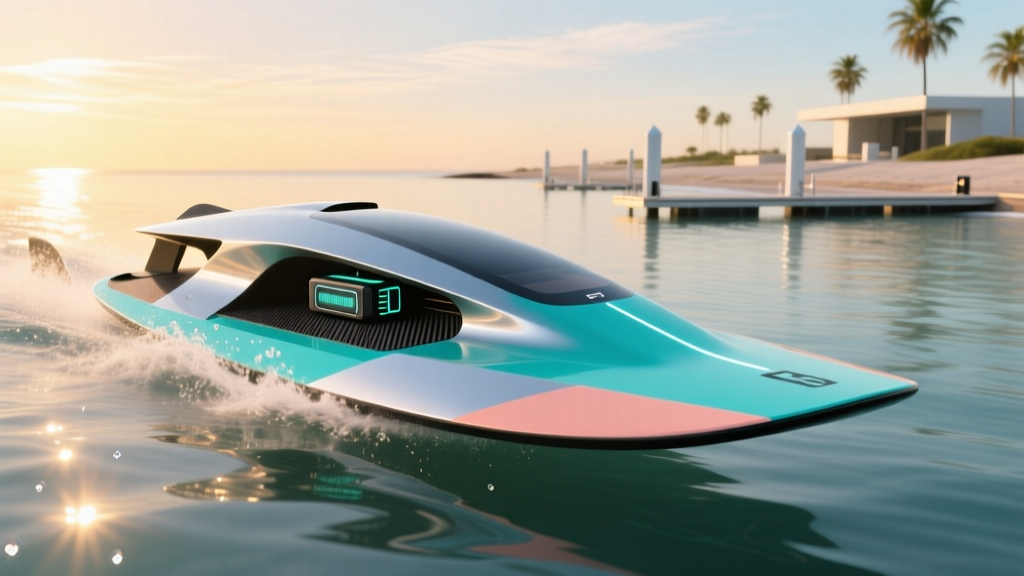
An electric hydrofoil board — commonly called an eFoil — is a surfboard-style platform with a mast and hydrofoil wing assembly mounted underneath. A battery-powered electric motor drives a propeller (or, in newer designs, an integrated jet drive), providing thrust. As speed increases, the hydrofoil wing generates lift, raising the board entirely out of the water and dramatically reducing drag.
The result is a smooth, nearly silent ride that feels closer to flying than surfing. Riders control speed via a handheld wireless trigger throttle, and most 2026 models pair with a smartphone app for battery monitoring, ride-mode customization, and GPS-based speed tracking.
Core Components
- Board: Typically 4'6" to 5'6" in length, constructed from fiberglass, carbon fiber, or composite foam. Carbon boards are lighter (15-20 lbs) but cost $2,000-$5,000 more than fiberglass equivalents (25-35 lbs).
- Mast and Fuselage: Aluminum or carbon mast (60-85 cm) connecting the board to the wing assembly. Carbon masts reduce weight and flex but add $1,500+.
- Wings: Front wing (surface area 1,250-2,000 cm²) and rear stabilizer. Larger wings provide more lift at lower speeds — better for beginners. Smaller, higher-aspect wings suit experienced riders seeking speed and carving performance.
- Motor: Brushless DC motor, typically rated between 3 kW and 6 kW peak output. Some 2026 models use direct-drive jet propulsion rather than exposed propellers for safety.
- Battery Pack: Removable lithium-ion pack, typically 1.5 kWh to 3.0 kWh usable capacity, using either NMC (nickel manganese cobalt) or LFP (lithium iron phosphate) cells.
- Hand Controller: Wireless Bluetooth throttle with haptic feedback, battery indicator, and emergency kill switch.
eFoil Battery Technology: kWh, Chemistry, and Real-World Ride Time
The battery is the single most expensive component of an electric hydrofoil board and the biggest determinant of your experience. Just as with EVs, understanding the distinction between kW (power — how fast energy is delivered) and kWh (energy — how much is stored) is essential.
| Brand/Model | Battery kWh (Usable) | Chemistry | Claimed Ride Time | Real-World Ride Time | Charge Time (0-100%) |
|---|---|---|---|---|---|
| Lift 5 | 2.2 kWh | NMC | ~90 min | 55-70 min | ~2.5 hours |
| Fliteboard Series 3 | 1.8 kWh (Flitecell Sport) / 3.0 kWh (Flitecell Explore) | NMC | 60-90 min (depends on cell) | 40-75 min | 2-3 hours |
| Hydroflyer X | 2.5 kWh | LFP | ~80 min | 50-65 min | ~3 hours |
| Awaken Foils Carbon | 2.0 kWh | NMC | ~75 min | 45-60 min | ~2 hours |
Real-world caveat: Claimed ride times assume moderate throttle use on flat water with a rider under 180 lbs. Aggressive carving, riding in chop or wind, or heavier riders (200+ lbs) will reduce ride time by 25-40%. Cold water (below 60°F) also reduces battery performance, similar to the cold-weather range loss seen in EVs — expect 10-20% less ride time in cold conditions.
NMC vs. LFP: Which Chemistry Should You Choose?
The same chemistry trade-offs that apply to EV batteries apply here:
| Factor | NMC (Nickel Manganese Cobalt) | LFP (Lithium Iron Phosphate) |
|---|---|---|
| Energy Density | Higher — lighter pack for same kWh | Lower — heavier pack for same kWh |
| Cycle Life | ~800-1,200 full cycles to 80% SoH | ~2,000-3,000+ full cycles to 80% SoH |
| Weight Impact | Better for performance boards | Acceptable for cruiser/recreational use |
| Safety | Higher thermal runaway risk (manage with BMS) | More thermally stable, lower fire risk |
| Cost | Higher per kWh | Lower per kWh |
For most recreational riders, LFP offers a compelling advantage: the longer cycle life means your $1,500-$2,500 battery pack will last significantly more seasons before capacity degradation forces a replacement. Performance-focused riders who need every ounce of weight savings may still prefer NMC.
Electric Hydrofoil Board Pricing: What You'll Actually Spend
eFoils are a significant purchase. Here's what the market looks like in 2026:
| Tier | Price Range | Typical Specs | Best For |
|---|---|---|---|
| Entry-Level | $4,000 - $6,500 | Fiberglass board, aluminum mast, 1.5-2.0 kWh NMC, 3-4 kW motor | First-time riders, casual use (10-20 sessions/year) |
| Mid-Range | $7,000 - $10,000 | Carbon/composite board, aluminum or carbon mast, 2.0-2.5 kWh, 4-5 kW motor | Regular riders (30-50 sessions/year), intermediate skill |
| Premium | $11,000 - $15,000+ | Full carbon board and mast, 2.5-3.0 kWh, 5-6 kW motor, jet drive option, multiple wing sets | Enthusiasts, daily riders, advanced carving/wave riding |
Additional Costs to Budget For
- Spare battery pack: $1,200 - $2,500 (essential for extending sessions beyond one pack's ride time)
- Extra wing sets: $400 - $900 per set (different sizes for different conditions)
- Safety gear: Helmet ($80-$200), impact vest ($100-$200), wetsuit ($150-$400)
- Transport: Board bag ($200-$500), vehicle rack adapter ($100-$300)
- Insurance: $200-$600/year through specialty marine/watercraft insurers (not covered under standard homeowners in most cases)
- Annual maintenance: $100-$300 (O-rings, propeller inspection, connector cleaning, firmware updates)
eFoil vs. Gas-Powered Alternatives: Is Electrification Worth It on the Water?
There are very few gas-powered hydrofoil boards on the market — the physics of hydrofoiling (low drag, need for smooth progressive thrust) favor electric motors. However, many prospective eFoil buyers are cross-shopping against other motorized watercraft. Here's how the costs compare:
| Cost Factor | Electric Hydrofoil Board (Mid-Range) | Gas Jet Ski (Mid-Range, e.g., Sea-Doo) |
|---|---|---|
| Purchase Price | $8,500 | $12,000 - $16,000 |
| Energy/Fuel per Session (1 hr) | $0.30 - $0.60 (electricity at $0.15/kWh) | $8 - $15 (gasoline at ~$3.50/gal, 4-8 gal/hr) |
| Annual Energy/Fuel (40 sessions) | $12 - $24 | $320 - $600 |
| Annual Maintenance | $100 - $300 | $500 - $1,200 (oil, filters, winterization, impeller) |
| Insurance | $200 - $600 | $300 - $800 |
| 5-Year Total (excl. purchase) | $1,560 - $4,620 | $5,600 - $13,000 |
| Registration | Not required in most states* | Required ($25-$100/year) |
| Noise Level | Near-silent | 75-90 dB |
| Emissions | Zero at point of use | Direct hydrocarbon + NOx emissions |
*Registration requirements vary by state. Some states classify eFoils as "vessels" requiring registration; others exempt them due to size. Check your state's boating authority before riding.
The operating cost advantage of an electric hydrofoil board is stark. At roughly $0.30-$0.60 per session in electricity (charging a 2.0 kWh pack from a standard 120V outlet), the eFoil costs 95% less per session to "fuel" than a gas-powered personal watercraft. Over five years, that adds up to hundreds or thousands in savings — even before factoring in the gas watercraft's substantially higher maintenance burden.
Charging and Ownership Logistics
Unlike EVs, which benefit from a growing public charging infrastructure, eFoil charging is almost entirely a home-base operation. Here's what that looks like in practice:
Charging Setup
Every major eFoil brand includes a dedicated AC charger (typically 300-600W) that plugs into a standard 120V household outlet. The battery pack is removable — you bring the pack inside to charge, not the entire board. This is a significant advantage over EVs for apartment dwellers: if you can carry a 15-25 lb battery pack inside, you can charge anywhere with a wall outlet.
Charge time math: A 2.0 kWh battery charging at 400W takes approximately 5 hours from 0-100%. In practice, most riders charge between sessions and rarely deplete fully. A 20-80% top-up typically takes 2-3 hours.
Real-World Ownership Considerations
- Transport: eFoil boards are 5-6 feet long and 30-50 lbs fully assembled. You'll need a vehicle with roof racks, a truck bed, or a dedicated trailer. The disassembled board + mast + battery fits in most SUV cargo areas.
- Storage: Store the battery at 40-60% state of charge if not riding for more than 2 weeks. Lithium-ion cells degrade faster when stored at 100% or 0% SoC — the same principle that applies to EV batteries.
- Water exposure: All 2026 eFoils are IP67+ rated for the motor/battery compartment, but connectors and charging ports must be kept dry and clean. Rinse with fresh water after every saltwater session.
- Climate: Cold water (below 55°F) reduces battery output and ride time. Cold air (below 40°F) makes the riding experience uncomfortable without a proper wetsuit. Most eFoil riders in northern climates get 4-6 months of usable season.
- Learning curve: Budget 3-5 sessions (with falls) before achieving consistent foiling. Most brands offer beginner wing configurations that make initial learning more forgiving.
Common Misconceptions About Electric Hydrofoil Boards
| Myth | Fact |
|---|---|
| "eFoils qualify for the $7,500 federal EV tax credit." | The IRS §30D credit applies only to qualified on-road motor vehicles with 4 wheels and a gross vehicle weight under 14,000 lbs. eFoils are classified as watercraft and do not qualify. (IRS §30D guidelines) |
| "You need a boat license to ride an eFoil." | Most states do not require a boating license for eFoils, though some require boater education cards. Regulations vary — check your state's wildlife or parks department. |
| "The battery will die in a year or two." | Modern NMC packs are rated for 800-1,200 cycles to 80% capacity retention; LFP packs exceed 2,000 cycles. At 50 sessions per year, an NMC pack should last 16+ seasons; LFP, 40+. |
| "eFoils are dangerous because of the propeller." | 2026 models feature propeller guards, automatic motor cut-off on falls (via leash or tilt sensor), and some use enclosed jet drives. Injury risk exists but is manageable with proper safety gear and training. |
| "You can only ride in the ocean." | eFoils work on lakes, rivers, reservoirs, and harbors. Flat, calm water is actually easier for beginners than ocean chop. Check local regulations — some reservoirs prohibit motorized watercraft. |
Decision Framework: Which eFoil Is Right for You?
Use this framework to narrow your choice:
Choose an entry-level eFoil ($4,000-$6,500) if:
- You're a first-time rider unsure about long-term commitment
- You plan to ride 10-20 sessions per year
- You prioritize value over performance
- You ride primarily on flat, calm water (lakes, protected harbors)
Choose a mid-range eFoil ($7,000-$10,000) if:
- You've tried eFoiling and know you want to commit
- You plan 30-50 sessions per year
- You want a balance of ride time, weight, and durability
- You want the option to upgrade wings and components over time
Choose a premium eFoil ($11,000-$15,000+) if:
- You're an experienced rider seeking high-performance carving or wave riding
- You ride 50+ sessions per year and need maximum durability
- You want full carbon construction for minimum weight
- You want jet-drive propulsion for safety (no exposed propeller)
Choose LFP battery chemistry if: You prioritize longevity and safety over weight savings, and you plan to keep the eFoil for 5+ years.
Choose NMC battery chemistry if: You need minimum weight for performance riding and are willing to accept a shorter overall pack lifespan.
Frequently Asked Questions
How fast can an electric hydrofoil board go?
Most 2026 eFoils have a top speed of 20-30 mph (17-26 knots). Entry-level models typically top out at 20-22 mph, while premium models with 5-6 kW motors can reach 28-32 mph. For context, most recreational foiling happens at 10-15 mph — higher speeds require advanced skill and significantly reduce battery ride time.
How much does it cost to charge an eFoil battery?
At the US average residential electricity rate of approximately $0.16/kWh (per EIA data), fully charging a 2.0 kWh battery costs about $0.32. Even with daily riding, annual electricity cost stays under $50.
Can I take an eFoil on an airplane?
This is the most restrictive factor in eFoil ownership. FAA regulations limit lithium-ion batteries on passenger aircraft to 100Wh (carry-on) or 160Wh (with airline approval). eFoil batteries at 1,500-3,000Wh far exceed these limits. You cannot fly with an eFoil battery. Ship it via ground freight (Hazmat-rated carrier required) or drive to your destination.
What happens when the battery dies on the water?
The board becomes a heavy, awkward surfboard. You can paddle it back to shore, but the weight (30-50 lbs) and lack of buoyancy compared to a standard surfboard make this tiring. Best practice: set a battery reserve alert at 15-20% on your app and head to shore immediately when it triggers. Most 2026 controllers provide progressive haptic and visual warnings.
Do eFoils require registration?
It depends on your state. Some states classify eFoils as motorized vessels requiring registration; others exempt them. For example, California and Florida have different thresholds for what constitutes a registrable vessel. Always verify with your state's boating authority before purchasing.
How long do eFoil batteries last before needing replacement?
With NMC chemistry and 50 sessions per year, expect 15-20+ years before the battery degrades to 80% of original capacity. LFP packs will likely outlast the board itself. Replacement packs cost $1,200-$2,500 depending on brand and capacity.
Is eFoiling good exercise?
Moderately so. While the motor provides propulsion, maintaining balance on the foil engages your core, legs, and stabilizer muscles continuously. A 60-minute session burns roughly 250-400 calories depending on conditions and rider effort. It's comparable to stand-up paddleboarding in exertion level.