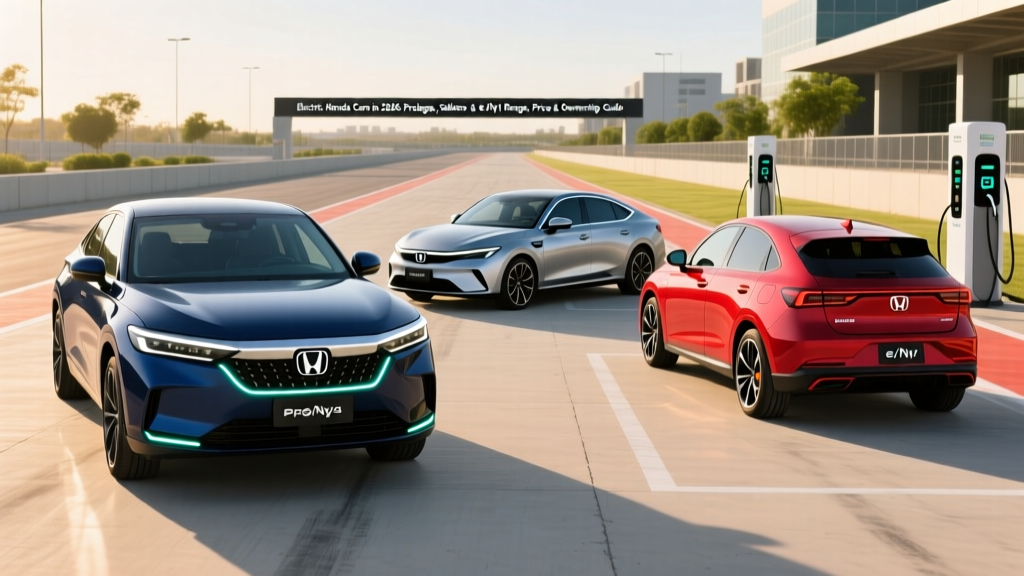
Honda's electric lineup in 2026 centers on three models: the Prologue SUV (EPA range up to 308 miles, starting ~$47,500), the upcoming Honda 0 Series Saloon sedan (announced, targeting 300+ miles, late 2026 production), and the e:Ny1 compact SUV (limited markets, ~256 miles WLTP). If you're searching for electric Honda cars you can actually buy today in the U.S., the Prologue is your only option — and it's a competent but not class-leading EV that makes sense primarily for buyers who value Honda's dealer network, Honda Sensing safety tech, and available AWD over maximum range or fastest charging.
2026 Honda Electric Vehicle Lineup at a Glance
Honda's electrification strategy has shifted dramatically since the Clarity EV's discontinuation. The current lineup leverages two platforms: the GM Ultium architecture (Prologue, developed jointly with GM) and Honda's own upcoming dedicated EV platform (the 0 Series). Here's how the numbers stack up:
| Spec | 2026 Prologue (FWD) | 2026 Prologue (AWD) | Honda 0 Saloon (Announced) | e:Ny1 (Non-U.S.) |
|---|---|---|---|---|
| EPA Range | 308 mi | 296 mi | 300+ mi (est.) | ~256 mi (WLTP) |
| Battery Capacity | 85 kWh usable (NMC) | 85 kWh usable (NMC) | ~80–90 kWh (est., thin-pack) | 68.8 kWh (NMC) |
| Peak DC Charge Rate | ~190 kW | ~190 kW | 350 kW (target) | ~100 kW |
| 10–80% DCFC Time | ~27 min | ~27 min | ~15 min (target) | ~40 min |
| Level 2 AC Rate | 11.5 kW (~34 mi/hr) | 11.5 kW (~34 mi/hr) | TBD | 11 kW |
| Horsepower | 288 hp | 288 hp (dual motor) | TBD | 201 hp |
| 0–60 mph | ~7.3 sec | ~6.5 sec | TBD | ~7.6 sec |
| Starting MSRP | ~$47,500 | ~$51,500 | TBD (late 2026) | N/A in U.S. |
| Battery Warranty | 8 yr / 100,000 mi | 8 yr / 100,000 mi | TBD | 8 yr / 100,000 mi |
Sources: EPA / fueleconomy.gov, Honda Prologue official specs.
Prologue vs. Gas and Hybrid: Real Cost Comparison
The most common question from buyers researching electric Honda cars is whether the Prologue actually saves money compared to a Honda CR-V Hybrid or a gas-powered CR-V. The answer depends entirely on your driving volume, electricity rate, and ownership horizon.
| Cost Factor (5-Year / 60,000 mi) | Prologue FWD ($47,500) | CR-V Hybrid AWD (~$36,500) | CR-V Gas AWD (~$34,000) |
|---|---|---|---|
| Purchase Price (MSRP) | $47,500 | $36,500 | $34,000 |
| Est. Federal Tax Credit (§30D) | Up to $7,500* | $0 | $0 |
| Effective Purchase Price | ~$40,000 | $36,500 | $34,000 |
| Fuel/Energy (60k mi) | ~$3,400 (at $0.14/kWh) | ~$5,800 (38 MPG, $3.50/gal) | ~$7,000 (30 MPG, $3.50/gal) |
| Maintenance (5 yr) | ~$1,200 | ~$2,800 | ~$3,200 |
| Insurance (est. avg) | ~$9,500 | ~$7,500 | ~$7,200 |
| 5-Year Total Cost | ~$54,100 | ~$52,600 | ~$51,400 |
*Federal §30D tax credit eligibility requires meeting income caps ($150K single / $300K joint MAGI), MSRP caps ($80K for SUVs), and battery critical-mineral/sourcing requirements. Rules are subject to change — verify current-year eligibility at IRS.gov. The credit can now be transferred to the dealer as a point-of-sale discount.
The Prologue narrows the gap with the CR-V Hybrid through lower energy and maintenance costs, but higher insurance premiums (typically 15–25% more for EVs) and a higher starting price keep total cost of ownership roughly comparable over five years. The Prologue pulls ahead meaningfully at the 8- to 10-year mark, where cumulative fuel savings and reduced maintenance compound.
Charging the Prologue: Home, Public, and the Curve Reality
Honda uses the NACS (Tesla-style) connector on the 2026 Prologue, giving it native access to the Tesla Supercharger network — a significant advantage for road-trip charging reliability. Here's what each charging level actually delivers:
| Level | Power | Miles Added per Hour | Use Case |
|---|---|---|---|
| Level 1 (120V outlet) | ~1.4 kW | ~3–4 mi/hr | Emergency/overnight trickle only |
| Level 2 (240V home) | 11.5 kW | ~34 mi/hr | Daily home charging — full charge in ~8 hr |
| DC Fast Charge | Peak 190 kW | ~180 mi in 15 min (peak) | Road trips; tapers significantly above 80% |
A critical ownership detail: the Prologue's charge curve peaks at ~190 kW only between roughly 10–35% State of Charge. From 35–60%, it sustains around 130–150 kW, and above 80% it drops to under 50 kW to protect the NMC cells. This means a 10–80% charge takes approximately 27 minutes at a 250+ kW-capable station, but an 80–100% top-off adds another 30–40 minutes. For road trips, plan stops around the 10–80% window.
Home charging installation for a Level 2 (240V/48A) charger typically costs $1,200–$3,500 including a hardwired wall connector, electrician labor, and permits — assuming your panel has capacity. Homes with older 100A panels may need a $2,000–$4,000 panel upgrade. Always get a quote from a licensed electrician before committing to a purchase.
Honda 0 Series Saloon: What We Know (and Don't)
The Honda 0 Series Saloon is Honda's first ground-up EV on its own dedicated platform — a thin, low-slung sedan targeting the Tesla Model 3 and Hyundai Ioniq 6 segment. Honda has confirmed:
- Production begins late 2026 (likely as a 2027 model-year vehicle)
- Target of 350 kW peak DC fast charging (10–80% in approximately 15 minutes)
- A "thin and light" battery pack design aimed at improving efficiency and interior space
- SAE Level 2+ driver assistance under the Honda Sensing 360+ suite — not autonomous driving; the driver must remain engaged at all times
Myths vs. Facts: Electric Honda Cars
Buyers researching Honda EVs encounter plenty of misinformation. Here's what the data actually shows:
| Myth | Fact |
|---|---|
| "Honda doesn't make real EVs" | The Prologue has a 308-mile EPA range, 190 kW DCFC, and NACS Supercharger access — it's a full-capability BEV. |
| "The battery will need replacing in 5 years" | Honda warranties the battery for 8 years/100,000 miles at 70%+ capacity retention. Industry data shows NMC packs typically lose 10–15% capacity over 8 years under normal use. |
| "You can't road-trip an EV" | With NACS connector and Supercharger access, the Prologue charges on the most reliable U.S. DC network. Plan 10–80% stops every ~220 highway miles. |
| "EVs cost more to own, period" | Upfront cost is higher, but energy and maintenance savings narrow the gap. At 15,000 mi/yr, the Prologue saves ~$1,200–$1,600/yr on fuel vs. a gas CR-V. |
| "Every Honda EV qualifies for $7,500 tax credit" | Credit eligibility depends on income caps, MSRP caps, and battery-sourcing rules that change annually. Verify at IRS.gov before purchasing. |
Who Should Buy a Honda EV — Decision Framework
Choose the Honda Prologue if:
- You want an AWD electric SUV with 290+ miles of range and Honda's dealer/service network
- You have access to Level 2 home charging (garage or driveway with 240V capability)
- You drive 10,000–15,000 miles/year in mixed city/highway conditions
- You value Supercharger network access via the NACS connector
- You qualify for the §30D federal tax credit (reducing effective price to ~$40K)
Choose a CR-V Hybrid instead if:
- You live in an apartment or lack reliable access to home or workplace charging
- You regularly drive in extreme cold (below 0°F) where range loss compounds
- Your budget is firmly under $40K and you need maximum cargo versatility today
- You tow more than 1,500 lbs (Prologue is not rated for heavy towing)
Wait for the Honda 0 Series Saloon if:
- You prefer a sedan over an SUV and want Honda's own next-gen EV platform
- 350 kW ultra-fast charging is a priority for your road-trip patterns
- You can comfortably wait until late 2026 or 2027 for availability
First-Time EV Buyer Checklist
If the Prologue is your first electric vehicle, these are the non-obvious ownership realities that spec sheets don't highlight:
- Verify your electrical panel. A 48A Level 2 charger requires a 60A dedicated circuit. If your home has a 100A panel with existing heavy loads (electric range, dryer, HVAC), you may need a panel upgrade — budget $2,000–$4,000.
- Preconditioning is not optional. Always use the HondaLink app to warm the battery 15–20 minutes before arriving at a DC fast charger. Skipping this can cut your peak charge rate by 30–40% in cool weather.
- Insurance will likely cost more. EV insurance premiums run 15–25% higher than equivalent gas vehicles due to battery replacement costs and specialized repair requirements. Get quotes before purchasing.
- Plan for charging deserts. If your regular routes include rural stretches, map Supercharger and Electrify America stations using A Better Routeplanner. The Prologue's ~250-mile real-world highway range means you'll want stations no more than 180 miles apart for comfort.
- Tires wear faster. EVs are heavier and deliver instant torque. Expect tire replacement at 25,000–35,000 miles rather than the 50,000+ miles typical on gas vehicles. Budget accordingly.
Frequently Asked Questions
Does Honda make a fully electric car I can buy right now?
Yes — the 2026 Honda Prologue is a fully electric mid-size SUV available at U.S. Honda dealers now. It offers 296–308 miles of EPA range depending on drivetrain. The Honda 0 Series Saloon is announced but not yet in production.
How much does it cost to charge a Honda Prologue at home?
At the U.S. average residential rate of ~$0.14/kWh, a full 85 kWh charge costs approximately $11.90 and delivers roughly 280–300 real-world miles. That works out to about $0.04 per mile — compared to $0.12–$0.14/mile for a gas CR-V at $3.50/gallon.
Does the Honda Prologue qualify for the $7,500 federal tax credit?
It may, but eligibility depends on your income (MAGI caps: $150K single / $300K joint), the vehicle's MSRP (under the $80K SUV cap), and current-year battery sourcing and critical-mineral requirements under IRS §30D rules. The credit can be applied as a point-of-sale discount at the dealer. Always verify at IRS.gov and consult a tax professional.
Is the Prologue built by Honda or GM?
The Prologue is manufactured by GM on the Ultium platform at the Spring Hill, Tennessee plant — the same architecture used by the Chevrolet Blazer EV and Cadillac Lyriq. Honda designed the exterior, interior, and tuning, but the battery, motors, and platform are GM-sourced. The upcoming 0 Series will be Honda's own ground-up design.
What's the real-world highway range of the Prologue?
In sustained 70–75 mph highway driving in moderate temperatures, expect approximately 250–270 miles from the FWD model. In winter conditions (below 32°F), that drops to roughly 200–230 miles. These figures assume no preconditioning; preheating the cabin and battery while plugged in can recover 10–15 miles of range.
Can I use Tesla Superchargers with the Honda Prologue?
Yes. The 2026 Prologue comes with a native NACS (North American Charging Standard) port, meaning it plugs directly into Tesla Superchargers without an adapter. This gives access to over 20,000 Supercharger stalls across the U.S.