How Does an Electric Heater Work in an EV? The Quick Answer
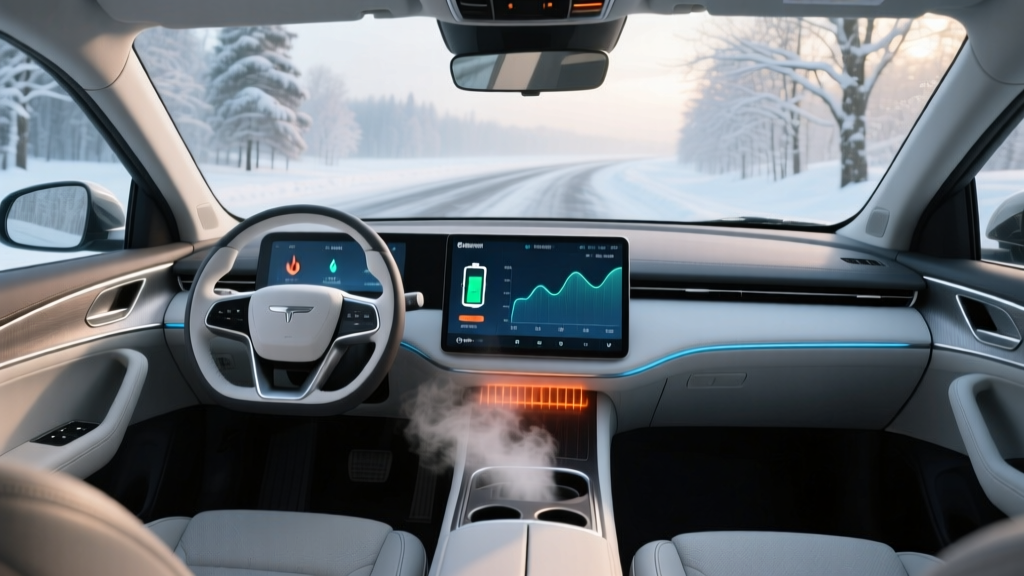
An electric heater in an EV works by passing electrical current through a resistive heating element — essentially a high-power version of a space heater or toaster coil. The element heats up as electrons encounter resistance, and a blower fan pushes cabin air across the hot element, delivering warm air through the vents. This system is called a Positive Temperature Coefficient (PTC) heater, and it draws directly from the vehicle's high-voltage traction battery (typically 60–100 kWh). Unlike a gas car that recycles "free" waste heat from the engine, an EV must generate all its cabin heat from stored battery energy — which is why running the heater can reduce your range by 10–30% in cold weather.
Many newer EVs supplement or replace PTC heaters with heat pump systems, which move ambient heat rather than generating it from scratch, cutting energy consumption roughly in half. We'll break down both systems, the real-world range cost, and what it means for your winter driving budget.
PTC Heaters vs. Heat Pumps: Two Ways EVs Make Heat
Understanding how an electric heater works starts with knowing there are two fundamentally different approaches used in modern EVs — and the difference has major implications for your winter range and electricity costs.
PTC Resistive Heaters: Simple but Power-Hungry
A PTC heater is a ceramic element whose electrical resistance increases as it gets hotter (that's the "positive temperature coefficient"). This self-regulating property prevents overheating without complex controls. When you crank the cabin heat, the EV's power electronics route high-voltage DC current from the traction battery through the PTC element. Typical power draw runs 3 to 6 kW — equivalent to running two or three household space heaters simultaneously.
On a freezing morning at 20°F, a PTC heater might pull a sustained 4–5 kW just to maintain a 70°F cabin. Over a 45-minute commute, that's roughly 3–4 kWh consumed solely for heating — energy that would otherwise go toward propulsion. In a 75 kWh battery, that's 4–5% of total capacity burned before you've even considered the extra rolling resistance and battery inefficiency that cold temperatures cause.
Heat Pumps: Moving Heat Instead of Making It
A heat pump works on the same refrigeration cycle as your home HVAC or an EV's air conditioning, but in reverse. Instead of generating heat through resistance, it uses a compressor and refrigerant loop to extract thermal energy from the outside air (yes, even at sub-freezing temperatures) and concentrate it inside the cabin. The key metric is the Coefficient of Performance (COP) — a heat pump typically achieves a COP of 2.0 to 4.0, meaning it delivers 2–4 kW of heat for every 1 kW of electrical energy consumed.
Compare that to a PTC heater, which has a COP of exactly 1.0 (1 kW of electricity produces 1 kW of heat). In practical terms, a heat pump might draw only 1.5–2.5 kW to keep the cabin warm at 30°F, versus 4–5 kW for a PTC system. That translates directly into preserved range.
| Metric | PTC Resistive Heater | Heat Pump System |
|---|---|---|
| Typical power draw at 30°F | 4–6 kW | 1.5–2.5 kW |
| Coefficient of Performance (COP) | 1.0 | 2.0–4.0 |
| Range impact (45-min commute, 20°F) | ~10–15 miles lost | ~4–7 miles lost |
| Effectiveness below 0°F | Full capacity maintained | COP drops; PTC backup often kicks in |
| Added vehicle cost | $0 (included) | ~$500–$1,200 option or standard on higher trims |
| Examples (2026 models) | Chevrolet Equinox EV (base), older Nissan Leaf | Tesla Model Y, Hyundai Ioniq 5, Kia EV6, Ford Mustang Mach-E (2024+) |
The trade-off: heat pumps lose efficiency as outdoor temperatures plunge. Below roughly -10°F to 0°F, there's less ambient heat to extract, the COP drops toward 1.0, and most systems engage a supplemental PTC element anyway. If you live in northern Minnesota or interior Alaska, a heat pump helps in the shoulder seasons but won't fully protect your range during deep freezes.
The Real-World Range Cost: How Much Winter Miles Do You Actually Lose?
EV range loss in cold weather isn't just about the heater. It's a combination of factors, and understanding each one helps you plan realistically.
Cold-Weather Range Loss Breakdown (Typical at 20°F)
- Cabin heating (PTC): 10–15% range reduction
- Cabin heating (heat pump): 5–8% range reduction
- Battery chemistry slowdown: Cold lithium-ion cells have higher internal resistance, reducing usable capacity by ~5–10% and limiting regenerative braking
- Increased rolling resistance: Cold tires and thicker lubricants add ~2–3% drag
- Denser cold air: Higher aerodynamic drag at highway speeds adds ~2–4%
Combined real-world impact: Expect 20–35% total range loss at 20°F with a PTC heater, or 15–25% loss with a heat pump — compared to the EPA sticker. An EV rated at 300 miles EPA might realistically deliver 195–240 miles in sustained 20°F driving.
Data from fueleconomy.gov and independent testing by organizations like AAA confirm these ranges. A study tracking multiple EV models found an average 30% range reduction at 20°F compared to 75°F conditions, with cabin heating being the single largest contributor.
For context, gas cars also lose efficiency in cold weather — the U.S. Department of Energy estimates a 10–12% fuel economy drop in short-trip winter driving (due to cold-engine enrichment, idling to warm up, and thicker fluids). But gas cars don't lose range proportionally because their tanks hold far more energy than needed, and waste engine heat is "free" for the cabin.
| Factor | EV (PTC Heater) | EV (Heat Pump) | Gas Car |
|---|---|---|---|
| Energy cost to heat cabin (per hour) | ~$0.60–$0.90 (at $0.15/kWh) | ~$0.23–$0.38 | ~$0.00 (waste heat) |
| Range/efficiency loss at 20°F | 20–35% | 15–25% | 10–15% |
| Preconditioning benefit | Major (can recover 10–15% range) | Moderate | Minimal |
| Fuel/energy cost per mile (winter) | ~$0.04–$0.06 | ~$0.03–$0.05 | ~$0.11–$0.15 |
Strategies to Minimize Winter Range Loss
If you're considering an EV in a cold climate, the heating system is only part of the equation. How you use it matters just as much.
Preconditioning: The Single Biggest Winter Trick
Preconditioning means warming the cabin and battery while the car is still plugged in at home. Most EVs let you schedule this through the companion app or infotainment system. The heater runs on grid power, not battery power, so you start your commute with a warm cabin, a warm battery (which improves efficiency and regen), and a full charge.
Testing shows preconditioning can recover 10–15% of the range you'd otherwise lose on a cold-soak start. If your EV has a heat pump, preconditioning is still valuable — it means the heat pump operates from a warm start rather than struggling to heat a freezing cabin from scratch.
Seat and Steering Wheel Heaters: Use Them Strategically
Heated seats typically draw only 50–100 watts each — roughly 1/40th the power of a PTC cabin heater. Heated steering wheels draw even less, around 30–50 watts. Using these contact heaters while setting the cabin air temperature a few degrees lower (say, 65°F instead of 72°F) can cut your heating energy consumption substantially. Your body feels warm because the heat is applied directly, while the cabin air system works less.
Battery Thermal Management
Modern EVs use active liquid thermal management systems to keep the battery pack in its optimal temperature range (roughly 68–95°F / 20–35°C). In winter, the system uses energy to warm the battery, which is essential for:
- Maintaining usable capacity (cold cells can't accept or deliver full charge)
- Enabling regenerative braking (many EVs limit or disable regen when the battery is cold)
- Protecting long-term battery health (charging a frozen lithium-ion cell causes lithium plating, a form of permanent degradation)
This battery warming draws additional energy — typically 1–3 kW during a cold-soak startup — adding to the total winter energy penalty. Preconditioning while plugged in eliminates this penalty from your driving range.
Cost of Winter EV Heating: What You'll Actually Spend
Let's put real numbers to the cost of running an electric heater in an EV versus the "free" heat in a gas car.
| Scenario | Heating Energy Used | Cost (at $0.15/kWh) | Cost (at $0.30/kWh) |
|---|---|---|---|
| PTC heater, no preconditioning | ~180 kWh/season | ~$27 | ~$54 |
| Heat pump, no preconditioning | ~85 kWh/season | ~$13 | ~$26 |
| PTC with preconditioning at home | ~120 kWh (grid-powered) | ~$18 | ~$36 |
| Heat pump with preconditioning | ~60 kWh (grid-powered) | ~$9 | ~$18 |
Even with a PTC heater and no heat pump, the total winter heating cost for a typical commuter is roughly $20–$55 for an entire season — a fraction of what you'd spend on the additional fuel a gas car burns in winter (roughly $40–$80 extra over three months for the same commute, at $3.50/gallon). The EV still wins on operating cost, even in the worst-case heating scenario.
According to IRS §30D guidelines, purchasing a qualifying new EV in 2026 may make you eligible for up to $7,500 in federal tax credits (subject to MSRP caps, buyer income limits, and battery component/critical mineral sourcing requirements). This credit can be applied at the point of sale, significantly offsetting the higher upfront cost of EVs equipped with heat pump systems on higher trims.
What First-Time EV Buyers in Cold Climates Should Know
If you're shopping for an EV and live somewhere with real winters, here's a practical decision framework.
Cold-Climate EV Buying: If X, Then Y
- If you live where winters average below 20°F: Prioritize an EV with a heat pump AND a battery thermal management system. Look for 300+ miles EPA range to absorb the 25–35% winter penalty and still have 200+ usable miles. Examples: Tesla Model Y (heat pump standard), Hyundai Ioniq 5 (heat pump on SEL/Limited), Kia EV9.
- If you live where winters are 25–40°F (mild cold): A heat pump is a nice-to-have but not essential. A PTC-equipped EV with 250+ EPA miles will serve you fine with preconditioning. Examples: Chevrolet Equinox EV, Volkswagen ID.4.
- If you have reliable home Level 2 charging: Preconditioning becomes effortless — schedule it for 30 minutes before your commute. This is the single most effective cold-weather strategy and makes any EV more livable in winter.
- If you rely on public charging only: Cold-weather EV ownership is significantly harder. You'll start each day with a cold-soaked battery and cabin, maximizing range loss. Consider a PHEV (plug-in hybrid) instead, which can use engine waste heat for the cabin without battery penalty.
- If you regularly drive 200+ miles in winter: Choose an EV with 320+ EPA miles and DC fast charging above 150 kW. Plan for charging stops to take 10–15 minutes longer in cold weather (cold batteries charge slower until warmed).
Home Charging Access: The Winter Make-or-Break
We can't assume every reader has a garage with a 240V outlet, but if you do — or can install one — it transforms winter EV ownership. A Level 2 home charger (typically 7.2–11.5 kW) lets you precondition without touching your battery, wake up to a warm car every morning, and avoid the misery of sitting in a freezing car at a public DC fast charger. Installation costs typically range from $500 to $2,500 depending on your electrical panel capacity and the distance from the panel to your parking spot. If your panel needs an upgrade to 200A, add $1,500–$3,000.
If you're apartment-dwelling or street-parking without charging access, a PHEV may be a more practical electrified option in cold climates. Models like the Toyota RAV4 Prime (42 miles electric-only range, EPA-estimated) let you commute on electricity in mild weather and switch to hybrid mode — with free engine waste heat — when it's freezing or you need longer range.
Common Misconceptions About EV Heaters
| Myth | Fact |
|---|---|
| "EVs can't handle cold weather — they'll leave you stranded." | Modern EVs with 250+ EPA miles retain 175–220 real-world miles even at 10°F with the heater running. That covers the vast majority of daily commutes. Plan longer trips around charging stops, just as you would in any vehicle. |
| "Running the heater drains the battery in minutes." | A PTC heater at 5 kW will drain a 75 kWh battery in 15 hours of continuous use. In practice, a 30-minute commute uses 2–3 kWh for heating — about 3–4% of the battery. It's meaningful but not catastrophic. |
| "All EVs have heat pumps now." | Many 2026 models still use PTC heaters, especially base trims and lower-priced models. Heat pumps are often standard on mid-to-high trims or available as part of a cold-weather package. Always check the specific trim's equipment. |
| "Gas cars don't lose range in winter." | Gas cars lose 10–15% fuel economy in cold weather (per DOE data). The difference is that a gas car's range buffer is so large that the loss is less noticeable — a 400-mile range dropping to 350 miles feels less urgent than a 280-mile EV dropping to 200 miles. |
| "You can't use the heater while DC fast charging." | You can. The heater runs normally while charging. In fact, charging generates battery heat, which the thermal management system can redirect to help warm the cabin — improving overall efficiency during the stop. |
Frequently Asked Questions
Does using the EV heater affect battery longevity?
No. The heater draws from the battery like any other load — it's no different from driving at highway speed in terms of discharge stress. What does affect battery health is repeatedly charging a cold-soaked battery at high power (DC fast charging without preconditioning the battery first). Modern thermal management systems mitigate this, but preconditioning before fast charging is always recommended.
How does an electric heater work compared to a gas car's heater?
A gas car's heater is essentially free: the engine produces enormous waste heat (only ~20–35% of gasoline's energy becomes motion), and the heater core simply routes some of that hot coolant through the dashboard. An EV has no waste combustion heat, so it must generate all cabin warmth electrically — either through resistive PTC elements (converting electricity directly to heat) or a heat pump (concentrating ambient heat). This is the fundamental reason EVs lose more range percentage-wise in winter than gas cars.
Should I get a PHEV instead of an EV if I live in a very cold climate?
If you lack home charging, regularly drive over 200 miles in sub-freezing weather, or live where temperatures routinely drop below 0°F, a PHEV is a strong alternative. You get electric-only commuting in mild conditions (typically 30–45 miles) and a gas engine for longer trips — with free waste heat for the cabin. The EPA's fueleconomy.gov tool lets you compare specific PHEV and BEV models side-by-side, including cold-weather efficiency estimates.
Can I add a heat pump to an EV that came with a PTC heater?
No. The heat pump is integrated into the vehicle's HVAC and thermal management architecture at the factory. It's not a dealer-installed accessory or aftermarket upgrade. If a heat pump is important to you, choose a trim or model that includes it from the factory.
Why does my EV's range estimate drop suddenly when I turn on the heater?
The range estimator (often called the "guess-o-meter") recalculates based on current energy consumption. When you activate a 4–5 kW PTC heater, the car's computer immediately accounts for that additional load and reduces the projected range. This isn't the battery suddenly losing charge — it's the prediction adjusting to a higher consumption rate. Once you turn the heater down or off, the estimate will climb back up.