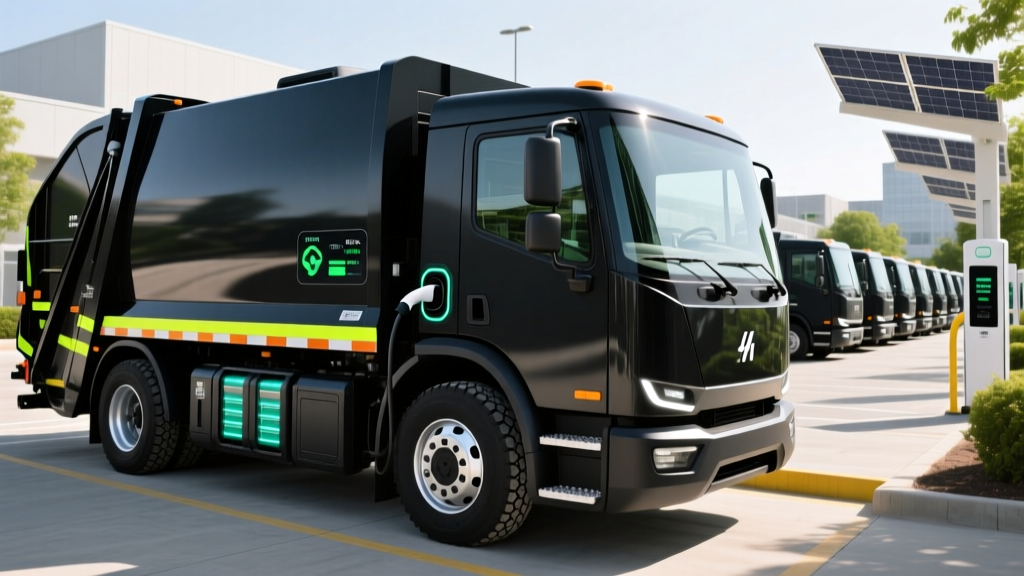
Municipalities and private waste haulers are increasingly evaluating electric garbage trucks as replacements for aging diesel refuse fleets. The core question for fleet managers: do battery-electric refuse trucks deliver enough daily range, payload, and uptime to justify a premium purchase price that can exceed $500,000 per unit?
Quick Answer: Yes — for most residential and commercial collection routes under 120 miles. Modern electric garbage trucks from Mack, BYD/AutoCar, Peterbilt, and Lion Electric carry 150–400 kWh LFP or NMC battery packs, achieve 100–160 miles of real-world range under load, and slash per-mile energy costs by 50–70% versus diesel. Upfront cost remains 2–3× a diesel equivalent, but total cost of ownership (TCO) breaks even within 5–8 years for high-utilization routes, especially with federal and state incentive stacking.
What Electric Garbage Trucks Are Available in 2026?
The Class 8 electric refuse segment has matured significantly since the early pilot programs of 2020–2022. Here are the primary models in active production and delivery for the 2026 model year:
| Model | Battery (kWh) | EPA/Est. Range | Peak DC Charge | HP / Torque | Base Price (est.) |
|---|---|---|---|---|---|
| Mack LR Electric | 376 kWh (NMC) | ~150 mi loaded | 150 kW (CCS) | 448 hp / 4,270 lb-ft | $525,000 |
| BYD / AutoCar ACX | 313 kWh (LFP) | ~130 mi loaded | 120 kW (CCS) | 490 hp / 3,600 lb-ft | $480,000 |
| Peterbilt 520EV | 210–350 kWh (NMC) | ~110–150 mi | 150 kW (CCS) | 400 hp / 3,100 lb-ft | $510,000 |
| Lion Electric Lion8 / Refuse | 210–350 kWh (NMC/LFP) | ~130–175 mi | 150 kW (CCS) | 335 hp / 2,500 lb-ft | $460,000 |
| Volvo VNR Electric (Refuse Config) | 375 kWh (NMC) | ~150 mi loaded | 250 kW (CCS) | 455 hp / 4,051 lb-ft | $540,000 |
Note: Range figures reflect real-world loaded refuse collection cycles with frequent stops, compactor operation, and low-speed urban driving. Unlike highway passenger EVs, refuse trucks consume significant energy powering hydraulic compaction systems — expect 1.5–2.5 kWh/mile depending on route density and payload.
Electric vs. Diesel Garbage Trucks: The Cost Comparison
The purchase-price sticker shock is real. A conventional diesel Class 8 refuse truck (Mack LR, Peterbilt 520, or Autocar ACX with a Cummins L9) typically costs $200,000–$280,000 depending on body and axle configuration. That means an electric garbage truck commands a $200,000–$300,000 premium at acquisition. But fleet economics extend far beyond the purchase order.
| Cost Category | Diesel Refuse Truck | Electric Refuse Truck | Notes |
|---|---|---|---|
| Purchase Price | $230,000 | $500,000 | Before incentives |
| Federal/State Incentives | $0 | –$40,000 to –$120,000 | IRA §45W commercial credit + state vouchers (e.g., CARB HVIP) |
| Fuel/Energy (annual, 25,000 mi) | $22,500 (diesel @ $4.50/gal, 5 mpg) | $7,500 (electric @ $0.12/kWh, 2 kWh/mi) | $15,000/yr savings |
| Maintenance (annual) | $12,000 | $5,000 | No oil, DPF, DEF, fewer brake replacements (regen) |
| Depot Charging Infrastructure (per truck share) | $0 | $30,000–$60,000 | Level 2 (19.2 kW) or DC fast (60–150 kW) depot chargers |
| Insurance (annual) | $6,500 | $7,800 | ~20% higher for EV commercial; declining |
| 5-Year TCO | $497,500 | $509,000 (net of incentives) | Near parity at 5 years with incentives |
| 8-Year TCO | $686,000 | $586,000 | $100K+ savings over life |
The breakeven point typically lands between years 5 and 7, heavily dependent on local electricity rates, diesel prices, route mileage, and available incentive stacking. Fleets in California (with CARB HVIP vouchers up to $120,000 per vehicle), New York, and New Jersey reach parity fastest. The federal IRA §45W Commercial Clean Vehicle Credit provides up to $40,000 for qualifying Class 8 vehicles — note this is a separate commercial credit from the consumer §30D, with different sourcing and domestic-content rules.
Charging Infrastructure: Depot Planning for Refuse Fleets
Unlike passenger EVs that rely on public charging networks, electric garbage trucks charge almost exclusively at the fleet depot — typically overnight during the 8–10 hour off-service window. This simplifies the charging equation but demands serious infrastructure investment.
Typical depot charging setup:
- Level 2 AC (19.2 kW): Adds ~10 miles of range per hour. A full charge from 20% to 100% on a 350 kWh pack takes ~14 hours — tight for daily cycling. Best for lower-mileage routes or supplemental top-ups.
- DC Fast (60–150 kW depot chargers): Adds 30–75 miles of range per hour. A 20–100% charge on a 350 kWh pack takes 3.5–5 hours at 100 kW sustained. This is the standard for daily-cycle refuse fleets.
- High-power DC (250+ kW, shared among vehicles): Used by larger fleets with power-management software that sequences charging to avoid peak-demand utility charges.
Infrastructure cost breakdown per truck position:
- DC fast charger hardware (60–150 kW): $40,000–$80,000
- Electrical service upgrade (480V three-phase, transformer, switchgear): $20,000–$60,000 per site
- Installation labor and permitting: $15,000–$40,000
- Software / charge management platform: $2,000–$5,000/year per site
Utility demand charges can significantly impact operating costs. Fleets should negotiate commercial EV rate schedules with their utility — many investor-owned utilities now offer off-peak commercial charging rates as low as $0.06–$0.09/kWh, which dramatically improves the TCO equation. Managed charging software (e.g., Amply, ChargePoint Fleet, EV Connect) can stagger charge sessions to minimize demand spikes.
Real-World Range: What Fleets Actually Experience
Published range claims for electric garbage trucks can be misleading if they don't account for the unique duty cycle of refuse collection. Unlike a long-haul truck running at steady highway speed, a garbage truck operates in an extreme stop-start pattern: 400–1,000 stops per shift, constant hydraulic compactor cycling, low average speeds (8–15 mph), and gross vehicle weights of 60,000–66,000 lbs when fully loaded.
| Claim | Reality |
|---|---|
| "200-mile range" | Marketing range under light-load, flat-terrain testing. Real-world loaded collection routes yield 100–160 miles depending on stops, compaction frequency, and grade. |
| "No range loss in cold weather" | Battery chemistry still suffers in sub-freezing temps. Expect 15–25% range reduction at 20°F, partially mitigated by battery thermal preconditioning and cab-heat management. |
| "Charges in 2 hours" | Only true at 250+ kW with a small pack. Most depot setups at 100–150 kW require 3.5–5 hours for a full charge on 300+ kWh packs. |
| "Electric trucks can't handle hilly routes" | Electric drivetrains produce peak torque at 0 RPM — they actually outperform diesel on steep grades. Regenerative braking recovers significant energy on descents. The concern is energy consumption, not capability. |
| "Battery replacement will cost $200,000" | Current LFP and NMC pack replacement for Class 8 runs $80,000–$140,000 depending on capacity. Most OEMs warranty packs for 8–10 years / 300,000–500,000 miles at ≥70% capacity retention. LFP packs in particular show minimal degradation in daily-cycle fleet use. |
Fleet managers planning routes should budget for 2.0–2.5 kWh/mile energy consumption on dense residential collection (800+ stops, heavy compaction) and 1.5–2.0 kWh/mile on lighter commercial routes. A 350 kWh usable battery at 2.2 kWh/mile yields roughly 159 miles — enough for most single-shift residential routes but tight for extended commercial or rural runs.
What First-Time Fleet EV Buyers Need to Know
Transitioning even a portion of a refuse fleet to electric is fundamentally different from buying a passenger EV. Here are the operational realities that catch first-time fleet electrification planners off guard:
- Lead times are long. Current order-to-delivery windows for Class 8 electric refuse trucks run 12–18 months. Plan infrastructure in parallel — depot charger installation and utility service upgrades often take 6–12 months themselves.
- Utility coordination is critical. A 10-truck depot charging at 150 kW each could require 1.5 MW of new electrical service. Engage your utility early — many offer make-ready programs that cover or subsidize the infrastructure on the utility side of the meter.
- Driver and technician training is mandatory. High-voltage systems (600–800V) require certified technicians for any traction-battery or power-electronics work. OEMs typically include training packages, but budget for ongoing ASE L3 or equivalent certification.
- Payload trade-offs exist but are shrinking. Early electric refuse trucks lost 2,000–4,000 lbs of payload to battery weight. Current models with higher energy-density NMC cells and optimized chassis designs have narrowed this gap to 1,000–2,000 lbs — often manageable within route-planning adjustments.
- Telematics and energy management are non-negotiable. Fleet platforms like Geotab, Samsara, or OEM-native systems track per-truck energy consumption, route efficiency, SoC profiles, and charger utilization. This data is essential for optimizing route assignments and identifying underperforming vehicles.
Decision Framework: Is an Electric Garbage Truck Right for Your Fleet?
Choose electric if:
- Your daily routes are under 120 miles with predictable return-to-depot scheduling
- You operate in a state with strong incentive programs (CA, NY, NJ, WA, OR, CO)
- Your depot has access to 480V three-phase power or your utility offers make-ready support
- You face local idling restrictions, noise ordinances, or zero-emission fleet mandates (e.g., CARB Advanced Clean Fleets rule)
- You plan to hold vehicles 8+ years (where TCO advantages compound)
Stick with diesel or consider CNG/RNG if:
- Your routes regularly exceed 150 miles or lack predictable depot return windows
- You operate in a region with high commercial electricity rates (>$0.20/kWh) and no off-peak EV tariffs
- Your depot cannot accommodate the required electrical service upgrades within budget
- You need immediate vehicle replacement and cannot absorb 12–18 month lead times
- Your fleet turns over vehicles in under 5 years (before TCO breakeven)
Frequently Asked Questions
How long do electric garbage truck batteries last?
Most OEMs warrant Class 8 battery packs for 8–10 years or 300,000–500,000 miles at a minimum of 70% State of Health (SoH). LFP (lithium iron phosphate) packs, used by BYD and increasingly offered by other OEMs, demonstrate superior cycle life — often exceeding 3,000 full charge cycles with less than 20% degradation. For a refuse truck cycling once daily, that translates to 8+ years of service before meaningful range reduction.
Can electric garbage trucks operate in extreme cold?
Yes, but with range penalties. Battery thermal management systems (liquid heating/cooling) mitigate extreme-temperature effects, but fleets in northern climates (Minnesota, Maine, Canada) should budget for 15–25% range loss at temperatures below 20°F. Preconditioning the battery while still plugged in at the depot recovers much of this loss. Cab heating is also a significant energy draw — electric refuse trucks use resistive or heat-pump HVAC systems that consume 5–15 kWh over a shift in cold weather.
What federal incentives are available for electric garbage trucks?
The IRA §45W Commercial Clean Vehicle Credit provides up to $40,000 per qualifying Class 8 vehicle (30% of the price differential vs. a comparable diesel, capped at $40,000). Eligibility requires meeting battery-component and critical-mineral sourcing thresholds that phase in annually through 2029. This is a business tax credit — it reduces the fleet operator's tax liability and is not available as a point-of-sale reduction the way the consumer §30D credit can be. Additionally, the EPA's Clean Heavy-Duty Vehicles Program and various state programs (notably California's HVIP) can stack additional incentives, potentially reducing net acquisition cost by $80,000–$160,000 per truck. Consult a tax professional for your specific eligibility.
How does maintenance compare between electric and diesel refuse trucks?
Electric garbage trucks eliminate the majority of powertrain maintenance: no engine oil, no diesel particulate filter (DPF) regenerations, no diesel exhaust fluid (DEF), no transmission fluid changes (most use direct-drive or single-speed reductions), and dramatically reduced brake wear thanks to regenerative braking handling 60–80% of deceleration. Fleets report 40–60% lower maintenance costs per mile. The primary maintenance items unique to electric trucks are battery thermal-management coolant service, high-voltage cable inspections, and eventual inverter/charger component replacement at high mileage.
What's the resale value of an electric garbage truck?
This remains an open question. The used market for Class 8 electric trucks is nascent — there simply aren't enough high-mileage units cycling through auctions yet to establish firm residual values. Battery State of Health will be the primary value determinant, similar to how engine hours and DPF condition drive diesel residuals today. OEM battery warranties that are transferable to second owners will support resale values. Conservative fleet planners should model a 10–15% residual value at 10 years until more market data emerges.