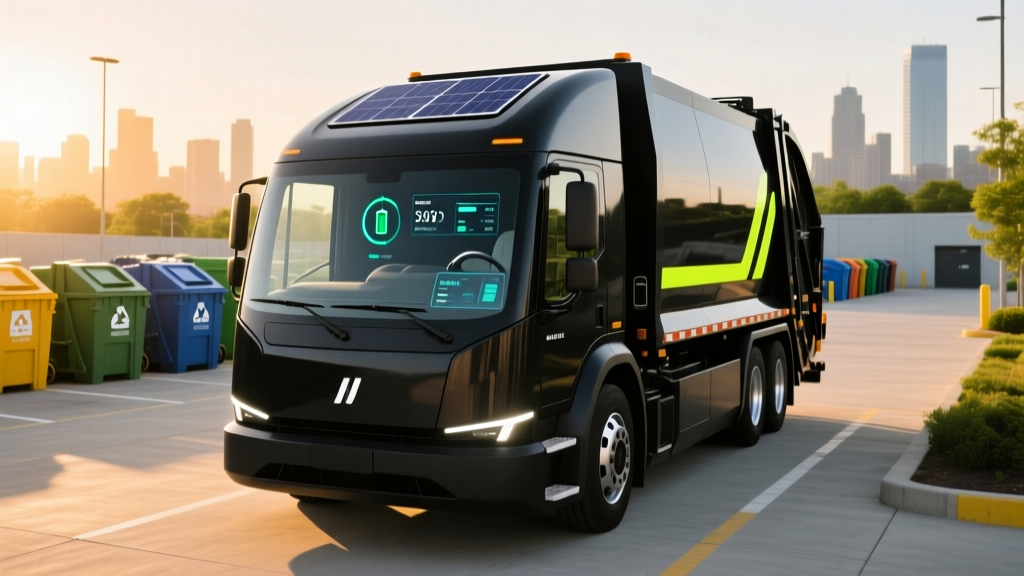
Quick Answer: An electric garbage truck in 2026 typically costs $350,000–$550,000 upfront (vs. $200,000–$280,000 for diesel), carries 150–250 kWh of NMC or LFP battery, and delivers 60–120 miles of real-world route range. Fleet operators recoup the premium in 5–8 years through diesel elimination ($25,000–$40,000/yr fuel savings), 60–70% lower maintenance costs, and federal Commercial Clean Vehicle Credits (up to $40,000 under IRC §45W). The trade-off: depot charging infrastructure ($50,000–$200,000+ per site) and route planning around battery capacity in extreme heat or cold.
Why Municipalities and Haulers Are Going Electric
Refuse collection is one of the most punishing duty cycles in commercial trucking: stop-and-go every 30–50 feet, heavy hydraulic compaction loads, 6–10 hour shifts, and return-to-depot routing. That same duty cycle is exactly why battery-electric refuse trucks make economic sense. Regenerative braking recaptures energy across hundreds of daily stops, and electric PTO (power take-off) for the compactor eliminates the diesel idle-and-rev cycle that burns 1–2 gallons per hour just running the blade.
The two dominant platforms in 2026 are the Mack LR Electric (now in its second generation) and the Peterbilt 520EV, with the BYD 8F and Autocar E-ACX competing for municipal contracts. Oshkosh's McNeilus eVolterra front-loader has gained traction with private haulers running commercial routes.
Fleet adoption is no longer pilot-stage. Cities like Los Angeles, Seattle, and New York have committed to full zero-emission refuse fleets by 2030–2035, and the EPA's Clean Truck Plan and California's Advanced Clean Fleets rule are accelerating timelines nationwide.
Specs That Matter: Range, Battery, and Charging
Unlike consumer EVs, refuse trucks aren't measured by 0–60 times or highway MPGe. The metrics that determine route viability are usable battery capacity (kWh), energy consumption per mile under load (kWh/mi), compactor energy draw, and depot charge rate (kW). Here's how the major 2026 platforms compare:
| Model | Battery (Usable kWh) | Chemistry | EPA/Est. Range | Peak DC Charge (kW) | 10–80% Time | Base Price (Est.) |
|---|---|---|---|---|---|---|
| Mack LR Electric (Gen 2) | 240 kWh | NMC | ~110 mi (route) | 150 kW | ~90 min | $425,000 |
| Peterbilt 520EV | 210 kWh | NMC | ~100 mi (route) | 150 kW | ~80 min | $395,000 |
| BYD 8F (Class 8) | 282 kWh | LFP | ~130 mi (route) | 170 kW | ~95 min | $380,000 |
| Autocar E-ACX | 195 kWh | NMC | ~85 mi (route) | 120 kW | ~85 min | $360,000 |
| McNeilus eVolterra | 250 kWh | NMC | ~120 mi (route) | 150 kW | ~95 min | $450,000 |
Real-World Range Reality: Manufacturers quote 100–150 miles of "route range," but actual energy consumption depends heavily on compaction intensity, terrain, ambient temperature, and payload weight. Expect 2.0–3.5 kWh/mile in mixed residential service. In summer heat (95°F+), battery thermal management can draw 5–8% additional energy. In winter (below 30°F), range drops 15–25% — the same physics affecting consumer EVs, amplified by the fact that cab heating and hydraulic fluid warmup add parasitic load. A truck rated for 110 miles may realistically complete a 75-mile route with 15% battery remaining in January in Chicago.
LFP vs. NMC in Refuse Service
BYD's use of LFP (lithium iron phosphate) chemistry deserves attention. LFP offers roughly 3,000–5,000 full charge cycles before reaching 80% state of health (SoH), compared to 1,500–2,500 cycles for typical NMC packs. For a refuse truck charging daily, that translates to 8–14 years of usable battery life on LFP vs. 4–7 years on NMC before a replacement or repurposing decision. The trade-off: LFP is heavier and less energy-dense, so BYD's 282 kWh pack weighs roughly 1,200 lbs more than a comparable NMC pack — a meaningful consideration when GVWR limits constrain payload.
Electric Garbage Truck vs. Diesel: The Total Cost Breakdown
The purchase-price gap is real and substantial. But refuse fleets operate on total cost of ownership (TCO), and the math shifts dramatically when you account for fuel, maintenance, and incentive dollars. Here's a side-by-side comparison based on a typical 5-day/week, 50-week/year residential route averaging 80 miles/day:
| Cost Category | Diesel Refuse Truck | Electric Refuse Truck |
|---|---|---|
| Purchase Price | $230,000 | $410,000 |
| Federal Tax Credit (§45W) | $0 | –$40,000 |
| Net Acquisition Cost | $230,000 | $370,000 |
| Annual Fuel/Energy (Yr 1) | $32,000 (diesel @ $4.20/gal, 3.2 mpg) | $9,600 (electricity @ $0.12/kWh, 2.8 kWh/mi) |
| Annual Maintenance | $18,000 | $6,000 |
| Annual Fuel + Maint. | $50,000 | $15,600 |
| Annual Savings (Electric) | — | $34,400 |
| Depot Charging Install (amortized 10 yr) | $0 | $12,000/yr |
| Net Annual Savings | — | $22,400 |
| Premium Payback Period | — | ~6.3 years |
Key assumptions: 20,000 miles/year, diesel at $4.20/gallon, commercial electricity at $0.12/kWh (varies significantly by utility and time-of-use rate), and IRC §45W Commercial Clean Vehicle Credit of $40,000 for Class 8 vehicles (30% of incremental cost over a comparable diesel vehicle, capped at $40,000 for vehicles over 16,000 lbs GVWR). Note: §45W is a business credit — it does not have the same MSRP or buyer-income caps as the consumer §30D credit, but it does require the vehicle to be deployed in a trade or business and meet domestic-content and critical-mineral sourcing thresholds that are tightening annually.
Where Diesel Still Wins
Honest accounting requires acknowledging diesel's advantages. A diesel refuse truck can refuel in 10 minutes and run a 120-mile route without range concern. Diesel infrastructure already exists at every depot. And for rural or long-haul commercial routes exceeding 130 miles, current battery capacity is a genuine constraint. Fleets running split shifts or covering wide geographic areas may need to retain diesel units on those routes while electrifying shorter, denser urban circuits first.
Depot Charging: The Infrastructure Cost Most Buyers Miss
The truck is only half the investment. Depot charging infrastructure is the other half — and it's where most first-time electric fleet buyers underestimate cost and timeline.
| Infrastructure Component | Per-Truck Cost Range | Notes |
|---|---|---|
| Level 2 AC Charger (19.2 kW) | $8,000–$15,000 | Suitable only for overnight (10–12 hr) dwell; too slow for mid-day top-ups |
| DC Fast Charger (50–150 kW) | $40,000–$90,000 | Required for same-day route recovery; CCS1 connector standard |
| Electrical Panel Upgrade | $15,000–$75,000 | Many depots need new 480V 3-phase service; utility transformer upgrades can add $50K–$200K |
| Trenching & Conduit | $5,000–$25,000 | Depends on charger distance from switchgear |
| Permitting & Engineering | $5,000–$15,000 | Utility interconnection studies required for >500 kW aggregate site load |
| Software / Fleet Management | $2,000–$5,000/yr | Charge scheduling, SoC monitoring, demand-charge optimization |
| Total Per Truck (DC Fast) | $70,000–$225,000 | Costs decrease per-truck when sharing switchgear across 4–10 chargers |
The critical planning variable is your utility's demand-charge structure. Many commercial utilities bill not just for energy consumed (kWh) but for peak power draw (kW) during any 15-minute window in the billing period. Simultaneously charging five trucks at 150 kW each can spike demand to 750 kW, triggering demand charges of $10–$20/kW/month — potentially $7,500–$15,000 in a single month. Smart charge-management software that staggers charging sessions and caps aggregate draw is not optional; it's a financial necessity.
Federal and state incentives can offset infrastructure costs. The §30C Alternative Fuel Vehicle Refueling Property Credit covers up to 30% of charging equipment and installation costs (capped at $100,000 per item of property for commercial installations), provided the installation is in an eligible census tract. Many state clean-fleet programs (California's HVIP, New York's Truck Voucher Incentive Program) stack additional funding on top.
Common Misconceptions About Electric Refuse Trucks
| Myth | Fact |
|---|---|
| "Electric garbage trucks can't handle a full route." | Most urban residential routes run 50–85 miles. Current 200+ kWh trucks handle these comfortably in temperate climates. Route planning is required for 100+ mile routes or extreme weather days. |
| "Batteries will need replacing every 3 years." | NMC packs are warrantied for 5–7 years/200,000 miles at 70% SoH. LFP packs last significantly longer. Real-world degradation data from early Mack LR Electric deployments shows ~8–12% capacity loss after 3 years of daily cycling. |
| "They can't run the compactor and drive at the same time." | Modern electric PTO systems deliver full hydraulic compaction power from the traction battery without impacting drivability. The ePTO draws 15–30 kW during compaction cycles — factored into range estimates. |
| "Cold weather makes them unusable." | Range drops 15–25% below 30°F — a real constraint requiring route adjustment or mid-day charging. Battery preconditioning and cab heat-pump systems mitigate the loss. Fleets in Minneapolis and Toronto operate year-round with adjusted route lengths. |
| "Charging takes too long for a working fleet." | Overnight depot charging (8–10 hours on Level 2 or 2–3 hours on DC fast) fits the return-to-base refuse model perfectly. Unlike long-haul trucking, refuse trucks don't need mid-route public charging. |
Decision Framework: Should Your Fleet Go Electric?
Choose an electric garbage truck if:
- Your routes are under 90 miles/day (with 100+ mile buffer for battery degradation over time)
- Trucks return to a single depot nightly with 8+ hours of dwell time
- Your depot has (or can get) 480V 3-phase electrical service
- You operate in a state or city with ZEV fleet mandates or incentive stacking
- Your fleet runs 5+ days/week (higher utilization = faster payback on fuel/maintenance savings)
- Noise ordinances or early-morning residential routes benefit from near-silent electric operation
Stick with diesel (or wait) if:
- Routes regularly exceed 120 miles or include long highway transfers between collection zones
- Your depot lacks electrical upgrade capacity and utility interconnection timelines exceed 18 months
- You run split shifts requiring the same truck to work two routes with <4 hours between them
- You operate in extreme cold (sustained sub-10°F) without ability to adjust route lengths seasonally
- Your fleet is small (1–3 trucks) and infrastructure cost can't be amortized across enough units
Maintenance and Long-Term Ownership Realities
Electric refuse trucks eliminate engine oil, coolant flushes, DPF (diesel particulate filter) regeneration, DEF fluid, transmission service, and exhaust-system repairs. Brake wear drops 50–70% thanks to regenerative braking handling the majority of deceleration. Fleet operators consistently report maintenance cost reductions of $10,000–$14,000 per truck per year.
What doesn't go away: hydraulic system maintenance (hoses, cylinders, pumps for the compactor), suspension and steering wear (these are still 33,000-lb Class 8 trucks pounding over curbs and potholes), tire replacement, and cab HVAC service. And when a traction battery does need replacement outside warranty, the cost is significant — $80,000–$150,000 for a 200–280 kWh pack, depending on chemistry and supplier.
Most manufacturers offer battery warranties at 70–80% capacity retention over 5–7 years or 150,000–200,000 miles. Mack's Gen 2 LR Electric, for example, warranties its 240 kWh NMC pack at 70% SoH for 6 years/200,000 miles. Read the warranty carefully: some manufacturers prorate coverage, and thermal-event exclusions vary.
Frequently Asked Questions
What federal tax credits apply to electric garbage trucks in 2026?
The IRC §45W Commercial Clean Vehicle Credit provides up to $40,000 for Class 8 electric trucks (30% of the incremental cost over a comparable diesel vehicle). The credit is claimed by the business or municipality that purchases and deploys the vehicle. Eligibility requires meeting battery-component and critical-mineral sourcing thresholds that phase up annually. Consult a tax professional — IRS guidance on §45W details the specific requirements and phase-out schedules. Additionally, the §30C credit can cover 30% of depot charging installation costs (up to $100,000 per item) in qualifying census tracts.
How long does it take to charge an electric garbage truck?
On a 150 kW DC fast charger, a 240 kWh battery charges from 10% to 80% in roughly 80–95 minutes. However, the charge curve tapers significantly above 80% — the final 20% can take an additional 60–90 minutes. Most fleets charge overnight on Level 2 (19.2 kW), which delivers a full charge in 10–14 hours — perfectly aligned with a truck that returns to depot at 3 PM and departs at 5 AM. DC fast chargers are used for mid-day top-ups or rapid turnaround between split shifts.
Can electric garbage trucks operate in extreme cold?
Yes, but with range penalties. Expect 15–25% range reduction in sustained temperatures below 30°F, and up to 30–35% below 10°F. Battery preconditioning (warming the pack before and during charging) is essential to maintain charge speed and battery health. Fleets in cold climates either shorten winter routes by ~20%, add mid-day charging infrastructure, or spec larger battery packs to absorb the seasonal loss. Cab heating in electric trucks uses a heat pump (3–5 kW draw) rather than waste engine heat, which is a net parasitic load that diesel trucks don't carry.
What's the connector standard for charging commercial electric trucks?
CCS1 (Combined Charging System) is the dominant DC fast-charging connector for Class 8 electric trucks in North America, including the Mack LR Electric, Peterbilt 520EV, and Autocar E-ACX. NACS (Tesla's connector) has not been adopted for heavy-duty commercial vehicles due to the higher current requirements. Some fleets also deploy MCS (Megawatt Charging System) infrastructure for future-proofing, though MCS-equipped trucks are still in limited deployment as of 2026.
How does regenerative braking affect refuse truck efficiency?
Regenerative braking is the single biggest efficiency advantage of electric refuse trucks. A typical residential route involves 400–800 stops per shift. Each stop recaptures kinetic energy that a diesel truck wastes as brake heat. Real-world data shows regen can recover 25–40% of the energy expended during acceleration, which is why electric refuse trucks achieve 2.0–3.5 kWh/mile (equivalent to ~10–12 mpg diesel-equivalent) despite the heavy, stop-intensive duty cycle. Without regen, the same truck would consume 4.0–5.0 kWh/mile.
What happens when the battery reaches end of life?
Traction batteries at 70–80% SoH are still functional for less demanding routes or can be repurposed for stationary energy storage (depot solar buffering, peak-shaving). Major manufacturers and third-party firms like Redwood Materials and Li-Cycle operate recycling programs that recover 90–95% of critical minerals (lithium, cobalt, nickel). Budget $80,000–$150,000 for a replacement pack if the truck will remain in service beyond the warranty period, though declining battery costs are expected to reduce this figure through the late 2020s.
Bottom Line for Fleet Decision-Makers
Electric garbage trucks are no longer experimental. The 2026 generation delivers proven route capability for the majority of urban and suburban residential collection routes, with operating costs that undercut diesel by $20,000–$35,000 per truck per year once infrastructure is in place. The barriers are front-loaded: higher acquisition cost, depot electrical upgrades, and the operational discipline of route-to-battery matching.
For fleets running dense, sub-90-mile routes with depot return, the payback math works in 5–8 years — and the trucks typically outlast that payback period by another 5–7 years of reduced-cost service. For long rural routes, split-shift operations, or depots with constrained electrical capacity, diesel or a phased transition remains the pragmatic choice. The key is honest route auditing before committing capital: measure your actual daily miles, compaction cycles, and dwell times, then spec battery capacity with a 20% degradation buffer for years 5–10 of service.