Quick Answer: An electric freight train uses overhead catenary wires or, increasingly, battery-electric locomotives to move cargo without diesel. While you won't buy a locomotive, the battery chemistries (LFP and high-nickel NMC), megawatt-scale charging standards (MCS), and thermal management systems developed for rail electrification are directly shaping the EVs you can buy today — from longer-lasting LFP packs in the Tesla Model 3 to faster-charging architectures in trucks like the Ford F-150 Lightning. Understanding rail-grade EV tech helps you make smarter battery and charging decisions.
Why Electric Freight Trains Matter to EV Buyers
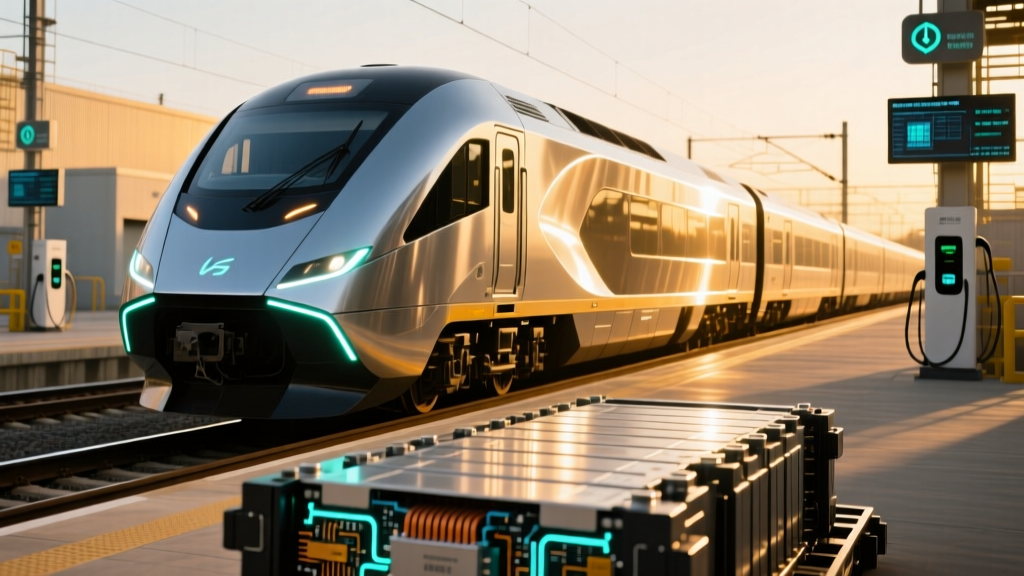
The keyword "electric freight train" has been surging in search interest, and for good reason. In 2026, the push to decarbonize heavy transport — from Class 8 trucks to locomotives — is accelerating battery and charging innovation that eventually trickles down to passenger EVs. Companies like Wabtec and Progress Rail are deploying battery-electric locomotives with packs exceeding 7,000 kWh (for context, a Tesla Model Y Long Range holds about 75 kWh usable). The engineering challenges at that scale — managing heat during sustained high-power discharge, ensuring battery longevity over thousands of cycles, and charging massive packs quickly — produce solutions that passenger-vehicle manufacturers adopt within a few years.
Here's the practical takeaway: the LFP (lithium iron phosphate) batteries now standard in many affordable EVs were validated for longevity in heavy-duty applications first. The Megawatt Charging System (MCS) connector being developed for electric freight trains and semi-trucks is influencing the next generation of DC fast-charging infrastructure you'll eventually use. And the thermal management lessons from rail are why your 2026 EV can precondition its battery for faster charging in cold weather.
Electric Freight Train vs. Diesel: The Numbers That Translate to Your EV
To understand what rail electrification teaches us about passenger EVs, consider the efficiency comparison that mirrors the EV-vs-gas debate in cars:
| Metric | Diesel Locomotive | Battery-Electric Locomotive | Passenger-EV Equivalent |
|---|---|---|---|
| Energy efficiency | ~35% (thermal) | ~85-90% (electric motor) | EV motor: ~85-90% vs. ICE: ~20-30% |
| Energy cost per mile | ~$6.50/mile (diesel) | ~$2.20/mile (electricity at $0.12/kWh) | EV: ~$0.04/mi vs. gas car: ~$0.13/mi |
| Maintenance cost reduction | Baseline | ~40-50% lower | EV: ~30-40% lower vs. ICE |
| Moving parts in drivetrain | ~200+ | ~20 | EV: ~20 vs. ICE: ~200+ |
| Regenerative braking recovery | None (rheostatic only) | ~30-40% energy recaptured | EV: ~15-25% recaptured in city driving |
The parallel is clear: electric motors are fundamentally more efficient than combustion, whether you're moving 4,000 tons of freight or a 4,500-pound crossover. The U.S. Department of Energy's fueleconomy.gov data consistently shows EVs converting 77-82% of grid energy to wheels, versus 12-30% for gasoline vehicles.
Battery Chemistry Lessons from Rail: LFP vs. NMC in Your EV
Electric freight train operators demand battery packs that survive thousands of deep cycles, extreme vibration, and temperature swings. That requirement has validated LFP chemistry for heavy-duty use — and it's the same chemistry now in the base Tesla Model 3, Ford Mustang Mach-E Select, and BYD vehicles available globally.
| Battery Trait | LFP (Rail-Validated) | NMC/NCA (Performance-Oriented) | What It Means for Your EV |
|---|---|---|---|
| Chemistry | Lithium Iron Phosphate | Nickel Manganese Cobalt / Nickel Cobalt Aluminum | LFP = longevity; NMC = range density |
| Cycle life | 3,000-5,000+ cycles | 1,000-2,000 cycles | LFP can outlast the vehicle itself |
| Energy density | ~160 Wh/kg (cell level) | ~250-300 Wh/kg (cell level) | NMC gives more range per pound |
| Thermal stability | Excellent (no thermal runaway to ~270°C) | Good (runaway risk at ~210°C) | LFP is inherently safer in crash scenarios |
| Cold-weather performance | Greater range loss (~35-40% at 20°F) | Moderate loss (~25-30% at 20°F) | NMC better for northern climates |
| Cost per kWh (2026) | ~$85-100/kWh | ~$110-135/kWh | LFP EVs are cheaper upfront |
| Charging to 100% regularly | Recommended (helps BMS calibration) | Daily limit to 80% recommended | LFP is lower-maintenance for daily use |
Rail operators chose LFP because a locomotive battery must endure 10+ years of daily deep cycling with minimal degradation. That same durability translates to your passenger EV: an LFP-equipped Model 3 can realistically retain 90%+ state of health (SoH) after 200,000 miles. If you're a first-time EV buyer prioritizing longevity over maximum range, an LFP pack is the smarter pick.
Megawatt Charging: What Freight-Train Tech Means for Your Charging Speed
Here's where electric freight train innovation directly shapes your future charging experience. Battery-electric locomotives and Class 8 trucks need to recharge packs of 500-7,000 kWh in under an hour. That requirement drove the development of the Megawatt Charging System (MCS), a connector standard capable of delivering up to 3.75 MW (3,750 kW) of power — roughly 10-15x the peak rate of today's fastest passenger-vehicle DC fast chargers.
You won't plug your EV into an MCS connector. But the infrastructure buildout — high-capacity grid connections, liquid-cooled cables, advanced power electronics — is being deployed at truck stops and freight corridors now. That same corridor infrastructure will eventually support passenger EVs with next-generation 800V and 1,000V architectures. Here's how charging speeds compare today:
| Charging Standard | Peak Power | Typical Vehicle | 10-80% Time | Miles Added in 15 Min |
|---|---|---|---|---|
| MCS (freight/trucks) | Up to 3,750 kW | Wabtec locomotive, Tesla Semi | ~30-45 min (huge packs) | N/A (different use case) |
| CCS/NACS DC fast (current gen) | 250-350 kW | Hyundai Ioniq 5, Tesla Model 3 | 18-25 min | ~120-180 miles |
| Next-gen 800V passenger | 400-500 kW | Porsche Macan EV, upcoming models | 12-15 min | ~200+ miles |
| Level 2 home (240V, 48A) | 11.5 kW | All EVs | Overnight (6-10 hrs) | ~30-45 miles/hour |
The real-world lesson for buyers: charging infrastructure investment driven by freight electrification is expanding the high-capacity grid connections that benefit everyone. If you're buying an EV in 2026, prioritize models with 800V architectures (Hyundai/Kia E-GMP, Porsche, upcoming GM Ultium vehicles) to take advantage of this infrastructure wave.
Real Costs: What EV Ownership Actually Looks Like in 2026
Whether the efficiency gains seen in electric freight trains translate to your wallet depends on your specific situation. Here's an honest cost breakdown comparing a typical 2026 EV (using the Hyundai Ioniq 5 SEL, MSRP ~$47,500) against a comparable gas vehicle (Toyota RAV4 AWD, MSRP ~$33,000):
| Cost Category (5-Year/75,000 Miles) | 2026 Hyundai Ioniq 5 SEL (EV) | 2026 Toyota RAV4 AWD (Gas) |
|---|---|---|
| Purchase price (MSRP) | $47,500 | $33,000 |
| Federal tax credit (§30D, if eligible) | -$3,750 (partial, battery sourcing) | $0 |
| Effective purchase price | $43,750 | $33,000 |
| Fuel/energy (75,000 mi) | $3,225 (home charging at $0.14/kWh, 3.5 mi/kWh) | $7,500 (at $3.50/gal, 28 MPG combined) |
| Maintenance | $1,200 (tire rotations, cabin filter, fluid top-offs) | $3,500 (oil changes, brakes, filters, belts) |
| Insurance (avg. national) | $9,750 ($1,950/yr avg.) | $7,500 ($1,500/yr avg.) |
| 5-year total cost | $57,925 | $51,500 |
| Cost per mile (all-in) | $0.77 | $0.69 |
Important caveats: The §30D federal tax credit for 2026 has strict requirements — buyer income caps ($150K single / $300K joint for new EVs), MSRP caps ($55K cars / $80K SUVs/trucks/vans), and battery component and critical mineral sourcing rules that change annually. Many EVs qualify for only a partial credit or none at all. Check the latest rules at IRS.gov's clean vehicle credit page before purchasing. State incentives vary widely and are not included here.
The EV also wins on depreciation-adjusted cost in many cases, as EVs have stabilized in resale value. But the higher insurance premiums (typically 15-30% above comparable gas cars) and the upfront price gap mean the break-even point is typically 5-7 years for buyers without generous state incentives.
First-Time EV Buyer: Misconceptions vs. Reality
| Common Misconception | Reality (With Data) |
|---|---|
| "EV batteries need replacing every 5 years" | Modern NMC packs retain 85-90% capacity at 150,000 miles; LFP retains 90%+. Federal law mandates 8-year/100,000-mile battery warranty (10 years/150,000 miles in CARB states). Full replacement: $8,000-$18,000, rarely needed. |
| "You can't road-trip an EV" | With 250-350 miles EPA range and DC fast charging adding 150+ miles in 20 minutes, road trips require 15-20 minute stops every 2.5-3 hours. Tesla Supercharger and Electrify America networks cover all major US corridors. |
| "EVs are worse in cold weather" | Range drops 20-40% in sub-freezing temps (real, not myth). But preconditioning while plugged in, heat pumps (standard on most 2026 EVs), and seat/steering heaters mitigate this. A 300-mile EPA EV delivers ~200-240 miles at 20°F — sufficient for most daily needs. |
| "Home charging requires a panel upgrade" | Most homes with 200A service can add a 48A Level 2 charger on a 60A circuit without a panel upgrade. Installation costs $500-$2,500 depending on distance from panel. Only older 100A homes typically need upgrades ($1,500-$4,000). |
| "EVs are always cheaper to own" | Not always. Higher purchase price, insurance, and potential public-charging costs (at $0.35-$0.55/kWh) can erase savings. The economics work best with home charging, moderate annual mileage (10-15K mi/yr), and available tax credits. |
Decision Framework: Should Rail-Grade EV Tech Influence Your Purchase?
Choose an LFP-battery EV (rail-validated chemistry) if:
- You plan to keep the vehicle 8+ years or 150,000+ miles
- You want the option to charge to 100% daily without degradation worry
- You live in a moderate climate (less extreme cold-weather range loss concern)
- You prioritize lower upfront cost over maximum range (LFP packs cost ~$25-40/kWh less)
- Examples: Tesla Model 3 RWD, Ford Mustang Mach-E Select (LFP trims), BYD Atto 3
Choose an NMC-battery EV if:
- You need maximum range per charge (300+ miles EPA) for road trips or long commutes
- You live in a cold climate where NMC's better low-temp performance matters
- You prioritize performance (higher energy density enables lighter, more powerful packs)
- You charge to 80% daily and don't mind the discipline
- Examples: Hyundai Ioniq 5 Long Range, Tesla Model Y Long Range, BMW iX xDrive50
Prioritize 800V architecture (benefiting from freight-charging R&D) if:
- You road-trip frequently and want the fastest possible DC charging (10-80% in under 20 min)
- You rely on public charging more than home charging
- You want future-proofing as higher-power chargers deploy along freight corridors
- Examples: Hyundai Ioniq 5/6, Kia EV6/EV9, Porsche Macan EV, Genesis GV60
Wait or choose a PHEV instead if:
- You lack reliable home or workplace charging access
- You regularly drive in areas with sparse DC fast-charging infrastructure (rural routes, charging deserts)
- Your budget is under $30,000 and you can't access used-EV credits
- A PHEV like the Toyota RAV4 Prime (42 miles electric-only, 38 MPG gas) gives you flexibility without range anxiety
Frequently Asked Questions
Are electric freight trains already operating in the US?
Battery-electric locomotives are in active pilot and limited commercial service as of 2026. Wabtec's FLXdrive and Progress Rail's EMD Joule are the leading platforms, with battery capacities ranging from 7,000 to 14,000 kWh. Full mainline electrification via overhead catenary wires — common in Europe and Asia — remains limited in the US to the Northeast Corridor (Amtrak) and a few commuter routes. The freight industry is pursuing battery-electric and hydrogen fuel-cell solutions rather than full catenary electrification for most routes.
Will MCS (Megawatt Charging) connectors be available for passenger EVs?
Not directly — MCS connectors are physically much larger and designed for heavy-duty vehicles. However, the grid infrastructure and power electronics deployed for MCS stations along freight corridors will enable higher-capacity DC fast-charging hubs that passenger EVs can use via CCS or NACS connectors at 350-500 kW. Think of it as a rising tide: freight investment makes the whole charging ecosystem more robust.
How does the efficiency of an electric freight train compare to diesel trucks?
Electric rail is roughly 3-4x more energy-efficient per ton-mile than diesel trucking, and battery-electric locomotives improve on that further by eliminating idling losses and recapturing energy through regenerative braking on downhill grades. This efficiency advantage is the same physics that makes a passenger EV 2.5-3x more energy-efficient per mile than a gas car — electric motors simply waste far less energy as heat.
What's the best EV battery chemistry for a first-time buyer in 2026?
For most first-time buyers, LFP is the pragmatic choice: lower cost, longer cycle life, no daily charging-limit anxiety, and proven durability from heavy-duty applications including rail. Choose NMC only if you need 300+ miles of range, live in extreme cold, or prioritize performance. Either way, the 8-year/100,000-mile federal battery warranty protects you against premature degradation regardless of chemistry.
Does the push for electric freight trains mean EV charging infrastructure will improve?
Yes, indirectly. The DOE's heavy-duty charging initiatives and private investment in freight-corridor electrification are driving utility upgrades (new substations, higher-capacity feeders) along major highways. These grid improvements benefit passenger EV charging stations co-located at travel plazas and rest stops. The National Electric Vehicle Infrastructure (NEVI) program continues funding corridor chargers through 2026 and beyond.
The Bottom Line for EV Buyers
Electric freight train technology isn't a distant curiosity — it's an R&D accelerator for the batteries, charging systems, and thermal management you'll find in 2026's passenger EVs. The LFP chemistry validated for 5,000-cycle locomotive use is the same chemistry giving budget-conscious EV buyers a pack that can outlast their ownership. The megawatt charging deployed for freight is pulling grid upgrades toward the highways you drive. And the efficiency advantage that makes rail electrification economically compelling — converting ~90% of energy to motion versus ~30% for combustion — is the same advantage saving EV owners $4,000-$5,000 in fuel costs over five years.
Your move: match the battery chemistry and charging architecture to your actual driving patterns, verify your §30D tax credit eligibility before committing, and choose the vehicle that works for your real-world miles — not the marketing sticker.