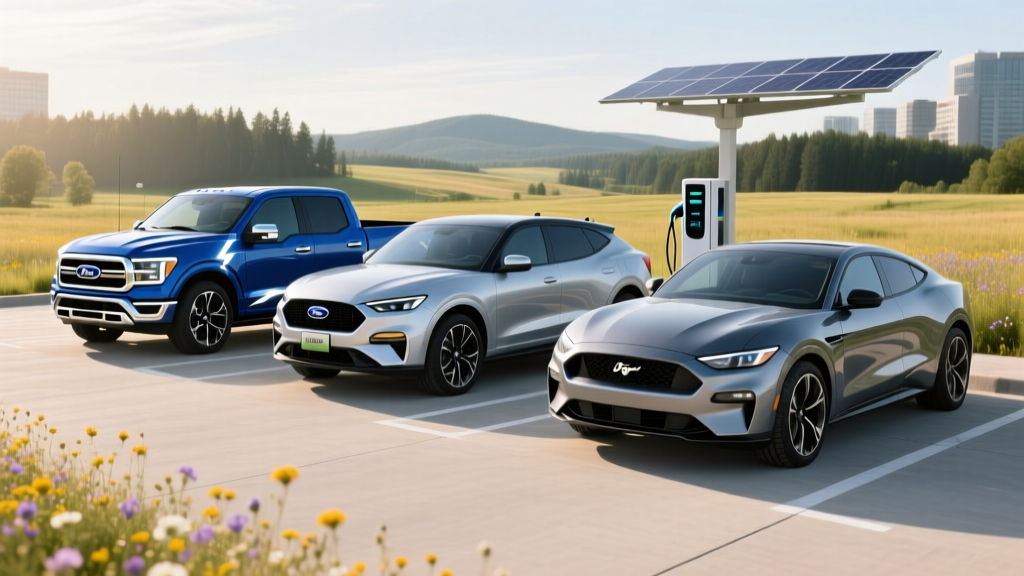
Quick Answer: Ford offers three electric vehicles for 2026: the F-150 Lightning pickup (EPA 240–320 mi, $54,995+), the Mustang Mach-E crossover (EPA 250–320 mi, $42,995+), and the commercial E-Transit van (EPA 126 mi, $47,995+). The Mach-E Select is the best entry point for most buyers; the Lightning suits truck buyers who can charge at home. Expect real-world highway range to fall 15–25% below EPA stickers, and verify §30D tax-credit eligibility before purchase, as battery-sourcing rules tighten annually.
Ford's 2026 Electric Vehicle Lineup at a Glance
| Model | Body Style | EPA Range | Battery (usable kWh) | Peak DC Charge | 10–80% Time | 0–60 mph | Base MSRP |
|---|---|---|---|---|---|---|---|
| F-150 Lightning (Std Range) | Pickup | 240 mi | 98 kWh (NMC) | 120 kW | ~41 min | 5.0 s (312 hp) | $54,995 |
| F-150 Lightning (Ext Range) | Pickup | 320 mi | 131 kWh (NMC) | 150 kW | ~38 min | 4.5 s (580 hp) | $69,995 |
| Mustang Mach-E Select (SR) | SUV | 250 mi | 72 kWh (NMC) | 115 kW | ~35 min | 6.3 s (266 hp) | $42,995 |
| Mustang Mach-E Premium (ER) | SUV | 320 mi | 91 kWh (NMC) | 150 kW | ~32 min | 5.1 s (346 hp) | $48,995 |
| Mustang Mach-E GT | SUV | 280 mi | 91 kWh (NMC) | 150 kW | ~32 min | 3.5 s (480 hp) | $59,995 |
| E-Transit | Cargo Van | 126 mi | 68 kWh (NMC) | 115 kW | ~45 min | N/A | $47,995 |
All figures reflect 2026 model-year EPA data and Ford manufacturer specifications. MSRP excludes destination charges. Real-world highway range at 70+ mph typically drops 15–20% below EPA estimates; cold-weather driving (below 30°F) can reduce range an additional 20–30% due to cabin heating demands and reduced battery chemistry efficiency.
Real-World Range Reality Check: The Mach-E Extended Range posts an EPA 320 miles, but sustained 75-mph highway driving in mild weather yields roughly 260–275 miles. In winter conditions with heat on, expect 210–230 miles. The F-150 Lightning Extended Range similarly delivers ~255–270 miles highway in fair weather and ~195–215 miles in cold conditions. Always plan road trips around 200-mile charging intervals for comfort.
Charging Speeds and Connector Standards
Ford's 2026 EVs use the NACS (North American Charging Standard) connector natively, following Ford's 2024 transition away from CCS. This gives Ford owners direct access to the Tesla Supercharger network — over 20,000 stalls across North America — without an adapter, a major practical advantage over competitors still using CCS.
| Level | Power (kW) | Miles Added/Hour | Use Case | Typical Cost |
|---|---|---|---|---|
| Level 1 (120V) | 1.2–1.4 kW | 3–5 mi/hr | Emergency/overnight trickle | $0.12–0.16/kWh (residential) |
| Level 2 (240V, 32A) | 7.7 kW | 22–28 mi/hr | Home daily charging | $0.12–0.16/kWh (residential) |
| Level 2 (240V, 48A) | 11.5 kW | 32–40 mi/hr | Home fast daily / overnight | $0.12–0.16/kWh (residential) |
| DC Fast Charge | 115–150 kW | 150–250 mi in 30 min | Road trips | $0.30–0.55/kWh (public) |
The Mach-E's onboard charger accepts up to 10.5 kW on Level 2, meaning a full charge from 10% takes roughly 8–9 hours on a 48-amp home station. The F-150 Lightning accepts up to 19.2 kW on Level 2 (with the optional 80-amp Ford Charge Station Pro), cutting that to about 7 hours for the Extended Range battery.
Charging curve reality: Peak DC fast-charge rates (120–150 kW) are only sustained between roughly 10–50% state of charge. Above 80%, charge speed tapers sharply — often below 40 kW — to protect the NMC battery. This is why 10–80% times are the industry benchmark; the final 20% can take as long as the first 70%.
Cost Breakdown: Electric Ford Vehicle vs. Gas Equivalent
The upfront premium for electrification is real, but operating costs tilt the long-term math. Here's a five-year comparison for the Mach-E Select versus the gas Ford Edge (discontinued but representative of the midsize SUV segment):
| Cost Category (5 Years) | Mach-E Select (AWD) | Gas SUV (Ford Edge AWD equiv.) |
|---|---|---|
| Purchase Price (MSRP) | $42,995 | $39,500 |
| Federal Tax Credit (§30D)* | –$3,750 to –$7,500 | $0 |
| Fuel/Energy (75,000 mi) | $3,200–$5,400 | $8,100–$9,800 |
| Maintenance (oil, brakes, filters) | $800–$1,200 | $2,800–$3,500 |
| Insurance (avg) | $7,200–$8,800 | $5,500–$7,000 |
| Estimated Total (before credit) | $54,195–$58,395 | $55,900–$59,800 |
*§30D credit eligibility depends on battery critical-mineral sourcing, buyer income caps ($150K single / $300K joint), and MSRP caps ($80K for SUVs/trucks, $55K for sedans). The Mach-E and Lightning currently qualify for partial or full credit depending on trim and sourcing updates — always verify on the IRS qualified vehicles list before purchasing. Point-of-sale transfer is available, letting you apply the credit as a down payment reduction.
Key takeaway: With the tax credit applied, the Mach-E reaches cost parity with a gas SUV within 2–3 years for drivers covering 12,000+ miles annually. Without home charging, public DC fast-charging costs ($0.35–0.55/kWh) can erode the fuel savings significantly — sometimes matching or exceeding gasoline cost per mile.
F-150 Lightning vs. Gas F-150: Does the Electric Truck Make Sense?
| Metric | F-150 Lightning Ext Range | F-150 Gas (3.5L EcoBoost) |
|---|---|---|
| EPA Combined | 70 MPGe / 48 kWh/100mi | 20 MPG combined |
| "Fuel" Cost per Mile | $0.04–0.07 (home) / $0.11–0.16 (public DC) | $0.15–0.19 |
| Towing Capacity | 7,700 lbs (Ext Range) | 13,000 lbs |
| Towing Range Impact | –40% to –55% | –25% to –35% |
| Payload | 1,800 lbs | 2,300 lbs |
| Front Trunk (Frunk) | 14.1 cu ft (400 lb capacity) | None |
| Pro Power Onboard | 9.6 kW standard | Optional 2.0–7.2 kW |
The Lightning is a capable daily-driver truck with genuine advantages: the massive frunk, Pro Power Onboard (which turns the truck into a 9.6 kW mobile generator for job sites or tailgating), and instant 775 lb-ft of torque. But if you regularly tow more than 5,000 lbs over long distances, the gas F-150 remains more practical. Towing a 6,000-lb trailer cuts Lightning highway range to roughly 120–140 miles — making road-trip towing a stop-every-hour affair.
Source: EPA F-150 Lightning data on fueleconomy.gov
Ford BlueCruise: What Level of Autonomy Are You Getting?
SAE Level 2 — Hands-Free, Eyes-Off (On Approved Roads Only): Ford BlueCruise is a Level 2 driver-assistance system. It allows hands-free driving on over 130,000 miles of pre-mapped divided highways, but the driver must remain attentive. An interior camera monitors your eyes. This is not self-driving — you cannot read, sleep, or look away. Ford charges $75/month or $2,500 for a three-year subscription after the initial trial period.
BlueCruise performs well on interstate highways with clear lane markings. It handles curves, maintains following distance, and manages lane centering smoothly. However, it disengages at construction zones, unmapped interchanges, and complex merges. In city driving, rain, or faded lane markings, you're driving manually. For 2026, Ford has expanded BlueCruise to include lane-change assist, but it still requires driver confirmation before each lane change.
What BlueCruise Does NOT Do: Navigate city streets autonomously, stop at unmapped stop signs, handle roundabouts, respond to traffic officers, or drive in heavy precipitation without driver intervention. Always keep hands near the wheel and eyes on the road.
Tax Credits, Incentives, and Eligibility for Ford EVs
The federal §30D Clean Vehicle Credit offers up to $7,500 for new EV purchases, but qualifying for the full amount requires meeting both critical-mineral and battery-component sourcing thresholds that tighten each year. As of 2026, vehicles must source an increasing percentage of battery minerals from US free-trade-agreement partners.
- Income caps: Modified AGI ≤ $150,000 (single), $225,000 (head of household), $300,000 (joint)
- MSRP caps: ≤ $80,000 for SUVs/pickups (Lightning, Mach-E), ≤ $55,000 for sedans
- Battery sourcing: Critical minerals and component requirements phase up annually — check the IRS qualified vehicles list for current Ford eligibility
- Point-of-sale transfer: You can assign the credit to the dealer at purchase, reducing your out-of-pocket cost immediately (regardless of tax liability)
- Used EV credit (§25E): Up to $4,000 or 30% of sale price (whichever is less) for qualifying used Ford EVs under $25,000
State incentives vary widely and change frequently. Consult your state energy office or a tax professional for local rebates, HOV-lane access, and utility charging incentives. Some utilities offer off-peak rates as low as $0.06–0.08/kWh, dramatically improving the ownership math.
Decision Framework: Which Electric Ford Vehicle Is Right for You?
Choose the Mustang Mach-E Select if: You want an affordable daily-driver crossover, drive under 250 miles daily, have Level 2 home charging, and prioritize lower operating costs over cargo space. At ~$42,995 before credits, it's Ford's most accessible EV.
Choose the Mustang Mach-E Extended Range if: You take regular road trips of 200–280 miles, live in a cold climate where range drops 20–30%, or want the 150 kW faster-charging capability for quicker DC stops.
Choose the F-150 Lightning if: You need a full-size truck for work or recreation, can install a Level 2 charger at home (ideally the 80-amp Charge Station Pro for 19.2 kW charging), don't regularly tow heavy loads over long distances, and value Pro Power Onboard and the frunk.
Wait or reconsider if: You live in an apartment without charging access, regularly drive 300+ miles in rural areas with sparse DC infrastructure, frequently tow over 5,000 lbs, or need a third row (Ford currently offers no 3-row EV — the Explorer EV is Europe-only).
Common Misconceptions About Ford EVs
| Myth | Fact |
|---|---|
| "The Lightning can't tow anything useful." | Rated for 7,700 lbs (Ext Range). It tows fine for short/local trips, but range drops 40–55% while towing, making long-distance towing impractical. |
| "Ford EVs use CCS and can't access Superchargers." | Since 2024, all new Ford EVs use NACS natively and access Tesla Superchargers directly — no adapter needed. |
| "The battery will need replacing in 5 years." | Ford warranties the battery for 8 years/100,000 miles with a 70% capacity retention threshold. Real-world data shows NMC packs losing 8–12% over 5 years under normal use. |
| "Home charging requires a panel upgrade." | Most homes with a 200-amp panel can support a 48-amp Level 2 charger (requiring a 60-amp breaker). Panel upgrades ($1,500–$3,000) are only needed for older 100-amp panels with high existing loads. Always get an electrician assessment. |
| "EVs cost more to insure, always." | Ford EV premiums run 15–25% higher than gas equivalents on average, but the gap has narrowed. Shop quotes — some insurers now price Mach-E coverage competitively with gas crossovers. |
Frequently Asked Questions
How much does it cost to charge a Ford EV at home?
At the US average residential rate of ~$0.16/kWh, fully charging a Mach-E Select (72 kWh) costs about $11.50. The Lightning Extended Range (131 kWh) costs about $21. With utility off-peak rates ($0.07–0.09/kWh), those figures drop to $5–6 and $9–12 respectively. Home charging is consistently the cheapest fueling option.
Can I charge a Ford EV at Tesla Superchargers?
Yes. All 2026 Ford EVs have native NACS ports and can use Tesla Supercharger stalls directly. Ford's FordPass app integrates Supercharger locations and handles payment. Non-Tesla CCS networks like Electrify America and EVgo are also accessible using Ford's included CCS-to-NACS adapter (for older CCS-equipped public chargers still in service).
What is the battery warranty on Ford electric vehicles?
Ford covers the high-voltage battery for 8 years or 100,000 miles (whichever comes first), warranting that it will retain at least 70% of original capacity. The electric powertrain components are covered for the same period. This is competitive with most mainstream EV brands.
Does the F-150 Lightning qualify for the full $7,500 tax credit?
Eligibility varies by trim, model year, and current battery-sourcing compliance. Some Lightning trims qualify for the full $7,500, others for $3,750 (meeting one of two sourcing thresholds), and some may not qualify at all depending on 2026 sourcing rules. Always check the IRS qualified clean vehicles list for the exact VIN configuration you're purchasing.
Is the Mach-E a good first EV for someone new to electric cars?
Yes, with one prerequisite: reliable home Level 2 charging. If you can install a 240V/32A or 48A charger at home (budget $500–$1,500 for equipment plus $800–$2,000 for electrician installation), the Mach-E Select is one of the most approachable EVs on the market — familiar crossover driving dynamics, strong BlueCruise highway assist, and straightforward FordPass app management. If you lack home charging, a plug-in hybrid like the Ford Escape PHEV may be a better bridge.
How does cold weather affect Ford EV range?
In sustained temperatures below 30°F, expect 20–30% range reduction. The battery's NMC chemistry becomes less efficient, and cabin heating draws significant energy (3–5 kW continuous). Using seat heaters and a heated steering wheel instead of cabin heat, and preconditioning the battery while plugged in, can recover 5–10% of that loss. The Mach-E and Lightning both have heat pumps on select trims, which improve winter efficiency by ~10–15% compared to resistive heating.