Quick Answer: Is the Electric Ford Transit Right for Your Fleet?
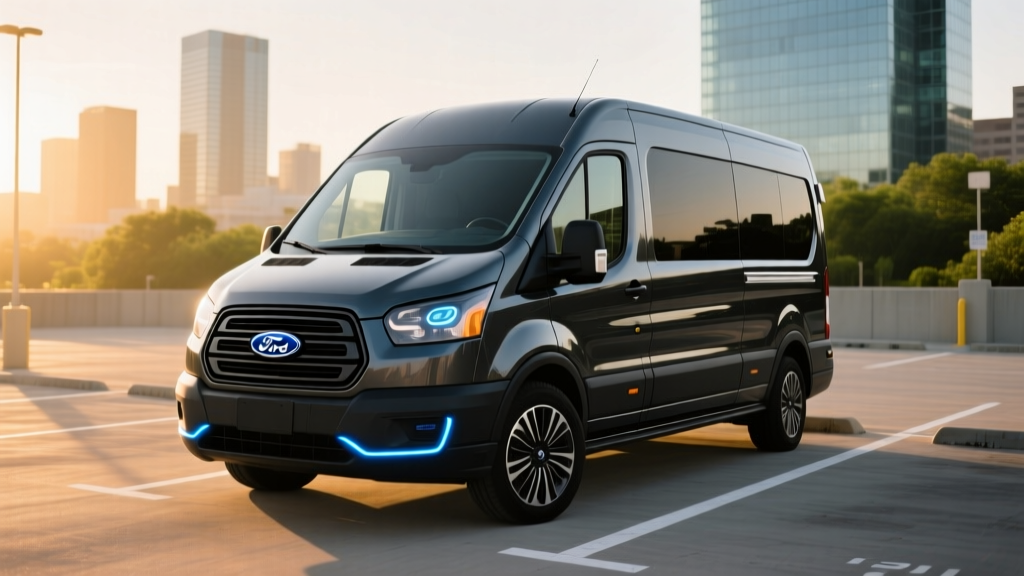
The 2026 Ford E-Transit delivers an EPA-estimated 126 miles of range from a 68 kWh usable LFP battery, targeting last-mile delivery and vocational routes that return to base nightly. It charges from 10–80% in roughly 45 minutes on a 115 kW DC fast charger, or overnight on Level 2. The base MSRP starts around $51,995 (cutaway/chassis cab configurations vary), but the commercial clean vehicle credit (§45W) can reduce effective cost by up to $7,500 for qualified commercial buyers — not the consumer §30D credit. It's best for predictable urban routes under 100 miles daily; it's a poor fit for long-haul or rural routes without mid-day charging infrastructure.
E-Transit Specs: Range, Battery, Charging & Performance
The E-Transit uses a lithium iron phosphate (LFP) battery pack — a deliberate choice by Ford for commercial duty. LFP chemistry trades some energy density for longer cycle life, better thermal stability, and tolerance for daily 100% charging without accelerated degradation. For fleet operators, that means less range fade over a 5–7 year service life.
| Specification | 2026 Ford E-Transit |
|---|---|
| EPA Range | 126 miles (cargo van, low roof) |
| Real-World Range (loaded, mixed driving) | ~95–110 miles |
| Battery (usable) | 68 kWh, LFP chemistry |
| Motor Output | 266 hp (198 kW), 317 lb-ft torque |
| 0–60 mph | ~8.5 sec (unloaded) |
| Max DC Fast Charge Rate | 115 kW peak |
| 10–80% DC Fast Charge | ~45 minutes |
| Level 2 Charge Rate | 10.5 kW (AC) |
| Level 2 Full Charge Time | ~8 hours (0–100%) |
| Payload Capacity | Up to ~3,300 lbs (varies by config) |
| Cargo Volume | 246.7 cu ft (low-roof cargo van) |
| Pro Power Onboard | 2.4 kW (optional 7.2 kW) |
| Battery Warranty | 8 years / 100,000 miles |
| Base MSRP (Cargo Van) | ~$51,995 |
Real-World Range Reality: The 126-mile EPA figure assumes moderate temperatures and partial load. In practice, a fully loaded E-Transit on a stop-and-go delivery route in winter conditions (below 32°F) may see effective range drop to 80–95 miles. Cold weather impacts LFP chemistry more noticeably than NMC, and cabin heating draws directly from the traction battery. Ford's thermal management system helps, but plan routes conservatively — treat 100 miles as your practical daily ceiling unless you have mid-day charging access.
Cost Breakdown: E-Transit vs. Gas Transit TCO Over 5 Years
The purchase price of the E-Transit is substantially higher than a comparable gas-powered Transit, but operating costs tilt the math back in EV favor — especially for high-mileage urban fleets. Here's a 5-year, 75,000-mile total cost of ownership (TCO) comparison assuming a delivery route averaging 50 miles/day, 5 days/week.
| Cost Category | E-Transit (EV) | Transit 3.5L EcoBoost (Gas) |
|---|---|---|
| Base MSRP | $51,995 | $44,500 |
| Federal Tax Credit (§45W Commercial) | −$7,500 | $0 |
| Effective Purchase Price | $44,495 | $44,500 |
| Fuel/Energy (75k mi) | $5,400 ($0.14/kWh avg) | $14,625 ($3.50/gal, 15 MPG) |
| Maintenance (5 yr) | $2,200 | $5,800 |
| Insurance (5 yr est.) | $9,500 | $8,200 |
| Estimated Depreciation | $18,000 | $15,000 |
| 5-Year TCO | $79,595 | $88,125 |
Key takeaway: The E-Transit saves roughly $8,500 over 5 years in this scenario, driven primarily by fuel and maintenance savings. Break-even happens around year 3–4 depending on local electricity rates and annual mileage. Fleets running 200+ miles/day will not find the E-Transit viable without route segmentation; those under 80 miles/day with depot charging see the strongest economics.
Note: The IRS §45W commercial clean vehicle credit applies to vehicles placed in service for business use. Eligibility depends on vehicle weight, battery capacity, and domestic content requirements. Consult a tax professional — this is not the consumer §30D credit and has different qualification rules.
Charging Infrastructure: What Fleet Operators Actually Need
Charging is where most E-Transit adoption plans succeed or fail. Unlike consumer EVs that can rely on public networks, commercial vans need predictable, depot-based charging. Here's what the infrastructure picture looks like.
| Charging Level | Power (kW) | Miles Added/Hour | Use Case |
|---|---|---|---|
| Level 1 (120V) | 1.4 kW | ~3 mi/hr | Not practical for fleet |
| Level 2 (240V, 48A) | 10.5 kW | ~24 mi/hr | Overnight depot charging (ideal) |
| DC Fast (CCS) | 115 kW peak | ~150+ mi/hr (to 80%) | Mid-day top-up or opportunity charging |
Depot charging math: A single Level 2 station (10.5 kW) running for 8 hours adds approximately 192 miles of range — more than enough to fully replenish the E-Transit's 68 kWh battery overnight. For a fleet of 10 vans, you'll need 10 Level 2 chargers (or fewer with smart load-management software that staggers charging). Budget $3,000–$7,000 per Level 2 stall installed, depending on electrical panel capacity and conduit runs. Utility demand charges may apply — contact your local utility early about commercial EV rate schedules.
DC fast charging caveat: The 115 kW peak rate is only sustained up to roughly 50–60% SoC, after which the charge curve tapers significantly. A 10–80% session takes ~45 minutes, not the 25 minutes some marketing materials imply. This is normal LFP behavior and protects battery longevity, but it means mid-day charging adds time to driver schedules.
Electric Ford Transit vs. Gas Transit: Head-to-Head
| Attribute | E-Transit (Electric) | Transit 3.5L V6 EcoBoost |
|---|---|---|
| Powertrain | Single electric motor, RWD | 3.5L twin-turbo V6, RWD/AWD |
| Horsepower | 266 hp | 310 hp |
| Torque | 317 lb-ft (instant) | 400 lb-ft |
| EPA Range / Fuel Economy | 126 mi / 2.0 kWh/mi | 15–17 MPG combined |
| Refuel/Recharge Time | 8 hr (L2) / 45 min (DC 10–80%) | ~5 minutes |
| Daily Practical Range | ~95–110 mi (loaded, real-world) | ~400+ mi |
| Maintenance Complexity | Low (no oil, filters, exhaust) | Standard ICE schedule |
| Noise/Vibration | Near-silent at idle and low speed | Noticeable engine noise |
| Pro Power Onboard | 2.4 kW standard (7.2 kW opt.) | 2.0 kW (limited) |
| Cold-Weather Impact | 20–35% range loss below freezing | Minimal range impact |
The gas Transit wins on range flexibility and refueling speed — no contest for routes exceeding 150 miles or for operations in extreme cold without heated depot parking. The E-Transit wins on per-mile energy cost, maintenance reduction, job-site power (Pro Power Onboard is a legitimate differentiator for tradespeople running tools), and urban drivability where instant torque and regenerative braking shine in stop-and-go traffic.
Common Misconceptions About the E-Transit
| Myth | Fact |
|---|---|
| "The battery will need replacing in a few years." | LFP batteries are rated for 3,000+ full cycles before reaching 80% capacity. Ford warranties the pack for 8 years/100,000 miles. At 50 miles/day, 5 days/week, that's ~7.7 years before even reaching the warranty threshold. |
| "You can't charge an E-Transit fast enough for commercial use." | Overnight Level 2 depot charging fully replenishes the battery in ~8 hours — sufficient for any route under 100 miles. DC fast charging at 115 kW adds ~80 miles in 30 minutes for opportunity charging. |
| "The E-Transit qualifies for the $7,500 consumer tax credit." | The E-Transit is a commercial vehicle and typically qualifies under §45W (Commercial Clean Vehicle Credit), not the consumer §30D credit. Different rules, forms, and eligibility requirements apply. |
| "Electric vans can't handle cold weather." | Range drops 20–35% in freezing temperatures — real and significant. But for a 50-mile daily route with a 126-mile EPA buffer, the E-Transit still completes its route. Preconditioning while plugged in mitigates the loss. |
| "Payload capacity is much lower because of the battery." | The E-Transit's battery is mounted under the floor. Payload is ~3,300 lbs — reduced from the gas Transit's ~4,000+ lbs, but still competitive for most last-mile and trade applications. |
Decision Framework: Should You Buy the Electric Ford Transit?
Choose the E-Transit if:
- Your daily routes are consistently under 100 miles (ideally under 80 miles in winter)
- You have depot or home-base parking where Level 2 chargers can be installed
- Your operation is urban or suburban with frequent stops (regen braking maximizes efficiency)
- You want to reduce per-mile operating costs and maintenance downtime
- Your business qualifies for the §45W commercial clean vehicle credit or local utility EV incentives
- You need job-site power via Pro Power Onboard for tools or equipment
Stick with the gas Transit (or wait) if:
- Your routes regularly exceed 120 miles per day without mid-day charging access
- You operate in regions with sustained sub-zero winters and no heated parking
- You lack depot charging infrastructure and can't install it (leased lot, landlord restrictions)
- Your payload requirements regularly push above 3,500 lbs
- You need AWD for job sites or rural routes (not available on E-Transit)
What First-Time Commercial EV Buyers Need to Know
Buying an electric van for business is fundamentally different from buying a consumer EV. Here are the non-obvious realities:
Utility coordination comes first. Before ordering chargers, contact your utility about commercial EV rate structures. Many utilities offer time-of-use (TOU) rates that make overnight charging dramatically cheaper — sometimes under $0.08/kWh. Others impose demand charges based on peak kW draw, which can spike your bill if you plug in 10 vans simultaneously at 4 PM. Smart charging software (e.g., Ford Pro Charging integration) can stagger sessions to avoid this.
Electrical upgrades may be needed. A depot with 5–10 Level 2 chargers may require a panel upgrade to 400A or 800A service. Budget $5,000–$25,000 for electrical infrastructure depending on existing capacity and conduit distance. Some utilities offer make-ready incentives that cover a portion of this cost.
Driver training matters. One-pedal driving via regenerative braking is different from a gas van. Drivers who adapt well report reduced fatigue in city traffic. Brief your team on maximizing regen and avoiding unnecessary HVAC use in extreme weather to preserve range.
Insurance may cost more. Commercial EV insurance premiums tend to run 10–20% higher than equivalent gas vehicles, reflecting higher repair costs and specialized parts. Get quotes before committing to your TCO model.
Ford Pro ecosystem is a real advantage. The E-Transit integrates with Ford Pro telematics, providing fleet managers with real-time battery state-of-charge, range forecasting, and charging optimization. If you already run Ford Pro on gas Transits, the transition is relatively seamless.
Frequently Asked Questions
What is the real-world range of the electric Ford Transit?
The EPA rates the E-Transit at 126 miles for the low-roof cargo van configuration. In real-world conditions with a full load and mixed driving, expect 95–110 miles. In freezing temperatures, plan for 80–95 miles. Always spec your routes against the worst-case (winter, loaded) number, not the EPA sticker.
Does the E-Transit qualify for any federal tax credits?
Yes — but typically under the IRS §45W Commercial Clean Vehicle Credit, not the consumer §30D credit. The credit can be up to $7,500 for vehicles under 14,000 lbs GVWR, subject to battery sourcing and domestic content requirements. Eligibility is complex; work with a tax professional to confirm your business qualifies.
How long does it take to charge the E-Transit?
On a Level 2 charger (10.5 kW), a full 0–100% charge takes approximately 8 hours — ideal for overnight depot charging. On a 115 kW DC fast charger, 10–80% takes about 45 minutes. The charge curve tapers above 80% SoC, so DC fast charging past 80% is slow and generally not recommended for daily use.
Can the E-Transit tow a trailer?
The E-Transit has a maximum towing capacity of approximately 5,000 lbs when properly equipped. However, towing significantly reduces range — expect a 30–50% reduction depending on trailer weight and aerodynamics. If your operation involves regular towing over long distances, the gas Transit is more practical.
What is the battery replacement cost?
Ford has not published a flat replacement price for the E-Transit's 68 kWh LFP pack, but commercial EV battery replacements in this class typically range from $12,000–$18,000 out of warranty. The 8-year/100,000-mile warranty covers defects and excessive degradation (below 70% capacity retention). LFP chemistry is specifically chosen for longevity, making out-of-pocket replacement less likely within a typical fleet lifecycle.
Is the E-Transit available with all-wheel drive?
No. The 2026 E-Transit is rear-wheel drive only. If your routes require AWD for snow, mud, or off-pavement job sites, the gas-powered Transit with the EcoBoost V6 and AWD remains the better choice.