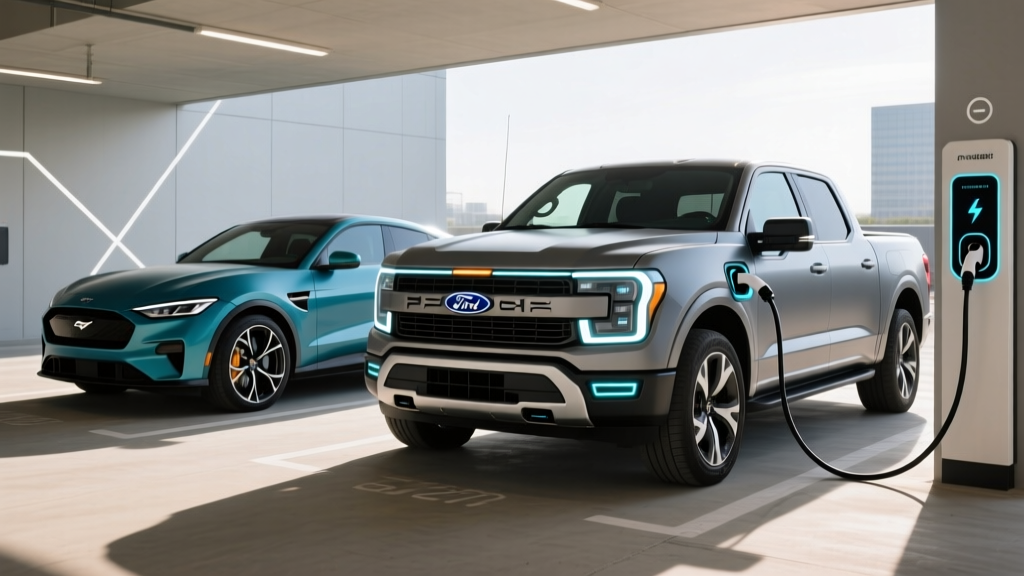
If you're researching electric Ford malfunctions before buying an F-150 Lightning, Mustang Mach-E, or E-Transit, here's the practical reality: Ford's EVs have faced documented issues with software glitches (SYNC 4A freezes, phantom drain), 12V auxiliary battery failures that strand the vehicle, and occasional high-voltage contactor faults — but major battery-pack failures remain rare under the 8-year/100,000-mile warranty. NHTSA recall data shows Ford issued multiple recalls for the Mach-E (high-voltage contactor overheating) and F-150 Lightning (reduced braking, loose steering bolts) between 2022 and 2025, while the Consumer Reports predicted reliability scores for both models have trended upward from "below average" in 2023 to "average" by the 2026 model year as Ford pushed over-the-air (OTA) fixes.
Quick Answer: Are Electric Fords Reliable in 2026?
Electric Fords are now average in predicted reliability — not class-leading like the Hyundai Ioniq 5 or Tesla Model Y, but no longer the liability they were in 2022-2023. Most malfunctions are software-related and fixable via OTA updates. The highest-risk components are the 12V lead-acid battery (replace every 3-4 years proactively, ~$250) and the SYNC 4A infotainment module. The traction battery pack itself has proven durable, with degradation averaging 5-7% over 100,000 miles based on fleet data.
Documented Electric Ford Malfunctions by Model
F-150 Lightning (2022-2026)
The F-150 Lightning has been Ford's highest-profile EV, and its malfunctions have drawn the most scrutiny. The most commonly reported issues across NHTSA complaints and owner forums include:
- 12V battery drain: The Lightning uses a conventional lead-acid 12V battery to run computers and accessories. Parasitic drain from always-on telematics has left owners stranded — even with a full high-voltage pack. Ford issued a software update in late 2024 to improve 12V charging logic, but failures persist in cold climates.
- Loose steering rack bolts (2022-2023 models): A 2023 NHTSA recall (NHTSA Recall 23V-413) affected ~3,500 trucks where steering rack bolts could loosen, potentially causing loss of steering assist. Dealership fix: re-torque and apply thread-locker.
- Reduced regenerative braking in cold weather: Below 40°F, the Lightning limits regen to protect the battery, which increases stopping distances if the driver isn't anticipating it. This is by design, not a defect, but it catches new EV drivers off guard.
- Range shortfall: The Extended Range pack (131 kWh usable, EPA 320 miles) delivers closer to 240-260 miles at sustained 75 mph highway speeds, and as low as 190-210 miles in sub-30°F weather with the cabin heater active. This isn't a malfunction — it's physics — but it's the #1 complaint from new owners who expected the EPA sticker to be a guarantee.
Mustang Mach-E (2021-2026)
The Mach-E has a longer service history, and its malfunction profile is better understood:
- High-voltage contactor overheating (2021-2022): The most serious recall (NHTSA 22V-412) affected ~49,000 vehicles. Under heavy acceleration, the main battery contactors could overheat and weld shut, potentially causing a loss of drive power. Ford's fix was a software update to limit contactor current and, in some cases, hardware replacement. Post-2023 models received redesigned contactors.
- SYNC 4A infotainment freezes: Black screens, unresponsive touch inputs, and Bluetooth dropouts are the single most common owner complaint. Ford has pushed multiple OTA updates, but some owners report needing a full APIM (Accessory Protocol Interface Module) replacement under warranty (~$1,200 out of warranty).
- Door handle malfunctions: The Mach-E's electronic push-button door handles can fail to deploy in freezing rain or after a 12V battery drop. Mechanical release cables exist (inside the door pocket) but aren't well-documented in the owner's manual.
- Phantom drain: Owners report losing 2-4% state of charge per day when parked, attributed to always-on connectivity and battery thermal management. A 2025 OTA update reduced this to ~1% daily by allowing deeper sleep states.
Cost of Ownership: Electric Ford vs. Gas Equivalent
Malfunctions matter most in the context of total cost. Here's how a 2026 F-150 Lightning XLT (Extended Range, $69,995 MSRP) stacks up against a 2026 F-150 XLT 3.5L EcoBoost V6 ($52,500 MSRP) over 5 years and 75,000 miles:
| Cost Category | F-150 Lightning XLT ER | F-150 XLT EcoBoost V6 |
|---|---|---|
| Purchase Price (MSRP) | $69,995 | $52,500 |
| Federal §30D Tax Credit (if eligible) | -$7,500* | $0 |
| Effective Purchase Price | $62,495 | $52,500 |
| Fuel/Energy (75k mi) | $5,250 (home L2, $0.14/kWh) | $12,375 (19 MPG avg, $3.50/gal) |
| Maintenance (75k mi) | $1,100 (cabin filter, wipers, brake fluid) | $3,800 (oil, filters, plugs, brakes) |
| Estimated Repair (out of warranty, yrs 4-5) | $1,400 (12V batt, SYNC module risk) | $1,800 (transmission, turbo risk) |
| Insurance (5-yr avg) | $11,200 | $8,500 |
| 5-Year Total Cost of Ownership | $81,445 | $78,975 |
*The §30D federal EV tax credit is subject to buyer income caps ($150k single / $300k joint), MSRP limits ($80k for trucks), and battery critical-mineral sourcing requirements. Verify eligibility at IRS.gov and confirm point-of-sale transfer availability with your dealer.
The Lightning costs roughly $2,500 more over 5 years, but that gap narrows if you drive more than 15,000 miles/year (where the fuel savings compound) or if your state offers additional rebates. The higher insurance premium for EVs — typically 15-25% above gas equivalents — is a real cost that many buyers overlook.
Electric Ford Malfunctions vs. Gas Ford Malfunctions
| Failure Category | Electric Ford (Lightning/Mach-E) | Gas Ford (F-150 EcoBoost/Explorer) |
|---|---|---|
| Powertrain Complexity | ~20 moving parts (motor, reduction gear) | ~2,000+ moving parts (engine, transmission) |
| Most Common Failure | 12V battery, software/SYNC | Transmission (10R80), turbo wastegate, water pump |
| Catastrophic Failure Risk | Battery pack (rare, covered 8yr/100k mi) | Engine/Transmission ($4,000-$8,000 out of warranty) |
| Average Annual Repair Cost (yrs 4-7) | $650 | $950 |
| Recall Volume (2021-2025) | Higher (new platform teething) | Moderate (mature platform) |
| Stranding Risk | 12V death = car won't start, even with full HV pack | Dead 12V = jump-startable; empty tank = tow |
The critical insight: electric Fords have fewer mechanical wear items but more software-dependent components. A gas F-150 with a dead 12V battery can be jump-started in 5 minutes. An F-150 Lightning with a dead 12V battery won't close its contactors to engage the high-voltage pack — meaning you need a 12V jump or replacement before the truck will move, despite having 300 miles of range sitting in the main battery.
Common Misconceptions About Electric Ford Reliability
| Myth | Fact |
|---|---|
| "The battery will need replacing at 100k miles for $20,000" | Ford's battery degradation data shows 5-7% capacity loss at 100k miles. The 8yr/100k-mi warranty covers drops below 70% capacity. Full pack replacement (if needed) runs $15,000-$22,000 but is rare — most failures involve individual modules ($2,000-$4,000). |
| "EVs break down more than gas cars" | NHTSA and J.D. Power data show EVs have fewer powertrain failures but more infotainment/software complaints. Overall, EVs visit the dealer less frequently for mechanical issues. |
| "Ford's EVs are unreliable because of the recalls" | Recalls are proactive safety corrections, not evidence of widespread failure. The Mach-E contactor recall affected a specific production window and was resolved with software + hardware updates. Post-2024 models incorporate the fix from the factory. |
| "OTA updates are just gimmicks" | Ford has pushed critical fixes via OTA: improved 12V charging logic, contactor current limits, phantom drain reduction, and BlueCruise map expansions. These updates resolve issues that would require a dealer visit on a gas car. |
What First-Time EV Buyers Should Know About Ford Reliability
If you're considering a new or used electric Ford, these ownership realities will set accurate expectations:
- Replace the 12V battery proactively. Don't wait for it to die. Budget $200-$300 every 3-4 years for an AGM replacement. Some owners swap to a lithium 12V (e.g., Ohmu or Antigravity) for ~$500 to eliminate the failure mode entirely.
- Learn the manual door releases. Both the Mach-E and Lightning have mechanical overrides that aren't obvious. Know where they are before you need them.
- Plan for cold-weather range loss. Expect 25-35% range reduction below 30°F if you use resistive cabin heat. Preconditioning while plugged in mitigates this significantly.
- Keep software updated. Decline OTA updates at your peril — Ford bundles reliability fixes with feature updates, and skipping them can leave known bugs unresolved.
- Understand the warranty boundaries. The battery and drive unit warranty (8yr/100k mi) is comprehensive, but the 12V battery, SYNC module, and door handles fall under the basic 3yr/36k-mi bumper-to-bumper coverage. Extended warranties (Ford Protect EV plan) can bridge this gap for ~$2,500-$3,500.
Decision Framework: Should You Buy an Electric Ford in 2026?
Choose an F-150 Lightning if:
- You need a full-size truck for towing (max 10,000 lbs) or job-site power (Pro Power Onboard, up to 9.6 kW V2L)
- You have Level 2 home charging (a 240V/48A circuit adds ~16 miles/hour, fully recharging the Extended Range pack overnight)
- You drive 12,000-20,000 miles/year, where the fuel savings offset the higher purchase price within 4-5 years
- You qualify for the §30D tax credit, bringing the effective price closer to a loaded gas F-150
Choose a Mustang Mach-E if:
- You want a sporty crossover with EPA range up to 320 miles (California Route 1 RWD) and 0-60 in 3.5 seconds (GT Performance Edition)
- You prioritize lower running costs over cargo space (34.4 cu ft behind rear seats vs. the Lightning's 52.8 cu ft bed + 14.1 cu ft frunk)
- You want Ford's most mature EV platform — the Mach-E has the longest service history and most resolved recall issues
Look elsewhere (Rivian R1T, Hyundai Ioniq 5, Tesla Model Y) if:
- Predicted reliability is your top priority — Hyundai and Tesla consistently score higher in Consumer Reports and J.D. Power EV reliability studies
- You live in a charging desert with limited DC fast-charging access and no home charging option
- You want NACS native compatibility without an adapter (2026 Mach-E and Lightning now ship with NACS, but 2022-2024 models require Ford's CCS-to-NACS adapter for Supercharger access)
Frequently Asked Questions
Are electric Ford malfunctions covered under warranty?
Yes, with important distinctions. The high-voltage battery pack and electric drive motors are covered for 8 years or 100,000 miles (whichever comes first) against defects and capacity loss below 70%. Software-related malfunctions (SYNC freezes, OTA update failures) are covered under the 3-year/36,000-mile bumper-to-bumper warranty. The 12V auxiliary battery is covered for only 1 year/12,000 miles as a wear item.
What is the most expensive electric Ford malfunction to repair out of warranty?
A full high-voltage battery pack replacement costs $15,000-$22,000 depending on the model and pack size (98 kWh standard vs. 131 kWh extended range for the Lightning). However, individual module replacements — which address most cell-level failures — run $2,000-$4,000. The next most expensive single-item repair is the drive motor/inverter assembly at $4,500-$6,000, though these failures are extremely rare.
Do electric Fords have more recalls than gas Fords?
Yes, by count. Ford's EVs have averaged 3-4 recalls per model in their first 3 production years, compared to 1-2 for mature gas models. This is typical for new platforms — Tesla's early Model 3 had similar recall density. The difference is that most EV recalls are resolved via OTA software updates without a dealer visit, while gas-car recalls typically require physical parts replacement.
How does the F-150 Lightning's reliability compare to the Rivian R1T?
Both trucks launched with significant teething issues. The 2026 Lightning scores "average" in Consumer Reports predicted reliability (approximately 42/100), while the R1T has improved to "average" as well (approximately 45/100) after early issues with drive-unit coolant leaks and software bugs. Neither matches the Toyota Tacoma's reliability benchmark, but both have improved markedly from their 2022-2023 lows. The Lightning's advantage is Ford's larger dealer network (~3,000 US locations vs. Rivian's ~50 service centers).
Can I avoid most electric Ford malfunctions with proper maintenance?
You can reduce risk significantly. The highest-impact actions are: (1) proactive 12V battery replacement every 3 years, (2) keeping all OTA updates installed, (3) using a Level 2 home charger rather than relying exclusively on DC fast charging (which accelerates battery wear if used daily above 150 kW), and (4) preconditioning the battery before fast charging in cold weather. EV maintenance is minimal, but it isn't zero.