Seeing an "electrical system malfunction" or "propulsion fault" message in your Ford EV can be alarming, but most electric Ford malfunction warnings trace back to a small set of known issues — 12V battery faults, high-voltage contactor recalls, software glitches, and charger communication errors — rather than catastrophic battery failure. If you're shopping for a 2026 Ford Mustang Mach-E or F-150 Lightning, or already own one, here's what you need to know about fault frequency, repair costs, and how Ford's EV reliability stacks up against gas and hybrid alternatives.
Quick Answer
The most common electric Ford malfunction warnings in 2024-2026 Mach-E and F-150 Lightning models stem from: (1) 12V auxiliary battery drain causing no-start/no-drive conditions, (2) the high-voltage battery contactor recall (NHTSA 22V-412) on early-build units, (3) OTA software bugs triggering phantom fault codes, and (4) CCS/NACS charge-port communication errors. Most are covered under Ford's 8-year/100,000-mile powertrain warranty or resolved via over-the-air updates. Battery pack replacements remain rare and expensive ($18,000–$32,000 out of warranty) but are infrequent under normal use.
Most Common Electric Ford Malfunction Codes and What They Mean
Ford's EV dash messages are often vague — "Stop Safely Now," "Electrical System Malfunction," or "Propulsion Power Reduced" — but the underlying causes cluster into a few categories:
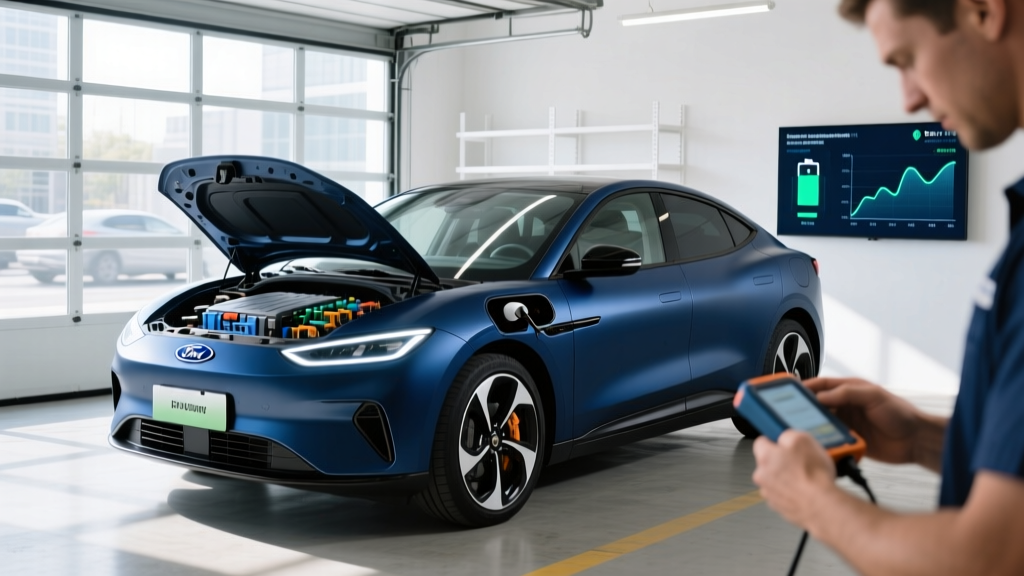
- 12V battery failure: Like every modern EV, the Mach-E and Lightning use a small 12V lead-acid or lithium-ion auxiliary battery to run computers and contactors. When it drops below ~11.8V, the vehicle refuses to start even though the high-voltage pack is full. This is the #1 roadside call for Ford EVs and costs ~$180–$320 to replace.
- High-voltage contactor recall (22V-412, expanded 23V-294): Certain 2021-2022 Mach-E Extended Range and GT models had contactors that could overheat during repeated DC fast charging or wide-open-throttle runs, welding shut and disabling propulsion. Ford's fix was a software update plus, where needed, contactor replacement under recall — free to owners.
- Charge port / CCS handshake faults: Intermittent "Charging Station Malfunction" messages, especially at Electrify America or third-party CCS stalls, often stem from connector pin wear or PLC communication timeouts. Ford's 2025+ switch to NACS (Tesla Supercharger-compatible) ports has reduced this on newer builds.
- OTA software regressions: Ford's SYNC 4A and powertrain control modules receive regular over-the-air updates. Occasionally an update introduces a phantom fault code (P0A0F-type) that clears on the next cycle or requires a dealer reflash.
- Coolant loop / thermal management faults: The Mach-E and Lightning use active liquid cooling. Low coolant or a failing pump triggers "Propulsion Power Reduced" to protect the pack — a $400–$900 repair out of warranty.
Real Repair Costs: EV vs Gas vs Hybrid Ford
How do these malfunction repair costs compare to a gas or hybrid Ford over a typical ownership cycle? The table below uses current dealer and independent-shop averages for common failure points:
| Component | Mustang Mach-E (BEV) | Escape Hybrid (HEV) | Escape 2.0L Gas |
|---|---|---|---|
| 12V battery | $220 | $220 | $220 |
| Traction battery (full) | $18,000–$28,000 | $3,500–$5,500 | N/A |
| Transmission / drivetrain | N/A (single-speed) | $3,800 eCVT | $4,200 8AT |
| Brakes (pad + rotor, 4-whl) | $650 (regen-saved) | $950 | $950 |
| Coolant service | $280 | $220 | $180 |
| Starter / alternator | N/A | N/A | $650 |
| Engine / motor (catastrophic) | $7,500 (motor) | $5,500 | $6,800 |
The EV wins on drivetrain simplicity (no multi-speed transmission, no starter, no alternator, dramatically reduced brake wear from regenerative braking), but loses badly on traction-battery replacement cost. In practice, per NHTSA and Consumer Reports data, full pack replacements on liquid-cooled Ford packs under 100,000 miles are rare — most reported "battery" faults are actually contactor, sensor, or 12V issues covered under the 8-year/100,000-mile warranty.
Warranty, Recalls, and What Ford Actually Covers
Ford's EV warranty structure matters when you're staring at a malfunction message:
- Bumper-to-bumper: 3 years / 36,000 miles
- Powertrain (incl. HV battery, motor, power electronics): 5 years / 60,000 miles
- EV-specific components (battery capacity retention): 8 years / 100,000 miles, with Ford warranting ≥70% of original capacity — a key number because it defines what counts as "degradation" vs a warrantable defect.
- Recall work: Always free regardless of mileage — including the HV contactor campaign and any future safety recalls.
Check your VIN on nhtsa.gov/recalls before buying used. A 2021-2022 Mach-E Extended Range that hasn't had the contactor recall performed is a rolling fault code waiting to happen.
EV vs Gas vs Hybrid: Total 5-Year Ownership Cost
Malfunction risk is only one input. Here's a realistic 5-year / 75,000-mile cost stack for a 2026 Mach-E Select RWD vs an Escape Hybrid vs a gas Escape, assuming home Level 2 charging and $3.40/gal gas:
| Cost Category | Mach-E Select RWD | Escape Hybrid | Escape 2.0L Gas |
|---|---|---|---|
| MSRP (base) | $42,495 | $34,095 | $31,495 |
| Federal §30D credit (if eligible) | –$3,750 (partial sourcing) | $0 | $0 |
| Fuel / electricity (75k mi) | $3,900 | $6,800 | $8,500 |
| Maintenance (scheduled) | $1,100 | $2,400 | $2,900 |
| Insurance (avg) | $9,400 | $7,200 | $7,000 |
| Estimated repairs (out-of-warranty tail) | $800 | $600 | $900 |
| 5-year depreciation | $19,000 | $14,500 | $15,200 |
| 5-yr net cost | $33,945 | $31,595 | $35,795 |
The Mach-E's lower energy and maintenance costs partially offset its higher purchase price and insurance premiums (EV insurance runs ~20-30% above comparable gas models per industry data). The hybrid is the sweet spot for buyers without reliable home charging. Per fueleconomy.gov, the 2026 Mach-E Select RWD rates at 101 MPGe combined vs the Escape Hybrid's 41 MPG combined — a 2.5x efficiency gap that matters most in city driving.
Real-World Ownership Considerations Before You Buy
A malfunction-free EV ownership experience depends as much on your situation as the car itself. Be honest about these four factors:
- Home charging access: If you can install a Level 2 (240V, 32–48A, 7.7–11.5 kW) charger, the Mach-E adds ~25–32 miles of range per hour of charging and you'll almost never visit a public charger. Without home charging, plan on 2–3 DC fast-charge stops per week at $0.35–$0.55/kWh — which erodes the fuel-cost advantage fast.
- Climate: Expect 20–35% range loss below 20°F on the Mach-E's NMC pack, even with its heat pump. A 250-mile EPA sticker becomes ~175 miles in a Minnesota January. Hybrids don't suffer this penalty.
- Driving pattern: Highway-heavy commutes (75+ mph) cut real-world range to ~80% of EPA. The Mach-E Premium AWD Extended Range (EPA 290 mi) delivers ~230 mi at 75 mph in 50°F weather — fine for most trips, tight for Denver-to-Vail runs without a stop.
- Towing: The F-150 Lightning's EPA range drops by roughly 50% when towing a 5,000-lb trailer. If you tow monthly, a gas or hybrid truck still wins on practicality.
Myths vs Facts: Electric Ford Malfunctions
| Myth | Fact |
|---|---|
| "Ford EV batteries fail constantly" | Ford's liquid-cooled NMC packs show ~6-9% degradation at 100k miles based on fleet data — well within the 70% warranty floor. |
| "An EV malfunction means a $30k tow" | Most faults are 12V, software, or contactor issues covered under warranty; catastrophic pack failures are rare outliers. |
| "You can't drive in the rain or through a car wash" | Mach-E and Lightning charge ports and packs are IP67-sealed. Drive and wash normally. |
| "Ford abandoned EV owners" | Recall campaigns are being performed; OTA updates continue on 2021+ models; the 8-yr/100k battery warranty is federally mandated and honored. |
| "Aftermarket fixes void the warranty" | Per the Magnuson-Moss Warranty Act, Ford must prove an aftermarket part caused the failure to deny coverage — but software tampering can void powertrain coverage. |
Decision Framework: Should You Buy, Keep, or Pass?
If → Then
- IF you have home Level 2 charging, drive <80 miles/day, and live in a moderate climate → THEN a 2025+ Mach-E (post-contactor-fix, NACS port) is a strong buy with low malfunction risk.
- IF you're buying a used 2021-2022 Mach-E Extended Range or GT → THEN verify the HV contactor recall (22V-412) was performed before purchase; walk away if not.
- IF you lack home charging and rely on street parking → THEN an Escape Hybrid is the lower-stress choice — no malfunction risk from public-charger communication faults.
- IF you tow frequently or drive in sustained sub-zero weather → THEN an F-150 PowerBoost Hybrid outperforms the Lightning on real-world range while towing.
- IF you see a "Propulsion Power Reduced" warning → THEN pull over safely, cycle the vehicle, and if the message persists, call Ford Roadside Assistance (covered under warranty) — don't limp it home.
FAQ: Electric Ford Malfunction Questions
What should I do if my Mach-E says "Stop Safely Now"?
Pull over immediately, shift to Park, and power off. This message typically indicates HV contactor or thermal runaway-prevention intervention. Call Ford Roadside Assistance (1-800-241-3673) — towing to a certified EV dealer is covered under warranty. Do not attempt to restart and drive.
Is the Ford EV battery recall still active in 2026?
Yes. The HV contactor recall (NHTSA 22V-412, later expanded) applies to specific 2021-2022 Mach-E Extended Range and GT VINs. Parts and software updates are still being performed free of charge. Check your VIN at nhtsa.gov/recalls.
How much does a Mach-E battery replacement cost out of warranty?
Full pack replacement runs $18,000–$28,000 for the Standard Range (70 kWh usable) and $24,000–$32,000 for the Extended Range (91 kWh usable), including labor. However, packs rarely need full replacement — individual modules can often be serviced for $2,500–$5,000.
Does the §30D federal tax credit still apply to the 2026 Mach-E?
Per IRS §30D rules, the Mach-E qualifies for up to $3,750 (partial critical-minerals credit; battery-component sourcing disqualifies the full $7,500 as of 2026). Income caps ($150k single / $300k joint) and the $80,000 MSRP cap for SUVs apply. The credit can be transferred to the dealer at point of sale. Always verify with a tax professional — sourcing rules tighten annually.
Are Ford EVs more reliable than Teslas?
On build quality and panel fit, Ford generally scores higher in initial quality surveys. On powertrain fault frequency, Tesla's simpler pack architecture and longer production history give it a slight edge per Consumer Reports 2025 data. Both brands trail Toyota/Hyundai in overall EV reliability — a factor worth weighing if malfunction anxiety is your primary concern.