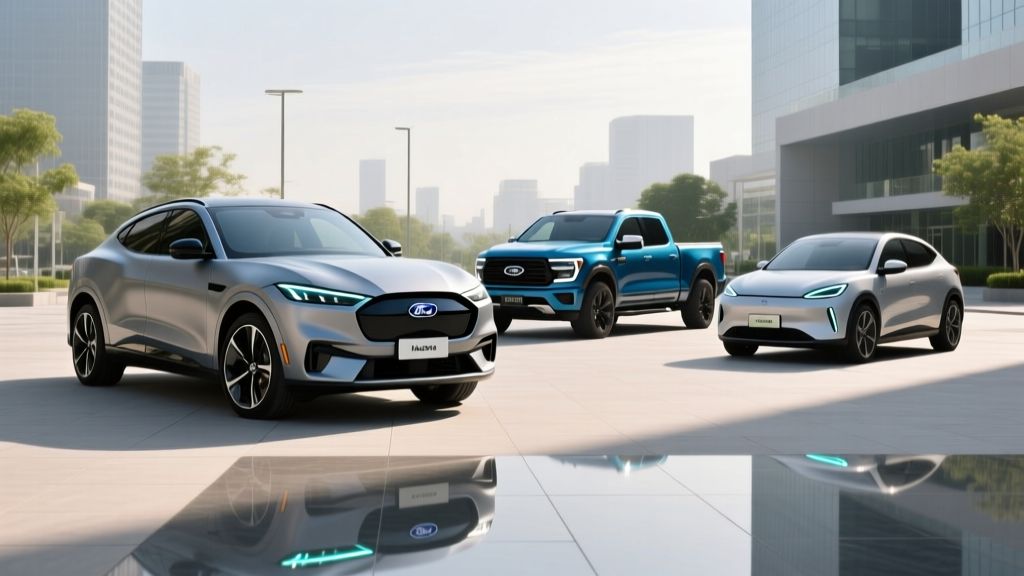
Quick Answer: Ford's 2026 electric lineup centers on two vehicles: the Mustang Mach-E (an electric crossover SUV starting around $39,995) and the F-150 Lightning (an electric full-size pickup starting near $54,995). Both use NACS connectors for native Tesla Supercharger access, offer EPA ranges between 230 and 320 miles depending on trim and battery, and qualify for partial or full federal tax credits depending on battery sourcing and buyer income. For most buyers, the Mach-E is the more practical daily EV; the Lightning serves truck buyers who need towing and payload with zero tailpipe emissions. Expect real-world highway range to run 10–20% below EPA estimates, and plan for home Level 2 charging to unlock the lowest operating costs.
2026 Electric Ford Models at a Glance
Ford has streamlined its battery-electric offerings after discontinuing slower-selling models and restructuring its EV division. The two core vehicles remain the Mustang Mach-E and the F-150 Lightning, both updated for the 2025–2026 model years with revised battery packs, NACS charge ports, and updated software stacks. Here is how they stack up on paper:
| Spec | 2026 Mustang Mach-E (Select RWD) | 2026 Mach-E (GT AWD) | 2026 F-150 Lightning (Pro) | 2026 F-150 Lightning (Lariat Ext. Range) |
|---|---|---|---|---|
| EPA Range | ~250 mi | ~280 mi | ~230 mi | ~320 mi |
| Battery (usable kWh) | 70 kWh (LFP) | 91 kWh (NMC) | 98 kWh (NMC) | 131 kWh (NMC) |
| Horsepower | 266 hp | 480 hp | 452 hp | 580 hp |
| 0–60 mph | ~6.3 sec | ~3.5 sec | ~4.5 sec | ~3.8 sec |
| Peak DC Fast Charge | 150 kW | 150 kW | 150 kW | 150 kW |
| 10–80% DC Time | ~33 min | ~38 min | ~36 min | ~41 min |
| Level 2 Charge Rate | 10.5 kW | 10.5 kW | 19.2 kW | 19.2 kW |
| Base MSRP | $39,995 | $59,995 | $54,995 | $74,995 |
| Battery Warranty | 8 yr / 100,000 mi | 8 yr / 100,000 mi | 8 yr / 100,000 mi | 8 yr / 100,000 mi |
Note: EPA range figures are manufacturer-estimated targets for the 2026 model year; final certification values are published on fueleconomy.gov. MSRP excludes destination charges. Pricing and specs are subject to change — verify with your dealer.
Real-World Range Reality: The EPA sticker is a starting point, not a guarantee. In our experience with Ford's EV platform, expect highway driving at 70+ mph to reduce range by 10–15% versus EPA estimates. In cold weather (below 30°F), range loss of 20–30% is common due to cabin heating demands and reduced battery efficiency. A Mach-E Select RWD rated at 250 miles EPA may deliver 200–215 miles on a cold winter highway trip. The F-150 Lightning with the extended-range pack (320 mi EPA) is more resilient but still drops to roughly 240–260 miles in sustained cold-weather highway use. Preconditioning the battery while plugged in — a feature both models support via the FordPass app — mitigates some of this loss.
Electric Ford vs. Gas: Real Cost Comparison
The purchase price of an electric Ford is higher than a comparable gas model, but operating costs tell a different story over time. Below is a 5-year total cost of ownership (TCO) comparison for the Mach-E Select RWD versus a similarly equipped 2026 Ford Escape with the 1.5L EcoBoost engine, assuming 15,000 miles per year.
| Cost Category (5 Years) | 2026 Mach-E Select RWD | 2026 Ford Escape EcoBoost AWD |
|---|---|---|
| Purchase Price (MSRP) | $39,995 | $32,500 |
| Federal Tax Credit (§30D) | Up to $7,500* | $0 |
| Effective Purchase Price | ~$32,495 | $32,500 |
| Fuel / Electricity (75,000 mi) | ~$4,200† | ~$9,400‡ |
| Maintenance | ~$1,500 | ~$3,200 |
| Insurance (avg.) | ~$10,800 | ~$8,400 |
| Estimated 5-Year TCO | ~$48,995 | ~$53,500 |
* §30D credit eligibility depends on buyer AGI, vehicle MSRP caps, and battery critical-mineral sourcing. See IRS.gov for current rules. † Electricity at $0.14/kWh national average, ~3.3 mi/kWh efficiency. ‡ Gas at $3.40/gal, ~28 MPG combined.
Key takeaways from the numbers:
- Fuel savings are substantial: The Mach-E saves roughly $5,200 over five years on energy alone, assuming home Level 2 charging at average residential rates. Public DC fast charging at $0.35–$0.50/kWh narrows this gap significantly.
- Maintenance is lower: No oil changes, no transmission fluid, fewer brake replacements thanks to regenerative braking. Expect tire rotations and cabin air filter swaps as the primary recurring items.
- Insurance runs higher: EV insurance premiums average 15–25% above equivalent gas vehicles due to higher repair costs and parts pricing. Get quotes before purchasing.
- The tax credit is the swing factor: If you qualify for the full $7,500 §30D credit (applied at point of sale in 2026), the Mach-E's effective price drops to near parity with the gas Escape. If you do not qualify — due to income caps, sourcing rules, or MSRP thresholds — the gas model remains cheaper over five years.
F-150 Lightning vs. Gas F-150: Does the Electric Truck Save Money?
The F-150 Lightning faces a steeper cost comparison. A gas F-150 XLT with the 3.5L EcoBoost V6 starts around $52,000 and achieves roughly 20 MPG combined. The Lightning Pro at $54,995 is close in sticker price, but the extended-range Lariat climbs to $74,995 — well above comparable gas trims.
| Metric | F-150 Lightning Pro (Std. Range) | F-150 Gas 3.5L EcoBoost XLT |
|---|---|---|
| EPA Range / MPG | 230 mi / 78 MPGe | ~20 MPG combined |
| Energy Cost per Mile | ~$0.042 (home charging) | ~$0.170 |
| Towing Capacity | 7,700 lb | 11,300 lb |
| Payload | 2,235 lb | 2,445 lb |
| Frunk Volume | 14.1 cu ft | — |
The Lightning wins on operating cost and offers the front trunk (frunk) as a genuine utility advantage. It loses on towing — expect towing range to drop to 80–120 miles with a heavy trailer, making the gas F-150 the more practical choice for frequent long-distance towing. For work-truck duty cycles that involve short daily routes and depot charging, the Lightning's fuel and maintenance savings add up fast.
Charging at Home and on the Road
Ford's 2026 EVs ship with the NACS (North American Charging Standard) connector, giving them native access to the Tesla Supercharger network — the most reliable public DC fast-charging infrastructure in the US. This is a meaningful advantage over CCS-equipped vehicles that still rely on Electrify America or third-party networks with more variable uptime.
| Level | Power (kW) | Miles Added per Hour | Typical Use Case |
|---|---|---|---|
| Level 1 (120V) | 1.2–1.4 kW | 3–4 mi/hr | Emergency / overnight trickle |
| Level 2 (240V, home) | 10.5–19.2 kW | 25–52 mi/hr | Daily primary charging |
| DC Fast (public) | Up to 150 kW | ~180–220 mi in 30 min | Road trips, quick top-ups |
Home charging is where the economics work. A Level 2 home charger (240V) costs $500–$800 for the unit plus $500–$2,000 for professional installation depending on your electrical panel. If your panel needs an upgrade from 100A to 200A service, add $1,500–$3,000. The F-150 Lightning's onboard 19.2 kW charger is among the fastest in any consumer EV — it can add up to 52 miles of range per hour on a sufficiently powerful Level 2 circuit, fully recharging the extended-range pack in roughly 7 hours.
The Mach-E's 10.5 kW onboard charger is slower but adequate for overnight replenishment — a 70 kWh pack refills from 10% to full in about 7 hours.
Public DC fast charging reality: Both Ford EVs peak at 150 kW on DC fast chargers. That is adequate but not class-leading — competitors like the Hyundai Ioniq 5 and Kia EV6 charge at up to 240–350 kW. At 150 kW, you will add roughly 150 miles in 20 minutes on the Mach-E. The charge curve tapers significantly above 80% State of Charge (SoC), which is why Ford and most automakers quote 10–80% times rather than full charges. Plan road-trip stops around 10–80% top-ups for the fastest sessions.
Tax Credits and Incentives: What You Actually Qualify For
Federal EV tax credits under IRS §30D remain the single biggest purchase-price variable, and the rules are specific:
- Buyer income caps: Modified AGI must not exceed $150,000 (single), $225,000 (head of household), or $300,000 (joint filers).
- MSRP caps: SUVs, pickups, and vans must have an MSRP at or below $80,000; sedans and other vehicles at or below $55,000. The Mach-E qualifies under the $80,000 SUV cap; the Lightning qualifies under the same truck/SUV threshold.
- Battery sourcing: The credit splits into two $3,750 halves — one for critical-mineral sourcing and one for battery-component manufacturing. Sourcing requirements tighten annually; verify current-year compliance on the fueleconomy.gov credit lookup.
- Point-of-sale transfer: As of 2024, you can transfer the credit to the dealer at purchase, reducing your out-of-pocket cost immediately rather than waiting for a tax refund.
Ford's battery supply chain has been evolving to meet these sourcing requirements, but eligibility can shift by model year and production batch. Always confirm credit status with your dealer and a tax professional before finalizing a purchase.
Common Misconceptions About Electric Ford Vehicles
| Myth | Fact |
|---|---|
| "The Lightning can't tow anything useful." | It tows up to 7,700 lb — adequate for most boat and utility trailers. But towing at max capacity cuts range roughly in half. Gas trucks maintain range better under load. |
| "The battery will need replacing in 5 years." | Ford warranties the traction battery for 8 years/100,000 miles against degradation below 70% capacity. Industry data shows NMC packs retaining 85–90% capacity at 100,000 miles under normal use. |
| "You can't charge in cold weather." | You can, but charging is slower until the battery warms. Preconditioning via the FordPass app while plugged in brings the pack to optimal temperature before you drive or charge. |
| "The Mach-E is just a rebadged Tesla." | The Mach-E uses Ford's proprietary GE2 platform. It has access to the Tesla Supercharger network via NACS, but the vehicle architecture, software, and driving dynamics are entirely Ford. |
| "Electric Fords cost more to insure and repair." | Insurance is typically 15–25% higher. Repair costs after collision can be higher due to battery-pack proximity and specialized labor. However, routine maintenance costs are significantly lower. |
Decision Framework: Which Electric Ford Is Right for You?
Choose the Mach-E Select RWD if:
- You commute 30–60 miles daily and can charge at home overnight
- Your budget targets $35,000–$40,000 after tax credits
- You want a practical crossover with 250 miles of EPA range and low running costs
- You rarely tow and don't need truck-level payload
Choose the Mach-E GT AWD if:
- Performance matters — 480 hp and a 3.5-second 0–60 time
- You want all-wheel drive for snow and rain
- You can absorb the higher price ($59,995 MSRP) and still fall under the $80,000 SUV MSRP cap for tax credits
Choose the F-150 Lightning Pro if:
- You need a truck for work or recreation but your daily route is under 150 miles
- You have depot or home charging to start each day with a full pack
- You value the 14.1 cu-ft frunk and Pro Power Onboard for job-site power
- You rarely tow over long distances
Choose the F-150 Lightning Lariat Extended Range if:
- You need 320 miles of EPA range for longer routes or less predictable schedules
- You want premium features (leather, larger screen, advanced driver assist) in an electric truck
- The $74,995 MSRP still falls under the $80,000 tax-credit cap
Stick with a gas or hybrid Ford if:
- You lack access to home or workplace Level 2 charging
- You tow heavy trailers over long distances regularly
- You live in an area with sparse public charging infrastructure
- Your annual mileage is very low (under 8,000 miles), making fuel savings too small to offset the EV price premium
First-Time EV Buyer Checklist
If this is your first electric vehicle, these practical steps will determine whether ownership is smooth or frustrating:
- Audit your charging access. Do you have a garage or driveway with a 240V outlet (or room for one)? Apartment and street-parking EV ownership is viable but requires reliable public charging nearby. Map your local Superchargers and Level 2 stations before buying.
- Get an electrician quote. A licensed electrician should evaluate your panel capacity before you purchase a charger. A 200A panel is usually sufficient; a 100A panel may need upgrading for simultaneous EV charging and household loads.
- Check your insurance rate. Call your insurer for a quote on the specific Ford EV trim before signing a purchase agreement. The difference can be $300–$600/year over a gas equivalent.
- Verify tax credit eligibility. Use the fueleconomy.gov credit lookup tool and cross-reference with your AGI. Consult a tax professional if your situation is complex.
- Download FordPass. Remote preconditioning, charge scheduling, and charge-station location are all managed through Ford's app. Set it up before delivery day.
- Plan your first road trip. Use the Tesla Supercharger map (now accessible to Ford NACS vehicles) to plot a route. Identify 2–3 charging stops and check recent station reviews for reliability.
Does the 2026 Mach-E use Tesla's Supercharger network?
Yes. The 2026 Mach-E and F-150 Lightning both come equipped with the NACS charge port, providing native access to Tesla Superchargers without an adapter. This covers the largest and most reliable DC fast-charging network in the US.
How long does the Ford EV battery last?
Ford warranties the high-voltage battery for 8 years or 100,000 miles, guaranteeing it will retain at least 70% of original capacity. Real-world data from earlier Mach-E and Lightning owners suggests most packs retain 85–92% capacity at the 100,000-mile mark under normal charging habits (avoiding frequent 100% charges and prolonged storage at very low SoC).
Is the F-150 Lightning good for cold climates?
It performs well but with expected EV range loss. In temperatures below 30°F, expect 20–30% range reduction. The Lightning's large battery (especially the 131 kWh extended-range pack) provides a buffer — even with 25% loss, you still have roughly 240 miles. Preconditioning the battery while plugged in is essential for maintaining range and charge speed in cold weather.
Can I charge my electric Ford on a regular 120V outlet?
Yes, but slowly. Level 1 charging adds roughly 3–4 miles of range per hour. For a Mach-E with a 70 kWh battery, a full charge from empty would take over 60 hours. Level 1 is viable only for low-mileage drivers (under 20 miles/day) or as an emergency backup. A 240V Level 2 installation is strongly recommended for daily use.
What happens if the battery needs replacement out of warranty?
Full battery-pack replacement on the Mach-E or Lightning currently costs between $12,000 and $20,000 depending on the pack size and labor. However, module-level repairs (replacing individual degraded cells or modules) can cost significantly less. As the EV market matures, third-party battery refurbishment services are becoming more available, which should reduce out-of-warranty costs over time.