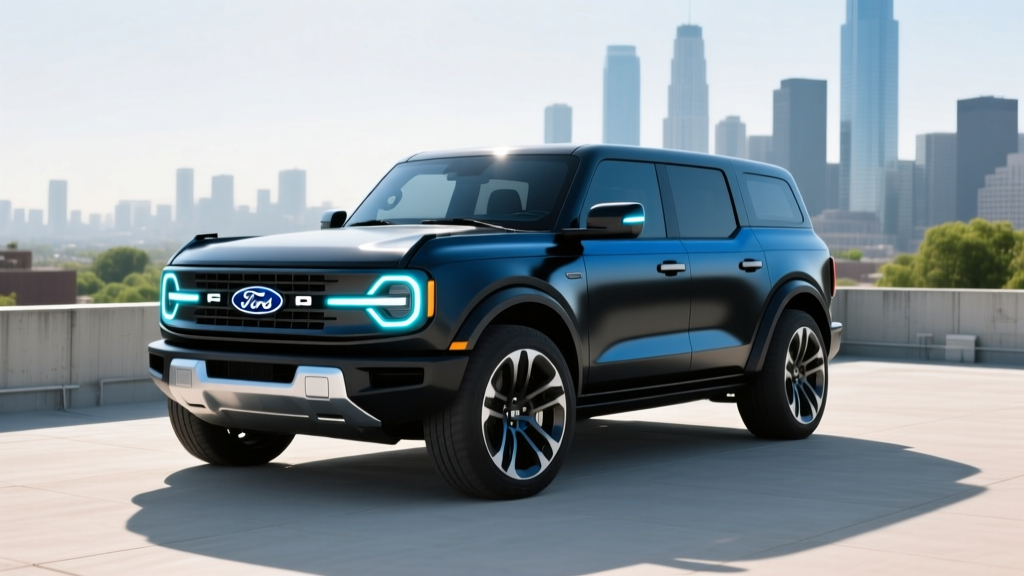
The Short Answer: No Electric Ford Bronco Exists Yet
As of the 2026 model year, there is no fully electric Ford Bronco available for purchase. Ford continues to sell the Bronco exclusively with internal-combustion powertrains — a 2.3L EcoBoost four-cylinder and a 2.7L EcoBoost V6, plus the high-output 3.0L V6 in the Bronco Raptor. Ford has not officially announced a battery-electric Bronco with a confirmed production date.
However, Ford has signaled its off-road EV ambitions. The company has filed trademarks and shown concepts suggesting an electrified 4x4 is in development, and the broader Ford Model e division continues to expand. If you want an electric SUV with genuine off-road capability today, several alternatives from Rivian, Jeep, and others fill the gap — and we break down exactly how they compare below.
Why Ford Hasn't Launched an Electric Bronco (Yet)
The Bronco's core buyer profile creates a unique engineering challenge for electrification. This is a body-on-frame off-roader whose owners regularly drive into remote areas far from charging infrastructure, tow heavy loads, and demand extreme articulation and durability. Ford has been cautious about electrifying this segment for several concrete reasons:
- Range under off-road load: Rock crawling, sand driving, and towing can cut EV range by 40-60% compared to EPA estimates. A Bronco EV would need a massive battery pack — likely 120+ kWh usable — to maintain acceptable real-world range in these conditions.
- Charging desert problem: Many popular off-road destinations (Moab, Rubicon Trail, remote national forests) have zero DC fast charging within 50+ miles. This creates a genuine stranding risk that doesn't exist with a gas tank and a jerrycan.
- Weight and ground clearance trade-offs: Large battery packs add 1,000-1,500 lbs. For an off-roader, that mass affects approach/departure angles, suspension travel, and tire wear on technical terrain.
- Platform architecture: The current Bronco rides on Ford's body-on-frame T6 platform (shared with the Ranger). Ford has not yet confirmed an electric skateboard platform optimized for serious off-road use, though the company's investment in flexible EV architectures suggests this is coming.
Ford CEO Jim Farley has publicly stated that the company sees "huge opportunity" in electric off-roaders and adventure vehicles, but no production timeline has been committed. Industry analysts expect a Bronco EV or PHEV could arrive in the 2027-2029 timeframe, but this remains speculation.
What You Can Buy Instead: Electric & Electrified Off-Road SUVs in 2026
If you're shopping for an electric vehicle that delivers Bronco-like capability, here's what's actually on dealer lots right now, with exact specifications:
| Vehicle | Powertrain | EPA Range | Battery (kWh) | 0-60 mph | Horsepower | Starting MSRP |
|---|---|---|---|---|---|---|
| Rivian R1S (Dual-Motor) | BEV | 352 mi | 106 kWh (NMC) | 4.5 sec | 533 hp | $79,900 |
| Rivian R1S (Quad-Motor) | BEV | 321 mi | 106 kWh (NMC) | 2.9 sec | 1,025 hp | $94,900 |
| Jeep Wrangler 4xe | PHEV | 21 mi electric + hybrid | 17.3 kWh (NMC) | 6.0 sec | 375 hp | $51,795 |
| Ford Bronco (2.7L V6) | Gas | ~380 mi (17.5 gal tank) | N/A | 6.5 sec | 330 hp | $40,895 |
| GMC Hummer EV SUV | BEV | 314 mi | 212.7 kWh (NMC) | 3.5 sec | 830 hp | $98,845 |
Sources: fueleconomy.gov, manufacturer specification pages. EPA range figures; real-world range typically 10-20% lower at sustained highway speeds or in cold weather.
Real Cost Breakdown: Electric Off-Roader vs. Gas Bronco
Let's compare the five-year total cost of ownership between the closest electric alternative (Rivian R1S Dual-Motor) and the Ford Bronco Badlands (2.7L EcoBoost, similarly equipped for off-road use). This is where the math either works for you or doesn't.
| Cost Category | Rivian R1S Dual-Motor | Ford Bronco Badlands 2.7L |
|---|---|---|
| Base MSRP | $79,900 | $48,495 |
| Federal Tax Credit (§30D) | $0 (MSRP exceeds $80K SUV cap; check current IRS sourcing rules) | $0 (not an EV/PHEV) |
| Estimated Insurance (5 yr) | $14,500 | $9,800 |
| Fuel/Energy (5 yr, 60K mi) | $5,400 (home L2 @ $0.14/kWh) | $11,250 (gas @ $3.50/gal, 19 MPG combined) |
| Maintenance (5 yr) | $2,100 | $4,200 |
| Est. Depreciation (5 yr) | $32,000 | $18,500 |
| 5-Year Total Cost | ~$101,900 | ~$55,245 |
The honest takeaway: The Rivian R1S is a dramatically more capable vehicle in terms of performance, technology, and on-road refinement, but it costs nearly twice as much over five years. The fuel and maintenance savings (~$7,950 combined over 5 years) do not come close to offsetting the $31,400 purchase price gap. An electric off-roader makes financial sense only if you were already shopping in the $75K+ SUV segment and value the performance and tech benefits.
For current §30D federal tax credit rules — including MSRP caps ($80,000 for SUVs/trucks), buyer income limits, and battery sourcing requirements — consult the IRS clean vehicle credit page or a qualified tax professional. Credit eligibility changes frequently.
Real-World Ownership: What First-Time EV Buyers Must Know
If you've never owned an EV and you're considering an electric off-roader as your first, here are the practical realities that brochures don't emphasize:
Home Charging Is Non-Negotiable for Most Owners
Over 80% of EV charging happens at home. If you can install a Level 2 (240V) charger in your garage or driveway, daily ownership is effortless — you wake up to a full "tank" every morning. A Level 2 installation typically costs $800-$2,500 including equipment and electrician labor, assuming your electrical panel has capacity. If you need a panel upgrade (common in older homes), add $1,500-$3,000. If you cannot charge at home — apartment dwellers, street parking only — an EV becomes significantly less convenient and you should carefully evaluate public charging access near your home before buying.
Charging Speeds: What the Numbers Actually Mean
Understanding the difference between kW (power, or how fast energy flows) and kWh (energy, or battery capacity) is critical. Think of kW as the width of a hose and kWh as the size of the bucket.
- Level 1 (120V household outlet): ~1.4 kW — adds about 3-5 miles of range per hour. Fine for a PHEV with a small battery; useless for a 100+ kWh EV battery.
- Level 2 (240V home/public): 7.2-19.2 kW — adds 25-60 miles per hour. A full overnight charge for any EV.
- DC Fast Charging: 50-350 kW — can add 100-250+ miles in 20-30 minutes. The Rivian R1S peaks at ~200 kW on compatible chargers, reaching 10-80% in approximately 30 minutes.
Charging curve reality: Peak kW is never sustained. A vehicle that "charges at 200 kW" only hits that rate at low state-of-charge (typically 10-30%). Above 80%, charging slows dramatically to protect battery health — often dropping below 50 kW. This is why manufacturers quote 10-80% times rather than 0-100%.
Cold Weather Cuts Range — Significantly
In freezing temperatures (below 32°F), expect 15-30% range loss depending on severity and whether you use cabin heat. The Rivian R1S with its heat pump system handles cold better than most, but a 352-mile EPA rating can realistically drop to 260-280 miles at 20°F on the highway. For off-road use in winter conditions, plan conservatively.
Common Misconceptions About Electric Off-Roaders
| Myth | Fact |
|---|---|
| "EVs can't handle real off-roading" | Electric motors deliver instant torque at zero RPM, which is ideal for rock crawling. The Rivian R1S has 14.9 inches of ground clearance (max), quad-motor torque vectoring, and has completed the Rubicon Trail. The limitation is charging access at remote trailheads, not capability. |
| "Electric SUVs can't tow" | The Rivian R1S is rated to tow 7,700 lbs. However, towing cuts range by roughly 40-50%. A 352-mile range drops to ~180 miles when towing a 5,000-lb trailer at highway speed. Plan charging stops accordingly. |
| "Battery replacement will cost $20,000+" | Rivian's battery warranty covers 8 years/175,000 miles with a minimum 70% capacity retention threshold. Real-world degradation data from early R1T/R1S owners shows approximately 5-8% loss over the first 60,000 miles. Full replacement is rarely needed and is covered under warranty for most owners. |
| "A PHEV is just as good as a full EV" | The Jeep Wrangler 4xe's 21-mile electric range covers short commutes but reverts to a 20 MPG combined gas hybrid for longer trips. You get some EV benefits locally but still pay for oil changes, transmission service, and gas on road trips. It's a bridge solution, not a full transition. |
| "I'll save money going electric" | You'll save on fuel and maintenance, but higher purchase price, insurance premiums (EV insurance averages 15-25% higher), and steeper depreciation in the current market often erase those savings over 5 years unless you qualify for tax credits or were already buying in a premium price bracket. |
Decision Framework: Should You Wait, Go Electric, or Stick With Gas?
Choose a gas Ford Bronco if:
- You regularly drive to remote off-road destinations with no charging infrastructure within 50+ miles
- Your budget is under $55,000 and you want a purpose-built off-roader
- You tow frequently and need maximum range between fuel stops
- You want to buy now and not speculate on future model releases
- You lack home charging access and public charging in your area is sparse
Choose the Rivian R1S (or similar electric off-roader) if:
- You have home Level 2 charging and your daily driving is under 200 miles
- You were already shopping in the $75,000+ luxury SUV segment
- You value instant torque, low center of gravity, and one-pedal driving on trails
- Your off-road trips are within range of DC fast charging corridors (or you're willing to plan around them)
- You want the lowest per-mile energy cost and minimal drivetrain maintenance
Choose the Jeep Wrangler 4xe (PHEV) if:
- You want some electric driving for a short commute but need gas range for weekend adventures
- You want removable doors and a folding windshield (no EV currently offers this)
- Your budget is $50,000-$60,000 and you want to reduce fuel costs without range anxiety
- You want to "test" electrified ownership before committing to a full BEV
Wait for a potential Ford Bronco EV if:
- You're specifically committed to the Bronco brand, parts ecosystem, and aftermarket support
- Your purchase timeline is flexible (2028+ based on current industry signals)
- You want to see how Ford's off-road EV platform performs in real-world use before committing
Frequently Asked Questions
Has Ford officially confirmed an electric Bronco?
No. As of early 2026, Ford has not announced a production electric Bronco with a confirmed release date or specifications. Ford has discussed electrifying its "iconic" nameplates, and trademark filings suggest the company is exploring the space, but nothing is confirmed for sale.
What's the closest electric alternative to a Ford Bronco?
The Rivian R1S is the closest match in terms of off-road capability, three-row seating, and adventure-oriented design. It offers up to 352 miles of EPA range, 14.9 inches of ground clearance, and genuine rock-crawling ability. The GMC Hummer EV SUV is larger and more powerful but starts near $99,000.
Can I convert a gas Ford Bronco to electric?
Aftermarket EV conversion companies (such as Zero Labs and others) have performed classic Bronco restomod conversions, but these typically cost $150,000-$300,000+ and are not practical for most buyers. Converting a current-generation Bronco would void all factory warranties and is not recommended.
Does the Ford Bronco Sport have an electric version?
No. The Bronco Sport (the smaller, unibody crossover based on the Escape platform) is currently sold only with gas powertrains (1.5L and 2.0L EcoBoost). Ford has not announced an electric Bronco Sport variant.
What federal tax credits apply to electric off-road SUVs?
Under IRS §30D, new clean vehicles may qualify for up to $7,500 in federal tax credits, but eligibility depends on multiple factors: the vehicle's MSRP must not exceed $80,000 for SUVs/pickups, buyer income must fall below caps ($300K joint / $150K individual), and battery components and critical minerals must meet domestic sourcing thresholds that tighten annually. The Rivian R1S Dual-Motor's MSRP falls just under the $80K cap at base, but options can push it over. Always verify current eligibility on IRS.gov before purchasing.
How much does it cost to charge an electric SUV at home vs. gas?
At the US average residential electricity rate of ~$0.16/kWh, fully charging the Rivian R1S's 106 kWh battery costs roughly $17, yielding about 3.2 miles per dollar. The gas Bronco at 19 MPG combined with gas at $3.50/gallon costs about $0.18 per mile — roughly 5.4 miles per dollar. Over 12,000 annual miles, that's approximately $2,210 in gas vs. $1,080 in electricity — a savings of ~$1,130 per year with home charging. Public DC fast charging at $0.35-$0.50/kWh narrows this gap significantly.
For the latest safety data on vehicles mentioned in this guide, consult NHTSA.gov and IIHS.org crash test ratings. Specifications, pricing, and tax credit eligibility are based on 2026 model year data and are subject to change.