The Short Answer: Fleet EV Savings
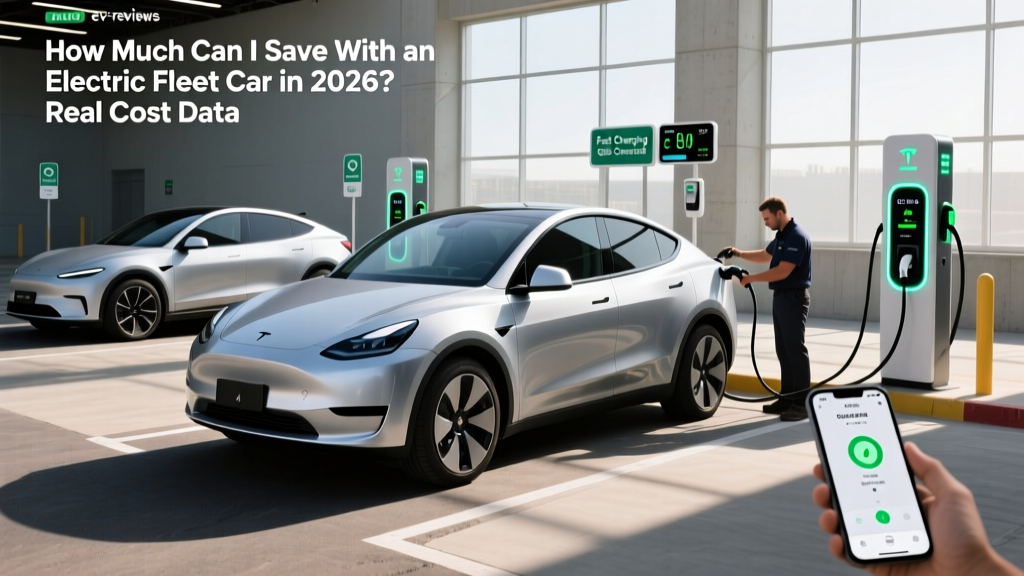
For most commercial fleets in 2026, switching a mid-size sedan or compact SUV from gas to electric saves $4,200–$7,800 per vehicle per year in combined fuel and maintenance costs. Over a 5-year fleet lifecycle, that translates to $21,000–$39,000 in net savings per vehicle after accounting for higher upfront purchase price, charging infrastructure, and available federal tax credits. The exact figure depends on annual mileage, local electricity rates, depot charging access, and whether vehicles qualify for the IRS §30D commercial clean vehicle credit (up to $7,500) or the §45W commercial credit for heavier fleet vehicles.
The Real Numbers: EV Fleet Cost Per Mile vs Gas
Fleet managers think in cost-per-mile, not MSRP stickers. Here's what the data shows for a typical 2026 fleet vehicle driven 25,000 miles annually — a reasonable figure for sales reps, service technicians, or delivery routes.
| Cost Category | Gas Fleet Vehicle (2026 Toyota Camry LE) | EV Fleet Vehicle (2026 Tesla Model 3 RWD) | Annual Difference |
|---|---|---|---|
| Fuel / Energy (25k mi/yr) | $2,500 (28 MPG combined @ $2.80/gal) | $680 (26 kWh/100mi @ $0.105/kWh depot rate) | +$1,820 savings (EV) |
| Maintenance | $1,100/yr (oil, filters, brakes, belts) | $350/yr (cabin filter, wipers, tire rotation) | +$750 savings (EV) |
| Tires | $400/yr | $520/yr (heavier vehicle, instant torque wear) | –$120 (gas wins) |
| Insurance (commercial fleet) | $1,800/yr | $2,100/yr (higher repair costs) | –$300 (gas wins) |
| Depreciation (5-yr) | $3,200/yr | $3,800/yr (faster depreciation) | –$600 (gas wins) |
| Net Annual Operating Cost | $9,000 | $7,450 | +$1,550 net savings/yr |
Sources: fueleconomy.gov for EPA efficiency data; AAA Your Driving Costs 2025 for maintenance/insurance averages; commercial electricity rates from EIA. Actual results vary by region and driving pattern.
The raw operating savings look modest at $1,550/year in this conservative scenario. But fleet economics shift dramatically when you factor in higher mileage, cheaper overnight depot charging, and tax incentives — which we'll cover next.
Total Cost of Ownership: 5-Year Fleet Breakdown
Fleet decisions are lifecycle decisions. Here's a 5-year TCO model for a 10-vehicle fleet of compact sedans, each driven 35,000 miles/year (a realistic figure for field sales or service fleets).
| 5-Year TCO Component | Gas Fleet (10 vehicles) | EV Fleet (10 vehicles) |
|---|---|---|
| Vehicle Acquisition (MSRP avg) | $295,000 ($29,500 × 10) | $395,000 ($39,500 × 10) |
| Federal Tax Credit (§45W, up to $7,500/vehicle) | $0 | –$75,000 (if eligible) |
| Net Acquisition Cost | $295,000 | $320,000 |
| Depot Charging Infrastructure (Level 2, 10 stalls) | $0 | $45,000–$85,000 (install + hardware) |
| Energy/Fuel (5 yrs, 35k mi/yr/vehicle) | $612,500 | $166,250 |
| Maintenance (5 yrs) | $192,500 | $61,250 |
| Insurance (5 yrs, fleet rate) | $315,000 | $367,500 |
| Residual Value (year 5) | –$105,000 | –$87,500 |
| Total 5-Year Fleet Cost | $1,307,500 | $872,500 |
| Per-Vehicle 5-Year Savings | ~$43,500 per vehicle | |
At higher mileage, the math overwhelmingly favors electric. The breakeven point for most fleet EVs falls between 18 and 30 months of operation, depending on fuel savings magnitude and whether charging infrastructure was already in place.
Commercial EV Tax Credits: §45W and §30D Explained
Fleet buyers have access to two distinct federal incentives, and understanding which applies to your vehicles is critical for accurate savings projections.
- §45W Commercial Clean Vehicle Credit — For vehicles acquired for business use. Up to $7,500 for vehicles under 14,000 lbs GVWR, or $40,000 for heavier vehicles. No MSRP cap. No personal income cap. Vehicle must meet battery component and critical mineral sourcing requirements per IRS guidance.
- §30D New Clean Vehicle Credit — Available if the vehicle is assigned to an employee for personal use (treated as a personal purchase). Up to $7,500 with strict MSRP caps ($55,000 sedans, $80,000 SUVs/trucks), buyer income limits ($150k single / $300k joint), and North American assembly requirements.
- Depot Charging Infrastructure Credit (§30C) — Up to 30% of charging equipment and installation costs, capped at $100,000 per item of property. This can significantly offset your Level 2 depot build-out.
- State and utility incentives — Many states and local utilities offer additional rebates for fleet electrification. Check AFDC's state law database for your jurisdiction.
Fleet Tax Credit Impact on Acquisition Cost
| Vehicle | MSRP | §45W Credit | Net Cost |
|---|---|---|---|
| 2026 Tesla Model 3 RWD | $38,990 | $7,500 | $31,490 |
| 2026 Chevrolet Equinox EV LT | $33,600 | $7,500 | $26,100 |
| 2026 Ford F-150 Lightning Pro (fleet) | $54,995 | $7,500 | $47,495 |
| 2026 Ford E-Transit (cargo van) | $47,595 | $7,500 | $40,095 |
Critical caveat: Battery sourcing requirements tighten annually. Not every trim or model year qualifies for the full credit. Always verify current eligibility on fueleconomy.gov's tax credit tool before projecting savings.
Charging Infrastructure: The Cost Fleet Buyers Underestimate
The single biggest variable in fleet EV savings is whether you can charge at a depot overnight. Public DC fast charging at $0.35–$0.55/kWh erases most of the fuel savings advantage. Depot Level 2 charging at commercial electricity rates of $0.08–$0.13/kWh is where the economics work.
| Depot Charging Component | Cost Range (per stall) | Notes |
|---|---|---|
| Level 2 charger hardware (48A / 11.5 kW) | $600–$1,500 | Commercial-rated units (e.g., ChargePoint CT4000, EV Box BusinessLine) |
| Electrical panel upgrade (if needed) | $2,000–$8,000 | Many fleet depots need 400A+ service for 10+ chargers |
| Wiring, conduit, labor (electrician) | $1,500–$4,500 | Distance from panel to parking spot is the main variable |
| Permits and utility interconnection | $500–$2,000 | Some utilities require demand-charge studies |
| Smart charging software (load management) | $20–$50/month/stall | Essential for fleets to avoid utility demand charges |
| Total per stall (typical) | $4,600–$16,000 | Average: ~$7,500/stall installed |
For a 10-vehicle fleet, expect $45,000–$85,000 in total depot charging infrastructure costs before the §30C credit. After the 30% credit, net cost drops to roughly $31,500–$59,500.
Demand charge warning: Commercial electricity bills include demand charges based on your peak kW draw. Ten vehicles plugging in simultaneously at 11.5 kW each = 115 kW peak. Without smart load management software that staggers charging sessions, demand charges can add $300–$1,200/month to your utility bill. Software like ChargePoint Fleet or Amply Power handles this automatically.
Real-World Fleet Considerations: Where EV Savings Shrink
Not every fleet use case benefits equally from electrification. Here's what honest fleet analysis must account for:
Cold-Weather Range Loss
In northern climates (Minnesota, Maine, Colorado), expect 20–35% range reduction in winter months. A 2026 Model 3 RWD with an EPA-rated 272-mile range may deliver only 180–215 miles in 20°F weather, especially with cabin heating. For fleets running fixed routes, this means some vehicles that barely cover their daily miles in summer may need mid-day charging in winter — or you need to spec the long-range variant.
Route Predictability
EV fleets excel on predictable routes under 200 miles/day with overnight depot charging. They struggle with:
- Long-haul routes exceeding vehicle range (DC fast charging downtime costs driver productivity)
- Unpredictable daily mileage (a 100-mile day followed by a 280-mile day creates charging logistics)
- Rural areas with sparse public charging networks (charging deserts are real — the Midwest and Mountain West remain underserved)
Vehicle Downtime and Charging Time
A gas fleet vehicle refuels in 5 minutes. An EV at a Level 2 depot charger adds roughly 40–50 miles of range per hour of charging (at 11.5 kW). A full charge from 10% to 100% takes 8–10 hours — fine for overnight, problematic for multi-shift operations. DC fast charging at 150–250 kW can deliver a 10–80% charge in 18–25 minutes, but frequent DCFC use accelerates battery degradation slightly and costs 3–5× more per kWh than depot charging.
Maintenance Savings Are Real but Not Uniform
EVs eliminate oil changes, transmission fluid, spark plugs, timing belts, and exhaust system repairs. Regenerative braking extends brake pad life to 80,000–120,000+ miles in many cases. However:
- Tire wear is 15–25% higher on EVs due to vehicle weight and instant torque
- Collision repair costs remain 20–30% higher than gas equivalents (specialized labor, battery safety protocols, sensor recalibration)
- Battery replacement outside warranty is $8,000–$18,000 — rare but possible after 8 years
Decision Framework: Should Your Fleet Go Electric?
If X, Then Y: Fleet Electrification Decision Matrix
| Your Fleet Profile | EV Recommendation | Expected Annual Savings/Vehicle |
|---|---|---|
| Daily routes <150 mi, depot parking, predictable schedules | Strong yes — ideal EV fleet use case | $5,000–$8,000 |
| Daily routes 150–250 mi, overnight depot charging available | Yes — spec adequate range, use smart scheduling | $4,000–$6,500 |
| Daily routes >250 mi, no mid-day charging infrastructure | Hybrid (PHEV) may be better — consider Toyota Prius Prime or similar | $1,500–$3,000 |
| Multi-shift operations, vehicles running 18+ hrs/day | Not yet practical — charging downtime kills utilization | Negative |
| No depot, street parking, no home charging for drivers | Wait — public charging costs erase savings | $0–$1,000 |
| Cold climate (<20°F winters), routes near range limits | Proceed with caution — add 30% range buffer, consider AWD/heat pump models | $3,000–$5,000 |
Common Fleet EV Myths vs Facts
| Myth | Fact (with data) |
|---|---|
| "EV batteries won't last the fleet lifecycle" | Modern LFP and NMC batteries retain 85–92% capacity at 150,000 miles. Federal warranty mandates 8 years/100,000 miles at ≥70% capacity. Most fleet vehicles are replaced before battery failure. Tesla's 2025 Impact Report showed median Model 3 degradation at ~12% after 200,000 miles. |
| "Charging takes too long for fleet operations" | Overnight Level 2 charging fully replenishes any fleet vehicle in 7–10 hours. For a vehicle driven 150 miles/day (consuming ~40 kWh), a 48A Level 2 charger (11.5 kW) replaces that energy in under 4 hours. Only multi-shift or long-haul fleets face genuine downtime issues. |
| "Electricity isn't cheaper than gas" | At the U.S. average commercial rate of $0.11/kWh and 3.5 mi/kWh efficiency, EV fleet fuel cost is $0.031/mile. At $2.80/gal and 28 MPG combined, gas costs $0.10/mile. That's a 3.2× cost advantage per mile — even before time-of-use optimization makes depot charging cheaper at night. |
| "There aren't enough fleet-ready EV models" | 2026 offers strong fleet options: Tesla Model 3 ($38,990), Chevy Equinox EV ($33,600), Hyundai Ioniq 5 ($42,900), Ford E-Transit ($47,595), Chevy Silverado EV ($49,900), and Ford F-150 Lightning ($54,995). The market still lacks affordable EV options in compact sedans and heavy-duty Class 4+ trucks. |
| "All EVs qualify for the $7,500 tax credit" | Battery sourcing requirements mean eligibility shifts frequently. Some trims qualify, others don't. Vehicles assembled outside North America are excluded. Always verify on fueleconomy.gov before purchase orders. |
First-Time Fleet EV Buyer Checklist
If you're evaluating your fleet's first electric vehicles, follow this sequence to avoid costly mistakes:
- Audit daily mileage by vehicle. Pull GPS or telematics data. Any vehicle averaging under 200 miles/day with predictable routing is a strong candidate.
- Assess depot electrical capacity. Have a licensed commercial electrician evaluate your panel. A 10-charger depot typically needs 200–400A of dedicated capacity. Factor in $5,000–$20,000 for a panel upgrade if needed.
- Request utility rate analysis. Ask your utility about commercial EV charging rates, time-of-use schedules, and demand charges. Many utilities now offer fleet-specific rate plans that can cut energy costs 20–40%.
- Start with 2–3 pilot vehicles. Don't convert the entire fleet at once. Run EVs alongside gas vehicles for 6 months, track real cost-per-mile, and validate charging logistics before scaling.
- Verify tax credit eligibility per vehicle VIN. The §45W commercial credit has different rules than §30D. Confirm battery sourcing compliance with the dealer's fleet department and cross-check on IRS.gov.
- Plan for driver training. Regen braking, one-pedal driving, and charge management require a 30-minute orientation. Fleet drivers unfamiliar with EVs can waste 10–15% of range through inefficient habits in the first months.
- Install smart charging management. Software that schedules charging during off-peak hours and staggers sessions to avoid demand charges is not optional for fleets of 5+ vehicles — it's where 15–25% of your energy savings lives.
FAQ: Electric Fleet Car Savings
What is the average cost per mile for an electric fleet car vs gas?
At commercial electricity rates ($0.08–$0.13/kWh) and typical EV efficiency (3.0–4.0 mi/kWh), expect $0.025–$0.043 per mile for energy. Gas fleet vehicles at 25–30 MPG combined and $2.80/gallon average $0.093–$0.112 per mile. That's a 60–75% energy cost reduction per mile with electric.
How long does it take to recoup the higher purchase price of a fleet EV?
Typical breakeven is 18–36 months for vehicles driven 25,000+ miles/year with depot charging. Lower mileage fleets may take 4–5 years. The §45W tax credit (up to $7,500) accelerates breakeven by 6–12 months. High-mileage fleets (40,000+ mi/yr) can break even in under 12 months.
Do electric fleet vehicles qualify for the federal tax credit?
Yes, under §45W (Commercial Clean Vehicle Credit) for vehicles acquired for business/fleet use. The credit is up to $7,500 for vehicles under 14,000 lbs GVWR, subject to battery component and critical mineral sourcing rules. Unlike §30D, §45W has no MSRP cap and no buyer income cap — making it more accessible for fleet purchases. Verify current eligibility on irs.gov.
What about battery replacement costs for fleet EVs?
Federal law mandates EV battery warranties of 8 years / 100,000 miles minimum (with capacity retention ≥70%). Most fleet vehicles cycle out of service before 100,000 miles. For fleets keeping vehicles longer, out-of-warranty battery replacement runs $8,000–$18,000 depending on the model. Real-world data shows modern batteries (especially LFP chemistry) retaining 88–92% capacity at 150,000 miles, making full replacement uncommon.
Is a plug-in hybrid (PHEV) a better fleet choice than a full EV?
PHEVs make sense for fleets with unpredictable daily mileage exceeding 200 miles, no depot charging, or routes in charging-desert regions. A PHEV like the Toyota Prius Prime (44 miles electric-only, 52 MPG combined on gas) offers partial electrification without range risk. However, PHEV maintenance costs are closer to gas vehicles (you still have an ICE, oil changes, and dual-powertrain complexity), and total savings are typically 40–60% less than a full BEV fleet conversion.
How does cold weather affect fleet EV range and savings?
At 20°F, expect 20–35% range reduction due to battery chemistry limitations and cabin heating demand. A vehicle rated at 270 miles EPA may deliver 175–215 real-world winter miles. This doesn't eliminate savings — it means you need to spec vehicles with a 30%+ range buffer above your maximum daily route. Models with heat pumps (standard on most 2026 Hyundai, Kia, and Tesla vehicles) lose only 15–25% in cold weather versus 30–40% for resistive heating systems.