Quick Answer: Are Electric Fire Trucks Viable in 2026?
Yes, for specific use cases. Electric fire trucks (EFTs) like the Rosenbauer RTX and Pierce Volterra cost $1.0M–$1.5M upfront — roughly 2x a diesel pumper — but deliver $15,000–$25,000/year in fuel and maintenance savings. Most current models offer 75–150 miles of range on battery alone (enough for urban call cycles) plus a diesel range extender for mutual-aid runs. Departments with depot charging, predictable call volumes, and grant access (FEMA AFG, state clean-air funds) are seeing 5–8 year payback. Rural departments lacking depot infrastructure or facing 200+ mile response territories should wait or stick with diesel.
What Are Electric Fire Trucks and Who Makes Them?
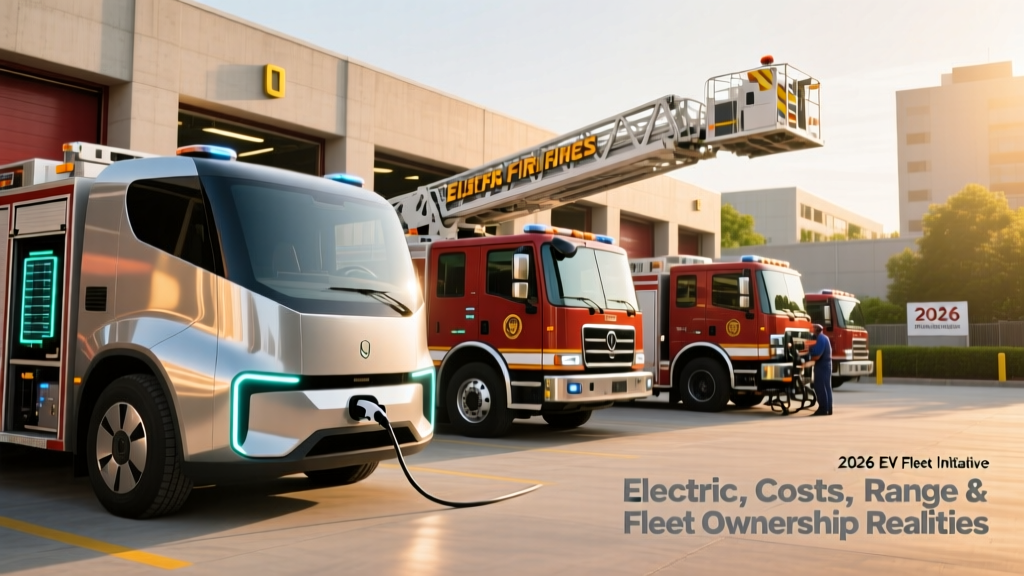
Electric fire trucks are Class 8 heavy-duty emergency apparatus using battery-electric drivetrains, often paired with a diesel range extender (EREV architecture) to handle extended incidents and highway responses. Unlike passenger EVs, these are custom-built vocational vehicles engineered around NFPA 1900 standards with pump-and-roll capability, aerial ladder hydraulics, and massive onboard power for scene lighting and tools.
The three primary manufacturers delivering units in 2026 are:
- Rosenbauer RTX — The most widely deployed platform, built on a Freightliner eM2 chassis with a ~200 kWh LFP battery pack, 150 kW DC fast-charge capability, and a 250 kW diesel generator for range extension. EPA-estimated equivalent range is approximately 100 miles on battery alone, with unlimited range when the generator runs. Base price: ~$1.2M for a pumper configuration.
- Pierce Volterra — Oshkosh's electric platform offering a 185 kWh NMC battery, 150 kW peak DC charging, and an integrated diesel range extender. Designed for structural firefighting with a 1,500 GPM pump. Base price: ~$1.3M.
- REV Fire Group (E-One/KME) eCyclone — Announced platform with a 225 kWh battery and projected 120-mile electric-only range. Limited deliveries began in late 2025; full production expected mid-2026. Pricing: ~$1.1M estimated.
These are not conversions of existing diesel trucks. They are ground-up electric architectures with lower centers of gravity (battery packs mounted between frame rails), regenerative braking sized for 60,000+ lb GVWR, and thermal management systems designed for pump-and-idle scenarios where the truck may sit at a scene for 4+ hours powering lights and equipment.
Electric Fire Truck vs. Diesel: Cost Comparison
The upfront sticker shock is real. A conventional diesel pumper costs $600,000–$800,000 in 2026, while an electric equivalent runs $1.0M–$1.5M depending on configuration (pumper, aerial, tanker). But fleet managers need to look at 15-year total cost of ownership — the typical service life of a front-line apparatus before it moves to reserve status.
| Cost Category | Diesel Pumper | Electric Pumper (EREV) | Notes |
|---|---|---|---|
| Purchase Price | $700,000 | $1,200,000 | Before grants/incentives |
| Fuel (15 years) | $337,500 | $112,500 | Diesel: $4.50/gal, 5 MPG; Electricity: $0.12/kWh |
| Maintenance (15 years) | $225,000 | $90,000 | No DPF/EGR/DEF, fewer moving parts, regen reduces brake wear |
| Battery Replacement (Year 12) | $0 | $85,000 | Estimated pack replacement at 80% SoH threshold |
| Charging Infrastructure | $0 | $60,000 | Level 2 depot charger + panel upgrade (shared across 2 trucks) |
| Insurance (15 years) | $150,000 | $165,000 | ~10% premium for EV repair complexity |
| Total 15-Year TCO | $1,412,500 | $1,652,500 | Before grants |
| Federal/State Grants | $0 | -$350,000 | DERA, AFG, state clean-fleet programs |
| Net 15-Year TCO | $1,412,500 | $1,302,500 | EFT saves ~$110,000 |
The math works when grants cover 25–40% of the purchase premium. Without grant funding, the payback stretches to 18–22 years — beyond the front-line service life of most apparatus. Departments in states with aggressive clean-fleet mandates (California's CARB rules, New York's Climate Act) have access to supplemental funding that can bring net purchase cost within $200K of diesel.
Range, Charging, and the Diesel Range Extender Reality
Range is the most misunderstood spec in electric fire apparatus. A 200 kWh battery in a 60,000 lb truck delivers roughly 1.5–2.0 kWh/mile under mixed driving (city response with regenerative braking recovers energy on deceleration). That translates to 100–130 miles on battery alone.
For context, the average urban fire department drives 8,000–12,000 miles per year on apparatus, with most responses under 5 miles from the station. A truck returning to quarters after each call can operate on battery alone for 90%+ of its runs, charging at the station between calls.
However, mutual-aid responses, highway incidents, and extended scenes change the equation entirely. That's why every major EFT platform in 2026 includes a diesel range extender — typically a 200–250 kW generator that can power the truck indefinitely while also running scene lighting and electric tools. This EREV (extended-range electric vehicle) architecture means range anxiety is essentially eliminated for fire service use.
| Metric | Battery-Electric Mode | Diesel Range Extender Active |
|---|---|---|
| Range | 100–130 miles | Unlimited (refuel in 10 min) |
| Fuel Cost per Mile | $0.30–$0.40 | $0.85–$1.10 |
| Noise at Scene | Near-silent (critical for rescue listening) | 70–80 dB generator |
| Idle Emissions | Zero | Diesel particulates, NOx |
| PTO Power for Tools | Direct from battery (instant) | Generator-dependent |
| Cold-Weather Range Loss | 20–35% reduction at 20°F | No reduction (waste heat available) |
The cold-weather caveat matters. Departments in Minnesota, Maine, or Colorado should expect a 20–35% reduction in electric-only range during winter months due to battery thermal losses and cab heating demands. A truck rated at 120 miles in July may deliver only 80 miles in January. The diesel range extender compensates for this, but it means winter operating costs trend closer to diesel.
Charging Infrastructure: What Fire Stations Actually Need
Depot charging is mandatory for electric fire trucks. You cannot rely on public charging networks for a 60,000 lb apparatus with proprietary connectors and 150+ kW demand. Here's what a typical station upgrade looks like:
- Level 2 Charging (19.2 kW): Adds ~10–12 miles of range per hour. A full charge from 20% to 100% takes approximately 10–12 hours. This is the baseline for overnight charging between shifts. Equipment cost: $8,000–$15,000 per charger.
- DC Fast Charging (60–150 kW): Adds 40–80 miles in 30 minutes. Necessary for departments running 3+ calls per shift or operating trucks across multiple stations. Equipment cost: $40,000–$80,000 per unit.
- Electrical Panel Upgrade: Most fire stations built before 2010 have 400–800 amp service. Adding two 19.2 kW Level 2 chargers requires 100 amps of dedicated capacity per charger. Many stations need a service upgrade to 1,200–2,000 amps, costing $25,000–$60,000 depending on utility transformer proximity.
- Total Infrastructure Cost: $60,000–$120,000 per station for a 2-truck deployment, including chargers, electrical work, permitting, and utility interconnection fees.
Utility demand charges are the hidden cost. Commercial electricity rates often include a demand component based on peak kW draw. Simultaneously charging two trucks at 150 kW can trigger $3,000–$6,000/month in demand charges unless the department negotiates an EV-specific tariff with the utility or installs behind-the-meter battery storage (adding $50,000–$100,000 to infrastructure costs).
Real-World Ownership: What Fleet Managers Report
Departments operating electric fire trucks since 2023–2024 (including Madison, WI; Portland, OR; and several California agencies) report consistent patterns:
What works well:
- Regenerative braking extends brake life by 40–60%, eliminating $8,000–$12,000 brake jobs every 2–3 years
- No diesel particulate filter (DPF) regenerations, which require 30–45 minute forced idling cycles that take trucks out of service
- Silent operation at rescue scenes improves communication and allows listening for victims
- Instant torque from electric motors improves acceleration from 0–30 mph (critical for intersection clearing)
- Onboard battery power eliminates the need for separate tow-behind generators at extended scenes
What's harder than expected:
- Charging discipline — crews must plug in immediately upon return, or the next shift inherits a depleted truck
- Training requirements for high-voltage safety (NFPA 70E certification for maintenance staff, $2,000–$4,000 per technician)
- Weight distribution changes — battery packs add 3,000–5,000 lbs, requiring suspension upgrades and affecting bridge-weight compliance
- Vendor lock-in — proprietary battery management systems mean only the OEM can perform certain diagnostics
- Resale value uncertainty — no established secondary market for used electric fire apparatus yet
Decision Framework: Should Your Department Go Electric?
If-Then Guide for Fire Department EV Adoption
- IF your department is urban/suburban with <15-mile response radius, predictable call volume, and station-based operations → THEN an EFT is viable today, especially with state/federal grant access
- IF you lack depot charging or your station electrical service is under 800 amps → THEN budget $60K–$120K for infrastructure before purchasing apparatus
- IF you operate in extreme cold (regular sub-20°F winters) and lack heated apparatus bays → THEN expect 30%+ range loss in winter; the diesel range extender becomes essential, reducing fuel savings
- IF your department is rural with 50+ mile mutual-aid responses and limited grant access → THEN wait 2–3 years for battery energy density improvements and secondary market pricing
- IF you're replacing a truck in the next 12 months and have access to FEMA AFG or state clean-air grants covering 30%+ of cost → THEN the TCO math favors electric
- IF your maintenance staff lacks high-voltage certification and your OEM dealer is 100+ miles away → THEN factor in $15K–$25K/year for contract maintenance and extended downtime risk
Common Misconceptions About Electric Fire Trucks
| Myth | Fact |
|---|---|
| "Electric trucks can't pump water." | Modern EFTs deliver 1,500–2,000 GPM pump capacity. The electric motor drives the pump via PTO, and the battery can sustain pumping for 2–4 hours without the diesel generator. |
| "They'll run out of battery at a big fire." | Every major EFT platform has a diesel range extender that can power the truck and pump indefinitely. No department has reported being stranded due to battery depletion. |
| "Battery replacement costs $200K+." | Current 200 kWh LFP packs cost $80,000–$100,000 to replace. With proper thermal management and 80% SoH threshold, replacement is typically needed at year 10–12, not year 5. |
| "They're too heavy for bridges and roads." | EFTs add 3,000–5,000 lbs vs. diesel equivalents. Most are engineered to stay within federal bridge formula limits (80,000 lbs gross). Departments must verify local bridge postings. |
| "Federal tax credits cover the full premium." | The IRS §30D credit caps at $40,000 for commercial vehicles over 14,000 lbs (via §45W). This covers only 8–10% of the EFT price premium. State and EPA DERA grants fill the gap. |
FAQ: Electric Fire Trucks
How long does it take to charge an electric fire truck?
On a 19.2 kW Level 2 depot charger, a full charge from 20% to 100% takes 10–12 hours — adequate for overnight turnaround. On a 150 kW DC fast charger, you can add 80 miles of range in approximately 30 minutes, but most departments use Level 2 for routine charging to reduce battery stress and avoid demand charges.
What happens if the battery dies during a call?
The diesel range extender automatically starts when battery state-of-charge drops below a threshold (typically 15–20%). The truck can operate indefinitely on diesel, just like a conventional pumper. Departments treat the battery as a fuel-saving and emissions-reduction layer, not the sole energy source.
Do electric fire trucks qualify for federal tax credits?
Yes, under the IRS §45W commercial clean vehicle credit, which provides up to $40,000 for vehicles over 14,000 lbs GVWR. However, this covers only a fraction of the $400K–$600K price premium over diesel. Most departments combine this with EPA Diesel Emissions Reduction Act (DERA) grants, FEMA Assistance to Firefighters Grants (AFG), and state clean-fleet incentives to bridge the gap.
What's the battery warranty on electric fire trucks?
Most OEMs offer 8–10 year / 150,000–200,000 mile warranties with a guaranteed 70–80% state-of-health threshold. Rosenbauer and Pierce both provide battery replacement or refurbishment if capacity drops below the threshold within the warranty period. Departments should negotiate extended warranty terms during procurement, as battery replacement at year 12 represents a significant unplanned cost.
Can electric fire trucks operate in extreme cold?
Yes, but with reduced electric-only range. At 20°F, expect 20–35% range loss due to battery chemistry limitations and cab heating demand. Battery thermal management systems (liquid heating/cooling) mitigate this but consume energy. The diesel range extender provides waste heat for cab warming and eliminates range anxiety in cold climates. Departments in Alaska, North Dakota, and similar climates report running the range extender more frequently in winter, which reduces fuel savings to 20–30% vs. 50–60% in summer.
How does maintenance compare to diesel?
Electric fire trucks eliminate oil changes, DPF/EGR service, DEF fluid, transmission rebuilds, and most brake jobs (regenerative braking handles 70–80% of deceleration). Annual maintenance savings run $8,000–$15,000 per truck. However, high-voltage system diagnostics require specialized training, and only the OEM can perform battery management system updates. Departments report shifting from in-house mechanical work to OEM service contracts, which cost $5,000–$8,000/year but include remote diagnostics and scheduled battery health checks.
Electric fire trucks are not a universal replacement for diesel apparatus in 2026, but they are a proven, cost-effective option for departments with the right operational profile and infrastructure access. The technology is mature enough for front-line deployment, the TCO math works with grant funding, and the operational benefits (silent scene operation, instant torque, reduced maintenance) are real. Rural departments and those without depot charging should monitor the market for 2–3 more years as battery energy density improves and charging infrastructure expands. For everyone else, the question is no longer "if" but "when" — and the answer depends on your next apparatus replacement cycle and grant funding timeline.