Quick Answer
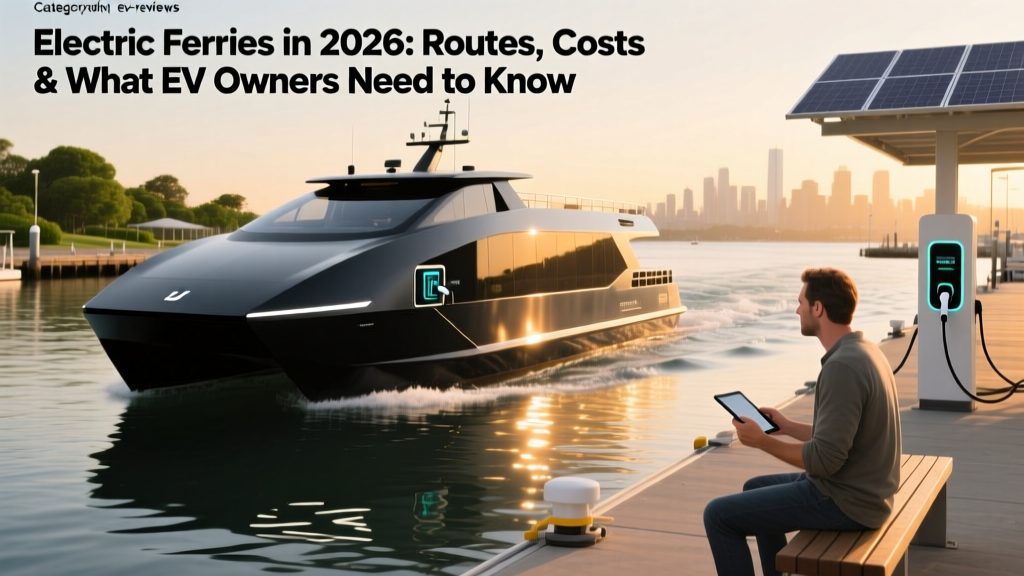
Electric ferries are battery-powered passenger and vehicle vessels that replace diesel engines with large lithium-ion battery packs (typically 1,000–10,000+ kWh) charged at dockside. As of 2026, fully electric car-carrying ferries operate on short routes in Washington State, Norway, Denmark, and select Canadian corridors. For EV owners planning road trips, the key question is whether the ferry route you need is electrified, whether the terminal offers shore-side EV charging while you wait, and whether your EV's range can cover the gap between charging stations on either side of the crossing. Most U.S. ferry routes still run diesel or hybrid-electric, but the shift is accelerating — and terminal charging infrastructure is the real bottleneck for EV travelers.
What Are Electric Ferries and Where Do They Operate?
An electric ferry swaps marine diesel engines for electric motors powered by onboard battery banks. A typical mid-size vehicle ferry carries between 2,000 and 5,000 kWh of battery capacity — for context, that's roughly 30 to 65 times the battery in a Tesla Model Y (75 kWh usable). These batteries charge via high-power shore connections while the vessel is docked, usually at 1–6 MW (megawatts) per connection, allowing a full turnaround in 10–20 minutes on short-hop routes.
The world leader in electric ferry deployment is Norway, where over 80 fully electric or plug-in hybrid ferries operate as of 2026, driven by national zero-emission maritime mandates. In North America, Washington State Ferries — the largest ferry system in the U.S. by ridership — is mid-way through its fleet electrification plan, with the first hybrid-electric vessels entering service on the Seattle-Bainbridge and Edmonds-Kingston routes, and fully electric conversions planned for the Jumbo Mark II class.
Other notable operators include BC Ferries in British Columbia (hybrid-electric Salish-class vessels), Denmark's Scandlines (hybrid-electric on the Rødby-Puttgarden route), and several smaller municipal operators in New York, San Francisco, and Seattle deploying electric passenger-only water taxis.
For the EV-owning road tripper, what matters is this: if you're driving onto a ferry, the vessel's propulsion type doesn't directly affect your car. What does matter is whether the ferry terminal on either end has Level 2 or DC fast charging available while you wait or immediately after disembarking.
EV Road Trip Planning: Ferry Terminals and Charging Access
The intersection of electric ferries and EV ownership comes down to logistics. Ferry crossings often sit in coastal or island corridors where charging infrastructure can be sparse. Here's what a first-time EV buyer or road-tripper needs to evaluate:
Terminal Charging Availability
As of 2026, only a handful of U.S. ferry terminals offer dedicated EV charging for waiting passengers. The Washington State Ferries system has been installing ChargePoint and EVgo stations at major terminals including Colman Dock (Seattle), Bainbridge Island, and Bremerton, but availability varies — expect 2–8 Level 2 ports (7–19 kW) and occasionally one or two 50–150 kW DC fast chargers at the busiest hubs.
In contrast, Norwegian ferry terminals are far ahead, with many offering 150–350 kW DC fast charging integrated into the waiting area, supported by the country's dense Fortum and Recharge networks.
Range Buffer on Island and Coastal Routes
Island routes — think San Juan Islands, Vancouver Island, or the Outer Banks — often have limited or no public charging on the far side. A practical rule: ensure your EV has at least 80 miles of real-world range remaining after disembarking before the next confirmed charging station. For a vehicle with an EPA-rated 300-mile range (expect ~240–260 miles real-world highway, less in cold weather), that means arriving at the terminal with at least 50% State of Charge (SoC).
Real-World Range Reminder
EPA range stickers assume mixed driving at moderate temperatures. On a highway-heavy road trip to a ferry terminal at 70+ mph in 35°F weather, expect your actual range to be 60–75% of the EPA figure. A 320-mile EPA vehicle may deliver only 200–220 miles in those conditions. Always plan ferry-trip charging with this buffer in mind.
Cost Comparison: Electric Ferries vs. Diesel Ferries
For ferry operators, the economics of electrification are compelling but front-loaded. For passengers and drivers, the cost impact shows up in ticket prices and, indirectly, in the fuel savings that keep fare increases modest over time.
| Metric | Diesel Ferry (Typical) | Electric Ferry (Typical) |
|---|---|---|
| Vessel Build Cost | $60–$120 million | $80–$150 million (battery cost premium) |
| Fuel/Energy Cost per Year | $2–$5 million (marine diesel) | $0.5–$1.5 million (shore electricity) |
| Maintenance Cost per Year | $1–$2.5 million | $0.5–$1.2 million (fewer moving parts) |
| Battery Replacement Cycle | N/A (engine overhaul ~15–20 yrs) | 10–15 years, $5–$15 million |
| Operating Lifespan | 40–50 years | 30–40 years (battery-dependent) |
| Emissions (per crossing) | 1–4 metric tons CO₂ | 0 direct (grid-dependent upstream) |
The data is clear: electric ferries have higher upfront capital costs but dramatically lower operating expenses. Washington State Ferries estimated that full fleet electrification would save $60–$80 million in fuel and maintenance over 20 years, according to their long-range fleet plan. For passengers, this translates to fare stability — diesel price spikes have historically driven 5–15% fare increases, while electricity rates are more predictable.
What This Means for EV Owners: Practical Decision Framework
If you own or are buying an EV and your driving includes ferry routes, here's how to evaluate your situation:
Ferry + EV Decision Framework
- If you commute by ferry daily (e.g., Bainbridge–Seattle, Staten Island–Manhattan): Prioritize an EV with at least 250 miles EPA range and confirm your home charging setup covers daily needs. Terminal charging is a bonus, not a requirement.
- If you take ferries on road trips 2–4 times per year (e.g., to Vancouver Island, Outer Banks, Door County): Map charging stations within 10 miles of both terminals before your trip. Apps like PlugShare and A Better Routeplanner are essential. Choose an EV with DC fast charging at 150+ kW (peak) to minimize stops en route.
- If you live on an island with no public charging: A plug-in hybrid (PHEV) may be more practical than a BEV unless you can install a home Level 2 charger. PHEVs like the Toyota RAV4 Prime (42 miles electric-only, 38 MPG combined gas) eliminate range risk on ferry-dependent routes.
- If your ferry route is fully electric: You're supporting lower-emission travel end-to-end, but this doesn't change your personal EV's charging needs — plan as you would for any road trip.
Common Misconceptions About Electric Ferries and EVs
| Myth | Fact |
|---|---|
| "Electric ferries can charge my car while I'm on board." | No. Vehicle decks on ferries do not provide charging. Your EV's battery is static during the crossing. Some terminals offer charging in the waiting area before boarding. |
| "All ferries are going electric soon." | Only a fraction. The U.S. has ~200+ vehicle/passenger ferries; fewer than 10 are fully electric or hybrid-electric as of 2026. Conversion timelines stretch into the 2030s for most operators. |
| "Electric ferries are slower than diesel." | Comparable. Most electric ferries cruise at 15–20 knots, matching diesel equivalents on short routes. Speed is limited by hull design and wave-wake regulations, not propulsion type. |
| "If the ferry is electric, the terminal must have EV chargers." | Not necessarily. Ferry electrification (vessel propulsion) and terminal EV charging (passenger cars) are separate infrastructure projects with different funding streams. Always verify terminal charging independently. |
| "Cold weather doesn't affect electric ferries." | It does. Battery performance drops 10–20% in cold water and air temperatures, requiring larger battery banks or more frequent charging — the same physics that reduce your EV's range in winter. |
Terminal Charging: What EV Owners Actually Need
The single most actionable step for an EV owner who uses ferries is to research terminal charging before you arrive. Here's a practical checklist:
- Check PlugShare or ChargePoint maps for the exact terminal address. Filter by connector type (NACS, CCS, CHAdeMO) and power level.
- Confirm whether chargers are in the staging/holding area (where you wait in your car before boarding) or in a separate parking lot. Staging-area chargers are rare but invaluable — you can charge while waiting in line.
- Have a backup plan within 5–10 miles of the terminal on both sides. Ferry delays and missed sailings are common; you may need more energy than planned.
- Precondition your battery if your EV supports it (Tesla, Hyundai/Kia E-GMP, Rivian, and others offer this). Navigating to a DC fast charger near the terminal will warm the battery for faster charging on arrival.
For context on what charging speeds mean in practice:
| Charging Level | Power (kW) | Miles Added in 30 Min | Typical Terminal Availability |
|---|---|---|---|
| Level 1 (120V outlet) | 1.4 kW | ~6–8 miles | Rare; emergency only |
| Level 2 (240V) | 7–19 kW | ~35–95 miles | Most common at ferry terminals |
| DC Fast Charge | 50–350 kW | ~100–400+ miles | Limited; major hubs only |
A 30-minute ferry wait on a Level 2 charger at 11.5 kW adds roughly 55–60 miles of range to a typical EV — enough to cover a moderate gap on the far side. A DC fast charger at 150 kW can add 150+ miles in 15 minutes, but only if your vehicle supports that charge rate and the battery is preconditioned.
The Bigger Picture: Maritime Electrification and Your EV
The growth of electric ferries is part of a broader maritime decarbonization trend that indirectly benefits EV owners. As ports invest in high-power shore-side electrical infrastructure to charge ferry batteries (often 2–10 MW connections), that same grid capacity can be leveraged for terminal EV charging stations. Washington State's ferry electrification program, for example, includes provisions for passenger vehicle charging infrastructure at upgraded terminals.
However, progress is uneven. Rural and island ferry terminals — precisely where EV drivers need charging most — are often the last to receive infrastructure upgrades due to grid capacity constraints and funding priorities. If your route falls in this category, plan your EV trips conservatively and advocate through local transit authorities for terminal charging investment.
Frequently Asked Questions
Can I charge my EV on a ferry during the crossing?
No. Vehicle decks on passenger ferries do not provide electrical outlets or EV charging. Your vehicle's battery remains at whatever State of Charge (SoC) it had when you drove on. Some newer vessel designs have explored onboard charging concepts, but none are in commercial operation as of 2026.
Are electric ferries safer than diesel ferries for EVs parked on the vehicle deck?
There is no elevated risk. EVs parked on a ferry deck are not charging and pose no different fire risk than on a diesel ferry. In the extremely unlikely event of a battery thermal event, modern ferry fire suppression systems are designed to handle vehicle fires regardless of propulsion type. The NHTSA has found EV fire incidence rates to be lower than internal combustion vehicles overall.
Which U.S. ferry routes have the best EV charging at terminals?
As of 2026, the strongest terminal charging is found at Washington State Ferries' major hubs (Colman Dock/Seattle, Bainbridge Island, Bremerton), the Staten Island Ferry terminals (Whitehall and St. George, with nearby public charging), and San Francisco Bay Ferry terminals near downtown SF and Oakland. Smaller and rural terminals remain underserved.
Do electric ferries cost passengers more than diesel ferries?
Generally no. While vessel construction costs are higher, operators recoup savings through lower fuel and maintenance costs over 10–20 years. Most publicly operated ferry systems set fares through government appropriations and fare boards; the propulsion type of a specific vessel doesn't directly change your ticket price.
Should I buy a PHEV instead of a BEV if I frequently use ferries?
It depends on the charging infrastructure at your destination. If the far side of your regular ferry route has no public charging and you can't install a home charger there, a PHEV offers a practical bridge — electric for daily driving, gas for the ferry-gap problem. If both sides of your route have reliable charging, a BEV works perfectly.