Quick Answer: An electric farm vehicle can handle most daily agricultural tasks — hauling feed, pulling light trailers, and powering tools via V2L (Vehicle-to-Load) — but range drops significantly under heavy towing, and rural charging infrastructure remains limited. For operations within a 60-mile daily radius with home Level 2 charging, a battery-electric truck like the Ford F-150 Lightning or Rivian R1T offers lower running costs and instant torque for hauling. For frequent heavy towing over 100+ miles or operations in charging deserts, a diesel or hybrid remains more practical in 2026.
Why Farmers Are Looking at Electric Trucks
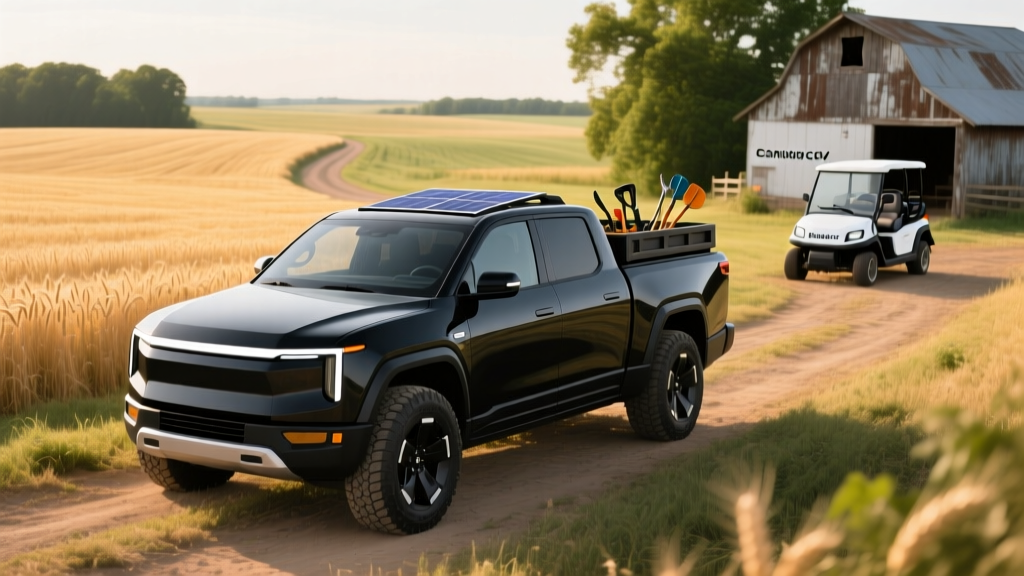
The idea of an electric farm vehicle isn't about saving the planet — it's about saving money on diesel, reducing maintenance downtime, and gaining a mobile power source in the field. Modern electric trucks deliver peak torque at 0 RPM, meaning a loaded bed or a trailer pull from a standstill requires no revving, no turbo lag, and no transmission hunting. For repetitive short-haul farm work — moving feed bins, hauling lumber, towing a stock trailer between paddocks — an EV's drivetrain characteristics align almost perfectly with the job.
But farming isn't just short loops. It's also 200-mile round trips to the co-op, muddy back roads, sub-zero January mornings, and the need to keep working when the nearest DC fast charger is 45 miles away. This guide breaks down which electric trucks can genuinely serve as farm and ranch vehicles in 2026, where they fall short, and what the real numbers look like.
The Top Electric Farm Vehicle Contenders in 2026
Three battery-electric trucks dominate the conversation for agricultural and utility use. Each has distinct strengths depending on your operation's daily mileage, towing demands, and power needs.
| Spec | Ford F-150 Lightning (Ext. Range) | Rivian R1T (Dual Max) | Chevrolet Silverado EV (4WT) |
|---|---|---|---|
| EPA Range | 320 mi | 410 mi | 460 mi |
| Battery (usable) | 131 kWh (NMC) | 141 kWh (NMC) | 200+ kWh (NMC) |
| Horsepower / Torque | 580 hp / 775 lb-ft | 1,025 hp / 1,198 lb-ft | 664 hp / 780 lb-ft |
| Max Towing (properly equipped) | 10,000 lbs | 11,000 lbs | 12,500 lbs |
| Payload | 2,235 lbs | 1,764 lbs | 1,800 lbs |
| Max DC Fast Charge | ~150 kW | ~220 kW | ~350 kW |
| 10–80% DC Charge | ~41 min | ~27 min | ~20 min |
| V2L / Pro Power Output | 9.6 kW (Pro Power Onboard) | ~3.5 kW (bed/cabin outlets) | 10.2 kW (PowerBase) |
| Bed Length | 5.5 ft | 4.5 ft (Gear Tunnel adds 67 cu ft) | 5 ft 11 in |
| Starting MSRP (2026) | ~$62,995 | ~$89,900 | ~$64,300 |
| §30D Tax Credit Eligible | Check current IRS sourcing | Partial / varies by trim | Check current IRS sourcing |
| Warranty (battery) | 8 yr / 100,000 mi | 8 yr / 175,000 mi | 8 yr / 100,000 mi |
Sources: fueleconomy.gov, Ford Motor Company, Rivian, Chevrolet. Specs reflect latest available 2025–2026 model-year data. Verify trim-specific details with the manufacturer.
Real-World Range: What Happens When You're Hauling a Load
EPA range stickers assume a light load, moderate temperatures, and mixed driving. Farm work violates nearly every one of those assumptions. Here's what to actually expect:
EPA vs. Reality — Towing & Farm Use:
- Empty bed, highway (70 mph): Expect 80–85% of EPA range. A 320-mile F-150 Lightning delivers roughly 260–275 real miles.
- Loaded bed (1,500+ lbs), mixed roads: Expect 70–75% of EPA. That same Lightning drops to ~225–240 miles.
- Towing 7,000–10,000 lbs: Expect 40–55% of EPA. The Lightning's 320-mile sticker becomes 130–175 miles. The Rivian R1T with 410 EPA miles yields ~165–225 miles under tow.
- Cold weather (below 32°F), no towing: Expect 65–75% of EPA. Battery chemistry slows, and cabin heating draws from the pack.
- Cold weather + towing: Plan for 35–45% of EPA. This is worst-case and the scenario where EVs genuinely struggle on the farm.
The physics are straightforward: moving mass costs energy, and air resistance from a boxy trailer multiplies consumption at highway speed. If your daily farm route is a 40-mile loop with a 3,000-pound feed trailer at 35 mph, an F-150 Lightning or Rivian R1T will handle it easily and come home with 60%+ state of charge. If you're pulling 9,000 lbs to a sale barn 120 miles away at 65 mph, you'll need a mid-route DC fast charge — and that charger had better be operational and available.
Charging on the Farm: Home Base vs. Rural Gaps
The single biggest factor in whether an electric farm truck works is home charging access. Most farms and ranches have the electrical service to support a Level 2 charger — often a 200-amp or 400-amp panel already serving welders, grain dryers, or shop equipment.
| Charging Level | Power (kW) | Miles Added per Hour | Farm Relevance |
|---|---|---|---|
| Level 1 (120V standard outlet) | 1.2–1.9 kW | 3–5 mi/hr | Emergency top-off only; ~35–50 mi overnight |
| Level 2 (240V, 48A circuit) | 11.5 kW | 25–30 mi/hr | Primary farm charging; full recharge in 10–14 hrs overnight |
| Level 2 (240V, 80A circuit) | 19.2 kW | 40–50 mi/hr | Faster overnight; requires 100A breaker and heavier wire |
| DC Fast Charge (public) | 150–350 kW | 300–900 mi/hr | Road trips and mid-day top-ups; rural availability varies widely |
Home Level 2 installation typically costs $1,200–$3,500 total (charger hardware, licensed electrician, permit, and wiring). If your panel needs upgrading from 100A to 200A to accommodate a 48A EV circuit alongside existing farm loads, budget an additional $1,500–$4,000. Many rural electric co-ops offer EV charger rebates — check with your local provider before hiring an electrician.
The challenge comes on the road. Rural America has genuine charging deserts. While the Tesla Supercharger network (now open to NACS-equipped Fords and GMs) and Electrify America have expanded highway coverage, county roads and small farm towns may have zero public charging within 30–50 miles. If your operation regularly sends trucks on routes beyond your Level 2 tether, map the DC fast chargers along those routes before buying.
V2L: The Electric Farm Vehicle's Secret Weapon
No gas truck can power a circular saw, a welder, or a grain auger from its fuel tank. An electric truck can. Vehicle-to-Load (V2L) turns the battery pack into a mobile generator, and for farm use, this is where EVs earn their keep in ways combustion trucks cannot.
The Ford F-150 Lightning's Pro Power Onboard offers up to 9.6 kW of continuous output through bed-mounted 240V and 120V outlets. That's enough to simultaneously run:
- A 240V MIG welder (~3–4 kW)
- Multiple power tools (drills, saws, grinders — 1–2 kW combined)
- Job-site lighting and battery chargers
- A small air compressor
Chevrolet's Silverado EV PowerBase system offers up to 10.2 kW, and the truck also supports V2H (Vehicle-to-Home), meaning during a rural power outage, the truck can back-feed your home's electrical panel through a compatible bidirectional charger — keeping your well pump, refrigerator, and furnace running for days on a 200+ kWh battery.
For context, a typical Honda EU7000is portable generator produces 5.5 kW and requires gasoline, oil changes, and maintenance. An F-150 Lightning carries 131 kWh of stored energy — the equivalent of running that generator at full output for over 23 hours, silently, with zero on-site emissions and zero fuel stops.
Cost Breakdown: EV Farm Truck vs. Diesel Over 5 Years
Let's compare a realistic 5-year ownership scenario: a Ford F-150 Lightning (Extended Range, ~$62,995 MSRP) versus a comparable Ford F-150 Power Stroke diesel (~$58,000 MSRP), both driven 15,000 miles/year (typical for a working farm truck), with 70% of that being local driving.
| Cost Category (5 Years) | F-150 Lightning (EV) | F-150 Diesel |
|---|---|---|
| Purchase Price (MSRP) | $62,995 | $58,000 |
| Estimated §30D Federal Tax Credit | Up to $7,500 (verify current IRS rules) | $0 |
| Effective Purchase After Credit | ~$55,495 | $58,000 |
| Fuel / Electricity (75,000 mi) | ~$4,500 (home L2 at $0.13/kWh avg) | ~$13,500 (diesel at $3.80/gal, 22 mpg avg) |
| Maintenance (oil, filters, DEF, brakes) | ~$1,200 (no oil/DEF; regen saves brakes) | ~$4,800 (oil changes, DEF fluid, fuel filters, DPF service) |
| Insurance (5-year est.) | ~$11,000 (EV premiums ~15–20% higher) | ~$9,200 |
| Estimated Depreciation (5 yr) | ~$28,000 | ~$22,000 |
| Total 5-Year Cost | ~$100,195 | ~$107,500 |
The EV comes out roughly $7,300 ahead over five years, primarily through fuel and maintenance savings. The gap widens further if diesel prices spike or if you have access to solar-powered or off-peak electricity. However, note the higher insurance premiums and steeper depreciation on EVs — both real costs that erode the advantage. If you drive fewer miles (under 10,000/year), the fuel savings shrink and the diesel may be cheaper overall.
Fuel costs based on U.S. Energy Information Administration averages. Tax credit eligibility per IRS §30D depends on MSRP caps, buyer income limits, battery sourcing, and critical-mineral requirements. Rules change frequently — verify before purchase and consider consulting a tax professional.
Common Misconceptions About Electric Farm Vehicles
| Myth | Fact |
|---|---|
| "EVs can't tow anything real." | The Silverado EV 4WT is rated for 12,500 lbs — competitive with many gas 3/4-tons. The limitation isn't capability; it's range under tow. |
| "The battery will die in a few years and cost $20K to replace." | Modern NMC packs are warrantied for 8 years / 100,000–175,000 miles at 70%+ capacity retention. Real-world degradation data from fleet EVs shows ~10–15% loss at 150,000 miles. Full replacements are rare and covered under warranty in most failure cases. |
| "You can't charge where there's no infrastructure." | Most farm trucks return to a home base nightly. A Level 2 charger in the barn or shop covers 90%+ of daily needs. The infrastructure gap matters for long-haul, not daily loops. |
| "Cold weather kills the battery permanently." | Cold reduces range temporarily (expect 25–35% loss below freezing) but doesn't cause permanent damage. Battery thermal management systems heat the pack during charging and driving. Range recovers when temperatures rise. |
| "EVs are unreliable on dirt roads and in mud." | Electric trucks like the R1T and Lightning have sealed battery packs, no air intake to clog with dust, and instantaneous torque control that excels in low-traction mud and snow. Ground clearance and approach angles are competitive with gas trucks. |
Decision Framework: Is an Electric Farm Truck Right for Your Operation?
Choose an electric farm truck if:
- Your daily driving radius is under 80 miles round-trip (loaded) or under 150 miles (unloaded).
- You have or can install a Level 2 (240V) charger at your home base, barn, or shop.
- You tow under 7,000 lbs for most trips, with occasional heavier loads on short routes.
- You value V2L capability — powering tools, welders, or equipment in the field without a separate generator.
- You want to reduce fuel and maintenance costs and your electricity rate is under $0.20/kWh.
- You operate in an area with at least one DC fast charger within 30 miles for the occasional long trip.
Stick with diesel or hybrid if:
- You regularly tow 8,000+ lbs over distances exceeding 100 miles one-way.
- Your operation is in a rural charging desert with no DC fast chargers within 50+ miles.
- You lack access to 240V electrical service and cannot justify a panel upgrade.
- Your truck needs to be operational 24/7 during harvest or calving season with no charging downtime.
- You drive over 25,000 miles/year, mostly highway — the EV's range-per-hour-of-charging math doesn't work for your schedule.
What First-Time EV Farm Buyers Should Know
1. Plan charging before you buy the truck. Have an electrician assess your panel capacity and quote a Level 2 installation. If you need a 200A panel upgrade, that adds weeks and $2,000–$4,000. Do this first.
2. Understand kW vs. kWh. kW is charge speed (how fast energy flows); kWh is battery capacity (how much energy the pack holds). A 150 kW charger fills a 131 kWh battery faster than a 50 kW charger — but the charge curve tapers above 80% state of charge, so the last 20% takes disproportionately long. For daily farm use, charge to 80% and top up only when needed.
3. Preconditioning matters. If you're heading to a DC fast charger, set your navigation to that station. The truck will pre-warm the battery to optimal temperature, enabling peak charge rates. Skipping this in cold weather can double your charging time.
4. The §30D tax credit isn't guaranteed. Federal EV tax credits under IRS §30D have MSRP caps ($80,000 for trucks), buyer income limits ($300K joint / $150K single), and strict battery sourcing and critical-mineral requirements. Credits can also be transferred at point-of-sale to reduce the purchase price directly. Verify eligibility on irs.gov before assuming you'll receive $7,500.
5. Insurance costs more. EV insurance premiums run 15–25% higher than comparable gas trucks due to higher repair costs and battery replacement values. Get quotes before committing.
Frequently Asked Questions
Can I tow a horse trailer or stock trailer with an electric truck?
Yes, within rated limits. The F-150 Lightning is rated for 10,000 lbs and the Silverado EV for 12,500 lbs. A loaded two-horse trailer typically weighs 5,000–7,000 lbs, well within capacity. Expect range to drop to 40–55% of the EPA sticker under tow. Plan your route around DC fast chargers if the trip exceeds ~120 miles loaded.
How long does a Level 2 home charger take to fully recharge a farm truck?
From near-empty to full on a 48-amp (11.5 kW) Level 2 charger: approximately 11–12 hours for the F-150 Lightning (131 kWh pack) and 12–13 hours for the Rivian R1T (141 kWh pack). Most farm use only depletes 30–50% of the battery daily, so a nightly charge adds that back in 4–6 hours.
Will an electric truck work in extreme cold (below 0°F)?
It will operate, but expect 30–40% range reduction compared to the EPA sticker in extreme cold, more if you're also towing. Battery preconditioning, a heat pump (standard on the Lightning), and garage parking help significantly. The truck will start instantly — no glow plugs, no cold-crank issues — which is a genuine advantage over diesel in winter.
What happens during a power outage on the farm?
An EV with V2H capability (like the Silverado EV with a bidirectional charger) can power your home for 3–7 days depending on load. Even without V2H, V2L outlets let you run critical equipment — a well pump, space heater, or refrigerator — directly from the truck's battery. A fully charged Lightning holds 131 kWh; an average home uses ~30 kWh/day.
Are there any electric tractors or dedicated farm EVs available?
As of 2026, full-size electric tractors remain in limited production or pilot programs (Monarch Tractor offers a compact electric utility tractor rated for ~30 HP equivalent, starting around $58,000). For most row-crop and heavy draft work, diesel tractors remain the only practical option. Electric trucks, however, are widely available and fill the utility, hauling, and light-towing roles effectively.
How do I find rural DC fast chargers for longer trips?
Use apps like PlugShare, A Better Routeplanner (ABRP), or the FordPass / myChevrolet apps, which show real-time charger status. The Tesla Supercharger network — now accessible to Ford and GM electric trucks via NACS adapters or native ports — has significantly improved rural highway coverage. Still, always verify a charger's status before relying on it; rural chargers can be offline or blocked.