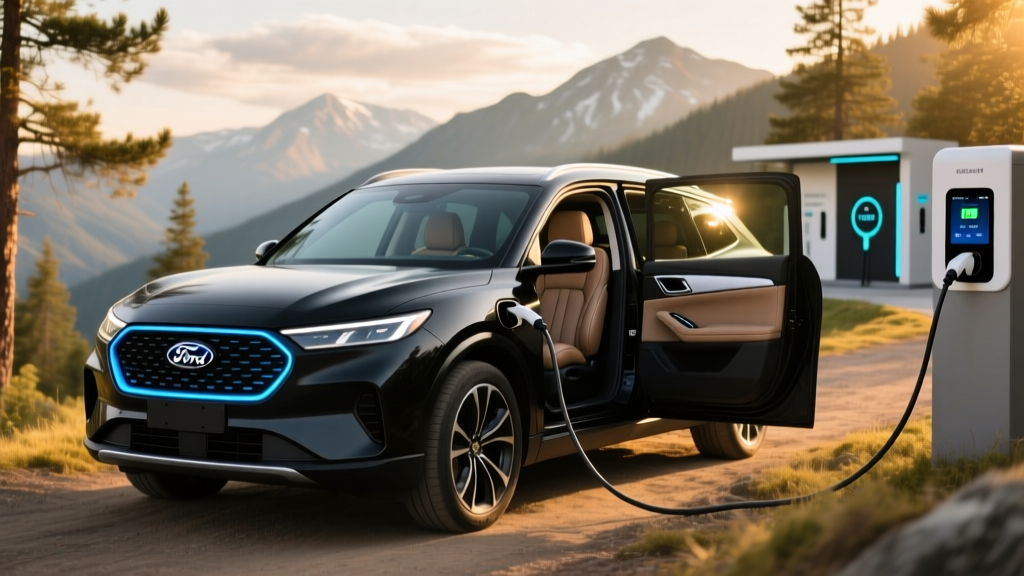
If you've been waiting for a full-size, three-row electric SUV that can actually tow and haul a family across the country, Ford's upcoming electric Expedition — widely referred to by enthusiasts and industry watchers as the Electric Expedition 2.0 — is shaping up to be one of the most anticipated EVs of the decade. But here's the practical truth right up front: as of mid-2026, Ford has not officially launched or named a production 'Electric Expedition.' The company's next-generation full-size electric SUV is being developed under the codename Project T3 at Ford's BlueOval City facility in Tennessee, and while spy shots and executive statements confirm it's coming, final specs, pricing, and a firm on-sale date remain unconfirmed.
What we do know from Ford's investor briefings, supply-chain reporting, and the trajectory of the F-150 Lightning platform is enough to build a credible buyer's framework. This guide breaks down realistic expectations for range, towing, charging, and total cost of ownership — and helps you decide whether to wait for the Electric Expedition or buy what's available today.
What Is the 'Electric Expedition 2.0' and Where Does It Stand in 2026?
The term "Electric Expedition 2.0" has gained traction in EV forums and search queries as shorthand for Ford's next-generation electric full-size SUV. Ford itself hasn't adopted the name officially — the current gas-powered Expedition continues through the 2026 model year with its 3.5L EcoBoost V6 — but the company has confirmed it's investing heavily in a body-on-frame electric SUV platform at its BlueOval City megasite.
Here's what's confirmed or strongly indicated as of 2026:
- Platform: A new, dedicated EV architecture (not a modified F-150 Lightning skate) designed for full-size SUVs with body-on-frame construction
- Production site: BlueOval City, Stanton, Tennessee — a $5.6 billion facility co-developed with SK On
- Timeline: Production originally targeted for 2025, now widely expected in 2027–2028 based on Ford's revised EV investment strategy announced in early 2025
- Market segment: Full-size, three-row SUV competing in the $65K–$90K range
Ford CEO Jim Farley has publicly stated the company is rethinking its large EV strategy to prioritize profitability and hybrid bridge products. That means the electric Expedition may arrive alongside — not replace — updated hybrid versions of the Expedition and Navigator platforms.
Projected Specs: Range, Battery, Charging, and Towing
Because Ford hasn't published final specifications, the numbers below are informed projections based on the F-150 Lightning's proven architecture, competitive benchmarking, and industry reporting. Treat them as directional, not guaranteed.
| Specification | Projected Estimate | Notes |
|---|---|---|
| EPA Range | 300–370 miles | Depends on battery pack size; expect Standard and Extended options |
| Battery Capacity | ~110–150 kWh (usable) | Likely NMC chemistry for energy density; LFP possible for base trim |
| Peak DC Fast Charge | 200–250 kW | 10–80% in roughly 25–35 minutes depending on pack size |
| Level 2 Charging | 11.5–19.2 kW (onboard) | Full charge in 8–14 hours overnight |
| Horsepower | 450–600+ HP | Dual-motor AWD expected as standard or widely available |
| 0–60 mph | 4.5–5.5 seconds | Comparable to Rivian R1S dual-motor |
| Towing Capacity | 8,000–10,000 lbs | Body-on-frame advantage; expect integrated trailer tech |
| Seating | 7 or 8 passengers | 3-row with bench or captain's chair options |
| Estimated Base MSRP | $65,000–$80,000 | Fully loaded could reach $95K+ |
| Battery/Powertrain Warranty | 8 years / 100,000 miles | Expected to match F-150 Lightning coverage |
Electric Expedition vs. What You Can Buy Today
If you can't wait two more years, here's how the projected electric Expedition stacks up against current 3-row EV SUVs available in 2026. These are the vehicles Ford will need to beat.
| Metric | Electric Expedition (Projected) | Rivian R1S (2026) | Tesla Model X (2026) | Kia EV9 (2026) |
|---|---|---|---|---|
| EPA Range | 300–370 mi | Up to 410 mi (Max Pack) | Up to 335 mi | Up to 304 mi |
| Starting MSRP | ~$65K–$80K | ~$79,900 | ~$81,630 | ~$54,900 |
| Towing | 8,000–10,000 lbs | 7,700 lbs | 5,000 lbs | 5,000 lbs |
| 3rd Row Space | Full-size (adults) | Tight for adults | Marginal for adults | Usable for adults |
| Body Style | Body-on-frame | Unibody (skateboard) | Unibody | Unibody |
| Peak DC Charge | 200–250 kW | 220 kW | 250 kW | 236 kW |
| §30D Tax Credit | TBD (sourcing unknown) | Up to $7,500 (varies) | Eligibility limited | Up to $7,500 (varies) |
The electric Expedition's key differentiator will be genuine full-size interior volume combined with serious towing. The Rivian R1S offers more range and a premium feel, but its third row is best for children. The Model X is aging and limited in towing. The Kia EV9 is the value pick, but its unibody platform caps towing at 5,000 lbs. If Ford delivers 350+ miles and 9,000+ lbs of towing, it owns a unique niche.
Total Cost of Ownership: EV SUV vs. Gas Expedition
One of the biggest questions for any buyer considering the electric Expedition is whether going electric actually saves money on a full-size SUV. Let's compare a projected electric Expedition against the current 2026 gas Ford Expedition over 5 years and 75,000 miles.
| Cost Category (5 yr / 75K mi) | Electric Expedition (Projected) | 2026 Gas Expedition (EcoBoost) |
|---|---|---|
| Purchase Price (base) | ~$72,000 | ~$60,000 |
| Federal Tax Credit (§30D) | $0–$7,500 (TBD) | $0 |
| Fuel/Energy Cost | ~$4,500–$6,000 | ~$11,000–$13,500 |
| Maintenance | ~$1,500–$2,000 | ~$3,500–$4,500 |
| Insurance (avg) | ~$12,000–$14,000 | ~$9,500–$11,500 |
| Estimated Depreciation | ~$28,000–$35,000 | ~$22,000–$28,000 |
| 5-Year Total (approx.) | ~$82,000–$101,000 | ~$84,000–$97,500 |
Key takeaways from this comparison:
- Energy savings are substantial: Home charging at $0.13/kWh yields roughly $0.04–$0.06 per mile for a large EV SUV vs. $0.15–$0.18/mile for the gas Expedition at 18 MPG combined and $3.50/gallon. That's $5,000–$8,000 saved on fuel alone over 5 years.
- Maintenance is genuinely lower: No oil changes, no transmission fluid, no spark plugs, and regenerative braking extends pad life. Expect 50–60% less routine maintenance spend.
- Insurance is typically higher: EV SUVs carry 15–25% higher premiums due to repair costs and battery replacement risk. Get quotes before committing.
- Depreciation is the wildcard: Full-size EVs are a new category. The F-150 Lightning saw significant depreciation in its first years; the electric Expedition may follow a similar curve until the used market matures.
- Breakeven timeline: If you qualify for the full $7,500 §30D federal tax credit, breakeven vs. gas could come in year 3–4. Without the credit, year 5–6.
Federal Tax Credit Eligibility: What to Expect
The IRS §30D clean vehicle credit offers up to $7,500 for qualifying new EVs, but eligibility depends on a matrix of rules that change regularly. Here's the 2026 framework:
- MSRP cap: SUVs must be under $80,000 MSRP — a potential issue for loaded electric Expedition trims
- Buyer income cap: AGI ≤ $150K (single), $225K (head of household), $300K (joint)
- Battery sourcing: Critical minerals and battery components must meet escalating domestic/free-trade-agreement thresholds
- Final assembly: Must be assembled in North America (BlueOval City, TN qualifies)
- Point-of-sale transfer: Credit can be applied at purchase to reduce out-of-pocket cost
- Foreign entity of concern (FEOC): Battery components from China, Russia, North Korea, or Iran disqualify the vehicle
Because Ford is manufacturing at BlueOval City with SK On battery cells produced in the U.S., there's a reasonable chance the electric Expedition will qualify for at least a partial credit — but the $80,000 SUV MSRP cap could disqualify higher trims. This is a critical factor for buyers budgeting around the incentive.
Common Misconceptions About Full-Size Electric SUVs
| Myth | Fact |
|---|---|
| "Electric SUVs can't tow seriously" | The F-150 Lightning tows 10,000 lbs. A body-on-frame electric Expedition should match or exceed this. However, towing cuts range roughly in half — a 350-mile SUV becomes a ~175-mile SUV with a heavy trailer. |
| "I'll never find a charger on road trips" | The U.S. now has over 70,000 public charging ports. Ford EVs have access to Tesla Superchargers via NACS adapter, dramatically expanding fast-charging coverage. Rural gaps remain real, though. |
| "The battery will need replacing in 5 years" | Modern NMC and LFP batteries show ~10–15% degradation over 150,000 miles based on long-term fleet data. Ford's expected 8-year/100,000-mile battery warranty covers capacity below ~70%. Full replacement costs $15,000–$25,000 but is rarely needed. |
| "Home charging is too expensive to install" | A Level 2 home charger installation typically runs $800–$2,500 if your electrical panel has capacity. A 200-amp panel upgrade adds $1,500–$3,000. This is a one-time cost that pays for itself within 1–2 years of fuel savings. |
| "Cold weather makes EVs useless" | Expect 20–35% range loss in sustained sub-freezing temps. A 350-mile EV becomes ~230–280 miles. That's still sufficient for most daily driving, and preconditioning while plugged in mitigates the loss. Heat pumps (expected on the electric Expedition) help significantly. |
Should You Wait or Buy Now? A Decision Framework
- You need genuine 8,000+ lb towing AND a usable adult third row — no current EV SUV delivers both
- Your current vehicle has 2+ years of life left and you're not in a rush
- You want Ford's dealer network for service in rural or midwest markets where Rivian/Tesla coverage is thin
- Body-on-frame durability for job-site or ranch use is a priority
- You need a 3-row EV SUV within the next 12 months — the electric Expedition is likely 18–30 months away from deliveries
- You don't tow more than 5,000 lbs — the Kia EV9 ($54,900, 304 mi, eligible for §30D credit) is the value leader today
- You want maximum range now — the Rivian R1S Max Pack (410 mi EPA, 7,700-lb tow) leads the segment
- Charging infrastructure access is critical — the Tesla Model X leverages the most mature Supercharger network natively
- You're open to a plug-in hybrid bridge — the 2026 Jeep Grand Cherokee 4xe or upcoming Expedition Hybrid could offer partial electrification without range anxiety
What First-Time EV Buyers Should Know Before Committing
Whether you're waiting for the electric Expedition or buying a different EV SUV today, these ownership realities apply universally:
- Home charging is non-negotiable for convenience. Public-only charging is viable but adds 2–4 hours per week and costs 2–3x more per kWh than home electricity. Confirm your home's electrical panel can support a 48-amp Level 2 circuit before purchasing.
- Understand kW vs. kWh. Kilowatt-hours (kWh) measure your battery's energy capacity — like gallons in a tank. Kilowatts (kW) measure charging speed — like the flow rate of a gas pump. A 130 kWh battery charging at 200 kW peak will not sustain that rate for the full session; expect the charge curve to taper significantly above 80% state of charge.
- Plan for real-world range, not EPA stickers. Highway driving at 75+ mph, cold weather, elevation changes, and cargo/towing loads all reduce range. Budget for 70–80% of the EPA number as your practical working range on road trips.
- Check your insurance before you buy. EV insurance premiums can be 15–25% higher than comparable gas vehicles. Get quotes from your provider for the specific model and trim before signing.
- Verify tax credit eligibility yourself. Don't rely solely on dealer assurances. Check the IRS's official list of qualifying vehicles and confirm your AGI falls within limits. Rules can change mid-year.
Frequently Asked Questions
Has Ford officially confirmed the electric Expedition name and specs?
No. As of mid-2026, Ford refers to its next-gen full-size electric SUV internally as Project T3. The "Electric Expedition" or "Expedition EV" name is widely assumed by industry analysts but not officially confirmed. Final specifications have not been published.
When will the electric Expedition be available to buy?
Based on Ford's revised EV timeline and BlueOval City production schedules, the most realistic estimate is a 2027 model year reveal with deliveries beginning in late 2027 or early 2028. Ford's strategy pivot toward hybrids may further adjust this timeline.
Will the electric Expedition qualify for the $7,500 federal tax credit?
It depends on final MSRP (must be under $80,000 for SUVs), battery sourcing compliance, and your personal income. Ford's U.S. manufacturing and SK On battery partnership position it well, but higher trims may exceed the MSRP cap. Always verify current eligibility at IRS.gov.
Can the electric Expedition tow as much as the gas version?
Projections suggest 8,000–10,000 lbs, which would match or approach the gas Expedition's 9,300-lb max. However, sustained towing dramatically reduces EV range — expect roughly 50% of the EPA range when pulling a heavy trailer. This is a physics limitation shared by all electric vehicles.
What's the best 3-row EV SUV I can buy right now?
It depends on your priority: Kia EV9 for value ($54,900, tax-credit eligible), Rivian R1S for range and adventure capability (410 mi Max Pack), or Tesla Model X for charging network access and performance. None match the projected towing + full-size third row combination that the electric Expedition aims to deliver.
Should I buy a hybrid Expedition instead of waiting for the EV?
If you can't wait and want partial electrification, a hybrid Expedition (expected as a 2026–2027 refresh option) could offer 25–30 MPG combined with no range anxiety. It won't deliver EV-level fuel cost savings or the §30D credit, but it's a practical bridge if you tow frequently in areas with limited charging infrastructure.