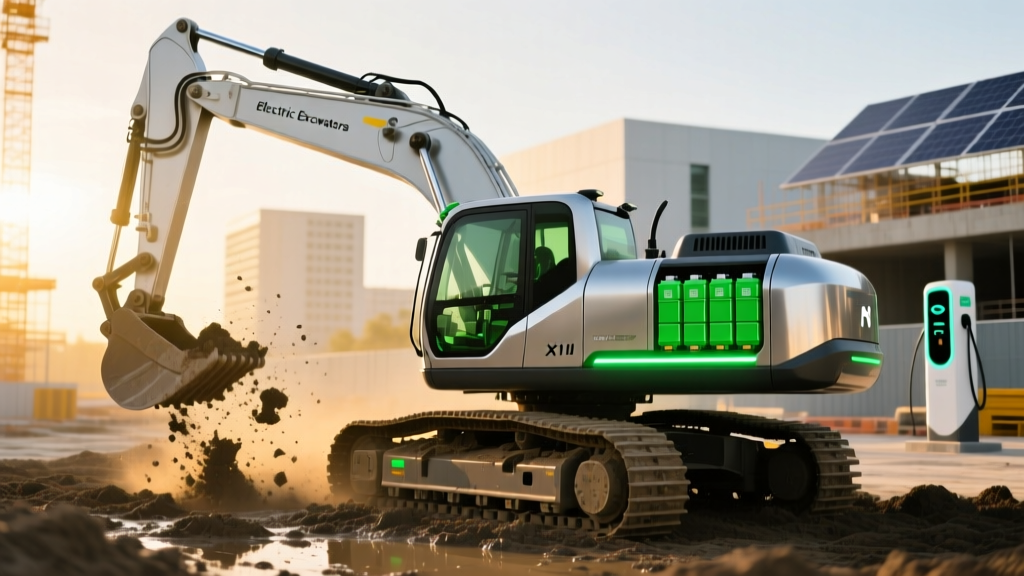
Electric excavators are battery-powered compact and midi digging machines (typically 1–15 metric tons) that replace a diesel engine with an electric motor and a lithium-ion traction pack, usually LFP chemistry in the 20–250 kWh range. In 2026, they make sense for contractors working in emissions-restricted zones, indoor demolition, utility trenches near homes, and municipalities with overnight depot charging — not for remote greenfield sites without grid access. Expect 4–8 hours of mixed-duty runtime per charge, 6–10 hour Level 2 top-ups, and purchase prices roughly 1.5–2.5× a comparable diesel, offset by ~60–75% lower energy cost per hour and far fewer maintenance intervals.
Quick Answer: Should You Buy an Electric Excavator?
Yes, if you work urban/indoor sites, have depot charging, and run <8 hours/day. No, if you need 12+ hour continuous operation in remote areas without grid power. Current 2026 battery packs can't match diesel's energy density for heavy continuous trenching far from a charger.
How Electric Excavators Compare to Diesel (With Numbers)
The honest comparison isn't about "saving the planet" — it's about jobsite fit and hourly operating cost. A 3.5-ton class electric mini excavator (think Bobcat E35e-class or Volvo ECR25 Electric lineage) typically carries a 40–65 kWh LFP pack, while the diesel equivalent burns roughly 0.8–1.2 gallons/hour under mixed load.
| Metric | 3.5t Electric Excavator | 3.5t Diesel Excavator |
|---|---|---|
| Purchase price (MSRP, 2026) | $85,000–$115,000 | $45,000–$62,000 |
| Battery / fuel capacity | 48–65 kWh LFP | 12–16 gal diesel tank |
| Runtime (mixed duty) | 4–7 hours | 10–14 hours |
| Refuel / recharge time | 6–10 hrs (Level 2, 7–22 kW) | 5 minutes |
| Energy cost per hour | $2.50–$5.00 (at $0.14/kWh) | $3.50–$5.50 (at $4.20/gal) |
| Scheduled maintenance/yr | ~$400–$800 | ~$2,200–$3,500 |
| Noise at operator ear | ~65–72 dBA | ~82–90 dBA |
| Tailpipe emissions on site | Zero | NOx, PM, CO₂ |
The gap is clear: electric wins on hourly operating cost, noise, and indoor legality; diesel wins on runtime, refuel speed, and upfront price. Most 2026 buyers are choosing electric specifically for regulated environments — tunnels, hospitals, schools, data centers, and cities with idle-emissions ordinances — where diesel is either banned or requires expensive scrubbers and ventilation.
Battery Packs, Charging, and Real-World Runtime
Don't let brochure "8-hour runtime" claims fool you. Like EVs, excavator runtime depends heavily on duty cycle. Continuous heavy digging or hydraulic hammer use can cut runtime by 40–50% versus light grading or pipe-laying.
Chemistry: Nearly all 2026 compact electric excavators use LFP (lithium iron phosphate) cells rather than NMC. LFP is heavier but offers 3,000–5,000 full cycles with minimal degradation, no cobalt supply-chain risk, and superior thermal stability — critical on a machine that vibrates and works in 100°F+ ambient. The trade-off is lower energy density, which is why you won't see electric excavators above ~15 tons with practical runtime yet.
Charging reality: Most machines accept 7–22 kW AC via a J1772 or Type 2 industrial inlet. A 60 kWh pack at 11 kW takes roughly 5.5 hours from 10–100%. DC fast charging (CCS or proprietary) is available on select 2026 models at 30–60 kW, cutting 10–80% to 45–70 minutes — but DC chargers cost $25,000–$60,000 installed and aren't standard on most contractor yards. Plan for overnight depot charging as your baseline, not fast-charge pit stops.
| Charging Scenario | Power | 0–100% Time (60 kWh) | Cost (60 kWh) |
|---|---|---|---|
| Standard 240V outlet (depot) | 7.2 kW | ~8.5 hours | $8.40 |
| Level 2 wallbox (yard) | 11–22 kW | 3–5.5 hours | $8.40 |
| DC fast charger (optional) | 40 kW | ~1.5 hours | $12–$18 (utility demand charges) |
| Diesel refuel (equivalent energy) | n/a | 5 minutes | $50–$65 |
Cold-weather caveat: LFP packs lose 15–25% usable capacity below 32°F, and hydraulic fluid thickens, increasing parasitic load. Northern-tier contractors report 4.5-hour winter runtimes on machines rated for 6 hours in summer. Spec a pack 20–30% larger than your calculated need if you work in sub-freezing climates.
Total Cost of Ownership: Where Electric Actually Wins
Upfront, electric excavators are brutal. A 5-ton electric will run $95,000–$130,000 versus $55,000–$70,000 for diesel. But commercial buyers think in cost-per-hour and 5-year TCO, not sticker price.
| 5-Year Cost (1,500 hrs/yr) | Electric (5t class) | Diesel (5t class) |
|---|---|---|
| Purchase | $110,000 | $62,000 |
| Energy (electricity / diesel) | $18,750 | $37,500 |
| Maintenance & fluids | $3,500 | $15,000 |
| DEF, filters, oil, coolants | $0 | $4,200 |
| Depot charger install | $6,500 | $0 |
| Estimated resale (yr 5) | -$38,000 | -$28,000 |
| Net 5-year cost | $100,750 | $90,700 |
| Cost per operating hour | $13.43 | $12.09 |
At 1,500 hours/year, diesel still narrowly wins on pure TCO in 2026 — unless you factor in:
- Incentives: Federal §48C Advanced Energy Project Credit (up to 30% for qualifying industrial equipment) and state programs like California's CORE voucher ($35,000–$65,000 per off-road electric machine) can flip the math dramatically.
- Bid preference: Municipal, federal, and LEED-tracked private projects increasingly require or score zero-emissions equipment.
- Indoor work access: Diesel can't bid hospital retrofits or tunnel jobs at all.
- Utilization >2,000 hrs/yr: Above this threshold, electric's lower hourly cost overtakes diesel's lower capex.
What First-Time Electric Excavator Buyers Must Know
Coming from diesel, the operational shift is bigger than the drivetrain. Plan for:
1. Depot charging is non-negotiable. You need a 240V/48A circuit minimum per machine, often with a 400A service upgrade for a 3-machine yard. Budget $4,000–$12,000 per stall including panel work, conduit, and a ruggedized Level 2 EVSE rated for outdoor construction environments.
2. You cannot "quick-trip" to refuel. A machine that runs out of battery on site is a $500+ tow call and a lost day. Dispatch must plan around SoC the way concrete trucks plan around drum set times.
3. Battery warranty matters more than machine warranty. Look for 5-year/5,000-hour or 70% capacity-retention thresholds. LFP packs rarely fail catastrophically, but a degraded pack at 65% SoH means your 6-hour machine becomes a 4-hour machine.
4. Hydraulics are still hydraulics. Electric motors drive hydraulic pumps; hoses, cylinders, and swing drives wear exactly like diesel machines. Don't confuse "electric drivetrain" with "maintenance-free."
5. Resale is uncertain. The used market for electric excavators is thin in 2026. Residual values are harder to predict than diesel's well-established curves. Lease or finance with a balloon if you're risk-averse.
Myths vs. Facts: Electric Excavator Misconceptions
| Myth | Fact (2026 data) |
|---|---|
| "They don't have enough power for real digging." | 3.5–8t electric machines match diesel bucket breakout forces; electric motors deliver peak torque at 0 RPM, which actually improves stall-pull performance. |
| "The battery won't last the life of the machine." | LFP packs are rated 3,000–5,000 cycles. At 1 cycle/day, 250 days/year, that's 12–20 years before hitting 80% SoH — typically longer than the machine's structural service life. |
| "You can charge from a standard 120V outlet." | Technically yes, at 1.4 kW — a 60 kWh pack would take 43 hours. Completely impractical for daily use. |
| "They qualify for the $7,500 EV tax credit." | The §30D clean vehicle credit applies to on-road vehicles. Off-road excavators generally qualify under §48C or §45W business credits instead — consult a tax professional. |
| "Electric means no downtime." | Hydraulic hoses, pins, bushings, tracks, and swing bearings still require scheduled service. Downtime shifts from engine to undercarriage. |
Decision Framework: Electric or Diesel?
Choose an electric excavator if:
- You work indoor, tunnel, or emissions-regulated urban sites
- Daily runtime stays under 6–8 hours mixed duty
- You have (or can install) depot Level 2 charging
- You bid municipal/government/LEED projects with ZE requirements
- You operate in California, Colorado, or other states with off-road ZE incentives
- Noise ordinances limit your diesel operating hours
Stick with diesel if:
- You work remote greenfield sites with no grid access
- You run 10–14 hour shifts with continuous heavy digging
- You need a single machine to cover multiple dispersed sites daily
- You're buying a 15+ ton class machine (electric options remain limited/premium in 2026)
- Your utilization is under 800 hours/year — capex dominates TCO at low use
FAQ
What size electric excavator should I buy?
Match to your most common job, not your biggest. A 3.5-ton electric mini handles 80% of utility and residential work and charges on a single 50A circuit. The 8–15t midi class exists but carries 150–250 kWh packs that need 3-phase depot power and 10+ hour charge times.
Can I run a hydraulic hammer on an electric excavator?
Yes, but hammer work is the most energy-intensive attachment. Expect runtime to drop 40–50% versus bucket digging. Spec a larger pack or plan a mid-shift top-up if hammering is a primary use case.
Do electric excavators qualify for any federal incentives?
Not the §30D consumer EV credit — these are off-road equipment. The relevant federal programs are §48C (advanced energy project credit for manufacturers/investors) and bonus depreciation under §168. State-level vouchers (California CORE, New York Truck Voucher) are often more valuable. Verify current eligibility with a tax professional.
What's the real-world range/runtime I should expect?
For a 5-ton class machine with a 60 kWh pack: light grading ~7 hours, mixed trenching ~5 hours, continuous hammer ~3 hours. Subtract 15–25% in sub-32°F weather. Manufacturer claims assume light intermittent duty — always derate by 30% for bid planning.
How long before I need to replace the battery?
LFP packs in 2026 machines are warrantied for 5–7 years / 70–80% capacity retention. Real-world replacement at end-of-life (15+ years out) is currently estimated at $18,000–$35,000 for a 60 kWh pack — but pack pricing has dropped ~14% annually, so replacement cost at year 12 will likely be far lower than today's estimate.
Sources: EPA off-road emissions standards, IRS §48C program guidance, manufacturer spec sheets from Volvo CE, Bobcat, and Caterpillar (2026 model year).