The Short Answer
Electric excavators in 2026 are commercially viable primarily in the compact and mini-excavator segment (1.5 to 6 metric tons), where battery-electric models from Volvo CE, Caterpillar, Kubota, and others deliver 4–8 hours of continuous digging on a single charge. Expect to pay a 40–70% upfront premium over diesel equivalents, but recoup that through 60–80% lower energy costs, near-zero scheduled powertrain maintenance, and eligibility for commercial clean-vehicle incentives (IRS §45W, up to $40,000 for heavy equipment). For mid-size and large excavators (10+ tons), battery-electric options remain limited or tethered to cable-power setups; diesel and diesel-electric hybrids still dominate. If your fleet runs compact machines on predictable urban or indoor job sites with access to Level 2 or DC charging, electric makes financial sense today. If you need 20-ton machines on remote sites without grid power, wait.
Why Electric Excavators Are Gaining Traction in 2026
The construction equipment sector is under mounting pressure to decarbonize. Municipal contracts in cities like Los Angeles, New York, and Oslo now include zero-emission equipment mandates for publicly funded projects. Indoor demolition, tunnel work, and warehouse-area construction — where diesel exhaust poses ventilation and health hazards — have become the beachhead use case for battery-electric excavators.
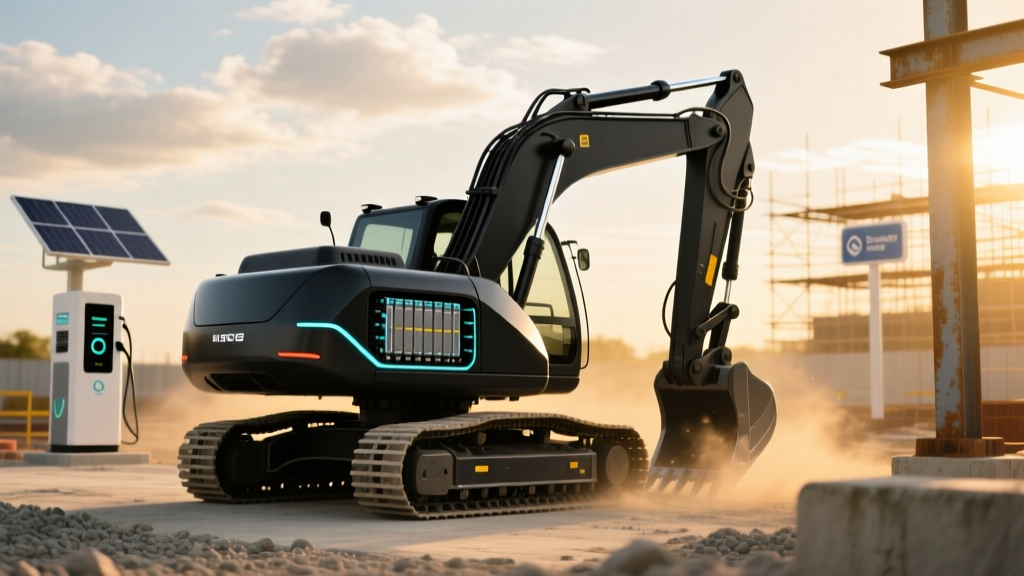
Unlike passenger EVs, construction equipment doesn't need 300 miles of range. An excavator's "range" is measured in operating hours per charge, and most compact electric excavators carry battery packs between 40 and 120 kWh — enough for a standard shift of intermittent digging, grading, and lifting. The physics are favorable: electric motors deliver peak torque at zero RPM, which is exactly what hydraulic pump systems need for responsive boom and bucket control.
Manufacturers have responded. Volvo CE's ECR25 Electric and EC18 Electric have been in production since the early 2020s and are now in their second-generation iterations. Caterpillar's 301.9 Electric mini excavator targets the 1.5–2-ton class. Kubota, Takeuchi, and Bobcat have all announced or shipped battery-electric compact models. Mid-size electric excavators (8–14 tons) from companies like XCMG and SANY are available in some markets, though North American availability and dealer support remain uneven.
Electric Excavator vs. Diesel: The Numbers That Matter
The decision to go electric isn't emotional — it's a total-cost-of-ownership calculation. Here's how a representative compact electric excavator (5-ton class, ~65 kWh battery) stacks up against its diesel counterpart across a 5-year, 5,000-hour ownership horizon.
| Cost Category | Electric (Battery) | Diesel |
|---|---|---|
| Purchase Price (MSRP est.) | $135,000–$160,000 | $80,000–$95,000 |
| Federal Tax Credit (§45W) | Up to –$40,000 | $0 |
| Net Acquisition Cost | $95,000–$120,000 | $80,000–$95,000 |
| Energy/Fuel Cost (5,000 hrs) | $4,500–$7,500 (electricity @ $0.12–$0.20/kWh) | $22,000–$30,000 (diesel @ $3.80–$4.50/gal) |
| Scheduled Powertrain Maintenance | $500–$1,200 (coolant, filters) | $6,000–$9,000 (oil, filters, DEF, injectors) |
| Hydraulic System Maintenance | Similar ($3,000–$5,000) | Similar ($3,000–$5,000) |
| Downtime Cost (est.) | Lower (fewer failure points) | Higher (DPF, turbo, injector issues) |
| Estimated 5-Year Total Cost | $103,000–$133,700 | $111,000–$139,000 |
Sources: Manufacturer spec sheets, IRS §45W Commercial Clean Vehicle Credit, U.S. EIA diesel pricing data. Actual costs vary by duty cycle, electricity rates, and local incentives.
The critical insight: the purchase-price gap narrows to near-parity after the §45W credit, and the electric machine pulls ahead on operating costs within 2,000–3,000 hours. For fleets running machines 1,000+ hours per year, the payback period is typically 2–3 years.
Battery Specs, Charging, and Operating Hours
Understanding an electric excavator's capability requires parsing three variables: battery capacity (kWh), charge rate (kW), and duty-cycle consumption (kWh per operating hour).
| Spec | Volvo ECR25 Electric (Gen 2) | Caterpillar 301.9 Electric | Bobcat E35e (Announced) |
|---|---|---|---|
| Operating Weight | ~2.7 tons (5,950 lbs) | ~1.9 tons (4,190 lbs) | ~3.5 tons (7,700 lbs) |
| Battery Capacity | ~48 kWh (NMC) | ~36 kWh (NMC) | ~65 kWh (announced, NMC) |
| Operating Hours (Avg. Duty) | 5–6 hours | 4–5 hours | 6–8 hours (est.) |
| Onboard Charger (Level 2) | ~11 kW AC | ~7.2 kW AC | ~15 kW AC (est.) |
| DC Fast Charge Capable | Yes, ~50 kW peak | Limited, ~25 kW | Yes, ~60 kW (announced) |
| 0–80% Charge Time (DC) | ~45–55 min | ~60–75 min | ~50–60 min (est.) |
| 0–80% Charge Time (L2 AC) | ~3.5–4 hours | ~4–5 hours | ~3.5–4.5 hours (est.) |
| Base MSRP (est.) | $140,000–$155,000 | $110,000–$130,000 | $150,000–$170,000 (announced) |
Note: Specs compiled from manufacturer press materials and industry reporting. Bobcat E35e figures are preliminary/announced. Verify with your local dealer for current availability and exact pricing.
A few practical observations from real-world fleet deployments:
- Duty cycle matters enormously. Continuous trenching at full hydraulic pressure can consume 10–14 kWh/hour, cutting operating time to 3–4 hours on a 48 kWh pack. Light grading and pipe-laying may draw only 5–7 kWh/hour, extending runtime to 7+ hours.
- Charge-curve taper is real. DC fast charging peaks at the rated kW only between ~10–50% state of charge (SoC). Above 70%, the charge rate typically drops by 40–60%. Plan lunch-break top-ups around the 20–80% window for maximum efficiency.
- Cold weather reduces usable capacity by 15–25% in sub-30°F conditions, just like passenger EVs. Battery thermal management systems mitigate this but add parasitic draw. Northern-climate fleets should spec machines with active battery heating and factor in reduced winter runtime.
Charging Infrastructure: What Job Sites Actually Need
This is where most electric excavator buyers hit their first real obstacle. Unlike a passenger EV parked at home overnight, a construction machine lives on a job site that may lack any electrical infrastructure.
Scenario A — Fixed yard or warehouse site: Install a 240V Level 2 station (50-amp circuit, ~$2,500–$6,000 installed including panel work). Machines charge overnight and are ready for a full shift. This is the ideal use case.
Scenario B — Urban job site with grid access: Coordinate with the local utility for temporary power or use a portable Level 2 charger connected to a construction power panel. DC fast chargers (50+ kW) can be trailer-mounted but cost $25,000–$60,000 for the unit alone.
Scenario C — Remote site, no grid: This is the dealbreaker for most pure-electric excavators. Options include a towable battery pack/generator (e.g., from companies like Ampere or similar) or a diesel genset — which partially defeats the emissions purpose. Cable-tethered electric excavators exist for mining and quarry applications but are impractical for most construction.
For fleets operating across multiple sites, the mobile charging logistics often dictate whether electric is feasible. Some contractors deploy a "mothership" trailer with a large stationary battery (200–500 kWh) charged at the yard overnight, then towed to sites to top up machines during breaks. This works, but adds $80,000–$150,000 in battery-trailer investment.
Real-World Ownership Considerations
Beyond the spec sheet, here's what fleet managers and owner-operators report after 12+ months with electric excavators:
What Works Well
- Noise reduction: Electric excavators operate at 70–80 dB vs. 95–105 dB for diesel. This opens up nighttime and noise-restricted urban work that diesel machines can't legally perform.
- Zero local emissions: Essential for indoor demolition, tunnel boring staging areas, and municipal contracts with clean-air clauses.
- Instant torque and smooth hydraulics: Operators consistently report better "feel" and more precise control, especially in fine-grading applications.
- Maintenance simplicity: No engine oil, no diesel particulate filter (DPF) regenerations, no DEF fluid, no turbocharger failures. The electric motor and inverter have far fewer wear components.
What Buyers Underestimate
- Charging downtime: A diesel excavator refuels in 5 minutes and runs 10+ hours. Even with DC fast charging, a 45–60 minute top-up mid-shift requires scheduling. Fleets often need an extra machine to cover charging gaps.
- Resale value uncertainty: Battery state of health (SoH) after 5,000+ hours is still an evolving data point. Most manufacturers warrant the battery for 5 years or a set hour count, but secondary-market pricing for used electric excavators is not yet established.
- Dealer support variability: Not all equipment dealers have technicians trained on high-voltage battery systems. Verify your local dealer's electric-equipment service capability before purchasing.
- Weight distribution: Battery packs are heavy and positioned low, which can actually improve stability — but it also means the machine may sit differently on soft ground. Operators need a brief adjustment period.
Tax Credits and Incentives for Electric Construction Equipment
The federal §45W Commercial Clean Vehicle Credit applies to qualified commercial clean vehicles, including off-road construction equipment in some interpretations. Key parameters for 2026:
- Credit amount: Up to $40,000 for vehicles with GVWR over 14,000 lbs (most excavators qualify by weight class, though classification varies — consult a tax professional).
- Credit amount (lighter equipment): Up to $7,500 for vehicles under 14,000 lbs GVWR, subject to battery sourcing and critical-mineral requirements similar to the §30D consumer credit.
- Point-of-sale transfer: Some commercial credits can be transferred to the dealer at purchase, reducing upfront cost. Verify with your equipment dealer and tax advisor.
- State and local incentives: California's CARB vouchers, New York's NYSERDA programs, and various utility rebate programs can stack additional $10,000–$50,000 in incentives. These vary enormously by jurisdiction — check AFDC (Alternative Fuels Data Center) for current state-level programs.
Critical caveat: Tax credit eligibility for off-road construction equipment is more complex than for passenger EVs. The IRS has issued guidance on what qualifies, but interpretations vary. Always confirm eligibility with a qualified tax professional before relying on credit projections in your purchase analysis.
Decision Framework: Should You Buy an Electric Excavator?
If / Then Decision Guide
| If you operate compact excavators (under 6 tons)... | Electric is a viable, cost-competitive option today. Proceed with evaluation. |
| If you need mid-size or large excavators (10+ tons)... | Battery-electric options are limited. Consider diesel-electric hybrids or wait for 2027+ model introductions. |
| If your machines run on fixed sites with 240V+ power access... | Strong candidate. Install Level 2 charging at the yard and spec machines for overnight charging. |
| If your sites are remote with no grid power... | Electric is not practical without significant mobile-charging investment. Diesel remains the default. |
| If you bid on municipal/government contracts with zero-emission requirements... | Electric excavators may be a competitive advantage or outright requirement. Factor incentive stacking into your bid. |
| If you run less than 500 hours/year per machine... | The fuel savings may not justify the upfront premium within a reasonable payback period. Run the numbers carefully. |
| If you operate in cold climates (sub-20°F winters)... | Spec machines with active battery thermal management and plan for 15–25% reduced winter runtime. |
| If indoor or noise-restricted work is a significant part of your business... | Electric excavators unlock revenue streams that diesel machines cannot access. This alone may justify the investment. |
Common Misconceptions About Electric Excavators
| Myth | Fact |
|---|---|
| "Electric excavators don't have enough power for real digging." | Electric motors deliver peak torque at zero RPM. Compact electric excavators match or exceed the breakout force of their diesel equivalents in the same weight class. They are not suitable for heavy rock excavation — but neither are diesel compacts. |
| "The battery will need replacing in 3 years." | NMC battery packs in construction equipment are rated for 3,000–5,000+ charge cycles before reaching 80% state of health. At one charge cycle per day, that's 8–14 years. Most manufacturers warrant batteries for 5 years or a defined hour threshold. |
| "You need a massive solar array to charge them." | A 48 kWh battery charges fully overnight on a standard 240V/50A Level 2 circuit drawing ~11 kW — roughly equivalent to running a large electric oven for 4 hours. Grid electricity at $0.12–$0.20/kWh is the standard fuel source. |
| "Electric excavators are only for eco-conscious companies." | The primary adoption drivers in 2026 are municipal contract requirements, indoor/urban work access, noise ordinances, and total-cost-of-ownership savings — not environmental branding alone. |
| "Charging takes too long on a job site." | With DC fast charging, a 20–80% top-up takes 30–50 minutes — aligning with scheduled operator breaks. Overnight Level 2 charging fully replenishes the battery between shifts. |
What First-Time Electric Excavator Buyers Should Know
- Audit your duty cycle first. Log the actual operating hours, task mix (digging vs. idling vs. travel), and site power availability for your current diesel machines over a 30-day period. This data — not manufacturer estimates — determines whether an electric model fits.
- Talk to your utility before buying. Commercial electricity rates, demand charges, and time-of-use pricing significantly affect operating costs. Some utilities offer construction-site EV charging rates or infrastructure rebates.
- Verify dealer service capability. Ask your dealer specifically: "Do you have a technician certified for high-voltage battery diagnostics on this model?" If the answer is no, factor in travel-to-service or mobile technician costs.
- Model the TCO honestly. Include the §45W credit, state incentives, electricity vs. diesel cost per operating hour, maintenance savings, and potential revenue from noise-restricted or zero-emission contracts. Spreadsheet the 3-year and 5-year totals before deciding.
- Consider a pilot, not a fleet conversion. Buy or lease one electric excavator, deploy it on your most favorable site, and track real-world performance for 6 months before committing to broader electrification.
Frequently Asked Questions
How long does an electric excavator battery last before replacement?
Most NMC battery packs in compact electric excavators are engineered for 3,000–5,000 charge cycles to 80% state of health. At one full cycle per working day, that translates to roughly 8–14 years of service. Battery replacement cost for a 48–65 kWh pack currently ranges from $15,000 to $30,000, though prices are declining. Manufacturer warranties typically cover 5 years or a specified operating-hour threshold against excessive degradation.
Can I use a portable generator to charge an electric excavator on a remote site?
Technically yes, but it undermines the emissions benefit and adds cost. A 20 kW diesel generator can Level-2 charge a compact electric excavator, but you're burning diesel to create electricity to run an electric machine — with conversion losses. For remote sites, a towable battery storage unit charged at your yard is a cleaner solution, though it requires significant capital investment ($80,000–$150,000).
Do electric excavators qualify for the $7,500 federal EV tax credit?
The consumer §30D credit is designed for on-road passenger vehicles and does not apply to off-road construction equipment. However, the §45W Commercial Clean Vehicle Credit may apply, offering up to $40,000 for heavy qualifying equipment. Classification of off-road equipment under §45W can be complex — consult a tax professional and review current IRS guidance before purchase.
Are electric excavators slower or weaker than diesel models?
In the compact class (under 6 tons), electric excavators typically match or exceed diesel equivalents in hydraulic breakout force, swing torque, and cycle times. Electric motors deliver instant peak torque, which benefits hydraulic pump responsiveness. Where electric falls short is in sustained high-load applications like continuous rock hammering — thermal management limits can throttle output. For the vast majority of compact excavator tasks (trenching, grading, pipe-laying, landscaping), performance is equivalent.
What happens if the battery runs out mid-shift?
The machine stops operating — there is no "reserve tank." Modern electric excavators provide state-of-charge warnings well in advance, and fleet management software can alert supervisors when a machine drops below 20% SoC. The operational discipline is similar to managing a diesel machine's fuel level: plan charging or swap breaks into the work schedule. Some fleets mitigate this by keeping a charged spare machine or scheduling a mid-shift DC fast-charge top-up during operator lunch breaks.