Quick Answer: The 2026 Cadillac Escalade IQ (the all-electric Escalade) features a pillar-to-pillar 55-inch LED display, available 36-speaker AKG Studio Reference audio, executive second-row seating with 12.6-inch personal screens, and a flat floor enabled by its Ultium battery platform. It offers an EPA-estimated 460 miles of range, peaks at roughly 200 kW DC fast charging (10–80% in ~35 minutes), and starts at $129,990. Compared to the gas Escalade, the IQ eliminates fuel costs (~$3,200/year savings at 12,000 miles) but carries a significantly higher purchase price and requires reliable Level 2 home charging to maximize convenience.
Inside the Electric Escalade Interior: What You Actually Get
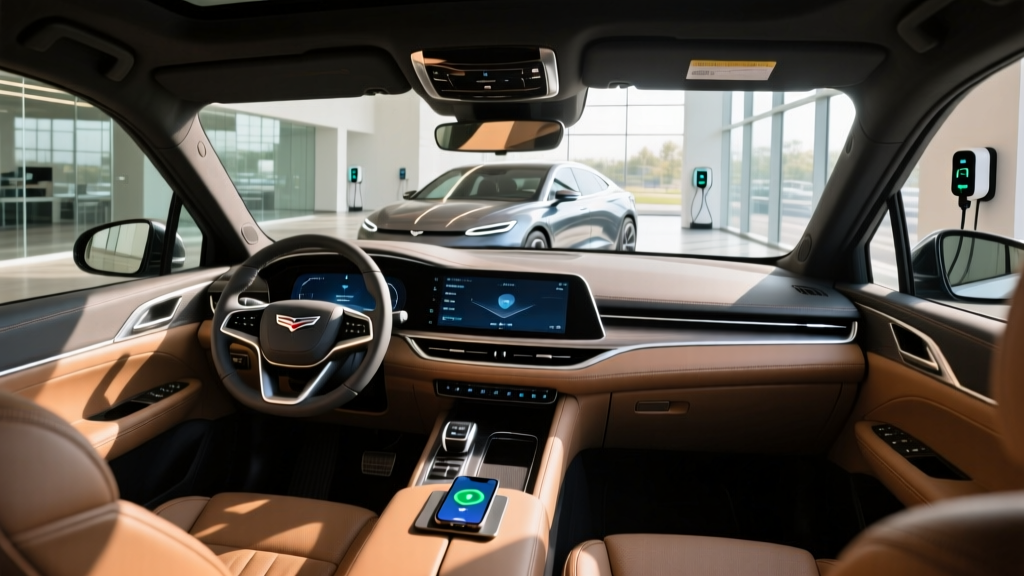
The cabin of the Escalade IQ represents a fundamental departure from the outgoing V8 model. Because GM's BT1 battery-electric platform places the Ultium battery pack beneath the floor, the interior benefits from a completely flat load surface and a lower center of gravity — changes that translate directly into passenger comfort and cargo flexibility.
The dashboard is dominated by a 55-inch total diagonal pillar-to-pillar LED display, combining a digital instrument cluster, infotainment touchscreen, and a dedicated passenger-side display into one continuous glass panel. This is not a single monolithic screen but rather a series of integrated displays under unified glass, running Google Built-In for navigation and voice assistance.
Second-row passengers in the available Luxury and Sport trims receive executive-style captain's chairs with heating, ventilation, massage functions, and individual 12.6-inch rear entertainment displays. The available 36-speaker AKG Studio Reference audio system includes headrest-mounted speakers for each front occupant — a feature that allows navigation prompts or phone calls to route to a single seat without disturbing the cabin.
Cargo volume behind the third row measures approximately 23.4 cubic feet, expanding to roughly 82 cubic feet with the second row folded. The front trunk (frunk) adds an estimated 10.7 cubic feet of enclosed storage — a practical advantage the gas Escalade cannot match, as its engine bay is occupied by the 6.2L V8.
| Feature | Specification |
|---|---|
| Main Display | 55-inch diagonal pillar-to-pillar LED |
| Rear Screens | Dual 12.6-inch personal displays (available) |
| Audio System | Up to 36-speaker AKG Studio Reference |
| Seating Capacity | 7 passengers (2-2-3 configuration) |
| Cargo (behind 3rd row) | ~23.4 cu ft |
| Frunk Volume | ~10.7 cu ft |
| Upholstery Options | Semi-aniline leather, available wood/metal trim |
Range, Battery, and Charging: The Numbers That Matter
The Escalade IQ is built on GM's Ultium platform with a massive ~200 kWh usable battery pack (NMC chemistry). This is among the largest battery packs in any production passenger vehicle, which directly explains both its EPA range and its substantial curb weight (estimated ~9,000 lbs).
EPA Range: 460 miles (estimated, Luxury trim)
Real-World Expectation: Expect approximately 370–410 miles during sustained highway driving at 70–75 mph. In cold weather (below 32°F), range may drop to 320–360 miles due to cabin heating demands and reduced battery efficiency. City driving with regenerative braking recovers energy more effectively, often matching or exceeding the EPA figure in stop-and-go traffic.
Charging performance is where the IQ's size creates a tradeoff. On a DC fast charger, the Escalade IQ can accept a peak rate of approximately 200 kW. However, because the battery is so large, a 10–80% charge still takes roughly 35–40 minutes under ideal conditions. The charge curve tapers significantly above 80% SoC — expect the final 20% to add another 25–30 minutes, which is typical for large NMC packs.
| Charging Level | Power (kW) | Time / Rate | Best Use Case |
|---|---|---|---|
| Level 1 (120V household) | ~1.4 kW | ~3–4 mi/hr added | Emergency/trickle only |
| Level 2 (240V home) | ~11.5–19.2 kW | ~25–42 mi/hr; full charge in 10–18 hrs | Daily home charging |
| DC Fast Charging | Up to ~200 kW peak | 10–80% in ~35–40 min | Road trips |
Home charging reality: With a 200 kWh pack, even an 11.5 kW Level 2 charger (the most common home setup on a 60-amp circuit) requires roughly 17–18 hours for a full 0–100% charge. Most owners will rarely deplete the battery fully, so overnight top-ups from 30–80% are practical (~8–9 hours). However, if you plan frequent long trips that deplete the pack below 20%, consider upgrading to a 19.2 kW home charger on an 80-amp or 100-amp circuit — this cuts charge times meaningfully but requires a panel assessment by a licensed electrician.
Escalade IQ vs Gas Escalade: Cost & Capability Comparison
The most common cross-shopping decision for Escalade IQ buyers is the gas-powered Cadillac Escalade with its 6.2L V8 (420 hp) or the 3.0L Duramax turbodiesel inline-six. Here's how the numbers stack up for a buyer considering both.
| Metric | Escalade IQ (Electric) | Gas Escalade (6.2L V8) |
|---|---|---|
| Starting MSRP | $129,990 | $83,895 |
| Horsepower | 680 hp (AWD) | 420 hp |
| 0–60 mph | ~4.8 seconds | ~6.1 seconds |
| EPA Range / Fuel Economy | 460 miles / ~70 MPGe | ~14 city / 18 hwy mpg |
| Annual Fuel/Energy Cost (12k mi) | ~$900–$1,200 (home charging) | ~$3,800–$4,200 (premium gas) |
| Annual Maintenance | ~$300–$500 | ~$800–$1,200 |
| Federal Tax Credit (§30D) | Up to $7,500 (if eligible) | None |
| Towing Capacity | ~8,000 lbs (est.) | 8,200 lbs |
| Cargo + Frunk | ~23.4 cu ft + 10.7 cu ft frunk | ~25.5 cu ft (no frunk) |
Key takeaway: The IQ costs roughly $46,000 more upfront but saves approximately $3,000–$3,500 annually in fuel and maintenance. At that savings rate, the break-even point versus the gas Escalade is roughly 13–15 years on energy/maintenance savings alone — meaning the IQ is primarily a technology and experience purchase, not a pure cost-saving play. Buyers who qualify for the full $7,500 federal tax credit and have access to low-cost home electricity shorten this timeline modestly.
On performance, the IQ's 680 hp and instant electric torque give it a decisive acceleration advantage (4.8s to 6.1s 0–60), and its lower center of gravity improves handling composure in corners. However, towing heavy trailers will reduce range significantly — expect 220–280 miles of range when towing near maximum capacity at highway speeds, a pattern consistent with all large electric SUVs.
Real Ownership Costs: 5-Year Breakdown
Beyond the sticker price, Escalade IQ ownership involves several cost categories that first-time EV buyers should budget for realistically.
| Category | Escalade IQ (Electric) | Gas Escalade (V8) |
|---|---|---|
| Purchase Price (base) | $129,990 | $83,895 |
| Federal Tax Credit | –$7,500 (if eligible)* | $0 |
| Home Level 2 Charger Install | $1,200–$2,800 | $0 |
| Fuel/Energy (5 yrs, 60k mi) | $4,500–$6,000 | $19,000–$21,000 |
| Maintenance (5 yrs) | $1,500–$2,500 | $4,000–$6,000 |
| Insurance (5 yrs, est.) | $14,000–$18,000 | $10,000–$14,000 |
| Estimated Depreciation (5 yrs) | $52,000–$65,000 | $38,000–$48,000 |
| Total 5-Year Cost (est.) | $196,190–$224,790 | $154,895–$172,895 |
*Federal §30D tax credit eligibility depends on buyer income limits (AGI ≤ $300k joint / $150k individual), vehicle MSRP caps ($80,000 for SUVs — the Escalade IQ at $129,990 base exceeds the MSRP cap and is likely ineligible for §30D). Consult IRS guidelines and a tax professional. Some state-level incentives may still apply.
The insurance premium reality: Luxury EVs carry higher insurance costs due to expensive replacement parts (that 55-inch display assembly alone costs thousands), specialized repair requirements, and higher vehicle values. Expect premiums 25–40% above the gas Escalade. Shop quotes from EV-friendly insurers before purchasing.
Depreciation risk: Large luxury EVs have historically depreciated faster than their gas counterparts in the first 3–5 years, partly due to rapid technology advancement and battery-health concerns among second-hand buyers. The IQ's massive battery pack may mitigate this somewhat — a 200 kWh pack degrading 10% still leaves 180 kWh and over 400 miles of range — but plan for steeper initial depreciation than a gas Escalade.
Federal Tax Credit Eligibility: The MSRP Problem
Here's where many luxury EV buyers encounter an unpleasant surprise. Under current IRS §30D rules, new clean vehicle credits require the vehicle MSRP to be $80,000 or less for SUVs, vans, and pickup trucks. The Escalade IQ's base price of $129,990 places it well above this threshold.
§30D Credit Requirements (2026):
- Vehicle MSRP must not exceed $80,000 (SUVs/trucks) or $55,000 (sedans)
- Buyer modified AGI must not exceed $300,000 (joint) / $150,000 (individual)
- Battery components and critical minerals must meet phased sourcing thresholds
- Vehicle must be assembled in North America
- Credit can be transferred to dealer at point of sale for an immediate price reduction
Bottom line: The Escalade IQ does not qualify for the federal $7,500 new-vehicle tax credit due to its MSRP. Buyers should not factor this credit into their purchase math. Check your state's EV incentive programs — some states (California, Colorado, New York, among others) offer rebates that are not MSRP-capped, though amounts and availability vary. Verify current programs through your state energy office or the Alternative Fuels Data Center.
Common Misconceptions About the Electric Escalade
| Myth | Fact |
|---|---|
| "460 miles of range means I'll never need to stop on road trips" | Real-world highway range is ~370–410 miles. At 75 mph with climate control, plan stops every 5–6 hours. Towing cuts range roughly in half. |
| "I can charge it on any standard outlet overnight" | Level 1 (120V) adds only ~3–4 miles per hour. A full charge from near-empty would take over 50 hours. A 240V Level 2 home charger is essential for daily ownership. |
| "The battery will need expensive replacement in a few years" | GM covers the Ultium battery with an 8-year/100,000-mile warranty (minimum 70% capacity retention). Modern NMC packs typically retain 85–90% capacity at 100k miles based on NHTSA and industry degradation data. |
| "It qualifies for the $7,500 federal tax credit" | The IQ's MSRP of $129,990 exceeds the §30D $80,000 SUV cap. It does not qualify for the federal new-vehicle credit. |
| "Electric means zero maintenance" | Tires wear faster on heavy EVs (the IQ weighs ~9,000 lbs). Cabin air filters, brake fluid, coolant, wiper blades, and suspension components still require service. Budget $300–$500/year. |
Who Should Buy the Escalade IQ? A Decision Framework
Buy the Escalade IQ if:
- You have (or can install) a 240V Level 2 home charger — ideally a 19.2 kW unit on a dedicated 80–100A circuit
- You want the latest in-cabin technology and a flat, spacious floor plan that the gas platform cannot offer
- You drive primarily in urban or suburban settings where regenerative braking maximizes efficiency
- You value instant torque and near-silent operation over traditional V8 character
- You're comfortable with a $130,000+ purchase price without federal tax credit offset
- You live in a region with reliable public DC fast charging for road trips (Tesla Supercharger network access via adapter, Electrify America, etc.)
Stick with the gas Escalade if:
- You tow heavy trailers frequently (boats, horse trailers, large campers) — towing halves EV range
- You live in an apartment or lack access to home charging
- You regularly drive in extreme cold (below 0°F) where range loss compounds with cabin heating demands
- You want a lower purchase price and the option of the $7,500 tax credit (available on some trims of competing luxury EV SUVs under $80k)
- You plan to keep the vehicle 10+ years and prefer the known long-term service network for V8 powertrains
First-Time EV Buyer Checklist: What to Know Before You Sign
If the Escalade IQ would be your first electric vehicle, these practical steps will prevent costly surprises:
- Get an electrical panel assessment. A 200 kWh battery demands robust home charging. Have a licensed electrician evaluate whether your panel supports a 60A, 80A, or 100A dedicated circuit. Panel upgrades (to 200A or 400A service) can cost $2,000–$5,000 and take weeks to permit.
- Test your commute with real range math. Take the EPA's 460 miles and multiply by 0.80 for highway-heavy commutes, or 0.70 for cold-weather months. If your longest regular drive exceeds that adjusted figure, map DC fast chargers along the route.
- Shop insurance before purchasing. Get quotes from at least three insurers. Luxury EV claims costs are higher, and some carriers price this more aggressively than others.
- Understand the charge curve. On road trips, charge from 10–80% (the fast portion) and skip the slow 80–100% top-up unless you're stopping overnight. This saves 20–30 minutes per stop.
- Precondition the battery before DC fast charging. The Escalade IQ's navigation system will automatically warm the battery when a charger is set as your destination. This can add 30–50 kW to your peak charge rate in cold weather — a significant time savings.
- Verify NACS vs CCS compatibility. GM has adopted the NACS (Tesla-style) connector for newer models. Confirm whether the IQ ships with NACS natively or requires an adapter for Tesla Superchargers, and whether your local public chargers support your connector type.
Frequently Asked Questions
Does the Escalade IQ have a frunk (front trunk)?
Yes. The Escalade IQ offers approximately 10.7 cubic feet of front trunk space, made possible by the absence of a traditional engine. This is useful for storing charging cables, groceries, or luggage that you want separated from the rear cargo area.
How does the 55-inch display work — is it one screen or multiple?
It's a continuous glass panel spanning the full dashboard width, but it comprises multiple integrated displays: a driver instrument cluster, a central infotainment touchscreen, and a passenger-side display. They operate as a unified system but can show independent content. The passenger display can stream entertainment without distracting the driver.
Can the Escalade IQ use Tesla Superchargers?
GM has been transitioning its EV lineup to the NACS connector standard. Confirm with your dealer whether the 2026 Escalade IQ ships with a native NACS port or a CCS port with an included NACS adapter. Either configuration should provide access to the Tesla Supercharger network, which remains the most reliable DC fast-charging network in the US.
What is the battery warranty on the Escalade IQ?
GM covers the Ultium battery pack with an 8-year/100,000-mile limited warranty, guaranteeing a minimum of 70% capacity retention. The electric drive components (motors, power electronics) carry similar coverage. This is consistent with industry standards for luxury EVs.
How does cold weather affect the Escalade IQ's range?
At temperatures below 32°F, expect a range reduction of approximately 15–25%, bringing real-world range from ~400 miles down to roughly 300–340 miles. Below 0°F, the reduction can reach 30%. Using seat heaters and steering wheel heating (which draw far less energy than cabin air heating) can partially offset this loss. The IQ's heat pump system (if equipped) improves cold-weather efficiency versus resistive heating.
Is the Escalade IQ eligible for any tax credits or incentives?
Due to its MSRP of $129,990 (well above the $80,000 SUV cap), the Escalade IQ does not qualify for the federal §30D new clean vehicle credit. State-level incentives vary — check your state's energy office or the Alternative Fuels Data Center for local rebates, HOV lane access, or utility charging discounts.
How much does it cost to charge the Escalade IQ at home?
At the US average residential electricity rate of ~$0.16/kWh, fully charging the ~200 kWh battery costs approximately $32. For a typical weekly top-up from 30% to 80% (~100 kWh), expect to pay around $16. Over a year of 12,000 miles, home charging costs roughly $900–$1,200 depending on local rates — compared to $3,800–$4,200 for premium gasoline in the V8 Escalade.