The Quick Answer: Is an Electric Dump Truck Right for Your Operation?
Bottom line: An electric dump truck makes financial sense in 2026 if your routes are under 150 miles round-trip, you can install depot-level DC fast charging (150–350 kW), and you drive enough annual miles to recoup the $150,000–$300,000 premium over diesel through fuel and maintenance savings. For long-haul, remote, or extreme cold-weather work, diesel remains the pragmatic choice. Expect a 3–5 year payback for high-utilization vocational fleets.
The electric dump truck segment has matured rapidly. Class 8 battery-electric vocational trucks from manufacturers like Volvo, Peterbilt, Mack, and Freightliner now deliver 150–250 miles of real-world range with payloads rivaling diesel counterparts. But a dump truck isn't a delivery van — it operates in quarries, construction sites, and off-road terrain where efficiency drops and charging infrastructure is scarce. This guide breaks down the exact numbers you need to evaluate whether electrifying your dump truck fleet pencils out.
Electric Dump Truck Specs: What's Available in 2026
Before comparing costs, let's ground this in hard specifications. The table below reflects current Class 8 battery-electric dump truck configurations available for order or in limited production in 2026.
| Spec | Volvo VHD Electric | Peterbilt 520EV / 579EV | Mack LR Electric | Freightliner eCascadia (Day Cab) |
|---|---|---|---|---|
| Battery Capacity (usable) | 375 kWh (NMC) | 282–396 kWh (NMC) | 376 kWh (NMC) | 291–475 kWh (NMC) |
| EPA Estimated Range | ~150 mi (vocational) | ~130–200 mi | ~140 mi (refuse/vocational) | ~155–230 mi |
| Real-World Loaded Range* | ~100–125 mi | ~90–160 mi | ~95–120 mi | ~110–180 mi |
| Peak DC Fast Charge Rate | 250 kW | 150–350 kW | 150 kW | 150–350 kW |
| 10–80% Charge Time | ~70 min (250 kW) | ~60–90 min | ~90 min (150 kW) | ~60–120 min |
| Motor Output | 666 hp (peak) | 670 hp (peak) | 448 hp (continuous) | 536 hp (peak) |
| GVWR | Up to 80,000 lbs | Up to 80,000 lbs | Up to 66,000 lbs | Up to 82,000 lbs |
| Base MSRP (cab + chassis) | ~$280,000–$350,000 | ~$250,000–$340,000 | ~$260,000–$320,000 | ~$230,000–$310,000 |
| Battery Warranty | 5 yr / 400,000 mi | 5 yr / 400,000 mi | 5 yr / 400,000 mi | 5 yr / 400,000 mi |
*Real-world loaded range assumes gross vehicle weight near 80,000 lbs, mixed vocational/highway driving, and moderate temperatures (50–80°F). Add full PTO (power take-off) dump body operation and subtract another 10–20% from range.
Range reality check: The EPA range figures above assume moderate loads and favorable conditions. A fully loaded electric dump truck hauling aggregate from a quarry will see range drop 30–40% below sticker. In sub-freezing temperatures, add another 15–25% loss due to battery chemistry limitations and cabin/heater load. Plan routes around your worst-case range, not the best-case number.
Electric Dump Truck vs. Diesel: Total Cost of Ownership
The upfront price gap is stark — an electric Class 8 dump truck costs roughly $150,000–$200,000 more than its diesel equivalent before incentives. But total cost of ownership (TCO) over 7–10 years tells a different story for high-utilization fleets.
| Cost Category (7-Year / 700,000 mi) | Electric Dump Truck | Diesel Dump Truck | Difference |
|---|---|---|---|
| Vehicle Purchase (cab + chassis) | $300,000 | $130,000 | +$170,000 |
| Federal Tax Credit (§30D / 45W Commercial) | –$40,000* | $0 | –$40,000 |
| Depot Charger Install (DC fast) | $85,000–$150,000 | $0 | +$85,000–$150,000 |
| Fuel / Electricity (700k mi) | $42,000–$56,000** | $168,000–$196,000*** | –$112,000–$154,000 |
| Maintenance (7 years) | $18,000–$25,000 | $45,000–$65,000 | –$20,000–$47,000 |
| DEF / Exhaust Aftertreatment | $0 | $8,000–$12,000 | –$8,000–$12,000 |
| Insurance (est.) | $35,000–$45,000 | $28,000–$38,000 | +$7,000–$10,000 |
| Estimated 7-Year TCO | $540,000–$626,000 | $379,000–$441,000 | +$81,000–$265,000 |
*The IRS §45W Commercial Clean Vehicle Credit provides up to $40,000 for qualifying Class 8 commercial EVs. Consult a tax professional — eligibility depends on vehicle sourcing, battery component origin, and your business tax liability. Rules are subject to change.
**Based on $0.06–$0.08/kWh depot charging and 2.0–2.5 kWh/mi consumption under load.
***Based on $4.00–$4.50/gallon diesel and 5.5–6.5 mpg vocational average.
The numbers reveal a critical insight: electric dump trucks don't yet achieve TCO parity with diesel for most owner-operators. The fuel savings are massive — $112,000 to $154,000 over seven years — but they're offset by the purchase premium and depot charging infrastructure. TCO parity typically requires 10+ years, 1,000,000+ miles, or state-level incentives (California's HVIP, for example, can add $60,000–$120,000 per truck).
Charging Infrastructure: The Make-or-Break Factor
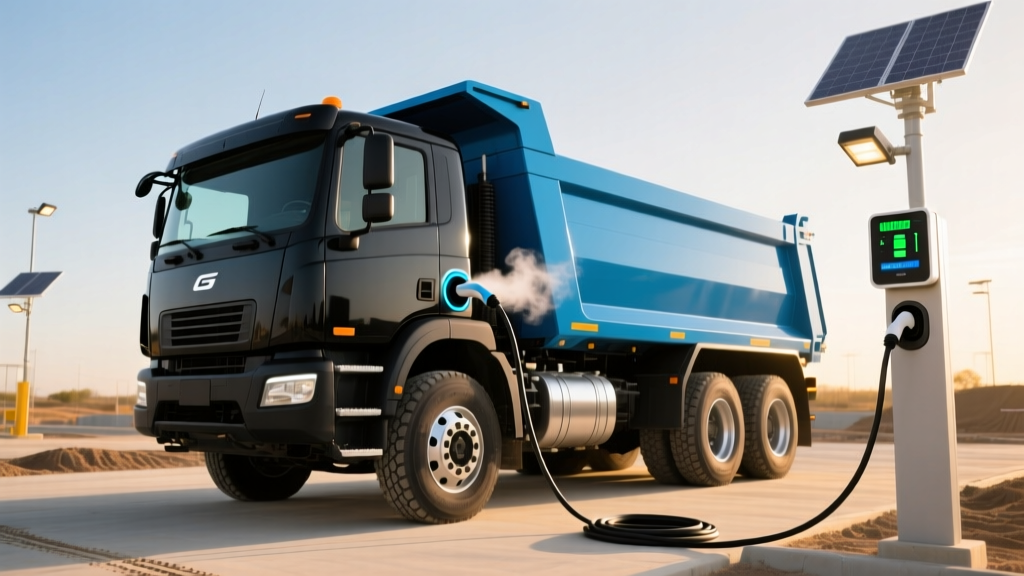
Unlike a delivery truck that returns to a predictable depot, a dump truck often works at remote job sites — quarries, highway construction zones, landfills. This makes charging logistics the single biggest operational hurdle.
| Charging Level | Power (kW) | Miles Added per Hour | Use Case | Install Cost |
|---|---|---|---|---|
| Level 2 (AC) | 19.2 kW | ~8–12 mi/hr | Overnight top-up only | $3,000–$8,000 per port |
| DC Fast (Depot) | 50–150 kW | ~30–80 mi/hr | Mid-shift opportunity charge | $40,000–$90,000 per unit |
| DC Ultra-Fast | 150–350 kW | ~80–160 mi/hr | Full recharge during lunch break | $85,000–$200,000 per unit |
For a fleet of five electric dump trucks, expect to spend $250,000–$500,000 on depot charging infrastructure, including electrical panel upgrades (potentially a new 480V transformer), trenching, permitting, and the chargers themselves. Lead times for utility service upgrades can stretch 6–18 months — plan accordingly.
Off-site charging reality: Public DC fast chargers along highways are designed for passenger EVs with CCS or NACS connectors, not Class 8 trucks. Pull-through lanes are rare, and many sites can't physically accommodate a 40-foot dump truck. Your operation must be depot-chargeable or you must negotiate dedicated charging at the job site.
What First-Time Electric Dump Truck Buyers Must Know
If you're transitioning from an all-diesel fleet, these operational realities will directly affect your bottom line:
- Payload penalty: Battery packs weighing 6,000–10,000 lbs reduce legal payload capacity. On a Class 8 truck with an 80,000-lb GVWR limit, that's 1,000–2,000 fewer pounds of aggregate per trip. Calculate whether the lost revenue per load offsets fuel savings.
- Regenerative braking advantage: Electric dump trucks recover significant energy on downhill hauls from quarries or elevated sites. Some operators report 15–25% range extension on routes with substantial elevation drop — regen braking converts gravitational potential energy back into battery charge.
- PTO electrification: Traditional dump bodies use hydraulic PTO driven by the diesel engine. Electric trucks use electric PTO (ePTO), which draws directly from the traction battery. Running the dump body 30–50 cycles per day consumes 15–30 kWh — factor this into your range calculations.
- Cold-weather derating: NMC lithium-ion batteries lose 15–25% usable capacity below 20°F. Charging speeds also drop significantly in cold weather unless the truck has active battery preconditioning. Northern-climate operators should spec battery thermal management systems and plan for reduced winter range.
- Driver acceptance: Electric dump trucks produce near-zero noise and vibration — a genuine quality-of-life improvement. But drivers accustomed to diesel engine braking and multi-gear transmissions need training on one-pedal regen driving and charge management.
Common Misconceptions About Electric Dump Trucks
| Myth | Fact |
|---|---|
| "Electric dump trucks can't handle heavy payloads" | Class 8 electric trucks are rated for 80,000 lbs GVWR, same as diesel. The trade-off is reduced payload capacity due to battery weight, not an inability to haul. |
| "Batteries won't last in construction environments" | Current NMC packs are sealed to IP67 standards (dust-tight, submersible). Major manufacturers warranty batteries for 5 years/400,000 miles at ≥70% capacity retention. Vibration and shock testing exceeds SAE J2380 standards. |
| "You can charge at any public station" | Most public DC fast chargers lack pull-through lanes, have weight limits, or are located at retail sites inaccessible to Class 8 trucks. Depot charging is effectively mandatory. |
| "The $40,000 tax credit covers the price gap" | The §45W credit reduces but doesn't eliminate the $150,000–$200,000 purchase premium. State incentives (CA HVIP, NY Truck Voucher, etc.) are often needed to close the gap. Check IRS.gov for current eligibility rules. |
| "Electric trucks have zero maintenance" | Maintenance is reduced (no oil, filters, DEF, DPF, or transmission fluid), not eliminated. Suspension, brakes, tires, cooling systems, and electrical components still require service. Budget 40–60% of diesel maintenance costs. |
Decision Framework: Should You Buy an Electric Dump Truck?
Choose an electric dump truck if:
- Your daily routes are under 120 miles round-trip (loaded)
- You operate from a fixed depot where you can install DC fast chargers
- You drive 80,000+ miles per year (high utilization maximizes fuel savings)
- You operate in a state with additional EV truck incentives (CA, NY, NJ, CO)
- Your job sites or clients require zero-emission equipment (increasingly common in urban infrastructure contracts and government RFPs)
- You plan to keep the truck 8–10+ years to amortize the purchase premium
Stick with diesel (or wait) if:
- Your routes regularly exceed 180 miles or involve remote areas without charging
- You operate primarily in sub-freezing climates without depot heating
- Your annual mileage is under 40,000 miles (fuel savings won't offset the premium)
- You can't secure depot charging infrastructure within your timeline
- You need maximum legal payload on every trip (battery weight penalty matters)
- You turn over trucks every 3–5 years (you won't capture the long-term savings)
For fleets on the fence, a pilot program — deploying one or two electric dump trucks alongside your existing diesel fleet — is the smartest path. Track real-world kWh/mi consumption, charge times, payload impact, and driver feedback for 6–12 months before committing to a larger order. According to NREL fleet electrification studies, actual energy consumption in vocational duty cycles varies 20–40% from manufacturer estimates, making real operational data essential.
Frequently Asked Questions
How long does it take to charge an electric dump truck?
At a 250 kW DC fast charger, a 375 kWh battery charges from 10–80% in roughly 70 minutes. At 150 kW, expect 90–120 minutes. Level 2 overnight charging (19.2 kW) adds about 8–12 miles of range per hour — enough for a partial top-up but not a full recharge. Note that charging slows significantly above 80% State of Charge due to the battery management system tapering current to protect cell longevity.
What's the real cost per mile to operate an electric dump truck vs. diesel?
At $0.07/kWh depot electricity and 2.2 kWh/mi under load, fuel cost is approximately $0.15/mile. A comparable diesel at 6 mpg and $4.25/gallon costs $0.71/mile. That's a $0.56/mile fuel savings — or $56,000 per 100,000 miles. Maintenance adds another $0.03–$0.05/mile in savings. Combined, you're looking at roughly $0.60/mile lower operating cost for electric.
Do electric dump truck batteries need replacement?
Current NMC battery packs are warrantied for 5 years or 400,000 miles at 70% capacity retention. Real-world degradation data from early-adopter fleets (refuse trucks, delivery vans) suggests 10–15% capacity loss over 5 years of heavy use. Full pack replacement costs $80,000–$150,000 in 2026, but most operators won't need this within the truck's first service life. Some manufacturers offer battery-as-a-service leasing to transfer this risk.
Can I get a federal tax credit for a commercial electric dump truck?
Yes. The IRS §45W Commercial Clean Vehicle Credit provides up to $40,000 for qualifying Class 8 vehicles. Eligibility depends on battery component sourcing, critical mineral requirements, MSRP thresholds, and your business's tax liability. The credit is non-refundable for most businesses but can be transferred to a dealer in some cases. Always consult a tax professional before relying on incentive projections.
How does regenerative braking affect dump truck range?
Regenerative braking is a major advantage in vocational duty cycles with frequent stops and elevation changes. A dump truck descending from a quarry or elevated work site can recover 10–25% of the energy spent climbing. Stop-and-go urban construction traffic also benefits. On flat highway hauls with few stops, regen provides minimal range extension — perhaps 3–5%.