Quick Answer: What Is an Electric Drive?
An electric drive is the propulsion system in a battery-electric vehicle (BEV) that replaces the internal combustion engine, transmission, and exhaust system with three core components: an electric motor, a power inverter, and a reduction gear. Energy stored in a high-voltage lithium-ion battery pack (measured in kilowatt-hours, or kWh) is converted by the inverter from DC to AC current, which spins the motor and drives the wheels. The result is instant torque, no multi-speed gearbox, far fewer moving parts, and zero tailpipe emissions. A typical modern EV electric drive delivers 200–500 horsepower, achieves 3–4 miles per kWh, and requires no oil changes, spark plugs, or transmission fluid swaps.
How an Electric Drive Actually Works
The simplicity of an electric drive is its biggest engineering advantage. Where a gasoline powertrain manages hundreds of moving parts — pistons, valves, camshafts, torque converters, clutch packs — an electric motor has essentially one: the rotor spinning inside the stator.
Here's the energy path in a modern BEV:
- Battery pack stores DC energy (e.g., 77.4 kWh usable in a Hyundai Ioniq 5, using NMC chemistry)
- Inverter converts DC to variable-frequency AC, controlling motor speed and torque
- Electric motor (permanent-magnet synchronous or AC induction) generates rotational force
- Single-speed reduction gear (~10:1 ratio) multiplies torque to the wheels
- Regenerative braking reverses the motor into a generator during deceleration, sending energy back to the pack
Because electric motors produce maximum torque from 0 RPM, there is no need for a multi-speed transmission. This eliminates shift lag, reduces drivetrain weight by roughly 50–80 lbs versus a comparable ICE driveline, and cuts maintenance dramatically.
Electric Drive vs. Gasoline Powertrain: The Numbers
The comparison isn't close on efficiency. According to the U.S. Department of Energy, electric motors convert over 85% of electrical energy into motive power at the wheels. Gasoline engines convert only about 12–30% of the energy in fuel — the rest is lost as heat, friction, and exhaust.
| Metric | Electric Drive (BEV) | Gasoline (ICE) |
|---|---|---|
| Drivetrain efficiency | 85–90% (battery to wheels) | 12–30% (fuel to wheels) |
| Moving parts in drivetrain | ~20 | ~200+ |
| Energy cost per mile (national avg) | $0.04–$0.06 (home L2) | $0.12–$0.16 (gas at $3.40/gal, 28 MPG) |
| 0–60 mph (midsize crossover) | 4.5–7.0 sec | 7.0–9.5 sec |
| Scheduled maintenance / year | $0.03/mile (~$360/yr) | $0.08–$0.10/mile (~$960/yr) |
| Brake pad life | 100,000+ miles (regen) | 30,000–60,000 miles |
| Tailpipe emissions | None | CO₂, NOx, particulates |
For a concrete example: the 2026 Tesla Model Y Long Range AWD uses a dual-motor electric drive producing 384 hp and 364 lb-ft of torque, achieves an EPA-estimated 320 miles of range, and earns 123 MPGe combined. A comparably equipped Toyota RAV4 gasoline AWD delivers 203 hp, 35 MPG combined, and roughly 410 miles of range on a 14.5-gallon tank — but costs about $0.14/mile to fuel versus the Model Y's ~$0.05/mile on home electricity at the national average of $0.17/kWh.
Real Costs of Electric Drive Ownership
The sticker price of EVs has dropped significantly. Several mainstream models now start under $38,000, and the federal §30D clean vehicle credit can reduce your effective cost by up to $7,500 if you, the vehicle, and its battery sourcing all meet current IRS requirements. But upfront cost is only part of the equation.
| Category | BEV (e.g., Chevy Equinox EV LT) | Gas (e.g., Chevy Equinox AWD) |
|---|---|---|
| Purchase price (MSRP) | $33,600 | $31,900 |
| Federal tax credit (§30D) | –$7,500 (if eligible) | $0 |
| Net purchase cost | $26,100 | $31,900 |
| Energy/fuel (60k mi) | $2,700 (home L2 @ $0.15/kWh) | $7,285 ($3.40/gal, 28 MPG) |
| Maintenance (60k mi) | $1,800 | $5,400 |
| Insurance (5 yr avg) | $9,500 | $7,800 |
| Depreciation (est.) | $12,000 | $13,500 |
| 5-year total cost | $52,100 | $65,885 |
Key takeaway: Over five years, the EV saves roughly $13,785 despite higher insurance premiums — primarily through fuel savings ($4,585), maintenance savings ($3,600), and the federal tax credit ($7,500). Your actual numbers depend on local electricity rates, driving mileage, and credit eligibility.
What About Insurance?
EV insurance premiums run 15–25% higher than comparable gas cars, driven by higher repair costs for battery-adjacent damage and specialized technician requirements. Average annual premiums for popular EVs range from $1,700–$2,200 versus $1,300–$1,700 for gas equivalents. Shop quotes from EV-friendly insurers like Geico, Progressive, or Tesla Insurance before committing.
Real-World Range: What the EPA Sticker Doesn't Tell You
EPA range estimates are standardized but don't capture every variable. Here's what to actually expect from a modern electric drive in daily life:
- Highway driving (70–80 mph): Expect 80–88% of EPA range. Aerodynamic drag rises with the square of speed. A 310-mile EPA rating drops to ~250–270 miles at sustained 75 mph.
- Cold weather (below 30°F): Range loss of 15–30% is normal due to battery chemistry slowdown and cabin heating demands. A 310-mile EV might deliver 220–260 miles in a 20°F winter commute. Models with a heat pump (standard on Hyundai/Kia E-GMP, Tesla, and many 2026 models) reduce this penalty to 15–20%.
- City / stop-and-go: You'll often exceed EPA range thanks to regenerative braking recapturing energy. The EPA city test cycle favors EVs heavily.
- Charging curve taper: DC fast charging peaks early (e.g., 240 kW at 10% SoC) and tapers significantly above 80%. A "10–80% in 18 minutes" claim is accurate, but 80–100% can take another 25–35 minutes. Plan road-trip stops around the 10–80% window.
Common Electric Drive Misconceptions — Fact-Checked
| Myth | Fact |
|---|---|
| "EV batteries need replacing every few years" | Federal law mandates battery warranties of at least 8 years/100,000 miles. Real-world data from Recurrent shows most packs retain 90%+ capacity at 100k miles. Full replacements are rare and cost $5,000–$20,000 when needed. |
| "Electric motors wear out like gas engines" | Electric motors have no pistons, rings, valves, or timing chains. The rotor and stator experience minimal mechanical wear. Motor failures before 200,000 miles are extremely uncommon. The reduction gear uses a small amount of fluid and rarely needs service. |
| "You can't drive an EV in cold climates" | Norway — where winters are brutal — has the world's highest per-capita EV adoption (~90% of new car sales). Preconditioning the battery while plugged in and using a heat pump mitigate range loss. Remote start without carbon monoxide risk is a bonus. |
| "Charging takes too long for road trips" | Modern 800V architectures (Hyundai/Kia/Genesis, Porsche, Lucid) charge 10–80% in 18–22 minutes at 350 kW chargers. Combined with a meal or restroom break, this mirrors gas-station stop time on trips under 500 miles. |
| "The electric grid can't handle mass EV adoption" | Most charging happens overnight at home, during off-peak hours when grid capacity is underutilized. The DOE estimates that even at 80% EV adoption, total U.S. electricity demand would increase only ~30%, phased in over decades. |
Charging at Home: The Foundation of Electric Drive Ownership
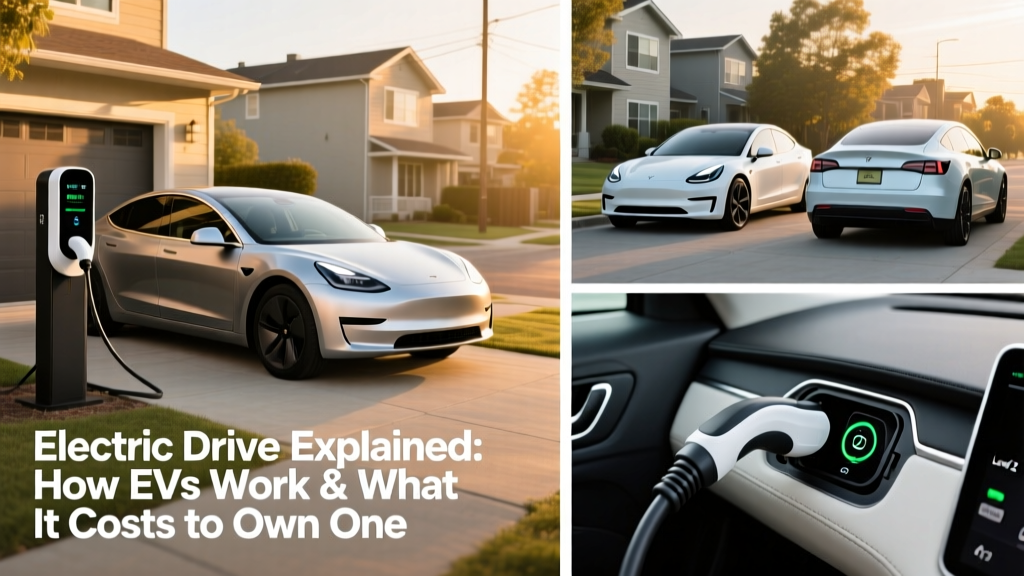
Over 80% of EV charging happens at home. If you have access to a garage or dedicated parking spot, a Level 2 home charger is the single best investment for EV ownership.
- Level 1 (120V outlet): Adds 3–5 miles of range per hour. Fine for PHEVs or low-mileage commuters, but too slow for most BEV owners.
- Level 2 (240V, 40–48 amp circuit): Adds 25–40 miles per hour. A full overnight charge covers virtually any daily driving. Installation typically costs $500–$2,000 depending on panel proximity and whether a 200-amp panel upgrade is needed.
- DC Fast Charging (public, 50–350 kW): Adds 100–250+ miles in 15–30 minutes. Best for road trips; not intended for daily use due to long-term battery health considerations.
If you lack home charging access — apartment living, street parking only — an EV is still viable but requires planning. Check for reliable public Level 2 or DC fast chargers within 1 mile of your home or workplace. Networks like ChargePoint, EVgo, and Electrify America offer subscription plans. If reliable public charging is more than 15 minutes away, a PHEV may be a better fit.
Should You Choose an Electric Drive? A Decision Framework
Choose a BEV (full electric drive) if:
- You can install a Level 2 charger at home or have reliable workplace charging
- Your daily commute is under 80 miles round-trip
- You want the lowest per-mile operating cost and minimal maintenance
- You qualify for the §30D federal credit (income under $150k single / $300k joint; vehicle MSRP under $55k sedans / $80k SUVs and trucks)
- You take road trips of 150–400 miles a few times per year and can plan DC fast-charging stops
Choose a PHEV (plug-in hybrid) if:
- You lack reliable home or workplace charging
- You frequently drive 300+ miles in rural areas with sparse charging infrastructure
- You want 25–50 miles of electric-only commuting with gas backup for longer trips
- You live in an extreme cold climate (below 0°F regularly) and want zero range-compromise
Stick with a gasoline HEV (standard hybrid) if:
- You have no access to any plug-in charging
- Your budget is under $28,000 and you prioritize lowest upfront cost
- You drive very low annual mileage (under 6,000 miles/year), making fuel savings negligible
Frequently Asked Questions
How long does an electric drive motor last?
Electric motors are among the most durable components in any vehicle. With no combustion, no reciprocating mass, and minimal friction, the motor itself commonly outlasts 300,000+ miles. The power inverter and reduction gear are the more likely service items, and even those rarely fail within the 8-year/100,000-mile powertrain warranty standard on most EVs.
Does regenerative braking really save brake pads?
Yes, dramatically. Because the electric motor handles most deceleration by converting kinetic energy back into stored electricity, the friction brakes are used far less. Many EV owners report original brake pads at 80,000–120,000 miles. Some Tesla owners have replaced brake pads for the first time past 150,000 miles. The trade-off: you should occasionally apply the friction brakes firmly to prevent rotor corrosion from disuse.
What's the difference between kW and kWh?
This is the most common EV confusion. kW (kilowatts) measures power — the rate of energy flow, like water pressure in a hose. It determines how fast you charge and how much power the motor produces. kWh (kilowatt-hours) measures energy — the total amount stored or consumed, like gallons in a tank. A 77 kWh battery charged at 11 kW takes roughly 7 hours from empty to full. Think of kW as the "speed" and kWh as the "size."
Is the federal tax credit guaranteed?
No. The §30D credit has multiple eligibility gates that change periodically. As of 2026, key requirements include: vehicle MSRP caps ($80,000 for SUVs/trucks/vans; $55,000 for sedans), buyer income limits ($300,000 joint / $150,000 single modified AGI), and battery component and critical-mineral sourcing requirements that restrict vehicles with certain foreign-sourced materials. The credit can be applied at the point of sale as a discount, but verify eligibility on the IRS clean vehicle credit page and with a tax professional before purchasing.
Do electric drives require any special maintenance?
Very little. The electric motor itself is essentially maintenance-free. You'll still need: cabin air filter replacement ($20–$50, every 15,000–20,000 miles), tire rotation (EVs wear tires 15–20% faster due to instant torque and heavier curb weight), brake fluid check (every 2 years), coolant system service for the battery thermal management loop (typically every 5 years or 60,000 miles), and windshield washer fluid. There is no engine oil, transmission fluid, spark plugs, timing belt, oxygen sensor, catalytic converter, or exhaust system to service.
What happens if the battery degrades?
All lithium-ion batteries lose capacity over time, but modern EV batteries degrade slowly — typically 1.5–2.5% per year under normal use. At 100,000 miles, expect 88–93% of original capacity. Federal warranty rules require manufacturers to guarantee at least 70% capacity retention for 8 years or 100,000 miles (10 years/150,000 miles in CARB states). If capacity drops below the threshold, the manufacturer must repair or replace the battery at no cost. To maximize longevity: avoid routinely charging to 100% for daily use (80% is ideal for NMC chemistry), use preconditioning before DC fast charging, and minimize repeated back-to-back fast charges in hot weather.
An electric drive represents the most significant simplification in automotive propulsion in a century — fewer parts, higher efficiency, lower operating costs, and smoother performance. The decision to adopt one comes down to your charging access, driving patterns, and budget. With 2026 pricing, current tax credits, and a growing public charging network, the math increasingly favors going electric for the majority of American drivers.