Quick Answer: Is an Electric Delivery Truck Right for Your Fleet?
An electric delivery truck makes financial sense in 2026 if your routes are under 150 miles per day, your vehicles return to a central depot nightly for Level 2 charging, and you qualify for the IRA's Commercial Clean Vehicle Credit (§45W) of up to $40,000. For last-mile delivery, shuttle services, and urban logistics, the total cost of ownership (TCO) undercuts diesel and gas vans within 3–5 years thanks to dramatically lower fuel and maintenance costs. However, if your routes exceed 200 miles daily, operate in extreme cold without depot charging, or require frequent highway-speed intercity runs, a conventional or hybrid van remains the more practical choice today.
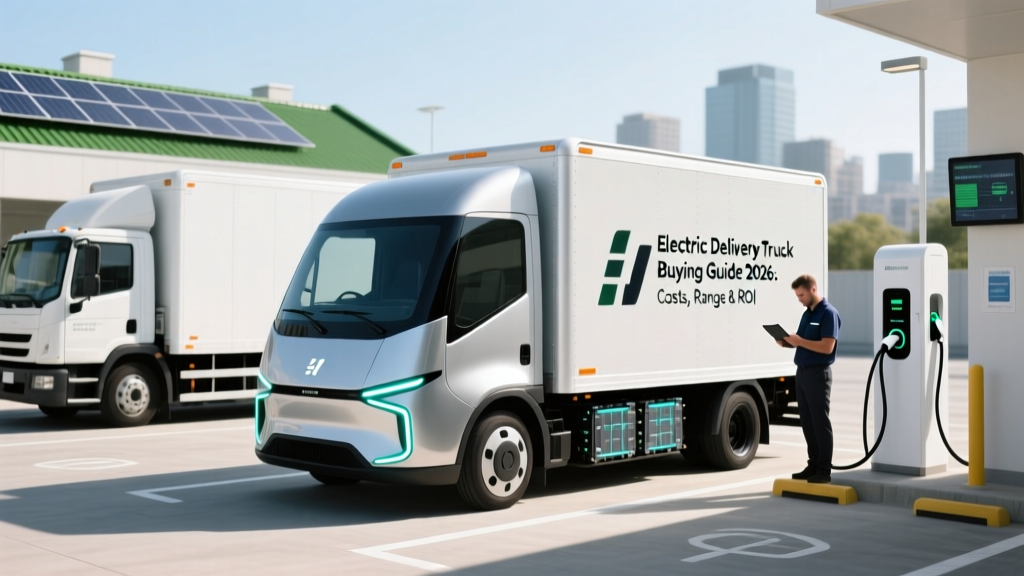
The commercial EV landscape has matured rapidly. As of the 2026 model year, fleet managers can choose from several production electric delivery trucks and vans — including the Ford E-Transit, BrightDrop Zevo 600, and Rivian EDV (Electric Delivery Van) built for Amazon — each with distinct range, payload, and charging profiles. This guide cuts through the marketing to give you the numbers, ownership economics, and decision framework you need before signing a fleet purchase order.
Top Electric Delivery Trucks in 2026: Specs Compared
Let's start with hard data. Below is a side-by-side spec comparison of the three most widely available electric delivery trucks and vans for the 2026 model year. All figures reflect manufacturer-published data and EPA estimates where applicable.
| Spec | Ford E-Transit (2026) | BrightDrop Zevo 600 (2026) | Rivian EDV (Amazon) |
|---|---|---|---|
| EPA Range | 126 mi (low-roof cargo van) | ~250 mi (estimated, 208 kWh battery) | ~150 mi (estimated) |
| Battery Capacity | 68 kWh usable (NMC) | 208 kWh (NMC) | ~135 kWh (estimated, NMC) |
| Peak DC Fast Charge | 115 kW | ~120 kW (est.) | ~150 kW (est.) |
| 10–80% DC Charge Time | ~45 min | ~90 min | ~60 min (est.) |
| Level 2 Charge Rate | 10.5 kW (AC) | ~11.5 kW (AC) | ~11 kW (AC) |
| Payload Capacity | 3,880 lbs | ~2,500 lbs | ~2,500 lbs |
| Cargo Volume | 487.3 cu ft (high-roof, extended) | 600 cu ft | ~660 cu ft |
| Horsepower / Torque | 266 hp / 317 lb-ft | ~300 hp (est.) | ~350 hp (est.) |
| Starting MSRP (approx.) | ~$52,000 | ~$100,000+ | Fleet-only (Amazon contract) |
| Battery/Powertrain Warranty | 8 yr / 100,000 mi | 8 yr / 100,000 mi (est.) | 8 yr / 175,000 mi |
Real-World Range Reality Check: The Ford E-Transit's EPA-estimated 126-mile range assumes a mix of city and highway driving at moderate temperatures with a partial load. In real-world urban delivery use — frequent stops, low average speeds, heavy regenerative braking — fleet operators report achieving 110–130 miles on a full charge. However, highway-heavy routes at 65+ mph, full payload, or winter temperatures below 30°F can drop usable range to 85–100 miles. Always spec your vehicle against your worst-case route, not your average route.
Electric Delivery Truck vs. Gas Van: Total Cost of Ownership
The purchase price of an electric delivery truck is substantially higher than a comparable gas or diesel van. The Ford E-Transit starts around $52,000, while a gas-powered Ford Transit cargo van starts near $46,000. But purchase price is only the beginning. Fleet economics are driven by per-mile operating costs, and that's where electric trucks gain ground quickly.
| Cost Factor (5-Year / 75,000 mi) | Ford E-Transit (EV) | Ford Transit 3.5L V6 (Gas) |
|---|---|---|
| Purchase Price (base MSRP) | $52,000 | $46,000 |
| Federal Tax Credit (§45W Commercial) | –$7,500 to –$40,000* | $0 |
| Fuel / Electricity (75,000 mi) | ~$4,500 (at $0.13/kWh avg) | ~$14,600 (at $3.50/gal, 16 MPG avg) |
| Maintenance (5 yr) | ~$1,800 | ~$5,500 |
| Insurance (5 yr est.) | ~$9,000 | ~$7,500 |
| Estimated 5-Year TCO (before credit) | ~$67,300 | ~$73,600 |
| Estimated 5-Year TCO (after max credit) | ~$27,300 | ~$73,600 |
*The IRS §45W Commercial Clean Vehicle Credit provides up to $7,500 for vehicles under 14,000 lbs GVWR and up to $40,000 for heavier commercial EVs. Eligibility depends on battery sourcing requirements, vehicle weight class, and your business tax liability. Consult a tax professional for your specific situation.
The math is clear: even before incentives, the E-Transit saves roughly $6,300 over five years in fuel and maintenance alone. With the commercial tax credit applied, the savings become transformative for fleet economics. The key variable is electricity cost — fleets with access to off-peak commercial rates or on-site solar can push fuel savings even higher.
Charging Infrastructure: What Fleet Buyers Actually Need
The single biggest barrier to electric delivery truck adoption isn't the vehicle — it's the charging infrastructure. Unlike consumer EVs that can rely on public networks, commercial delivery trucks need predictable, depot-based charging to maintain route reliability.
Depot Charging Essentials
Most electric delivery trucks will charge overnight at a fleet depot using Level 2 (AC) chargers. Here's what that looks like in practice:
- Level 2 charging at 10.5 kW adds roughly 25–30 miles of range per hour on an E-Transit
- Full overnight charge (8–10 hours) is sufficient to replenish the 68 kWh battery from near-empty
- Per-station installation cost ranges from $3,000 to $7,000 per Level 2 unit, including a dedicated 240V/60A circuit, commercial-grade EVSE hardware (e.g., ChargePoint CT4000 or Blink HQ), conduit, and permitting
- Electrical panel upgrades can add $5,000–$20,000+ if your depot's existing service can't support multiple simultaneous chargers — a 10-vehicle fleet may need a 400A or 800A service upgrade
| Charging Level | Power (kW) | Miles Added/Hour (E-Transit est.) | Use Case |
|---|---|---|---|
| Level 1 (120V AC) | ~1.4 kW | ~3–4 mi/hr | Not practical for fleet use |
| Level 2 (240V AC) | 10.5 kW | ~25–30 mi/hr | Primary overnight depot charging |
| DC Fast Charge | Up to 115 kW | ~150+ mi/hr (peak) | Mid-day top-up, opportunity charging |
For fleets running split shifts or longer routes, DC fast charging can serve as a mid-day opportunity charger. At 115 kW peak, the E-Transit can recover roughly 45 miles of range in a 20-minute driver break. However, sustained DC charging at this rate generates significant battery heat, and charge speed tapers considerably above 80% state of charge. Plan your charging strategy around the 10–80% window for the fastest sessions.
Utility Incentives and Make-Ready Programs
Before paying full price for depot charging infrastructure, check with your local utility. Many investor-owned utilities offer "make-ready" programs that cover the cost of electrical infrastructure upgrades (wiring, panels, conduit) to the charging pad — sometimes covering 50–100% of those costs. These programs exist because utilities want the predictable overnight load that fleet EV charging provides. Programs vary by state and utility, so contact your commercial account representative directly.
Federal Tax Credits and Incentives for Commercial EVs
The incentive landscape for electric delivery trucks differs significantly from consumer EVs. Fleet buyers and businesses should understand two primary federal credits:
§45W Commercial Clean Vehicle Credit
- Credit amount: Up to $7,500 for vehicles with GVWR under 14,000 lbs; up to $40,000 for vehicles at or above 14,000 lbs
- Eligible buyers: Businesses and tax-exempt organizations (not individual consumers for personal use)
- Vehicle requirement: Must be a qualified plug-in EV or fuel cell vehicle purchased for business use
- Battery sourcing: Battery components must meet domestic content and critical mineral requirements that phase in through 2026 — verify current-year rules with the IRS
- No MSRP cap: Unlike the consumer §30D credit, there is no manufacturer's suggested retail price cap
- No income cap: Business income limits do not apply
- Transferability: Tax-exempt organizations (nonprofits, governments, tribal entities) can receive the credit as a direct payment
Additionally, many states and local air quality districts offer their own incentives for commercial EV adoption — from California's Hybrid and Zero-Emission Truck and Bus Voucher Incentive Program (HVIP) to New York's Truck Voucher Incentive Program. These can stack with federal credits and dramatically reduce effective purchase price. Check your state energy office or air quality management district for current program availability.
Common Misconceptions About Electric Delivery Trucks
Fleet buyers evaluating electric delivery trucks encounter a lot of noise. Let's separate fact from fiction with data.
| Myth | Fact |
|---|---|
| "EV batteries won't last the life of the vehicle" | Modern NMC and LFP batteries in commercial EVs are warranted for 8 years / 100,000+ miles at a minimum 70% capacity retention threshold. Fleet data from early E-Transit and BrightDrop deployments shows degradation of roughly 5–10% over the first 100,000 miles — well within warranty. Replacement cost for a 68 kWh pack currently ranges from $10,000–$18,000 out of warranty, but few fleets will need this within a typical 7-year vehicle lifecycle. |
| "Electric trucks can't handle cold weather" | Cold weather does reduce range — typically 15–30% at 20°F due to battery chemistry and cabin/cargo heating demands. However, delivery trucks with heat pump systems (standard on most 2026 models) mitigate this significantly. The real solution is route planning: spec your truck for worst-case winter range, not summer range, and precondition the battery while still plugged in at the depot. |
| "Charging takes too long for commercial use" | For depot-based overnight charging, it doesn't matter — your truck charges while parked for 8–10 hours. Level 2 charging fully replenishes an E-Transit battery in about 7 hours. For mid-day top-ups, DC fast charging adds 45+ miles in 20 minutes. The constraint is route design, not charging speed. |
| "Electric trucks have less payload capacity" | Battery weight does reduce payload vs. an equivalent gas van. The E-Transit gives up roughly 400–600 lbs of payload compared to a gas Transit. For most last-mile delivery applications (parcels, food, parts), this is well within operational margins. For heavy freight, it can be a legitimate limitation. |
| "There are no electric delivery trucks available now" | The Ford E-Transit has been in production since 2022 and is widely available through commercial dealers. BrightDrop Zevo vans are in production for fleet customers. The Rivian EDV is currently exclusive to Amazon but signals where purpose-built commercial EVs are heading. |
Real-World Ownership: What First-Time EV Fleet Buyers Should Know
Transitioning a fleet from gas to electric involves operational changes beyond the vehicles themselves. Here's what experienced fleet managers wish they'd known before their first electric delivery truck purchase:
Driver Training Is Non-Negotiable
Electric delivery trucks drive differently. Regenerative braking — which recovers kinetic energy during deceleration and feeds it back to the battery — changes the braking feel substantially. Drivers accustomed to coasting to stops in gas vans need to learn one-pedal driving techniques to maximize range recovery. Most manufacturers offer fleet driver training modules; use them. Fleets that skip training report 10–15% lower real-world range due to inefficient driving habits.
Telematics and Route Optimization
Modern electric delivery trucks generate enormous telematics data: state of charge, energy consumption per route segment, battery temperature, and regenerative braking efficiency. Fleet management platforms like Ford Pro, Geotab, and Samsara integrate this data to optimize routes for energy efficiency, flag vehicles that need mid-day charging, and predict maintenance needs. Budget for a telematics subscription ($15–$30/vehicle/month) — it pays for itself in range optimization alone.
Maintenance Is Simpler, Not Zero
Electric delivery trucks eliminate oil changes, transmission fluid, spark plugs, exhaust systems, and most brake wear (thanks to regenerative braking). But they still require tire rotations, cabin air filter replacements, coolant system checks, windshield washer fluid, and suspension service. Budget roughly 60–70% less on powertrain maintenance vs. gas — but don't eliminate your maintenance line item entirely.
Insurance Premiums Run Higher
Commercial EV insurance premiums typically run 15–25% higher than equivalent gas vehicles, driven by higher repair costs for battery and power electronics damage, limited collision repair networks, and higher vehicle values. Get quotes from your commercial insurer before finalizing your purchase decision. Some insurers now offer EV-specific fleet policies with more competitive rates.
Decision Framework: Should You Buy an Electric Delivery Truck?
Choose an Electric Delivery Truck If:
- Your daily routes are under 150 miles and vehicles return to a central depot nightly — this covers the vast majority of last-mile delivery, urban courier, and service-call operations
- You have depot parking with electrical access or can invest in Level 2 charging infrastructure ($3,000–$7,000 per station plus potential panel upgrades)
- You qualify for the §45W commercial tax credit — the $7,500–$40,000 credit fundamentally changes the purchase economics
- Your fleet operates in a city or metro area with lower average speeds, frequent stops, and high idle time — exactly where regenerative braking maximizes EV efficiency and where zero tailpipe emissions improve urban air quality
- You want predictable fuel costs — electricity prices are far more stable than gasoline/diesel, protecting your fleet budget from commodity price swings
Stick With Gas or Hybrid Vans If:
- Your daily routes regularly exceed 200 miles with no opportunity for mid-day charging — current electric delivery truck range simply doesn't cover intercity or long-haul routes reliably
- You operate in extreme cold climates (sustained sub-zero temperatures) without heated depot parking — range loss can exceed 30%, and cold-soaked batteries charge far more slowly
- Your payload requirements are near the maximum for the vehicle class — the battery weight penalty (400–600 lbs) may push you into a heavier vehicle class or require a second trip
- You lack depot charging access and cannot install it — relying on public DC fast charging for daily fleet operations is unreliable, expensive, and operationally unpredictable
- Your business cannot absorb higher upfront cost even with tax credits — cash flow constraints are real, and the credit requires sufficient tax liability to offset (or direct-pay eligibility for tax-exempt entities)
Frequently Asked Questions
What is the real-world range of a Ford E-Transit on a delivery route?
In mixed urban delivery use with frequent stops, moderate loads, and temperatures between 50–80°F, fleet operators typically achieve 110–130 miles on a full charge — close to the EPA estimate of 126 miles. Highway-heavy routes at sustained 65+ mph reduce this to roughly 90–105 miles. In winter conditions below 30°F, expect 85–100 miles. Always plan routes against your worst-case range scenario.
How much does it cost to charge an electric delivery truck per day?
Assuming a full daily charge of 68 kWh (Ford E-Transit) at a commercial electricity rate of $0.12/kWh, daily charging costs approximately $8.16. Over a 5-day work week, that's $40.80 — compared to roughly $72 in gasoline for an equivalent gas Transit achieving 16 MPG over 126 miles at $3.50/gallon. The per-mile fuel cost advantage is roughly 55–65% in the EV's favor.
Can I use a standard outlet to charge a delivery truck overnight?
Technically yes, but practically no. Level 1 charging (120V) at roughly 1.4 kW would take over 48 hours to fully charge a 68 kWh battery — completely impractical for daily fleet operations. Level 2 charging at 240V / 10.5 kW is the minimum viable standard, completing a full charge in approximately 7 hours. Plan for professional electrical installation of dedicated Level 2 circuits at your depot.
How long do electric delivery truck batteries last before replacement?
Current NMC battery packs in commercial delivery vehicles are engineered for 1,500–3,000 full charge cycles before reaching 70–80% of original capacity. For a truck charged once daily, that translates to roughly 8–12 years of service before significant range loss. Manufacturer warranties typically cover 8 years / 100,000 miles at a minimum 70% capacity retention threshold. Out-of-warranty battery replacement currently costs $10,000–$18,000 depending on pack size, though costs continue declining.
Do electric delivery trucks qualify for the $7,500 consumer tax credit?
No — the consumer §30D Clean Vehicle Credit applies to personal-use vehicles. Commercial electric delivery trucks purchased by businesses qualify for the separate §45W Commercial Clean Vehicle Credit, which offers up to $7,500 for vehicles under 14,000 lbs GVWR and up to $40,000 for heavier vehicles. Eligibility depends on battery component sourcing requirements and your business's tax situation. Consult a tax professional to confirm your eligibility.
What happens if my electric delivery truck runs out of charge on a route?
Unlike a gas van that can be refueled in 5 minutes from a jerry can, a depleted EV requires a flatbed tow to a charger — a costly and time-consuming disruption. This is why route planning against worst-case range is critical. Most fleet telematics platforms will alert dispatchers when a vehicle's state of charge drops below a threshold, enabling proactive route reassignment or mid-day charging. Build a 20% range buffer into every route plan.
Electric delivery trucks have moved from pilot programs to production reality. For the right use case — predictable routes, depot charging, urban delivery — the economics are compelling and improving every year. The key is matching the vehicle to your operation with clear eyes about range limits, infrastructure needs, and total costs. Run your own numbers, pilot one or two vehicles before committing a full fleet, and lean on your utility's commercial EV programs to defray infrastructure costs.