The Short Answer on Electric Cruise Ships
As of 2026, fully electric cruise ships do not exist for ocean-going passenger travel. The energy requirements of moving a 100,000+ gross-ton vessel across oceans far exceed current battery technology. What does exist are hybrid-electric cruise ships (like MSC's World Europa with LNG fuel cells) and fully electric passenger ferries operating short coastal and fjord routes (such as Norway's all-electric fjord ferries running 60–80 mile routes). If you're an EV owner researching sustainable ocean travel, hybrid-electric ships with shore-power capability represent today's practical ceiling, while battery-electric remains confined to ferries under ~100 nautical miles.
Why a Fully Electric Cruise Ship Doesn't Exist Yet
The physics are unforgiving. A modern mid-size cruise ship like Norwegian's Prima-class vessels consumes roughly 1,200–1,500 MWh per day at sea — that's the equivalent of draining approximately 15,000 Tesla Model Y battery packs (75 kWh each) every 24 hours. Even the largest battery systems deployed on ships today, such as the 10 MWh installations on some Norwegian ferries, cover only minutes of full-power operation on a cruise-scale vessel.
For comparison, the largest battery-electric vehicle on US roads — the Tesla Semi with its ~900 kWh estimated pack — stores less than 1 MWh. You would need over 1,500 Tesla Semis' worth of battery capacity to power a cruise ship for a single day, not counting the weight penalty that would sink the efficiency equation further.
Energy density is the core bottleneck:
- Lithium-ion batteries: ~250 Wh/kg at the cell level
- Marine diesel (HFO): ~11,900 Wh/kg
- LNG: ~13,900 Wh/kg (before cryogenic tank weight)
That roughly 48:1 energy density gap between diesel and lithium-ion means a battery-electric cruise ship with equivalent range would require batteries weighing tens of thousands of tons — more than the ship's entire displacement.
What Electric Cruise Technology Actually Looks Like in 2026
The maritime industry has adopted a tiered electrification approach that mirrors the automotive world's split between BEVs, PHEVs, and HEVs:
| Category | Powertrain | Typical Range | Example Vessels | Status |
|---|---|---|---|---|
| Full Electric (BEV) | Battery-only (LFP/NMC) | 40–80 nautical miles | Norwegian fjord ferries (e.g., MF Ampere successors) | Operational |
| Hybrid-Electric (PHEV) | Battery + diesel/LNG gensets | Unlimited (fuel range) | Hurtigruten's MS Roald Amundsen, Ponant's Le Commandant Charcot | Operational |
| Shore-Power Capable | Diesel/LNG + cold ironing | Unlimited (fuel range) | MSC World Europa, Royal Caribbean Icon of the Seas | Operational |
| Fuel Cell Electric | Hydrogen/methanol fuel cells | 200–500 nm (demonstrated) | Various pilot projects | Announced / Pilot |
| Full Electric Cruise | Battery-only (ocean-scale) | Transoceanic | None | Not feasible |
Hybrid-electric cruise ships like Hurtigruten's battery-assisted expedition vessels use 3–5 MWh battery packs primarily for peak-shaving (smoothing engine load) and silent maneuvering in sensitive areas like Arctic fjords — not for primary propulsion over long distances. This is functionally similar to a plug-in hybrid car using its battery for city driving before the engine takes over on the highway.
Battery Ferries: The Real "Electric Cruise" Experience
If you want to actually ride a fully electric passenger vessel, battery-electric ferries are your option today. Norway leads the world here, with over 70 all-electric ferries in operation as of 2026, many built by Norwegian shipyards using LFP (lithium iron phosphate) battery chemistry for its superior cycle life and thermal stability in marine environments.
Typical specs for an operational Norwegian electric ferry:
- Battery capacity: 2,000–4,000 kWh (LFP)
- Route length: 15–50 nautical miles (17–58 statute miles)
- Charging: Shore-side DC fast charging at 1.5–3 MW during 10–20 minute port stops
- Passenger capacity: 120–360 passengers plus vehicles
- Annual energy cost vs diesel: ~60–80% reduction per the DNV maritime classification society
These ferries operate on fixed, short routes with predictable charging infrastructure at each terminal — a maritime parallel to how a Nissan Leaf with 150 miles of range works perfectly for a defined daily commute with home charging.
Cost Comparison: Electric Ferry vs Diesel vs Hybrid Ship
| Cost Factor | Diesel Ferry | Electric Ferry (LFP) | Hybrid Cruise Ship |
|---|---|---|---|
| Fuel / Energy | $4,500–$6,000 | $800–$1,200 (grid electricity) | $15,000–$25,000 (LNG + battery assist) |
| Maintenance (annualized per voyage) | $1,800 | $600 | $3,500 |
| Battery replacement reserve | $0 | $400–$700 | $200–$400 |
| Shore infrastructure (annualized) | $0 | $500–$900 | $300 |
| Total per voyage | $6,300–$7,800 | $2,300–$3,400 | $19,000–$29,200 |
The electric ferry's cost advantage is dramatic on short, high-frequency routes — much like how a BEV commuter car saves $3,000–$5,000 annually over a gas car when home charging is available. But the comparison only holds where shore charging infrastructure exists and routes are short enough for current battery energy density.
Shore Power: Where EV Owners See the Connection
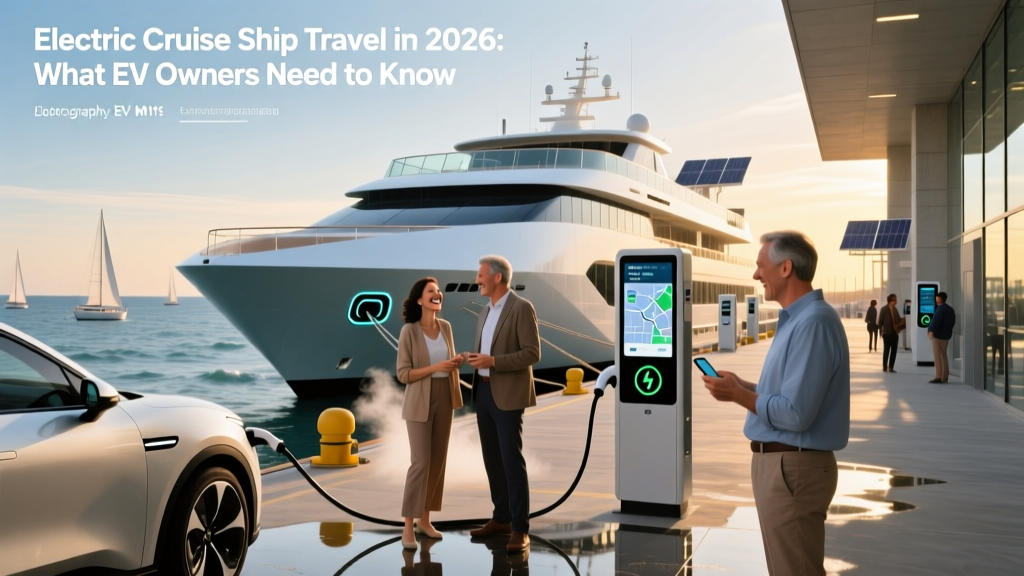
The most relevant electrification technology for cruise ship passengers in 2026 is cold ironing (shore power / shore-side electricity). This allows ships to plug into the local electrical grid while docked, shutting down diesel generators and eliminating port-side emissions.
As of 2026, the EPA and various port authorities report that approximately 15–20 major ports worldwide offer high-voltage shore power compatible with large cruise vessels, including Los Angeles, Long Beach, San Francisco, Seattle, Vancouver, and several European ports. Ships must be built or retrofitted with shore-power connections — a $5–15 million investment per vessel.
For EV owners, the parallel is direct: just as you wouldn't buy a BEV without confirming home or workplace charging access, booking a cruise on a shore-power-capable ship to a shore-power-equipped port is the most impactful electrification choice currently available.
Decision Framework: What Kind of Eco-Conscious Traveler Are You?
If your priority is...
- Lowest-emission ocean travel today: Book a hybrid-electric expedition cruise (Hurtigruten, Ponant) on routes with shore-power ports. Expect 20–30% lower emissions vs conventional ships.
- Zero-emission water travel: Choose an electric ferry route — Norway's fjord crossings, Washington State Ferries' planned electric conversions, or BC Ferries' hybrid fleet. Routes are short (under 60 miles) but genuinely battery-electric.
- Future-proofing: Watch for methanol fuel-cell cruise ships (announced by MSC and others for late-2020s delivery). These could cut lifecycle emissions 60–80% vs LNG, but are not yet sailing.
- Maximum sustainability per dollar: A conventional cruise to a shore-power port on a newer, more efficient ship (Icon-class, World-class) still beats older vessels by 25–40% on emissions per passenger-mile, even without full electrification.
Common Misconceptions About Electric Cruise Ships
| Myth | Fact |
|---|---|
| "Electric cruise ships are sailing now" | No ocean-going cruise ship is fully battery-electric. Hybrid-electric and shore-power ships exist, but they still burn fossil fuels for primary propulsion. |
| "Solid-state batteries will fix this soon" | Even at 2x energy density (~500 Wh/kg), solid-state batteries would still be ~24x less energy-dense than marine diesel. Transoceanic electric cruise ships require a fundamental energy storage breakthrough, not incremental improvement. |
| "Solar panels on deck could power a cruise ship" | A cruise ship's top deck (~20,000 m²) with 22% efficient panels generates ~1–2 MW peak in full sun — roughly 5–10% of the ship's total power demand. Helpful for hotel loads, irrelevant for propulsion. |
| "Hybrid cruise ships are as green as EVs" | Hybrid ships reduce emissions 15–30% vs conventional. A full BEV eliminates tailpipe emissions entirely (though upstream electricity generation matters). The comparison gap is significant. |
| "I can book an electric cruise today" | You can book hybrid-electric expedition voyages and electric ferry crossings. Marketing materials sometimes blur this distinction — verify the actual powertrain before booking. |
What EV Buyers Can Learn From Maritime Electrification
The cruise ship electrification story reinforces lessons every EV buyer already knows from the automotive world:
- Energy density is destiny. Just as LFP batteries trade some range for cost and longevity in cars, maritime applications face the same physics — batteries work where routes are short, predictable, and charging-equipped.
- Infrastructure precedes adoption. Shore-power ports are the maritime equivalent of DC fast-charging corridors. Without them, even willing operators can't electrify.
- Hybrids bridge the gap. PHEV cruise ships (battery for port maneuvering, engines for open water) mirror the PHEV car strategy — electric where it's easy, fuel where range demands it.
- Marketing outpaces reality. "Green cruise" marketing often highlights auxiliary battery systems while the ship still burns thousands of tons of fuel. This mirrors automotive greenwashing — always check the actual powertrain specs.
Frequently Asked Questions
Are there any fully electric cruise ships operating in 2026?
No. Every operational cruise ship carrying passengers on multi-day ocean voyages uses fossil fuels (diesel, LNG, or heavy fuel oil) for primary propulsion. Some have battery packs for auxiliary functions like peak-shaving and silent port maneuvering, but these are hybrid systems, not fully electric.
What's the largest fully electric passenger vessel?
The largest battery-electric passenger vessels are Norwegian car-and-passenger ferries with battery packs in the 3,000–5,000 kWh range, operating on routes under 60 nautical miles. China has tested larger electric river vessels, but these are cargo-focused. Nothing at cruise-ship scale operates on batteries alone.
How does cruise ship energy consumption compare to driving an EV?
A large cruise ship uses approximately 1,200–1,500 MWh per day. A Tesla Model Y Long Range has a 75 kWh battery. The ship consumes the equivalent of fully draining roughly 17,000 Model Y batteries every day. Per passenger-mile, modern cruise ships achieve roughly 100–140 BTU/passenger-mile — comparable to a mid-efficiency car with 1.5 occupants, per fueleconomy.gov data cross-referenced with maritime industry reports.
Will hydrogen fuel cells make electric cruise ships viable?
Hydrogen and methanol fuel cells are the most promising path to zero-emission cruise travel, with pilot projects underway. However, hydrogen's volumetric energy density (even when compressed to 700 bar) requires enormous tank volumes that compete with passenger space. Methanol fuel cells are more space-efficient but still in demonstration phases. Commercial fuel-cell cruise ships are not expected before 2028–2030.
Should I avoid cruises if I'm an environmentally conscious EV owner?
This is a personal calculation. A 7-day cruise generates roughly 0.5–1.0 metric tons of CO₂ per passenger (varies by ship age and fuel). That's comparable to 2–4 round-trip domestic flights. If you choose to cruise, newer ships with shore-power capability, LNG fuel, and hybrid systems have measurably lower per-passenger emissions than older vessels. Pairing a cruise with carbon offsets and choosing lines investing in electrification (Hurtigruten, Ponant, some MSC vessels) reduces — but doesn't eliminate — the environmental impact.
How is shore power (cold ironing) similar to EV charging?
Shore power is the maritime equivalent of plugging your EV into a Level 2 charger. The ship connects to the port's electrical grid (typically 6.6 kV or 11 kV high-voltage AC) and shuts down its onboard generators. This eliminates port emissions entirely — similar to how an EV parked and charging at home produces zero tailpipe emissions. The limitation is identical: it only works where infrastructure exists.