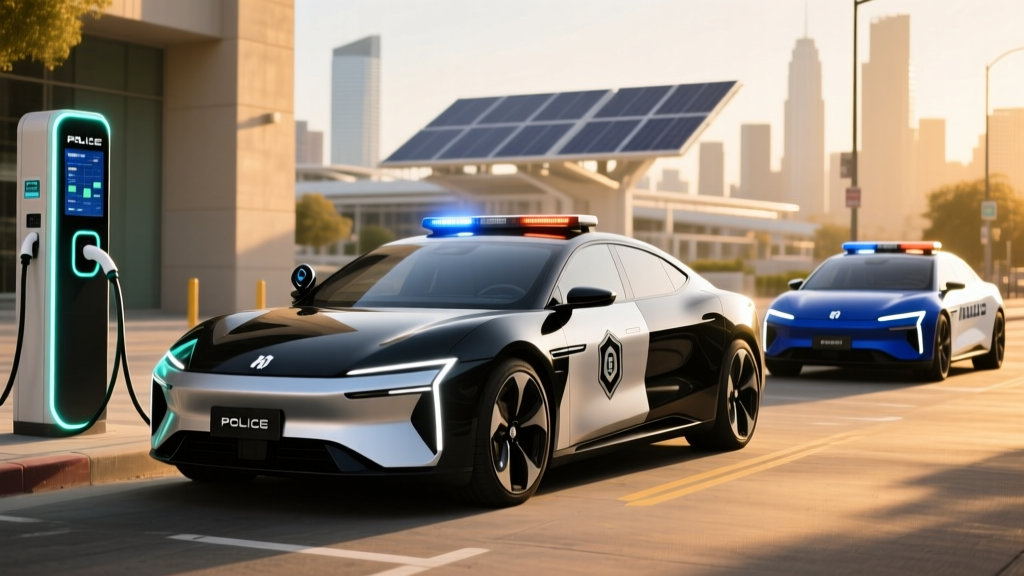
Law enforcement agencies across the U.S. are testing and deploying electric cop cars at a growing pace, but the decision to electrify a patrol fleet is far more complex than swapping a Crown Victoria for a Tesla. As of 2026, the Ford Pro F-150 Lightning, Chevrolet Blazer EV PPV, and Tesla Model Y are the most common battery-electric pursuit and patrol vehicles in active or pilot service. The core answer for fleet managers: electric patrol vehicles can cut per-mile fuel and maintenance costs by 40–60%, but they require significant upfront investment in depot charging infrastructure, careful route and shift planning around 250–310 miles of real-world range, and honest assessments of cold-weather performance and pursuit-duty energy draw.
Quick Answer: Are Electric Cop Cars Ready for Patrol?
Yes — for urban and suburban patrol with predictable shifts and depot charging. No — for rural agencies, extreme cold climates, or departments unable to fund Level 2 depot charging at scale. The total cost of ownership favors EVs over 5 years, but the infrastructure hurdle is real and often costs $50,000–$200,000+ per precinct.
Which Electric Cop Cars Are Actually in Police Service?
Unlike the consumer EV market with dozens of models, the police-spec electric vehicle market in 2026 is narrow. Manufacturers build pursuit-rated variants with reinforced suspensions, upgraded cooling, steel wheels rated for curb strikes, and integrated emergency equipment wiring. Here are the primary contenders:
| Model | EPA Range | Battery (usable) | Peak DC Charge | 10–80% Time | 0–60 mph | Base Fleet MSRP |
|---|---|---|---|---|---|---|
| Ford F-150 Lightning (Police Responder) | 230 mi (std) / 320 mi (ext) | 98 kWh (std) / 131 kWh (ext) NMC | 150 kW (std) / 155 kW (ext) | ~38 min (ext) | ~4.0 sec (ext) | ~$62,000 |
| Chevrolet Blazer EV PPV | 279 mi (FWD) / 249 mi (AWD) | 85 kWh (est.) NMC | 190 kW | ~28 min | ~5.5 sec (AWD) | ~$54,000 |
| Tesla Model Y (aftermarket upfit) | 308 mi (LR AWD) | 75 kWh NMC | 250 kW | ~15 min | 4.8 sec | ~$46,000 (pre-upfit) |
| Dodge Charger Daytona EV (announced) | 317 mi (R/T est.) | 100.5 kWh NMC | ~200 kW (est.) | ~27 min (est.) | ~3.3 sec (Scat Pack) | TBA — not yet in fleet service |
The Ford F-150 Lightning Police Responder dominates deployments because it is purpose-built for law enforcement: upfitter-friendly, rated for light pursuit, and backed by Ford Pro's commercial service network. The Blazer EV PPV (Police Pursuit Vehicle) is the first Chevy to carry the PPV badge as an EV, targeting agencies that want a sedan-class footprint. Tesla Model Ys appear in departments like Fremont, CA and South Pasadena, CA, often as non-pursuit patrol or community service vehicles with aftermarket light-bar and cage upfits.
Real-World Range Reality for Patrol Duty
EPA range figures are measured on mild mixed-driving cycles. Patrol duty involves constant idling (climate control for K9 units or prisoner transport), aggressive acceleration from stops, and high electrical loads from radios, laptops, and light bars. Fleet managers should budget 25–40% range reduction from EPA stickers during active patrol shifts. A Blazer EV PPV rated at 279 miles EPA may deliver 170–210 miles of usable patrol range before requiring a charge.
EV Patrol Costs vs. Gas: The 5-Year Fleet Breakdown
The economic case for electric cop cars hinges on the gap between higher acquisition cost and dramatically lower per-mile operating expenses. Here is a modeled comparison based on a typical urban patrol vehicle running 25,000 miles per year over a 5-year service life:
| Cost Category | Ford F-150 Lightning (EV) | Ford Explorer ICE (Gas) |
|---|---|---|
| Purchase / Upfit | $72,000 (vehicle + upfit) | $52,000 (vehicle + upfit) |
| Fuel / Electricity (5 yr) | $9,400 (depot L2 @ $0.12/kWh avg) | $31,250 (gas @ $3.50/gal, 16 mpg avg) |
| Maintenance (5 yr) | $4,200 (tires, cabin filter, fluid top-offs) | $11,800 (oil, brakes, trans, belts, plugs) |
| Depot Charging Install (per vehicle share) | $8,000–$15,000 | $0 |
| Estimated Resale (year 5) | $18,000 | $12,000 |
| Total 5-Year Net Cost | $75,600–$82,600 | $83,050 |
The numbers show the EV reaching cost parity or savings within the service life, but only if the department can charge at depot rates (residential or commercial utility pricing). Public DC fast charging at $0.35–$0.50/kWh erases the fuel savings rapidly. The Alternative Fuels Data Center publishes fleet electrification case studies from agencies that have published their actual operating data.
Charging Infrastructure: The Real Bottleneck
The single largest barrier to electric cop car adoption is not the vehicle — it is the charging infrastructure. A precinct running 20 patrol EVs on two shifts needs a carefully engineered depot charging solution.
| Level | Power (kW) | Miles Added/Hour | Typical Use Case |
|---|---|---|---|
| Level 1 (120V) | 1.4 kW | ~4 mi/hr | Not viable for fleet |
| Level 2 (240V, 48A) | 11.5 kW | ~32 mi/hr | Overnight depot — primary method |
| Level 2 (240V, 80A) | 19.2 kW | ~52 mi/hr | Faster depot — requires heavier service |
| DC Fast (150 kW) | 150 kW | ~450 mi/hr (peak) | Mid-shift top-up, pursuit recovery |
Most fleet deployments rely on Level 2 overnight charging at the precinct or motor pool. At 11.5 kW, a Blazer EV PPV with a depleted 85 kWh battery reaches full charge in roughly 7.5 hours — feasible for an end-of-shift plug-in. But installing 20 Level 2 chargers in a precinct parking lot often requires a new 480V three-phase electrical service upgrade, trenching, conduit runs, and utility coordination. Costs range from $3,000–$6,000 per stall for simple surface-mount installs to $15,000–$25,000 per stall when panel upgrades and utility transformer work are needed.
DC fast chargers (150–350 kW) at the depot enable mid-shift top-ups but cost $50,000–$150,000 each installed, plus ongoing demand charges from the utility that can add thousands per month to the electric bill.
Cold Weather, Pursuit, and the Limits Agencies Must Accept
Electric cop cars face three operational constraints that gasoline patrol vehicles do not:
Cold-weather range loss. Lithium-ion batteries lose 20–40% of their effective range at temperatures below 20°F. A Blazer EV PPV delivering 200 miles of patrol range in July may deliver only 120–140 miles in a Minnesota January. Heat pumps (standard on the Lightning, optional or unavailable on some models) reduce but do not eliminate this penalty. Agencies in cold climates must plan shorter shifts or install mid-shift DC fast chargers.
Pursuit energy consumption. High-speed pursuit draws enormous current — sustained 80–100 mph driving can consume energy at 2–3× the EPA test cycle rate. A 10-minute pursuit at highway speeds can consume 15–25 miles of range. This is not a dealbreaker (gas vehicles also burn fuel rapidly in pursuit), but it means post-pursuit vehicles may need to be swapped out rather than returned to the same shift.
Charging time vs. refueling time. A gas Explorer refuels in 3 minutes. An EV at a 150 kW DC fast charger takes 25–40 minutes for a 10–80% charge. For two-shift operations, this means the vehicle is off the road longer between shifts unless depot charging is fast enough to turn over during shift change.
Electric Cop Car Myths vs. Facts
| Myth | Fact |
|---|---|
| "EVs can't handle pursuit speeds." | The F-150 Lightning Police Responder is pursuit-rated to 100+ mph. The Charger Daytona Scat Pack does 0–60 in ~3.3 seconds. Speed is not the limitation — sustained energy draw is. |
| "EVs will leave officers stranded." | No documented case of a police EV stranding an officer on patrol in published fleet reports. Range management software and shift planning prevent this. |
| "Electric cop cars are cheaper overall." | Cheaper to operate, more expensive to acquire and equip with infrastructure. Total savings depend on annual mileage and electricity rates. |
| "Federal tax credits offset the cost." | Government fleet purchases do not qualify for the §30D consumer credit. However, some agencies access state/local electrification grants and EPA Clean School Bus-adjacent programs. |
Federal and State Incentives for Fleet Electrification
One critical point fleet managers often miss: the IRS §30D clean vehicle credit is designed for individual taxpayers, not government entities purchasing vehicles for fleet use. A city police department buying 10 Blazer EV PPVs cannot claim $7,500 per vehicle on a federal tax return — the city has no federal tax liability.
However, several alternative funding paths exist:
- State and local EV fleet grants — California's Hybrid and Zero-Emission Truck and Bus Voucher Incentive Project (HVIP), New York's NYTVIP, and similar programs in Colorado, Oregon, and New Jersey offer $10,000–$40,000 per vehicle for public fleet electrification.
- EPA Climate Pollution Reduction Grants — competitive grants under the Inflation Reduction Act that have funded municipal fleet conversions.
- Utility make-ready programs — many investor-owned utilities (PG&E, Con Edison, Xcel Energy) fund the electrical infrastructure side of depot charging, covering trenching, conduit, and panel upgrades.
- Federal surplus and DOJ grant programs — some Bureau of Justice Assistance grants now include electrification as an eligible cost category.
Always consult your state energy office and a grant-writing specialist familiar with current-year program rules — incentive availability changes annually.
Decision Framework: Should Your Agency Go Electric?
If / Then: Electric Cop Car Suitability
- If your agency operates in an urban or suburban area with average daily patrol mileage under 150 miles per shift → electric patrol vehicles are a strong fit with Level 2 depot charging.
- If your department can secure capital funding for depot charger installation ($50K–$200K+ per precinct) → operating cost savings justify the transition over 3–5 years.
- If you operate in a climate with winter lows below 10°F → plan for 30–40% range reduction, shorter shifts, or mid-shift DC fast charging. Consider PHEVs or ICE as a portion of the fleet.
- If your agency covers a rural district with 200+ mile response areas and no public DC fast charging → EVs are not yet suitable as primary patrol vehicles. Wait for 400+ mile models or expanded highway charging.
- If your officers require frequent high-speed pursuit capability → EVs are pursuit-rated, but plan for post-pursuit vehicle swaps and energy recovery time. Maintain a mixed fleet.
- If community engagement and emissions reduction are policy priorities → EV patrol vehicles provide visible, measurable impact and often qualify for additional grant funding.
First-Time EV Fleet Buyer: What to Know Before Issuing an RFP
For fleet managers transitioning from an all-ICE motor pool to one that includes electric cop cars, the learning curve extends beyond the vehicle itself:
Engage your utility early. Depot charging for 10–20 vehicles may require a new transformer, dedicated service drop, or time-of-use rate plan. Utility planning cycles run 6–18 months — start before you issue a vehicle RFP.
Specify charging management software. Fleet charging platforms (e.g., Ford Pro Intelligence, ChargePoint Fleet, EV Connect) allow dispatchers to monitor state of charge, schedule charging during off-peak rate windows, and prevent vehicles from being dispatched with insufficient range.
Budget for upfitting. Police EVs require the same cages, partitions, light bars, sirens, and radio systems as ICE vehicles, but integration is newer. Upfitters are still developing standardized kits for EV-specific mounting points and high-voltage clearance zones. Add $8,000–$15,000 per vehicle for full patrol upfit.
Train officers on regen and range management. One-pedal driving and regenerative braking behave differently than the engine-braking feel of a gas V6 interceptor. Officers accustomed to aggressive driving styles will see faster battery depletion until they adapt.
Plan battery warranty coverage into lifecycle cost. Ford warranties the Lightning battery at 8 years / 100,000 miles with a 70% capacity retention threshold. Chevy covers the Blazer EV battery at 8 years / 100,000 miles. A patrol vehicle hitting 25,000 miles per year will reach 100,000 miles in 4 years — within warranty, but replacement cost out of warranty can run $15,000–$22,000 for a pack of this size.
Frequently Asked Questions
Can electric cop cars handle high-speed pursuits?
Yes. The Ford F-150 Lightning Police Responder is pursuit-rated by Ford, and the Dodge Charger Daytona EV (when available in police trim) will offer pursuit-level acceleration. The limitation is not top speed but sustained energy consumption — a 15-minute pursuit at 100+ mph can consume 25–40 miles of range, requiring post-pursuit charging or a vehicle swap.
How much does it cost to charge a police EV per shift?
At a depot Level 2 charger drawing commercial electricity at $0.12/kWh, fully recharging a 100 kWh battery (typical for a Lightning or Blazer PPV) costs approximately $12. Compare this to $50–$70 for 14–20 gallons of gasoline for an equivalent ICE patrol vehicle. Annual fuel savings per vehicle often exceed $3,500.
Do government fleets qualify for the $7,500 federal EV tax credit?
No. The IRS §30D credit applies to individual taxpayers with income and MSRP caps. Government agencies should pursue state fleet electrification grants, utility make-ready programs, and federal EPA or DOJ competitive grants instead.
What happens if a police EV runs out of charge on duty?
Published fleet reports from early-adopting agencies (Fremont PD, South Pasadena PD, Bargersville PD) show no documented strandings. Fleet management software provides real-time SoC monitoring, and dispatchers can assign vehicles based on remaining range. As with gas vehicles, running out is a planning failure, not a technology failure.
Are there hybrid police vehicles as an alternative?
Yes. The Ford Explorer Police Interceptor Hybrid has been in widespread service since 2020, offering ~24 mpg combined — roughly 50% better fuel economy than the V6 gas version. For agencies not ready for full EV infrastructure, PHEVs and HEVs offer a bridge with no charging requirement and meaningful fuel savings.