The Short Answer on Electric Convertibles
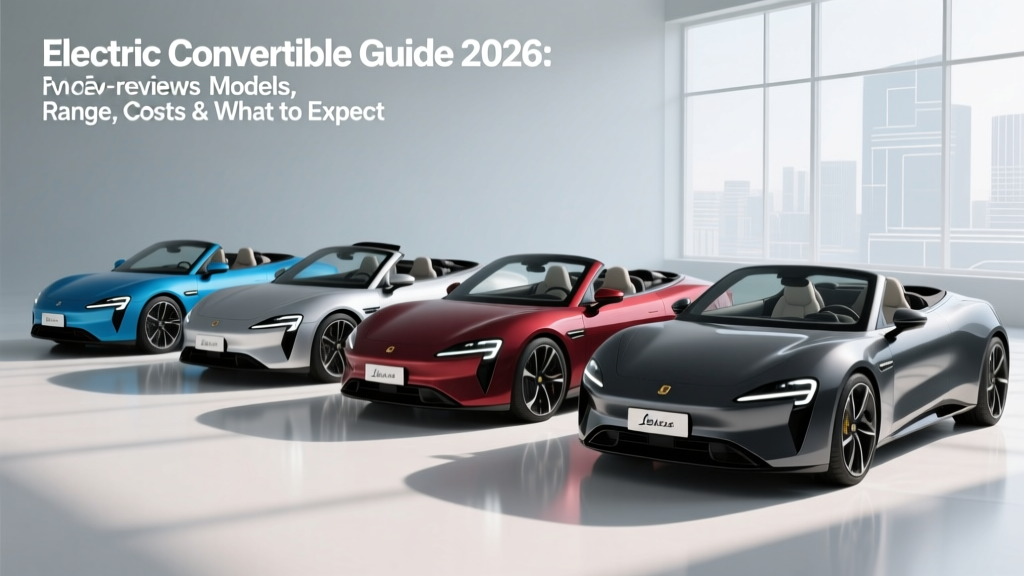
As of the 2026 model year, the electric convertible market is extremely limited. The only mass-production, fully electric convertible available in the U.S. is the Mini Cooper SE Convertible (EPA-estimated 137 miles of range, ~$38,900 starting MSRP). The MG Cyberster is expected to arrive in limited markets but remains unconfirmed for wide U.S. availability. If you need an open-top EV with real highway range (250+ miles), you'll currently need to consider a panoramic glass-roof EV (like the Tesla Model 3 or Hyundai Ioniq 5) or wait for upcoming models. For most buyers, an electric convertible today is a fun, urban-focused second car — not a primary daily driver or road-trip machine.
The Current Electric Convertible Lineup
The EV market has expanded rapidly, but convertibles remain a niche the industry hasn't prioritized. Retractable roof mechanisms add weight, complexity, and cost — and automakers have focused electrification budgets on high-volume SUVs and sedans. Here's what's actually buyable or confirmed for the U.S. market as of 2026:
| Model | Status | EPA Range | Battery (kWh) | Peak DC Charge | 0-60 mph | Base MSRP |
|---|---|---|---|---|---|---|
| Mini Cooper SE Convertible | Available (2025-2026 MY) | ~137 mi | 54.2 (usable ~50, NMC) | 95 kW | ~7.3 sec | ~$38,900 |
| MG Cyberster | Announced — U.S. availability unconfirmed | ~300 mi (WLTP est.) | 77 (NMC) | ~140 kW (est.) | ~3.2 sec (AWD) | TBD |
| Polestar 6 (concept-derived) | Announced ~2026-2027 | ~300 mi (target) | ~100+ (est.) | ~250 kW (target) | ~3.2 sec | ~$75,000 (est.) |
The Mini Cooper SE Convertible is the only model you can walk into a U.S. dealership and buy today. The MG Cyberster has generated significant interest but MG's U.S. re-entry timeline remains uncertain. The Polestar 6 roadster was announced years ago but has faced repeated delays — treat its specs as preliminary until Polestar confirms production timing and pricing.
Deep Dive: Mini Cooper SE Convertible
Since the Mini is the only realistic option for U.S. buyers right now, it deserves a thorough look. Mini refreshed the Cooper SE lineup for the 2025 model year with a larger battery and updated platform, and the convertible variant carries over into 2026.
Range & Efficiency
The EPA-estimated range sits at approximately 137 miles on a full charge. In real-world driving, expect 110-120 miles on mixed highway trips at 70+ mph, and potentially 95-105 miles in cold weather (below 40°F) with the cabin heater running. The soft top provides less insulation than a fixed steel roof, amplifying winter range loss compared to the hardtop Cooper SE.
EPA Range: ~137 miles
Real-World Highway (70 mph): ~110-120 miles
Cold Weather (30°F, heater on): ~95-105 miles
City / Mild Weather: ~130-140 miles
Charging
The Cooper SE Convertible charges at up to 95 kW on DC fast chargers. Mini quotes a 10-80% charge in approximately 30 minutes under ideal conditions. On a Level 2 home charger (11 kW AC), a full charge takes roughly 4.5-5 hours. The car uses a CCS1 connector in the U.S.
Charging curve reality: the car peaks near 95 kW up to roughly 40-50% state of charge, then tapers to 50-60 kW through 80%, and drops further above 80%. Plan fast-charging stops around the 10-80% window to avoid the slow taper zone.
Performance & Driving
The single front-mounted motor produces 218 hp and 243 lb-ft of torque. The 0-60 mph time of approximately 7.3 seconds is adequate for city merging but not thrilling by EV standards. The low center of gravity and Mini's signature go-kart handling make it genuinely fun on winding roads — especially with the top down.
Tax Credit Eligibility
The Mini Cooper SE Convertible's eligibility for the federal §30D tax credit (up to $7,500) depends on battery sourcing and critical mineral requirements that shift regularly. As of 2026, the Cooper SE is assembled in Europe, and its battery components may not meet the domestic-content thresholds required for the full credit. Check the latest fueleconomy.gov listing and consult a tax professional before relying on the credit in your purchase decision. The MSRP ($38,900) falls well under the §30D cap of $55,000 for passenger cars, and most buyers will fall within the income limits ($150K single / $300K joint).
Electric Convertible vs. Gas Convertible: Cost & Ownership Comparison
How does the Mini Cooper SE Convertible stack up against a gas-powered convertible like the Mazda MX-5 Miata — the closest analog in price and spirit?
| Metric | Mini Cooper SE Convertible (EV) | Mazda MX-5 Miata (Gas) |
|---|---|---|
| Base MSRP | ~$38,900 | ~$30,170 |
| EPA Range / Tank Range | ~137 mi | ~330 mi (11.9 gal × 28 mpg combined) |
| Fuel / Energy Cost per Mile | ~$0.04 (home charging, $0.14/kWh) | ~$0.12 ($3.40/gal, 28 mpg) |
| Annual Fuel/Energy (12K mi) | ~$480 | ~$1,440 |
| Annual Maintenance (est.) | ~$200-300 | ~$500-700 |
| Insurance (annual avg.) | ~$1,600-2,000 | ~$1,200-1,500 |
| 5-Year Fuel/Energy Savings | EV saves ~$4,800 in energy; ~$1,500-2,000 in maintenance | |
| 0-60 mph | ~7.3 sec | ~5.8 sec (2.0L) |
| Cargo Space | ~5.1 cu ft (top down) | ~4.6 cu ft |
The math: The EV costs roughly $8,700 more upfront but saves about $960/year in energy and maintenance combined. At that rate, the break-even point is approximately 9 years — longer than most ownership cycles. The EV makes financial sense primarily if you have cheap home charging (solar or off-peak rates below $0.10/kWh), drive mostly short urban trips, or qualify for state/local incentives that narrow the upfront gap.
The Miata wins on range, refueling speed (3 minutes at any gas station), and highway road-trip practicality. The Mini wins on daily commuting cost, instant torque delivery, and zero tailpipe emissions in urban environments.
Real-World Ownership: What First-Time EV Convertible Buyers Must Know
Home Charging Is Non-Negotiable for This Car
With only 137 miles of EPA range, relying on public DC fast charging as your primary strategy is impractical and expensive. Public DC fast charging costs $0.30-$0.50/kWh in most U.S. markets — at $0.40/kWh, your per-mile cost jumps to roughly $0.11, nearly matching a gas car. A Level 2 home charger is essential.
| Home Charging Setup | Equipment Cost | Electrician Install | Permit | Total Range |
|---|---|---|---|---|
| Level 2 (240V, 32A/48A) — existing 200A panel, short run | $300-$650 | $500-$1,200 | $50-$150 | $850-$2,000 |
| Level 2 — panel upgrade needed (100A → 200A) | $300-$650 | $2,000-$4,000 | $100-$250 | $2,400-$4,900 |
| Level 1 (120V outlet, included cord) | $0 | $0-$200 (dedicated circuit) | $0-$50 | $0-$250 |
Level 1 charging (120V) adds roughly 4-5 miles of range per hour — enough for a 50-mile daily commute if you plug in overnight (10-12 hours yields ~45-60 miles). But for the Cooper SE's ~50 kWh usable battery, a full Level 1 charge takes 12+ hours. Level 2 is strongly recommended.
Climate Matters More in a Convertible
EVs lose 20-35% of their range in sustained cold weather (below 30°F) due to battery chemistry limitations and cabin heating demands. In a convertible, the soft top's reduced insulation compounds this effect. If you live in Minnesota or Maine, expect winter range closer to 90-100 miles — making this strictly a fair-weather commuter in cold climates.
Hot climates are less problematic for range but require active battery thermal management. The Cooper SE uses liquid cooling, which handles summer heat adequately, but preconditioning (cooling the battery before fast charging) is important to maintain charge speeds above 90°F ambient.
Insurance Costs Run Higher
EV insurance premiums average 15-25% higher than comparable gas cars, driven by higher repair costs (specialized high-voltage components, aluminum body panels, recalibration of ADAS sensors). For a $38,900 electric convertible, budget $1,600-$2,000/year depending on your location, driving record, and coverage level. Get quotes before purchasing — some insurers (like GEICO and Progressive) have narrowed the EV premium gap, while others still penalize it heavily.
Common Misconceptions About Electric Convertibles
| Myth | Fact |
|---|---|
| "The battery makes it too heavy to handle well." | The Cooper SE weighs ~3,600 lbs — heavier than a Miata (~2,400 lbs) but the battery's low placement gives a lower center of gravity. Handling is competent, if not as nimble as the lightest gas roadsters. |
| "You can't take an EV convertible on a road trip." | You can, but with 137 miles of range, you'll stop every 90-110 miles to charge for 25-35 minutes. It's feasible for leisurely weekend trips with planned routes — not for covering 500 miles in a day. |
| "The battery will need expensive replacement in a few years." | Mini provides an 8-year/100,000-mile high-voltage battery warranty (covering degradation below 70% capacity). Modern NMC batteries in liquid-cooled packs typically retain 85-90% capacity at 100,000 miles based on fleet data from similar platforms. |
| "EVs are cheaper to own than gas cars in every scenario." | Not true for low-mileage drivers. If you drive under 6,000 miles/year, the EV's higher upfront cost and insurance may never be offset by fuel savings. The math favors EVs at 10,000+ annual miles with home charging. |
| "More electric convertibles are coming soon." | The Polestar 6 and MG Cyberster are announced but face uncertain U.S. timelines. Don't delay a purchase based on concepts — buy what's confirmed and available. |
Decision Framework: Should You Buy an Electric Convertible?
Buy the Mini Cooper SE Convertible if:
- You have Level 2 home charging access (garage or dedicated outdoor outlet)
- Your daily commute is under 60 miles round-trip
- You want a fun, low-cost city and back-road cruiser
- This is a second or third vehicle, not your only car
- You live in a mild climate or accept reduced winter usability
- You value zero tailpipe emissions in your neighborhood
Wait or choose a different vehicle if:
- You need 250+ miles of range for highway road trips
- You rely exclusively on public charging (apartment/condo without charging access)
- You live in a region with harsh winters and need year-top-down usability
- This will be your only vehicle
- You need more than 5 cubic feet of cargo space
- You want the performance of a Porsche Boxster or the range of a Tesla — no current electric convertible delivers both
Consider a glass-roof EV instead if: You want open, airy driving with real range. The Tesla Model 3 (EPA 341 mi, ~$38,990) and Hyundai Ioniq 5 (EPA 303 mi, ~$42,600) both offer expansive glass roofs that flood the cabin with light and sky — without the range, cost, and structural compromises of a retractable soft top.
Battery Longevity & Warranty
The Mini Cooper SE Convertible uses an NMC (nickel manganese cobalt) lithium-ion battery pack. Mini backs it with an 8-year / 100,000-mile warranty guaranteeing at least 70% capacity retention. For context, independent data from European Cooper SE fleets (2020-2024 models) shows average degradation of approximately 8-12% over 60,000 miles — well within the warranty threshold.
To maximize battery life:
- Set daily charge limit to 80% for routine commuting; charge to 100% only before longer trips
- Avoid leaving the car at very low SoC (below 10%) for extended periods, especially in heat
- Use preconditioning before DC fast charging to protect the battery and maintain charge speed
- Don't fear DC fast charging — occasional use won't meaningfully accelerate degradation with modern thermal management
A full battery replacement (out of warranty) would cost an estimated $8,000-$12,000 based on comparable Mini/BMW pack pricing — but this scenario is rare within the first 10-12 years of ownership for liquid-cooled packs.
Frequently Asked Questions
Is the Mini Cooper SE Convertible the only electric convertible I can buy in 2026?
For the U.S. market, yes — it's the only mass-production fully electric convertible currently sold through dealerships. The MG Cyberster may arrive in limited form, and the Polestar 6 remains announced but unconfirmed for timing and U.S. availability.
Does the federal EV tax credit apply to the Mini Cooper SE Convertible?
It depends on current battery sourcing and critical mineral requirements under IRS §30D rules. The MSRP ($38,900) is under the $55,000 passenger car cap, and most buyers meet the income limits ($150K single / $300K joint). However, European-assembled vehicles with non-qualifying battery components may not receive the full $7,500 credit. Always verify on IRS.gov and consult a tax professional before purchase.
How much does it cost to charge the Cooper SE Convertible at home?
At the U.S. average residential rate of ~$0.16/kWh, a full charge of the ~50 kWh usable battery costs roughly $8.00 — yielding about 137 miles of range. That's approximately $0.06 per mile in energy cost. If you have solar panels or off-peak rates below $0.10/kWh, the cost drops to $0.03-$0.04 per mile.
Can I road-trip in an electric convertible with 137 miles of range?
Yes, but plan carefully. You'll need a DC fast charger every 90-110 miles (allowing a buffer), and each stop takes roughly 25-35 minutes (10-80%). A 300-mile trip becomes a 5-6 hour journey including charging. It's viable for leisurely weekend drives with scenic stops — not for time-sensitive travel.
Will the soft top affect my EV's range compared to the hardtop?
Minimally in mild weather — the weight difference is small and aerodynamics are similar with the top up. The bigger impact is thermal: the soft top provides less insulation, so cabin heating in winter draws more energy from the battery, compounding cold-weather range loss by an estimated 5-10% versus the hardtop variant.
Is an electric convertible practical as a daily driver?
It depends entirely on your commute and charging setup. For a sub-60-mile daily commute with home Level 2 charging, it works well. For longer commutes, frequent highway driving, or apartment living without charging access, the limited range becomes a daily constraint rather than a minor inconvenience.