If you're researching electric conversion — swapping an internal combustion engine for a battery-electric powertrain — here's the direct answer: most EV conversion kits cost between $15,000 and $50,000+ installed, deliver 80-150 miles of real-world range, and take 200-400 labor hours. For the vast majority of drivers, buying a used or new production EV delivers better range, reliability, safety, and warranty coverage at a lower total cost. Electric conversions make sense primarily for classic car preservation, specialty vehicles, or enthusiasts who value the project itself over pure economics.
Quick Answer: Should You Convert Your Gas Car to Electric?
- Cost: $15,000–$50,000+ for parts and labor (vs. $28,000–$45,000 for a new production EV)
- Range: Typically 80–150 miles real-world (vs. 250–350+ miles for modern production EVs)
- Charging: Usually Level 2 only (3.3–7.2 kW); DC fast charging rarely available
- Warranty: None on the conversion; original vehicle warranty voided
- Best for: Classic car owners, specialty builds, dedicated hobbyists
- Not for: Daily commuters needing reliable range, first-time EV buyers, budget-conscious shoppers
What Is an Electric Conversion and How Does It Work?
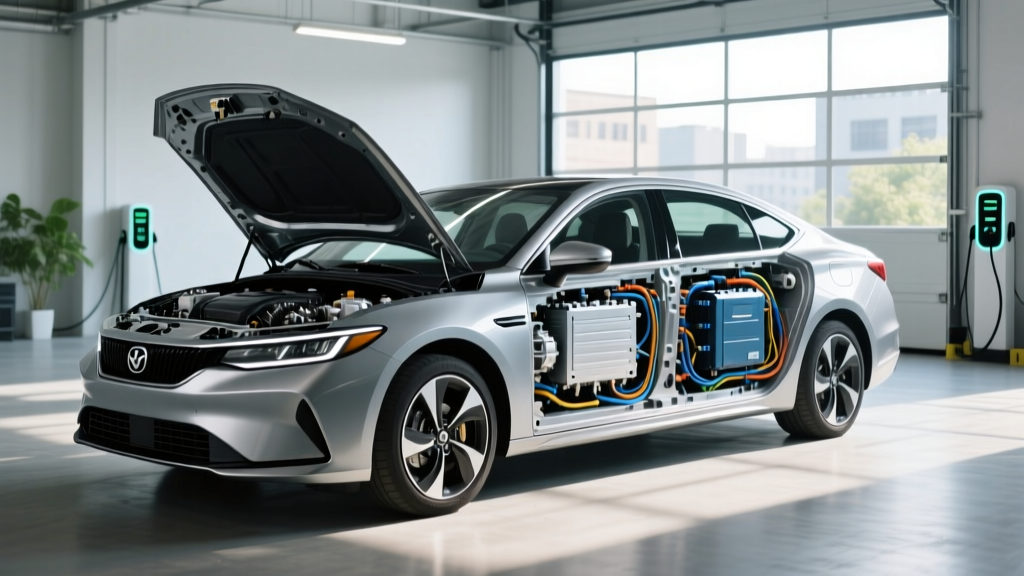
An electric conversion (sometimes called an EV swap or ICE-to-EV conversion) involves removing a vehicle's internal combustion engine, fuel system, exhaust, and transmission, then installing an electric motor, battery pack, power electronics, and charging system in their place. The process requires significant fabrication, electrical engineering, and software integration.
A typical conversion includes:
- Electric motor: Often salvaged from a wrecked Tesla, Nissan Leaf, or Chevrolet Bolt, or purchased new from suppliers like NetGain or HPEVS (50–150 kW output typical)
- Battery pack: Usually 20–60 kWh of usable capacity, assembled from salvaged modules or new cells (LFP or NMC chemistry)
- Motor controller: Manages power delivery (e.g., AEM, Sevcon, or OpenInverter units)
- BMS (Battery Management System): Critical for cell balancing, thermal management, and safety cutoffs
- Onboard charger: Enables Level 1 (1.4 kW) or Level 2 (3.3–7.2 kW) AC charging
- Thermal management: Heating and cooling for battery longevity (often limited or absent in budget conversions)
- DC-DC converter: Steps down high-voltage battery to 12V for accessories
Professional shops like EV West, Electric Classic Cars, and Zero EV Lab charge $30,000–$75,000+ for turnkey conversions. DIY builds using salvaged components can hit $15,000–$25,000 but demand advanced electrical and mechanical skills.
Electric Conversion Cost Breakdown vs. Buying a Production EV
| Cost Category | DIY Conversion | Professional Conversion | New Production EV (e.g., Chevy Equinox EV, Hyundai Ioniq 5) |
|---|---|---|---|
| Vehicle/parts purchase | $8,000–$15,000 | $20,000–$40,000 | $33,000–$48,000 MSRP |
| Labor/fabrication | $0 (your time, 200–400 hrs) | $10,000–$35,000 | $0 |
| Battery pack (kWh) | 20–40 kWh, $4,000–$10,000 | 40–70 kWh, $8,000–$20,000 | 60–84 kWh included |
| Registration/inspection | $200–$800 (varies by state) | $200–$800 | Standard fees |
| Federal tax credit (§30D) | $0 (not eligible) | $0 (not eligible) | Up to $7,500 if eligible |
| Total estimated cost | $15,000–$25,000 | $35,000–$75,000 | $25,500–$48,000 after credit |
| Warranty coverage | None | 1–3 years on conversion work | 3–5 yr basic, 8 yr/100K mi battery |
The economics are stark: a professionally converted vehicle often costs more than a new production EV with 300+ miles of EPA range, DC fast charging, modern ADAS features, and a full factory warranty. The IRS §30D tax credit — up to $7,500 for eligible new EVs — does not apply to conversions, widening the gap further. Subject to income caps, MSRP limits, and battery-sourcing requirements, the credit can bring a $42,000 Chevrolet Equinox EV down to an effective $34,500, undercutting most professional conversions.
Range, Charging, and Performance: Conversion vs. Production EV
| Specification | Typical EV Conversion | 2026 Hyundai Ioniq 5 (SEL AWD) | 2026 Tesla Model Y (Long Range) |
|---|---|---|---|
| Battery capacity (usable) | 20–50 kWh | 84 kWh (NMC) | 75 kWh (NMC) |
| EPA range | N/A (not EPA-certified) | 290 mi (EPA) | 320 mi (EPA) |
| Real-world range | 80–150 mi | 250–270 mi highway; ~220 mi cold | 270–290 mi highway; ~240 mi cold |
| DC fast charging | Rarely available | Peak 240 kW, 10–80% in ~18 min | Peak 250 kW, 10–80% in ~15 min |
| Level 2 charging | 3.3–7.2 kW | 10.9 kW | 11.5 kW |
| Motor output | 50–150 kW (67–201 HP) | 258 kW (320 HP) | 384 HP |
| 0–60 mph | 8–14 seconds (weight-dependent) | 5.1 seconds | 4.8 seconds |
| Thermal management | Limited or none | Active liquid cooling + heat pump | Active liquid cooling + heat pump |
| Regen braking | Basic (often single-mode) | Multi-mode, one-pedal capable | Multi-mode, one-pedal capable |
The performance gap is significant. Most conversions lack active thermal management for the battery, which means range degrades faster in hot or cold weather, DC fast charging is unsafe or impossible (high-current charging without cooling accelerates degradation and creates fire risk), and sustained highway driving generates heat the pack cannot shed efficiently. Production EVs like the Ioniq 5 use sophisticated liquid cooling loops and heat pumps that maintain battery temperature across a wide operating range — critical for both longevity and real-world usability.
On charging specifically: if you can only charge at Level 2 speeds (3.3–7.2 kW) in a conversion, a full charge of a 40 kWh pack takes 6–12 hours. That works for overnight home charging but makes road trips impractical. A production EV adding 200+ miles in 20 minutes at a DC fast charger is a fundamentally different ownership experience.
Real-World Ownership Considerations
Before committing to an electric conversion, honestly assess these factors:
Home Charging Access
Conversions almost exclusively rely on home charging. If you have a garage or dedicated parking with access to a 240V circuit (NEMA 14-50 or hardwired Level 2 EVSE), overnight charging works. If you rely on street parking or apartment living with no charging infrastructure, a conversion's limited range and lack of DC fast charging become serious daily obstacles. Even production EV owners without home charging report significant friction — for a conversion with 100 miles of range and no fast-charge option, the problem is magnified.
Climate and Range Loss
Most conversions lack the sophisticated thermal preconditioning and heat pump systems found in production EVs. Expect 30–40% range loss in freezing temperatures (compared to 15–25% in well-managed production EVs). If you live in Minnesota, Michigan, or upstate New York, a 120-mile summer range might drop to 70–80 miles in January. This is a hard physics problem: lithium-ion cells have higher internal resistance when cold, and without active heating, both range and charge acceptance suffer.
Insurance and Registration
Insuring a converted vehicle requires specialty carriers familiar with modified vehicles. Standard insurers may decline coverage or exclude the electric drivetrain from claims. Registration processes vary by state — some require a reconstructed vehicle title, safety inspections, and proof of electrical system compliance. Budget extra time and paperwork for this process.
Maintenance and Repair
One genuine advantage of EVs over gas cars is lower maintenance — no oil changes, no timing belts, no exhaust systems. But a conversion introduces a different maintenance reality: custom-fabricated components, non-standard wiring, and one-off engineering mean repairs require the original builder or a specialist. If your BMS fails or a contactor welds shut, you can't roll into any dealership for warranty service.
Common Electric Conversion Myths vs. Facts
| Myth | Fact |
|---|---|
| "Conversions save money compared to buying an EV." | A professional conversion typically costs $35,000–$75,000. A new Chevy Equinox EV starts at ~$33,000 and qualifies for up to $7,500 in federal tax credits, bringing effective cost to ~$25,500 with 315 miles of range and a full warranty. |
| "I can use any old car battery." | 12V lead-acid batteries cannot power an EV drivetrain. Conversions require high-voltage lithium-ion packs (200–400V) with a dedicated BMS. Used Tesla or Leaf modules are common sources. |
| "Conversions are eligible for EV tax credits." | The federal §30D credit applies only to new qualified clean vehicles from OEM manufacturers meeting battery-sourcing and MSRP requirements. Conversions do not qualify. Some states offer separate credits for converted vehicles — check your state's energy office. |
| "It's plug-and-play with a kit." | Even comprehensive kits require custom motor mounts, battery enclosure fabrication, high-voltage wiring, brake system integration (regen and vacuum assist), and software calibration. Expect 200–400 hours of skilled labor for a safe, roadworthy result. |
| "Converted EVs are just as safe as production EVs." | Production EVs undergo NHTSA crash testing and have engineered crumple zones, battery armor, and automatic high-voltage disconnect. Conversions typically lack crash testing, and battery placement may compromise structural integrity if not engineered carefully. |
| "I'll get 200+ miles of range." | Achieving 200+ miles requires a 60–80 kWh battery pack, which costs $15,000–$25,000 alone, adds 800–1,200 lbs, and may exceed the vehicle's suspension and braking capacity. Most realistic conversions deliver 80–150 miles. |
When Does an Electric Conversion Actually Make Sense?
Despite the economic and practical headwinds, there are legitimate use cases where an electric conversion is the right choice:
- Classic car preservation: Converting a 1965 Ford Mustang, 1973 Volkswagen Beetle, or 1980s BMW to electric preserves the vehicle's character while eliminating carburetor maintenance, emissions failures, and fuel system deterioration. Companies like EV West and Lunaz specialize in this niche.
- Specialty and fleet vehicles: Airport ground support, warehouse vehicles, or farm equipment that operate on fixed routes with predictable daily mileage can benefit from electrification when no production EV equivalent exists.
- Engineering education and hobby: For enthusiasts who want to learn power electronics, battery management, and motor control, a conversion project provides hands-on experience no production EV purchase can match.
- Discontinued models with sentimental value: If you have a specific vehicle you love and no production EV matches its form factor (e.g., a classic pickup truck), conversion preserves what you value.
Decision Framework: Should You Convert or Buy?
Electric Conversion Decision Guide
Choose an electric conversion if:
- You own a classic or specialty vehicle with no production EV equivalent
- You have advanced electrical/mechanical skills (DIY) or a $35,000+ budget (professional)
- You have reliable home charging access and drive under 80 miles/day
- You value the project, craftsmanship, or preservation over pure economics
- You understand there is no warranty, no crash-test data, and limited service options
Buy a production EV if:
- You need 250+ miles of range for commuting, road trips, or unpredictable schedules
- You want DC fast charging for travel beyond your local area
- You want a factory warranty (8-year/100,000-mile battery coverage is standard)
- You qualify for the federal §30D tax credit or state incentives on new EVs
- You want modern safety features (automatic emergency braking, lane-keeping, blind-spot monitoring)
- You want predictable insurance, registration, and service options
- Your budget is under $35,000 and you want the most range and features per dollar
Electric Conversion FAQ
How long does an electric conversion take?
A professional conversion typically takes 3–6 months from start to delivery. A DIY build by an experienced hobbyist working evenings and weekends may take 6–18 months. Complex builds with custom battery enclosures, integrated thermal management, and full interior restoration can exceed a year.
Can I add DC fast charging to a conversion?
Technically yes, but it requires a high-voltage architecture (350V+), a CCS or NACS inlet, a compatible charge controller, and critically, active battery thermal management to handle the heat generated at 50–150 kW charge rates. Most conversion battery packs lack adequate cooling, making DC fast charging unsafe. Budget $5,000–$10,000+ additional if you pursue this.
What happens to the original transmission in a conversion?
Most conversions retain the original manual transmission (locked in 2nd or 3rd gear) or use a single-speed reduction gear. Automatic transmissions are generally removed because they require engine-driven hydraulic pumps. Some high-end conversions use purpose-built single-speed EV gearboxes for optimal efficiency.
Are electric conversions street legal?
Yes, but the process varies by state. Most states require a reconstructed or specially constructed vehicle title, a safety inspection (brakes, lights, structural), and sometimes an electrical system inspection. California's BAR (Bureau of Automotive Repair) has specific protocols for EV conversions. Check your state's DMV before starting a build.
How does conversion affect resale value?
For classic cars, a well-executed conversion by a reputable shop can increase value among the right buyers (e.g., a converted air-cooled Porsche 911 may sell for $150,000–$250,000). For common vehicles (a converted Honda Civic or Ford Ranger), the conversion cost rarely recoups at resale — you may spend $30,000 converting a car worth $5,000 and struggle to sell it for $20,000.
What battery chemistry is best for a conversion?
LFP (lithium iron phosphate) cells offer longer cycle life (3,000–5,000 cycles vs. 1,000–2,000 for NMC), better thermal stability, and lower cost per kWh, but are heavier and bulkier. NMC (nickel manganese cobalt) cells offer higher energy density (more range in a smaller package) but degrade faster and require more careful thermal management. For a conversion without sophisticated cooling, LFP is generally the safer choice.
Bottom Line: Know What You're Signing Up For
Electric conversions are real, technically feasible, and can produce a satisfying vehicle — for the right project and the right owner. But as a practical transportation decision in 2026, converting a gas car to electric costs more, delivers less range, charges slower, carries no warranty, and lacks the safety engineering of a production EV. If your goal is affordable, reliable electric transportation, a new or used production EV is the clear winner. If your goal is to preserve a classic, learn power electronics, or build something unique, a conversion can be deeply rewarding — just go in with realistic expectations about cost, range, and the engineering challenges ahead.