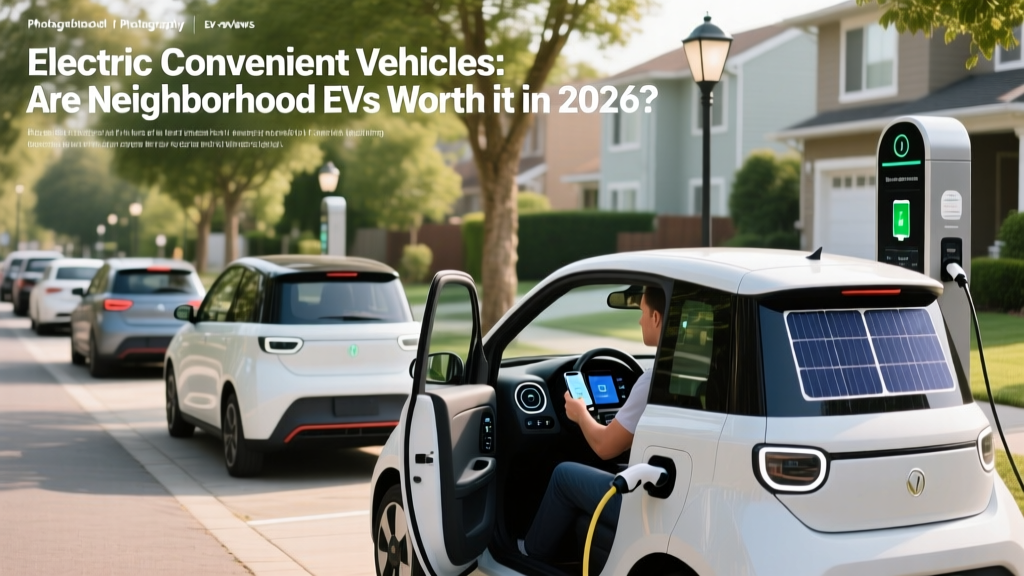
Quick Answer: What Are Electric Convenience Vehicles?
Electric convenience vehicles — formally known as Neighborhood Electric Vehicles (NEVs) or Low-Speed Vehicles (LSVs) — are street-legal, battery-powered runabouts capped at a top speed of 25 mph under Federal Motor Vehicle Safety Standard (FMVSS) No. 500. They typically offer 30–60 miles of range on lead-acid or lithium-ion packs, cost between $8,000 and $20,000, and are legal on roads with speed limits of 35 mph or less in most states. They are ideal for short neighborhood errands, gated communities, campuses, and retirement villages, but they are not substitutes for full-speed passenger EVs.
Defining the Category: NEVs, LSVs, and PTVs
The term "electric convenience vehicle" is an umbrella that covers several vehicle classes, each with different regulatory standing:
- Neighborhood Electric Vehicles (NEVs) / Low-Speed Vehicles (LSVs): Federally regulated under FMVSS 500. Must have headlamps, turn signals, seat belts, VIN, and a top speed between 20–25 mph. Street-legal on low-speed roads in most states.
- Personal Transportation Vehicles (PTVs): A broader category that includes golf carts and utility carts. Many PTVs are not street-legal without modification.
- Medium-Speed Vehicles (MSVs): An emerging class (top speed 25–35 mph) recognized in a handful of states but not yet federally standardized as of 2026.
When you search for electric convenience vehicles, you're mostly looking at NEVs/LSVs from manufacturers like GEM (Polaris), Club Car, Tomberlin, and Arcimoto — plus an influx of imported micro-cars from Chinese OEMs sold under various badges.
Spec Snapshot: Top Electric Convenience Vehicles in 2026
| Model | Battery (kWh) | Chemistry | EPA/Advertised Range | Top Speed | Charge Time (0–100%) | Base MSRP |
|---|---|---|---|---|---|---|
| GEM e2 (2025–26) | 14.4 kWh | LFP | ~55 mi | 25 mph | ~6–8 hr (120V) | $14,500 |
| GEM e4 | 14.4 kWh | LFP | ~45 mi (4-passenger load) | 25 mph | ~6–8 hr (120V) | $17,800 |
| Club Car Onward EV (4-pass) | ~7.2 kWh | Lithium-ion | ~35 mi | 19 mph (LSV trim: 25 mph) | ~5 hr (120V) | $13,500 |
| Tomberlin E-Merge E2 | ~10 kWh | AGM / Li-ion option | ~40 mi | 25 mph | ~6 hr (120V) | $15,200 |
| Arcimoto FUV (announced/preliminary) | ~20 kWh | NMC | ~102 mi (claimed) | 75 mph* | ~4 hr (L2) | ~$21,000 (est.) |
*Arcimoto FUV exceeds LSV speed limits and is classified as a motorcycle/autocycle in most states — included for context as a "next-step" convenience vehicle.
Electric Convenience Vehicles vs. Full EVs vs. Gas Golf Carts
The core buyer decision is whether a $15,000 NEV or a $35,000+ full EV (like a Chevrolet Equinox EV or Nissan LEAF) better serves your actual trips. Here's a data-driven comparison:
| Factor | NEV / LSV (e.g., GEM e2) | Compact Full EV (e.g., 2026 Nissan LEAF S) | Gas Golf Cart |
|---|---|---|---|
| Base Price | $14,500 | ~$28,140 | $9,000–$12,000 |
| Top Speed | 25 mph | 90+ mph | 15–19 mph |
| Range | 35–55 mi | 212 mi (EPA) | ~100 mi (8-gal tank) |
| Legal Roads | ≤35 mph limit (most states) | All public roads | Private property / LSV roads only |
| Fuel/Energy Cost per Mile | ~$0.03/mi (at $0.15/kWh) | ~$0.04/mi | ~$0.12/mi (gas) |
| Annual Maintenance | ~$100–$200 | ~$300–$500 | ~$400–$700 (oil, belts, filters) |
| Federal §30D Tax Credit | Not eligible | Up to $7,500 (if eligible) | Not eligible |
| Crash Safety (NHTSA rated) | No — minimal structure | Yes — 5-star rated models available | No |
Key insight: NEVs are not eligible for the federal §30D Clean Vehicle Credit because they do not meet the definition of a "qualified vehicle" under IRS guidelines — they lack the required safety certifications and MSRP thresholds that apply to highway-capable passenger vehicles. Some states and municipalities offer local rebates for NEVs (typically $500–$2,000), but you'll need to check your specific jurisdiction.
Real Costs of Owning an Electric Convenience Vehicle
| Cost Category | Year 1 | Year 2–5 (Annual Avg) | 5-Year Total |
|---|---|---|---|
| Purchase Price | $14,500 | — | $14,500 |
| Registration & Title | $50–$200 | $30–$100 | $170–$600 |
| Insurance | $300–$600 | $250–$500 | $1,300–$2,600 |
| Electricity (5,000 mi/yr) | $75 | $75 | $375 |
| Maintenance (tires, brakes, cabin filter) | $100 | $150 | $700 |
| Battery Replacement Reserve | — | — | $2,000–$4,000 (if needed yr 5–8) |
| Total 5-Year | $17,045–$20,775 | ||
For comparison, a gas golf cart driven 5,000 miles per year burns roughly 500 gallons of fuel at an annual cost of ~$1,500–$1,750 (at $3.00–$3.50/gal), totaling $7,500–$8,750 in fuel alone over five years. The NEV's electricity cost for the same mileage: under $400.
Battery longevity matters. Modern LFP packs in NEVs (like those in the GEM lineup) are rated for 2,000+ cycles before degrading to 80% State of Health (SoH). That translates to roughly 50,000–100,000 miles — well beyond what most NEV owners drive in a decade. Older AGM (absorbent glass mat) lead-acid packs, still found in some budget models, last only 500–800 cycles and may need a $2,000–$3,500 replacement by year 3 or 4. Always confirm battery chemistry before purchasing.
Where Electric Convenience Vehicles Make Sense — And Where They Don't
Actionable Decision Framework
Choose an electric convenience vehicle (NEV/LSV) if:
- Your typical trips are under 15 miles round-trip (grocery runs, school drop-off, community errands)
- You live in a gated community, retirement village, island, or small town with roads posted ≤35 mph
- You already own a full-speed vehicle for highway trips
- You can charge at home from a standard 120V outlet (NEVs don't require Level 2 installations)
- Your state explicitly permits LSVs on the roads you'll use (check NHTSA and your state DMV)
Choose a full-speed EV instead if:
- You need to travel on roads with speed limits above 35 mph
- You commute more than 20 miles one-way
- You need highway-capable crash safety (crumple zones, airbags, side-impact protection)
- You want access to the federal §30D tax credit (up to $7,500 with income/MSRP/sourcing rules)
- You need cargo capacity beyond a few grocery bags or year-round climate control
Common Misconceptions About Electric Convenience Vehicles
| Myth | Fact |
|---|---|
| "NEVs don't need insurance or registration." | In most states, LSVs require a VIN, title, registration, and at minimum liability insurance. They are not "off-road" toys. |
| "You can drive a golf cart anywhere." | Standard golf carts are NOT street-legal on public roads. Only LSV-certified models with the required safety equipment (headlamps, mirrors, seat belts, VIN) can be registered for road use. |
| "NEVs qualify for the $7,500 EV tax credit." | NEVs/LSVs do not meet the IRS definition of a qualified clean vehicle under §30D. They lack the required battery capacity thresholds and safety certifications for highway vehicles. |
| "All electric convenience vehicles have the same range." | Range varies dramatically: 20 mi (older lead-acid carts) to 55+ mi (modern LFP NEVs) to 100+ mi (enclosed micro-EVs like the Arcimoto FUV). Battery chemistry and vehicle weight are the primary factors. |
| "NEVs are safe in a crash." | NEVs have no crumple zones, no airbags, and minimal side-impact protection. They are designed for low-speed environments. A collision with a full-size vehicle at 25 mph can be catastrophic. Drive defensively and avoid mixed-traffic roads. |
Charging and Home Setup: What First-Time Buyers Need to Know
One of the biggest advantages of electric convenience vehicles is charging simplicity. Unlike full EVs that benefit from 240V Level 2 installations ($500–$2,500 for equipment and electrician work), most NEVs charge from a standard 120V household outlet at roughly 1.2–1.5 kW.
| Charging Method | Power (kW) | Miles Added per Hour | Full Charge Time (14 kWh pack) |
|---|---|---|---|
| 120V Standard Outlet (Level 1) | 1.2–1.5 kW | ~8–12 mi/hr | ~8–10 hours |
| 240V Level 2 (some models) | 3.3–6.6 kW | ~25–45 mi/hr | ~2–4 hours |
| DC Fast Charging | Not supported | — | — |
Practical tip: Because NEV charging draws only ~12 amps on a 120V circuit, you can plug into a standard outdoor-rated GFCI outlet without upgrading your electrical panel. However, if you plan to charge both a full EV (Level 2) and a NEV simultaneously, consult a licensed electrician about your panel capacity — most 200-amp residential panels can handle both, but older 100-amp panels may need an upgrade ($1,500–$3,000).
kW vs. kWh — the critical distinction: kW (kilowatts) is the rate of power delivery — how fast energy flows into your battery. kWh (kilowatt-hours) is the total energy stored — like gallons in a fuel tank. A 14 kWh battery charged at 1.4 kW takes roughly 10 hours. Confusing these units is the most common mistake new EV and NEV owners make when estimating charge times.
State Laws and Where You Can Legally Drive an NEV
Federal law (FMVSS 500) sets the manufacturing standard for LSVs, but where you can drive one is determined by state and local law. As of 2026:
- Most permissive states: Florida, Arizona, Texas, California, and South Carolina have broad LSV access on roads up to 35 mph, with some municipalities allowing crossings at higher-speed intersections.
- Restricted states: A handful of states impose additional equipment requirements (windshields, wipers, enclosed cabins) or limit LSVs to specific road types or planned communities.
- Always verify locally: County and city ordinances can further restrict LSV operation. Check with your local DMV or department of transportation before purchasing.
According to the Insurance Institute for Highway Safety (IIHS), the safety gap between LSVs and conventional vehicles is substantial. The IIHS recommends limiting NEV use to environments with low traffic volumes and speeds at or below 25 mph — sound advice that aligns with how most NEV owners actually use these vehicles.
What Should a First-Time Electric Convenience Vehicle Buyer Know?
If you're considering an NEV as your first electrified vehicle purchase, here's a prioritized checklist:
- Confirm your state and local road legality first. Don't buy before you know which roads you can legally drive on.
- Insist on LFP battery chemistry. Avoid AGM/lead-acid unless the discount is substantial and you accept a 3–4 year replacement cycle.
- Check for a valid 17-digit VIN. This is required for registration, titling, and insurance. Imported micro-carts sometimes lack proper VINs.
- Verify FMVSS 500 compliance. The vehicle must have headlamps, tail lamps, turn signals, exterior mirrors, seat belts, and a parking brake.
- Budget for insurance. Even though NEVs are low-speed, insurers typically charge $25–$50/month for liability coverage. Some specialty insurers (like Hagerty or Progressive's off-road division) offer better rates.
- Test-drive on your actual routes. A 25 mph top speed feels very different on a quiet residential street versus a 35 mph road with passing trucks.
- Understand the safety trade-off. You are trading crash protection for cost savings and convenience. This is an acceptable trade only in controlled, low-speed environments.
How fast do electric convenience vehicles go?
Federally regulated NEVs/LSVs are limited to a top speed of 25 mph. Some "medium-speed" variants reach 35 mph in states that allow them, but these are not federally standardized. Golf carts without LSV certification typically top out at 15–19 mph.
Can I drive an electric convenience vehicle on any road?
No. In most states, LSVs are restricted to roads with posted speed limits of 35 mph or below. They cannot be driven on highways, interstates, or high-speed arterials. Local ordinances may impose further restrictions. Always verify with your state DMV.
Do electric convenience vehicles qualify for EV tax credits?
No. NEVs and LSVs do not qualify for the federal §30D Clean Vehicle Credit. The IRS requires qualifying vehicles to meet specific battery capacity, MSRP, and safety certification thresholds that LSVs do not satisfy. Some states or utilities offer separate NEV rebates — check your local programs.
How long does the battery last in a NEV?
Modern LFP (lithium iron phosphate) packs are rated for 2,000+ charge cycles, which translates to roughly 8–12 years of typical NEV use (5,000 miles/year). Older AGM/lead-acid packs last 500–800 cycles, or about 3–5 years, and cost $2,000–$3,500 to replace.
Is an electric convenience vehicle the same as a golf cart?
Not exactly. A standard golf cart is a PTV (Personal Transportation Vehicle) that is generally not street-legal. An NEV/LSV is a golf-cart-like vehicle that has been manufactured or modified to meet federal safety standards (FMVSS 500) and can be registered for road use. The distinction matters for insurance, registration, and legality.
What's the real-world range in cold weather?
Expect 20–35% range reduction on LFP-equipped NEVs when temperatures drop below 40°F. AGM/lead-acid packs can lose 40–50%. If your winter round-trip errand is 15 miles, a NEV rated for 50 miles may deliver only 30–35 usable miles in January. Plan accordingly.