The Bottom Line on Electric Construction Vehicles
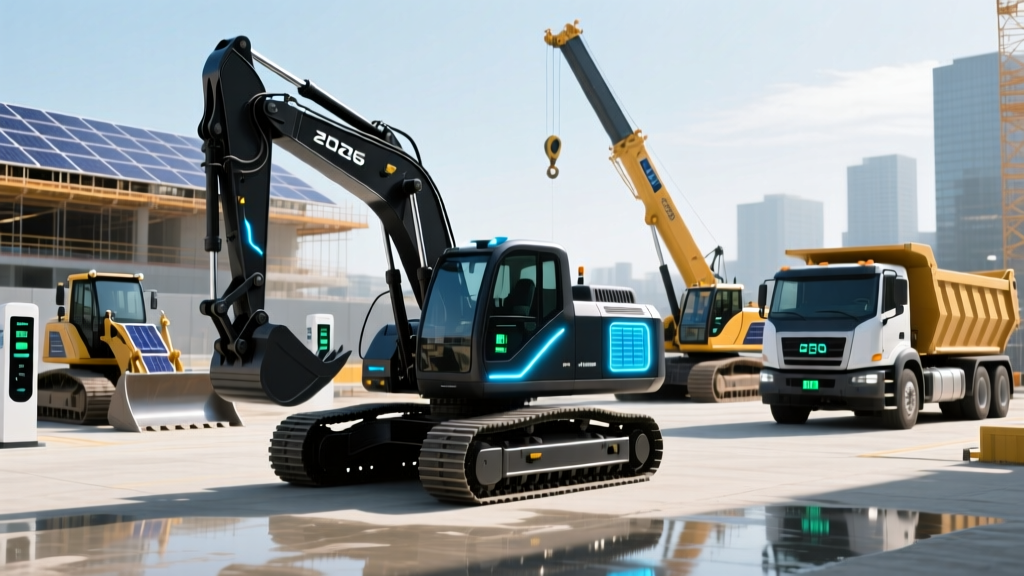
Electric construction vehicles — battery-electric excavators, wheel loaders, compact track loaders, and dump trucks — are now commercially available from major OEMs including Volvo CE, Caterpillar, JCB, and Bobcat for compact and mid-size classes. Expect upfront purchase premiums of 50–120% over diesel equivalents, offset by 60–80% lower fuel costs and 40–60% lower scheduled maintenance over a 5-year duty cycle. Most current models deliver 4–8 hours of active work per charge on battery packs ranging from 60 to 400+ kWh, with DC fast charging (50–150 kW) replenishing 10–80% in 45–90 minutes. They make strongest economic sense for urban job sites with noise and emission restrictions, indoor demolition, utility trenching, and fleet operators with depot-based overnight Level 2 charging.
What Electric Construction Vehicles Actually Are (and Aren't)
When buyers search for "electric construction vehicles" in 2026, they're encountering a rapidly evolving category that spans several machine classes. Unlike passenger EVs measured by highway range, electric construction equipment is rated by operating hours per charge and energy consumed per duty cycle (kWh/hour of active work). The key distinction: kW is the charge rate (how fast you refill), while kWh is the battery capacity (how much energy is stored for work).
Here's what's commercially available for purchase or lease in North America as of the 2026 model year:
- Compact excavators (3–6 metric tons): Volvo ECR25 Electric, JCB 19C-1E, Bobcat E32e
- Compact wheel loaders: Volvo L25 Electric, JCB 403E
- Compact track loaders: Bobcat T7X (announced), Caterpillar prototypes in limited deployment
- Mid-size excavators (14–25 tons): Volvo EC230 Electric (limited markets), Caterpillar 320 Electric (pilot programs)
- Dump trucks and haulers: Smaller site-dumpers from Thwaites and Mecalac; large mining haulers (Caterpillar 793E, Komatsu) in closed-site pilot programs
Full-size production excavators (30+ tons) and large articulated dump trucks remain predominantly in announced or pilot-fleet status. If a dealer tells you a 50-ton battery-electric excavator is available for immediate delivery, verify the claim — most are still diesel or hybrid-electric at that class.
Spec-by-Spec: Electric vs. Diesel Construction Equipment
| Specification | Electric (e.g., Volvo ECR25 Electric) | Diesel (e.g., Volvo ECR25) |
|---|---|---|
| Battery / Fuel Capacity | ~60 kWh (LFP chemistry) | ~13 gal diesel tank |
| Active Work Time | 5–7 hours (load-dependent) | 8–12 hours (refuel in 5 min) |
| Charge / Refuel Time | 10–80% in ~60 min at 50 kW DC | ~5 minutes (diesel fill) |
| Energy / Fuel Cost per Hour | $2.50–$4.50 (at $0.12–$0.18/kWh) | $8.00–$14.00 (at $4.00–$4.50/gal diesel) |
| Scheduled Maintenance | Minimal: hydraulic fluid, grease, cabin filter | Engine oil, filters, DEF, coolant, belts |
| Noise Level at Operator | ~70 dBA | ~85–92 dBA |
| Exhaust Emissions at Site | Zero (tailpipe) | Tier 4 Final diesel (NOx, PM) |
| Base MSRP (approx.) | $95,000–$130,000 | $55,000–$75,000 |
| Weight (machine + battery) | ~5,800 lb | ~5,400 lb |
The data shows a consistent pattern across compact classes: electric machines cost roughly 1.5–2.0× more upfront but deliver 60–80% fuel savings per operating hour. Whether that premium pays back depends entirely on utilization rates and duty cycles — which we break down below.
The Real Costs: Purchase, Charging, Maintenance, and Total Ownership
Construction fleet managers need total cost of ownership (TCO), not sticker price. Here's a realistic 5-year / 6,000-hour cost model for a compact electric excavator versus its diesel counterpart, based on published OEM data and industry-average utilization.
| Cost Category | Electric (5-ton class) | Diesel (5-ton class) |
|---|---|---|
| Purchase Price | $115,000 | $65,000 |
| Federal / State Incentives | –$10,000 to –$25,000 (varies; see below) | $0 |
| Charging Infrastructure (depot Level 2 + DC fast) | $15,000–$35,000 (one-time) | $0 (existing diesel supply) |
| Energy / Fuel (6,000 hrs) | $18,000–$24,000 | $54,000–$72,000 |
| Scheduled Maintenance (6,000 hrs) | $4,500–$7,000 | $14,000–$20,000 |
| Unplanned Downtime Cost (est.) | $3,000–$5,000 | $8,000–$12,000 |
| Estimated Residual Value (Year 5) | $25,000–$40,000 | $18,000–$28,000 |
| Net 5-Year Cost | $110,000–$147,000 | $113,000–$151,000 |
The TCO crossover typically occurs between years 3 and 5 for machines running 1,000–1,500 hours annually. Below 600 hours/year, the diesel machine almost always wins on pure economics. Above 2,000 hours/year, the electric machine's energy savings compound rapidly.
Incentives: What's Actually Available
Unlike passenger EVs governed by IRS §30D clean vehicle credits, electric construction equipment generally does not qualify for the federal $7,500 consumer EV tax credit — these machines are classified as off-road industrial equipment, not highway-capable vehicles. However, fleet buyers can access:
- IRS §179 expensing and bonus depreciation: Full purchase-price deduction in year one for qualifying business equipment (confirm eligibility with your tax professional).
- State and utility incentive programs: California's CORE (Clean Off-Road Equipment Voucher Incentive Project) offers point-of-sale vouchers of $10,000–$45,000 per machine depending on class. Similar programs exist in New York, New Jersey, and parts of the Pacific Northwest. Check your state's air-resources board for current voucher availability.
- Utility demand-response and EV-rate programs: Many commercial utilities offer reduced electricity rates for depot charging, especially overnight (off-peak rates of $0.06–$0.10/kWh vs. standard $0.14–$0.22/kWh).
- South Coast AQMD and regional air-district grants: For fleets operating in non-attainment zones, additional incentives of $5,000–$20,000 per unit may apply.
Charging Infrastructure: What a Job Site Actually Needs
This is where most electric construction vehicle evaluations stall. A compact excavator with a 60 kWh battery needs roughly 55–58 kWh to recharge from 10% to full (accounting for charging losses). Here's what that looks like across charging levels:
| Level | Power (kW) | Time 10–80% (60 kWh pack) | Infrastructure Needed |
|---|---|---|---|
| Level 1 (120V) | 1.4–1.9 kW | 30+ hours (impractical) | Standard outlet — not viable |
| Level 2 (240V/480V) | 7.2–22 kW | 3–7 hours | Depot wall-mount charger, 50A–100A circuit |
| DC Fast Charge | 50–150 kW (CCS2 or J1772-derived) | 30–60 minutes | Dedicated DC cabinet, 480V 3-phase service |
Depot charging is the backbone. Most fleet operators install Level 2 chargers (19.2–22 kW) at the equipment yard for overnight replenishment. A single 22 kW Level 2 unit can fully recharge a 60 kWh compact machine in roughly 3 hours — sufficient for next-morning deployment if the machine returns to the yard each evening.
On-site fast charging is the bottleneck. For machines that stay on a job site for days or weeks, you'll need a mobile DC fast charger or a temporary 480V 3-phase connection. Companies like Volvo CE and JCB offer portable DC charging units (50–90 kW) designed for construction yards, but these require generator power or temporary utility drops in remote locations. Budget $25,000–$65,000 for a mobile DC fast charger, plus the cost of a diesel-powered generator if grid power isn't available on-site.
Panel upgrade reality: A depot running 3–5 compact electric machines charging simultaneously at 22 kW each needs 66–110 kW of continuous electrical capacity — roughly 200A–400A of 480V 3-phase service. Many commercial properties already have this; smaller yards may need a panel upgrade costing $8,000–$25,000. Always have a licensed commercial electrician perform a load calculation before committing to a fleet order.
Common Misconceptions — Fact-Checked
| Myth | Fact |
|---|---|
| "Electric excavators can't match diesel digging force." | Hydraulic breakout force is a function of pump pressure and cylinder geometry, not power source. The Volvo ECR25 Electric matches its diesel twin's 29.2 kN bucket digging force. Electric motors actually deliver instant peak torque, which can improve responsiveness in swing and travel functions. |
| "Batteries won't last in construction — too much vibration and dust." | Current LFP (lithium iron phosphate) packs in construction equipment are rated IP67 for dust and water ingress and undergo vibration testing to ISO 13003 standards. Volvo CE warranties its compact electric machine batteries for 5 years / 5,000 hours with guaranteed capacity retention above 80%. Real-world degradation data from early European fleet deployments shows ~8–12% capacity loss at 4,000 hours. |
| "You can't use them in cold weather." | Battery performance drops 15–25% in sub-freezing temperatures — similar to range loss in passenger EVs. Machines with active thermal management (battery heating) mitigate this. Expect 4–5 hours of work instead of 6–7 in 20°F conditions. Preconditioning the battery during morning startup recovers most of the loss. |
| "There are no electric options above compact size." | Mid-size (14–25 ton) electric excavators from Volvo CE and Caterpillar are in pilot and limited-production phases as of 2026. Full production availability for 30+ ton classes remains 2027–2029. For large earthmoving, hybrid-electric and hydrogen-fuel-cell machines are the nearer-term alternatives. |
| "Electric construction vehicles qualify for the $7,500 federal EV tax credit." | Generally no. IRS §30D applies to on-road vehicles meeting specific MSRP, income, and battery-sourcing requirements. Off-road construction equipment is ineligible. However, §179 expensing, state vouchers (like California CORE), and utility rebates can offset $15,000–$50,000+ of the purchase price. |
Decision Framework: Should Your Fleet Go Electric?
If-Then Buying Guide for Electric Construction Vehicles
- IF your machines are compact class (under 6 tons) AND return to a depot nightly AND you run 1,000+ hours/year → Electric is likely cost-effective today. TCO crossover within 3–5 years with current incentives.
- IF you work in urban zones with noise ordinances (under 75 dBA at property line) or indoor demolition sites → Electric provides immediate operational access that diesel cannot match, regardless of TCO.
- IF your fleet operates on remote sites without grid power AND machines stay on-site for weeks → Wait. Mobile DC charging infrastructure is improving but still adds $30,000–$65,000 per site and requires diesel generators — negating much of the emissions benefit.
- IF you need machines above 25 tons for heavy earthmoving or quarrying → Not yet. Stay with Tier 4 Final diesel or evaluate hybrid-electric options. Full battery-electric availability in large classes is expected 2027–2029.
- IF utilization is under 600 hours/year (seasonal or specialty work) → Diesel wins on economics. The electric premium won't pay back at low utilization. Consider renting electric for specific noise-restricted jobs instead.
- IF you're bidding on government contracts with zero-emission requirements (federal, state, or municipal) → Electric provides a competitive advantage now. Many DOT and municipal RFPs in California, New York, and Washington state award bid preference points for zero-emission equipment.
First-Time Buyer Checklist: What to Know Before You Order
- Audit your duty cycle. Log actual operating hours per machine for 30 days. Note peak-demand days (continuous digging vs. intermittent trenching). Electric machines handle intermittent duty far better than continuous heavy-load cycles.
- Map your charging topology. Which machines return to the yard nightly? Which stay on-site? Your answers determine whether Level 2 depot charging alone is sufficient or whether you need mobile DC fast chargers.
- Get a commercial electrical load study. Before ordering, have a licensed electrician assess your depot's available amperage at 480V 3-phase. A panel upgrade from 200A to 400A service can cost $8,000–$25,000 and take 4–8 weeks for utility coordination.
- Research state incentives before purchase. California CORE vouchers, for example, are first-come-first-served and can run out mid-year. New York's NYTVCC program and New Jersey's NJ ZIP program have similar structures. Apply before taking delivery.
- Negotiate battery warranty terms. Insist on a written capacity-retention guarantee: minimum 80% State of Health (SoH) at 5 years or 5,000 hours, whichever comes first. Replacement battery packs for compact machines currently cost $15,000–$25,000 — this is your single largest risk exposure.
- Plan for technician training. Electric construction machines require high-voltage safety certification for service technicians (typically a 2–3 day OEM course). Factor in $1,500–$3,000 per tech for initial training.
- Request a demo or rent before buying. Most OEM dealers offer 1–2 week trial periods. Use them to validate your duty-cycle assumptions with real kWh consumption data.
Where This Market Is Heading (2026–2028)
The electric construction vehicle market is expanding from compact machines into mid-size and heavy classes, driven by tightening emissions regulations in urban centers and the maturation of LFP battery supply chains. Key developments to watch:
- Caterpillar and Komatsu are piloting battery-electric 20–30 ton excavators with select fleet partners, with general-production targets in 2027–2028.
- Hydrogen fuel-cell machines are emerging as a complementary path for large, high-utilization equipment where battery weight and charge time remain impractical.
- Battery swap systems — pioneered in Chinese construction equipment (SANY, XCMG) — are being evaluated for North American deployment, potentially solving the charge-time bottleneck for multi-shift operations.
- LFP chemistry dominance: Nearly all current electric construction machines use LFP batteries rather than the NMC chemistry common in passenger EVs. LFP sacrifices ~15% energy density but gains significantly in cycle life (3,000–5,000 full cycles vs. 1,500–2,500 for NMC), thermal stability, and lower per-kWh cost — the right trade-off for heavy-duty work machines.
For fleet managers evaluating their first electric construction vehicle purchase in 2026, the compact class is the proven entry point. The economics work at moderate-to-high utilization, the charging infrastructure is manageable at depot level, and the operational benefits — zero on-site emissions, dramatically lower noise, reduced maintenance — are real and measurable. Just don't expect the same breadth of model availability you'd find in the diesel aisle. This market is real, but it's still early.
Frequently Asked Questions
How long do electric construction vehicle batteries last?
Current LFP batteries in compact electric excavators and loaders are warrantied for 5 years or 5,000 operating hours with at least 80% capacity retention. Real-world fleet data from European deployments (where electric construction machines have been in wider use since 2020) shows approximately 8–12% degradation at 4,000 hours. At typical utilization of 1,200 hours/year, expect the original battery to remain functional for 8–10 years before replacement becomes necessary.
Can I charge an electric excavator from a standard job-site generator?
Technically yes, but it's inefficient and expensive. A 50 kW diesel generator can power a DC fast charger, but you're burning diesel to generate electricity to charge a battery — round-trip efficiency drops to roughly 30–35%, negating most of the cost and emissions advantage. Grid-powered depot charging is the intended use case. Mobile battery banks (e.g., from companies like Volvo CE's mobile power units) are a cleaner off-grid alternative, though they add $40,000–$80,000 to your equipment investment.
Do electric construction vehicles qualify for any federal tax credits?
Generally, no — the IRS §30D clean vehicle credit applies to on-road vehicles meeting MSRP caps ($80,000 for SUVs/trucks), buyer income limits, and battery-sourcing requirements. Off-road construction equipment doesn't qualify. However, IRS §179 allows full expensing of qualifying business equipment in the year of purchase, and bonus depreciation (phasing down through 2027) may further accelerate write-offs. Consult your tax professional for specifics applicable to your business structure.
What's the biggest risk in buying electric construction equipment today?
The two biggest risks are: (1) charging infrastructure mismatch — ordering machines before confirming your depot electrical capacity or job-site power access, leading to idle equipment; and (2) residual value uncertainty — the used market for electric construction machines is still forming, and year-5 resale values carry more uncertainty than well-established diesel depreciation curves. Mitigate both by starting with a single-machine pilot before committing to fleet-scale orders.
How does cold weather affect electric construction machine performance?
Expect 15–25% reduced operating time in temperatures below 32°F, consistent with lithium-ion battery behavior across all applications. Machines with active battery thermal management (heating circuits) recover most of this loss but consume some energy for heating. For fleets operating in northern climates with sustained sub-zero temperatures, spec machines with preconditioning capability and plan for shorter winter shifts or mid-day top-up charging.