Short answer: Electric construction equipment—primarily compact excavators, wheel loaders, and site utility vehicles—is now a viable option for contractors working in noise-restricted zones, indoor demolition, and urban job sites with access to charging. Expect to pay 40–80% more upfront than diesel equivalents, but recoup costs through 70–85% lower energy spend and near-zero powertrain maintenance. A 2026 compact electric excavator like the Volvo ECR25 Electric starts around $75,000 (vs. ~$45,000 diesel), with a 150–250 kWh battery pack delivering 4–8 hours of typical work before needing a recharge. Federal §45W commercial clean vehicle credits and state incentive programs can offset $15,000–$40,000 of the purchase, depending on your business structure and location.
What Electric Construction Equipment Actually Covers in 2026
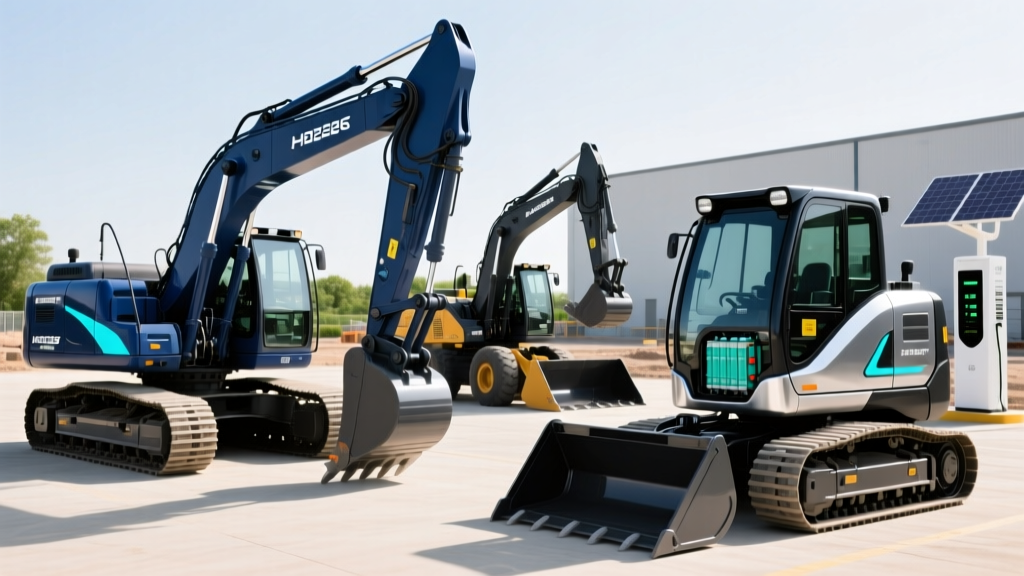
When buyers search for "electric construction equipment," they're usually not looking at 40-ton mining haul trucks. The electrified heavy-equipment market in 2026 is concentrated in the compact and mid-size segment where battery weight and energy density align with realistic duty cycles:
- Compact excavators (3–6 ton): Volvo ECR25 Electric, Caterpillar 301.9 Electric (announced for late 2026), JCB 19C-1E
- Compact wheel loaders (1–3 ton payload): Volvo L25 Electric, Kramer KL 25.5e, Wacker Neuson WL20e
- Site dumpers and utility vehicles: Wacker Neuson DW15e, Mecalac ES800
- Aerial work platforms and scissor lifts: Largely electric already (JLG, Genie, Snorkel)
- Light towers and site power: Battery-electric replacements for diesel gensets
Full-size excavators (20+ ton), dozers, and haul trucks remain predominantly diesel or diesel-electric hybrid. Battery energy density in 2026 sits at roughly 250–300 Wh/kg at the cell level (NMC chemistry dominant in this segment), which means a 500 kWh pack weighs around 3,500–4,000 lbs—manageable on a compact machine with a 10,000-lb operating weight, but prohibitive for large earthmoving equipment that runs 12+ hours in remote locations.
Electric vs. Diesel: The Cost and Performance Comparison
The core ownership question comes down to whether higher capital cost is justified by lower operating expense. Here's how a typical compact excavator stacks up over five years of commercial use:
| Category | Electric (e.g., Volvo ECR25 Electric) | Diesel (e.g., Volvo ECR25) |
|---|---|---|
| Purchase price (MSRP) | $75,000 | $45,000 |
| Federal/state incentives | −$20,000 (est. §45W + state) | $0 |
| Net acquisition cost | $55,000 | $45,000 |
| Energy/fuel cost (5 yr, 10,000 hrs) | $7,500 (avg $0.15/kWh, 75 kWh/day) | $37,500 (avg $4.25/gal, 1.8 gal/hr) |
| Powertrain maintenance (5 yr) | $1,200 (hydraulic fluid, filters) | $8,500 (oil, filters, DEF, injectors, DPF) |
| Downtime cost (estimated) | $1,500 | $5,000 |
| Residual value (year 5) | −$22,000 | −$18,000 |
| Total 5-yr cost | $43,200 | $78,000 |
| Cost per operating hour | $4.32 | $7.80 |
The crossover point where electric becomes cheaper typically arrives between years 2 and 3, assuming 1,500+ operating hours annually and reliable site charging. Below 800 hours/year, the higher purchase price is harder to justify unless you're working in environments that mandate zero emissions or low noise.
Battery Specs, Charging, and Real-World Runtime
Understanding electric construction equipment requires the same kW vs. kWh distinction that applies to EVs: kWh is the battery's energy capacity (how much work it can do), while kW is the charge rate or motor power (how fast energy flows).
| Specification | Value |
|---|---|
| Battery capacity (usable) | 150–250 kWh (NMC lithium-ion) |
| Battery voltage | 400–600V DC |
| Onboard charger (Level 2 AC) | 22–40 kW |
| DC fast charge capability | Up to 150 kW (CCS2 connector typical) |
| Charge time 0–80% (DC fast) | 60–90 minutes |
| Charge time 0–100% (Level 2 AC, overnight) | 6–10 hours |
| Operating weight | 5,000–12,000 lbs |
| Hydraulic system power | 20–45 kW continuous |
| Typical runtime (mixed digging/travel) | 4–8 hours |
| Battery warranty | 5 years / 10,000 operating hours (typical) |
Runtime varies enormously with duty cycle. Continuous heavy digging drains a 200 kWh pack in roughly 3.5–4 hours. Light grading, trenching, or intermittent use with idle periods extends that to 7–8 hours. Cold weather reduces effective capacity by 10–20% below freezing, similar to passenger EVs, because battery internal resistance increases and hydraulic fluid viscosity rises.
Charging logistics on a job site require planning. Most compact electric machines charge overnight at a yard or depot via a 480V three-phase Level 2 connection (22–40 kW). For multi-shift operations, a 150 kW DC fast charger can add roughly 60–80% capacity during a lunch break. Installing a 480V/60A three-phase circuit at a contractor yard typically costs $8,000–$25,000 depending on panel capacity, trenching distance, and local utility interconnection requirements—work that must be specified by a licensed electrician.
Where Electric Equipment Wins (and Where It Doesn't)
The business case for electric construction equipment is highly situation-dependent. Here's a practical decision framework:
Choose electric construction equipment if:
- You work in noise-restricted environments (hospitals, schools, residential areas with early/late-hour ordinances) — electric machines operate 5–10 dB quieter than diesel, often below 70 dB(A) at the operator station
- You perform indoor demolition, tunnel work, or enclosed-structure construction where diesel exhaust ventilation is costly or impractical
- Your municipality or client requires zero-emission equipment on bid specifications (increasingly common in California, New York, and federal infrastructure projects)
- Your machines return to a home yard nightly where Level 2 charging can be installed
- You operate 1,500+ hours/year, making the energy and maintenance savings meaningful
- You can access federal §45W commercial clean vehicle credits (up to $40,000 for vehicles over 14,000 lbs GVWR) and state incentive programs
Stick with diesel (or wait) if:
- You work on remote sites without grid power and rely on fuel trucks for resupply
- Your duty cycle demands 10–12+ hours of continuous heavy work without charging breaks
- You need full-size equipment (20+ ton excavators, large dozers, haul trucks) where electric options don't yet exist in production
- Your annual utilization is below 800 hours, making the upfront premium difficult to amortize
- Your local utility cannot provide three-phase power at your equipment yard without a prohibitively expensive transformer upgrade
Real-World Ownership Considerations Contractors Should Plan For
Beyond the spec sheet, several practical factors shape the ownership experience:
Charging infrastructure lead times. Utility upgrades for three-phase 480V service can take 3–9 months in some regions. Plan your first electric equipment purchase alongside the charging installation, not after delivery. If your yard is on single-phase residential-style service, you'll almost certainly need a panel and transformer upgrade.
Battery degradation and replacement. NMC lithium-ion packs in construction equipment typically lose 10–20% capacity over 5,000–8,000 operating hours (roughly 5–8 years of typical use). Warranty thresholds usually guarantee 70–80% state of health (SoH) at 10,000 hours. A full battery replacement on a compact excavator currently costs $18,000–$35,000 depending on pack size—factor this into your 8–10 year ownership model if you plan to keep the machine long-term.
Hydraulic system reality. Electric construction equipment still uses hydraulic systems for digging, lifting, and attachment operation. The electric motor replaces the diesel engine as the prime mover driving the hydraulic pump. You'll still maintain hydraulic hoses, cylinders, and fluid—but you eliminate engine oil, fuel filters, DEF fluid, diesel particulate filters (DPF), and exhaust aftertreatment systems entirely.
Resale value uncertainty. The used market for electric construction equipment is thin in 2026. Early adopters face residual-value risk similar to early passenger EVs. Lease or finance structures with guaranteed residuals can mitigate this. Major auction houses (Ritchie Bros., IronPlanet) are just beginning to see electric machines on the secondary market.
Operator acceptance. Operators consistently report preferring electric machines for reduced vibration, noise, and heat in the cab. The instant torque delivery of electric motors also provides responsive hydraulic control. Training requirements are minimal—most manufacturers report a 1–2 hour orientation covers the differences (charge management, regenerative braking behavior, startup/shutdown sequence).
Common Misconceptions About Electric Construction Equipment
| Myth | Fact |
|---|---|
| "Electric excavators can't generate enough breakout force." | Hydraulic system pressure (not the prime mover) determines breakout force. Electric machines match diesel equivalents on hydraulic pressure (typically 3,500–4,500 psi) because the electric motor drives the same pump architecture. |
| "Batteries won't last in dusty, vibrating construction environments." | Battery packs in construction equipment are rated IP67/IP69K (dust-tight, high-pressure washdown resistant) and undergo vibration testing to ISO 12405 standards. These are not repurposed passenger EV packs—they're purpose-built for off-highway shock loads. |
| "Charging takes too long for a productive job site." | Overnight Level 2 charging at the yard covers most single-shift operations (4–8 hours of runtime). For two-shift work, a 150 kW DC fast charger adds 60–80% in about an hour—comparable to a lunch break. Continuous 24/7 operations remain a diesel use case. |
| "The federal tax credit doesn't apply to construction equipment." | The IRS §45W commercial clean vehicle credit applies to qualified off-road vehicles and equipment meeting battery-capacity requirements, with credits up to $40,000 for machines over 14,000 lbs GVWR. Eligibility depends on battery sourcing and business-use requirements—consult a tax professional and review current IRS guidance at irs.gov. |
| "Electric equipment is only for California." | While California's CARB regulations and incentive programs (via the California Energy Commission) accelerate adoption, contractors in New York, New Jersey, Massachusetts, Washington, and British Columbia are active buyers, driven by municipal zero-emission requirements and indoor-work advantages. |
Charging Infrastructure Cost Breakdown
Before ordering electric equipment, budget for the charging side. Here's a realistic range for a contractor yard installation:
| Component | Low Estimate | High Estimate |
|---|---|---|
| Level 2 EVSE (40 kW three-phase, CCS2) | $6,000 | $15,000 |
| DC fast charger (150 kW, CCS2) | $45,000 | $90,000 |
| Electrical panel upgrade (if needed for 480V service) | $5,000 | $25,000 |
| Utility transformer/service upgrade | $0 (existing capacity) | $50,000+ (new transformer) |
| Trenching and conduit (per 100 ft run) | $2,500 | $8,000 |
| Permits and engineering | $1,500 | $5,000 |
| Electrician labor | $3,000 | $12,000 |
| Total (Level 2, no utility upgrade) | $18,000 | $65,000 |
| Total (DC fast, with utility upgrade) | $55,000 | $190,000+ |
Many utilities offer commercial EV charging incentives, demand-charge management programs, or make-ready infrastructure rebates that can offset 30–50% of installation costs. Contact your utility's commercial accounts team before finalizing equipment orders.
Frequently Asked Questions
Can electric construction equipment handle cold weather?
Yes, but with a capacity penalty. Below 32°F, expect 10–20% reduction in usable battery capacity and slightly slower hydraulic response due to fluid viscosity. Most electric machines include battery thermal management (heating) that draws from the pack during cold starts. Preconditioning the battery while still plugged in at the yard mitigates this loss. In extreme cold (below 0°F), diesel machines also face starting and DEF-freezing issues, so the comparison isn't one-sided.
How do I charge electric equipment on a remote job site without grid power?
This remains the primary limitation. Options include: (1) a towable battery energy storage system (BESS) charged at the yard and transported to site, (2) a diesel or biodiesel generator used as a range extender for charging, or (3) temporary utility service for long-duration projects. For truly remote, off-grid work, diesel remains the practical choice in 2026.
What is the battery replacement cost and timeline?
Replacement packs for compact electric excavators range from $18,000–$35,000 in 2026. Battery technology cost curves suggest this will decline 30–40% by the early 2030s. Most manufacturers warranty batteries for 5 years / 10,000 operating hours at 70–80% capacity retention. Actual degradation data from early-adopter fleets in Europe (where electric equipment has been deployed since 2019–2020) shows roughly 12–18% capacity loss at 6,000 hours—within warranty thresholds.
Does the §45W commercial clean vehicle credit apply to off-road equipment?
The §45W credit, administered by the IRS, covers "qualified commercial clean vehicles" which can include certain off-road mobile equipment meeting battery capacity and weight requirements. The credit is up to $7,500 for vehicles under 14,000 lbs GVWR and up to $40,000 above that threshold. Battery component and critical mineral sourcing requirements apply, and the rules continue to evolve. Consult a tax professional and review the latest guidance at irs.gov before relying on a specific credit amount in your purchase decision.
How does electric equipment resale value compare to diesel?
The used market for electric construction equipment is immature in 2026, with limited transaction data. Early indicators suggest stronger residual values for machines with documented battery health reports (state of health above 85%), but weaker values for machines with degraded packs. Leasing with a guaranteed residual can hedge this uncertainty. As fleet adoption grows through the late 2020s, a more predictable secondary market is expected to develop.
Can I use my existing hydraulic attachments with electric equipment?
Generally, yes. Most electric compact excavators and loaders use standard hydraulic coupler systems (e.g., ISO quick-attach) and provide auxiliary hydraulic flow rates comparable to diesel equivalents. Verify flow rate (GPM) and pressure (PSI) compatibility with your specific attachments—particularly hydraulic breakers and augers that demand high continuous flow.
Sources: Volvo Construction Equipment specifications, IRS §45W Commercial Clean Vehicle Credit, manufacturer product pages for JCB, Wacker Neuson, and Kramer. Pricing and incentive figures are estimates for 2026 and subject to change. Consult manufacturer dealers and tax professionals for current quotes and eligibility.