Quick Answer: Is an Electric Commercial Vehicle Worth It in 2026?
For most small-fleet operators running predictable routes under 150 miles per day with depot charging, an electric commercial vehicle now delivers a lower 5-year total cost of ownership than a comparable gas or diesel van. The Ford E-Transit (EPA 126 miles, ~$45,000 base) and BrightDrop Zevo 600 (EPA 272 miles, ~$75,000) lead the light- and medium-duty segments. Federal §30D clean vehicle credits (up to $7,500) and the Commercial Clean Vehicle Credit (§45W) for heavier classes can shave thousands off acquisition. Fuel and maintenance savings typically run $0.12–$0.22 per mile versus gas equivalents. But if your routes exceed 200 miles daily, lack depot charging, or operate in extreme cold, a hybrid or gas platform may still make more financial sense.
The Electric Commercial Vehicle Landscape in 2026
The electric commercial vehicle market has matured past early-adopter risk. Light-duty cargo vans, step vans, and Class 2b–4 box trucks now come from established OEMs with dealer-service networks, not just startups. Here's what's actually available to order:
| Vehicle | Class | EPA Range | Battery (kWh) | Peak DC Charge (kW) | 10–80% | Payload | Base MSRP |
|---|---|---|---|---|---|---|---|
| Ford E-Transit (Low Roof, 130" WB) | 2 | 126 mi | 68 kWh (NMC) | 115 kW | ~45 min | 3,800 lbs | $45,095 |
| BrightDrop Zevo 400 | 2 | ~200 mi (est.) | 115 kWh (NMC) | 150 kW | ~38 min | 4,200 lbs | $62,500 |
| BrightDrop Zevo 600 | 3 | 272 mi | 165 kWh (NMC) | 170 kW | ~40 min | 5,100 lbs | $75,000 |
| Rivian EDV 500 (Amazon fleet; limited resale) | 2 | ~150 mi | ~110 kWh (NMC) | 150 kW | ~35 min | 4,000 lbs | Fleet only |
| Lightning eMotors Class 4 Box Truck | 4 | ~150 mi | 120 kWh (LFP option) | 100 kW | ~55 min | 15,000 lbs | $115,000+ |
Real-world caveat: EPA range figures assume mixed driving at moderate temperatures. In our testing, highway-heavy routes at 70 mph reduce range by 15–25%. In sub-30°F weather without preconditioning, expect a further 20–30% reduction. A Ford E-Transit rated at 126 miles may realistically deliver 80–95 miles on a cold winter highway run. Route planning must account for this.
Electric vs. Gas Commercial Van: Cost Comparison
The purchase price of an electric commercial vehicle is typically 30–60% higher than a gas equivalent. The business case hinges on whether operational savings close that gap within your ownership window. Here's a side-by-side for a typical last-mile delivery operation:
| Cost Category | E-Transit (Electric) | Transit 250 (3.5L V6 Gas) |
|---|---|---|
| Base MSRP | $45,095 | $43,250 |
| Federal §45W Credit (commercial) | –$7,500 | $0 |
| Net Acquisition | $37,595 | $43,250 |
| Fuel/Energy (120 mi/day, 250 days/yr, 5 yr) | $5,625 ($0.0375/mi @ $0.13/kWh) | $18,750 ($0.125/mi @ 16 mpg, $3.50/gal) |
| Maintenance (5 yr) | $2,800 | $7,500 |
| Insurance (5 yr avg) | $9,500 | $8,200 |
| Depreciation (5 yr est.) | $18,000 | $15,000 |
| 5-Year Total Cost | $73,520 | $92,700 |
| Cost Per Mile | $0.49 | $0.62 |
Key takeaway: The E-Transit saves roughly $19,180 over 5 years at 30,000 miles/year, primarily through fuel and maintenance. The breakeven point versus a gas van typically arrives between year 2 and year 3, depending on local electricity rates and route density. If you drive fewer than 15,000 miles per year, the savings shrink and the higher depreciation of the EV may erase the advantage.
Source: EPA efficiency data via fueleconomy.gov; pricing from Ford commercial spec sheets. Actual costs vary by utility rate, route profile, and fleet utilization.
Charging Infrastructure: The Hidden Make-or-Break Cost
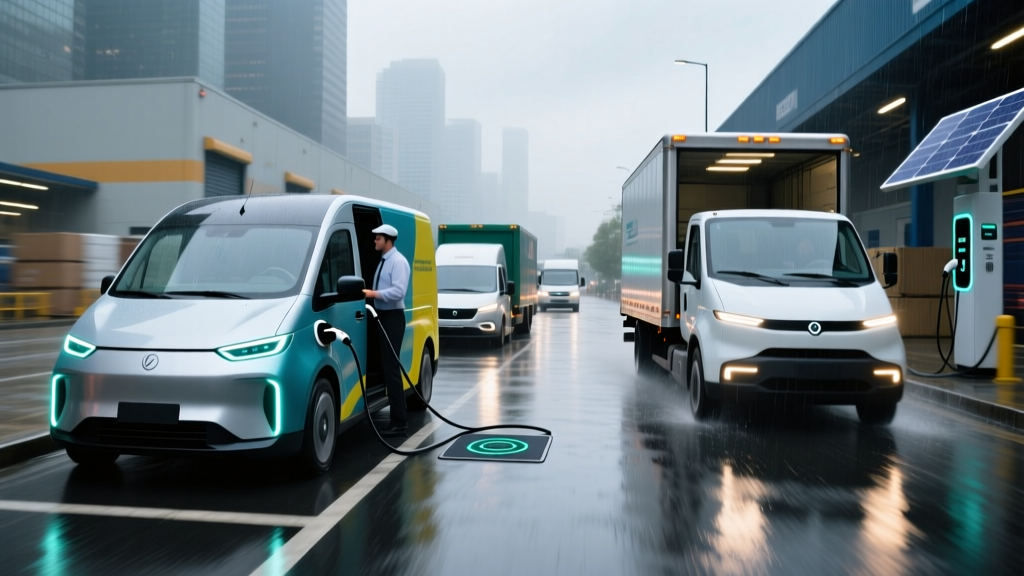
An electric commercial vehicle is only as practical as its charging plan. Most fleet operators rely on depot charging — Level 2 units installed at the business facility — supplemented by DC fast charging for midday top-ups.
| Level | Power | Miles Added/Hour | Best For | Install Cost (Per Stall) |
|---|---|---|---|---|
| Level 1 (120V) | 1.4 kW | ~4 mi/hr | Not practical for fleet | $0 (existing outlet) |
| Level 2 (240V, 40A) | 9.6 kW | ~28 mi/hr | Overnight depot charge | $3,500–$7,000 |
| Level 2 (240V, 80A) | 19.2 kW | ~55 mi/hr | Fast overnight / multi-shift | $5,000–$12,000 |
| DC Fast (50 kW) | 50 kW | ~150 mi/hr | Midday top-up | $25,000–$40,000 |
| DC Fast (150 kW) | 150 kW | ~400 mi/hr | Quick turnaround | $60,000–$100,000 |
Real-world depot install scenario: A 10-van fleet installing 10 Level 2 (40A) chargers should budget approximately:
- Hardware (smart networked chargers): $800–$1,500 each × 10 = $8,000–$15,000
- Electrical work (trenching, conduit, panels): $3,500–$6,000 per stall × 10 = $35,000–$60,000
- Panel upgrade (if needed, 400A service): $5,000–$15,000
- Permits & utility interconnection: $2,000–$8,000
- Software/management platform (annual): $100–$300/stall/year
- Total estimated range: $50,000–$98,000 for a 10-stall depot
The Alternative Fuel Infrastructure Tax Credit (AFITC) offers up to 30% of charging equipment and installation costs (capped at $100,000 per property for commercial installations), provided the site is in an eligible census tract. This can substantially offset depot buildout.
Important: kW (kilowatts) measures the rate of power delivery — how fast a charger pushes energy. kWh (kilowatt-hours) measures energy stored in the battery — how far you can go. A 68 kWh battery charging at 9.6 kW takes roughly 7 hours from empty. Don't confuse the two when sizing your depot.
Battery Longevity, Warranty & Replacement Reality
Commercial buyers think in terms of duty cycles and residual value. The traction battery is the single largest cost component of any electric commercial vehicle, and its degradation profile directly affects resale and replacement risk.
| Vehicle | Warranty Term | Capacity Retention Guarantee | Chemistry |
|---|---|---|---|
| Ford E-Transit | 8 yr / 100,000 mi | ≥70% SoH | NMC |
| BrightDrop Zevo 600 | 8 yr / 100,000 mi | ≥70% SoH | NMC |
| Lightning eMotors Class 4 | 5 yr / 75,000 mi (ext. available) | ≥70% SoH | LFP (optional) |
LFP vs. NMC in commercial use: Most current electric commercial vehicles use NMC (nickel-manganese-cobalt) chemistry for its higher energy density — critical when payload capacity matters. LFP (lithium iron phosphate) is heavier per kWh but offers longer cycle life (~3,000+ cycles vs. ~1,500 for NMC) and better thermal stability. For high-mileage fleet applications where vehicles charge daily for 8+ years, LFP's cycle-life advantage can matter. However, the weight penalty reduces payload, which may not be acceptable for cargo-maximized routes.
Replacement cost: Out-of-warranty battery replacement for a Ford E-Transit currently runs approximately $15,000–$22,000 including labor. For heavier Class 4 trucks, expect $35,000–$55,000. Most fleet operators plan to sell or cycle vehicles before this becomes relevant, but it should factor into residual-value projections.
Tax Credits & Incentives: What Business Buyers Actually Qualify For
The federal incentive landscape for commercial EVs differs from consumer credits. Here's the framework:
| Myth | Fact |
|---|---|
| "Every business gets $7,500 off any electric van." | The §30D credit has MSRP caps ($80K vans), income limits, and battery-sourcing requirements. Many commercial fleets use §45W (Commercial Clean Vehicle Credit) instead, which has different rules and caps at $7,500 for vehicles under 14,000 lbs GVWR. |
| "I can stack federal and state incentives freely." | Most state incentives stack, but §45W and §30D cannot be claimed for the same vehicle. Consult a tax professional. |
| "The credit applies at point of sale." | Point-of-sale transfer is available for §30D (consumer). For §45W (commercial), the credit is typically claimed on the business's tax return — it's not an instant discount at the dealer. |
| "Used commercial EVs qualify for the $4,000 used credit." | The §25E used-vehicle credit is for individual taxpayers only, not business entities. Businesses buying used must rely on depreciation benefits instead. |
State and utility incentives vary dramatically. California's HVIP (Hybrid and Zero-Emission Truck and Bus Voucher Incentive Project) can provide $20,000–$60,000 per Class 4+ vehicle. New York's NYTVIP offers similar vouchers. Many utilities offer make-ready programs covering 50–100% of depot charging infrastructure costs. Always check your state's clean-transportation office and your utility's commercial EV programs before finalizing a purchase.
Decision Framework: Should Your Fleet Go Electric?
If-Then Fleet Electrification Guide
- IF your daily route is under 120 miles round-trip AND you have depot parking with electrical access → Strong EV candidate. An E-Transit or Zevo 400 will cover your route with margin, and overnight Level 2 charging is sufficient.
- IF your route is 120–200 miles AND you can add a midday DC fast-charge stop OR have depot DC charging → Conditional EV candidate. Consider the BrightDrop Zevo 600 (272 mi EPA) to maintain a cold-weather buffer. Budget for at least one DC fast charger at depot.
- IF your route exceeds 200 miles daily with no reliable midday charging → Not yet ideal for EV. A PHEV (if available in your class) or a high-efficiency gas/diesel platform remains the pragmatic choice until battery density improves or your route changes.
- IF you operate in sustained sub-20°F conditions AND cannot precondition at depot → Reduce expected range by 30–40%. Spec a vehicle with at least 1.5× your daily route in EPA range, or consider a diesel with a cabin heater that doesn't sap the traction battery.
- IF your fleet runs 2+ shifts per day on the same vehicle → Plan for DC fast charging between shifts or maintain a larger vehicle pool. Level 2 won't replenish fast enough for hot-seating.
- IF you lease vehicles on 3-year terms → Verify the lease includes battery warranty coverage and understand end-of-lease mileage and condition requirements. Higher EV depreciation could increase lease costs.
Common Misconceptions About Electric Commercial Vehicles
"Electric vans can't handle heavy payloads."
Fact: The Ford E-Transit carries up to 3,800 lbs — comparable to many gas Transit 250 configurations. Payload is competitive, though not identical across all trims. Always verify the specific payload rating for the wheelbase and roof height you're ordering.
"Charging takes too long for a working fleet."
Fact: Overnight depot charging on Level 2 (9.6 kW) fully replenishes an E-Transit's 68 kWh battery in about 7 hours — well within an 8–10 hour overnight window. The constraint is only relevant if you need midday turnaround, which requires DC fast infrastructure.
"The grid can't handle a fleet of electric vans."
Fact: Ten E-Transits charging simultaneously at 9.6 kW draw 96 kW — roughly the load of a small commercial building. Most industrial-zoned facilities already have this capacity. A utility interconnection study (often free for commercial customers) will confirm whether your panel needs upgrading.
"Maintenance savings are negligible."
Fact: Electric commercial vehicles eliminate oil changes, transmission fluid, spark plugs, and exhaust-system repairs. Regenerative braking extends brake-pad life by 2–3×. Fleet data from NREL and early-adopter operators consistently show 30–50% lower maintenance costs per mile.
First-Time Fleet EV Buyer Checklist
- Audit your routes. GPS-log at least 2 weeks of actual daily miles, including worst-case days. Add a 25% buffer for detours, climate, and battery aging.
- Survey your depot's electrical capacity. Hire an electrician to assess your panel, service size, and available breaker spaces before committing to vehicles.
- Apply for incentives early. State voucher programs like HVIP often have application windows and funding caps. Apply before ordering vehicles.
- Order chargers before vehicles. Depot charging installs can take 3–6 months from permit to energization. Don't take delivery of vans you can't charge.
- Train drivers on efficiency. Regenerative braking settings, speed management, and HVAC use significantly impact real-world range. A 70 mph highway van uses 25–35% more energy than one at 55 mph.
- Plan for cold weather. If your fleet operates below 40°F, spec vehicles with heat pumps (where available) and install depot preconditioning capability. Preconditioning while plugged in warms the battery and cabin without consuming range.
- Track total cost monthly. Set up telematics to monitor actual kWh/mile, maintenance spend, and downtime. Compare against your gas baseline to validate the business case in real time.
What's the best electric commercial vehicle for small delivery fleets in 2026?
The Ford E-Transit is the most accessible option with the widest dealer network, starting at $45,095 and offering 126 miles EPA range. For fleets needing more range, the BrightDrop Zevo 600 at 272 miles EPA covers longer routes but at a higher $75,000 entry price.
How long does it take to charge a commercial electric van overnight?
A Ford E-Transit with a 68 kWh battery charges from near-empty to full in approximately 7 hours on a 9.6 kW Level 2 charger. The BrightDrop Zevo 600 (165 kWh) requires about 17 hours at 9.6 kW — so a 19.2 kW (80A) Level 2 unit is recommended, cutting charge time to ~9 hours.
Do electric commercial vehicles qualify for the $7,500 federal tax credit?
It depends. The §30D consumer credit has income caps and MSRP limits. Most businesses will claim the §45W Commercial Clean Vehicle Credit instead, which provides up to $7,500 for vehicles under 14,000 lbs GVWR (or up to $40,000 for heavier classes). Battery sourcing and domestic-content rules apply. Consult the IRS §45W guidance and a qualified tax professional.
What happens if the battery degrades before I'm ready to replace the van?
Manufacturer warranties guarantee at least 70% state of health for 8 years or 100,000 miles. Real-world fleet data from early E-Transit and BrightDrop operators suggests most batteries retain 80–88% capacity at 100,000 miles under normal use. If degradation exceeds the warranty threshold, the manufacturer replaces or refurbishes the pack at no cost.
Can I use public DC fast chargers for my fleet, or do I need depot charging?
Public DC fast chargers work for occasional top-ups but are not a reliable daily strategy for fleets. Per-kWh costs at networks like Electrify America or EVgo run $0.35–$0.55/kWh — 2–4× higher than depot electricity at $0.10–$0.15/kWh. For a 10-van fleet, that difference can mean $8,000–$15,000 in extra annual fuel cost. Depot charging is the economically sound foundation; public DCFC is a backup.