Quick Answer: Electric commercial planes remain in limited regional service and certification testing as of 2026. Unlike ground EVs — where you can buy a 300+ mile range BEV today and charge at home overnight — electric aviation faces severe energy-density constraints. Current battery technology (~250 Wh/kg at the cell level) limits electric aircraft to roughly 100–400 nautical miles with 9–30 passengers, compared to 1,000+ nm for turboprops. For consumers, the practical takeaway: electric ground vehicles are mature and buyable now; electric flight is a 2030s proposition for most travelers.
Where Electric Commercial Planes Stand in 2026
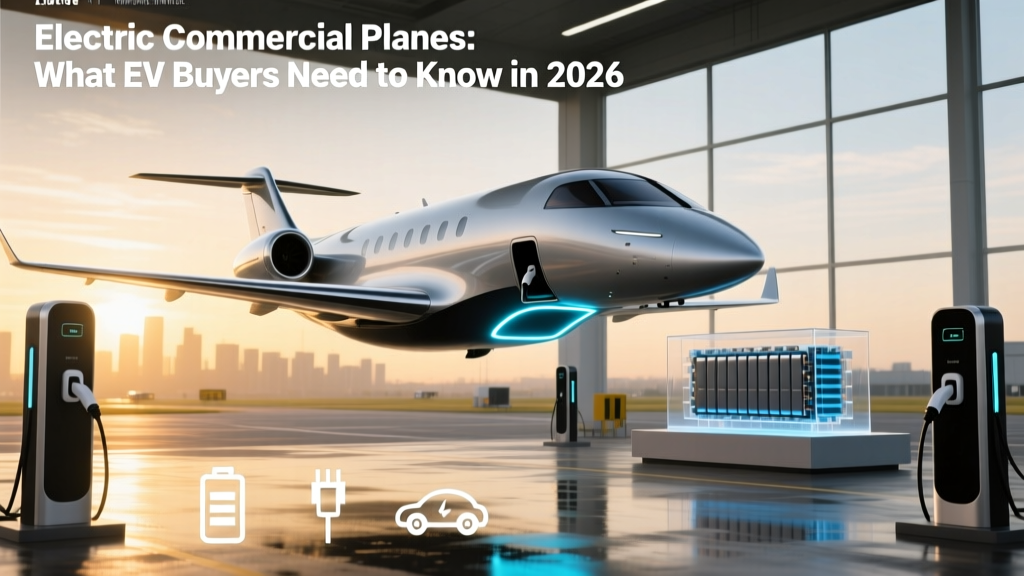
Electric commercial aviation is real, but narrow in scope. Companies like Heart Aerospace (ES-30, 30-seat hybrid-electric regional), Eviation (Alice, 9-passenger), and Beta Technologies (Alia cargo/passenger) have moved from concept to flight testing. The Eviation Alice completed its first flight in 2022 and targets FAA certification, with claimed specs of 440 nautical miles range and a cruise speed of 260 knots. Heart Aerospace's ES-30, backed by orders from United Airlines and Air Canada, uses a hybrid-electric configuration — batteries plus reserve turbogenerators — to extend range to approximately 200 km on pure electric and up to 800 km with hybrid assist.
These aircraft serve a specific niche: short-haul regional routes (think Portland to Seattle, or island-hopping in Hawaii) that currently rely on small turboprops or regional jets. They are not replacing Boeing 737s or Airbus A320s on cross-country flights.
Energy Density: Why Planes Can't Use the Same Batteries as Your EV
The fundamental physics constraint is energy density. Here's the comparison that matters:
| Energy Source | Specific Energy (Wh/kg) | Practical Implication |
|---|---|---|
| Jet-A fuel | ~11,900 Wh/kg (effective ~4,000 after turbine efficiency) | Long-haul flights, heavy payloads |
| NMC lithium-ion (current best cells) | ~250–300 Wh/kg | Short regional flights only |
| LFP lithium-ion (common in EVs) | ~160–180 Wh/kg | Too heavy for practical aircraft use |
| Solid-state (projected, late 2020s) | ~400–500 Wh/kg | Could extend range to ~600 nm |
Your Tesla Model Y Long Range carries about 75 kWh of usable energy in a ~480 kg battery pack. That's roughly 156 Wh/kg at the pack level. For a car, that's fine — rolling resistance and aerodynamic drag at 70 mph are manageable. For an aircraft fighting gravity continuously, you need far more energy per kilogram. Jet-A fuel delivers approximately 40x the effective specific energy of current lithium-ion cells.
This is why electric commercial planes max out at 9–30 passengers on routes under 400 nautical miles. Scaling to 150-passenger, transcontinental flights would require battery energy densities that don't exist in any lab today.
Electric Planes vs. Ground EVs: A Reality Check
If you're an EV buyer wondering whether to wait for electric planes or buy an EV now, here's the data-driven comparison:
| Factor | Ground EVs (2026 Market) | Electric Commercial Planes (2026) |
|---|---|---|
| Availability | Dozens of models, widely available | Flight testing / early certification; limited routes by late 2020s |
| Range | 250–400+ miles EPA (BEV) | 100–440 nautical miles (small aircraft, 9–30 seats) |
| Charging/Refueling | Home Level 2: 6–19 kW; DC fast: 150–350 kW, 10–80% in 15–30 min | High-power ground charging, 30+ min turnaround; airport infrastructure TBD |
| Cost to Consumer | $30,000–$80,000+ MSRP; eligible for up to $7,500 §30D credit (see IRS rules) | Not consumer-purchasable; ticket pricing TBD |
| Infrastructure | Mature: home chargers, public networks (Tesla, Electrify America, EVgo) | Airport charging infrastructure largely unbuilt |
| Technology Maturity | Production-ready; 2nd/3rd-gen platforms | Prototype/certification phase |
The takeaway: ground EVs solve a problem you can act on today. Electric commercial planes address a different problem — short-haul aviation emissions — that won't affect your personal transportation decisions for years.
What Electric Planes Mean for EV Battery Tech
Here's where electric aviation does matter to EV buyers: the battery technology developed for aircraft will eventually trickle down to cars.
Aviation demands extreme energy density, fast charge rates, and rigorous safety margins. Companies developing solid-state batteries — Toyota, Samsung SDI, QuantumScape — cite aviation as a key market. If solid-state cells reach 400–500 Wh/kg commercially (projected for late 2020s to early 2030s), that translates to EVs with:
- 500+ mile EPA range in midsize sedans and SUVs without increasing pack weight
- 10-minute DC fast charges (10–80%) thanks to higher C-rates and better thermal stability
- Reduced degradation — solid-state electrolytes resist dendrite formation, potentially extending battery life beyond 200,000 miles with minimal capacity loss
Aviation also pushes advances in thermal management and structural battery packs (where the battery is a load-bearing component). These innovations will appear in production EVs before they appear in commercial airline service.
Common Misconceptions About Electric Planes
| Myth | Fact |
|---|---|
| "Electric planes will replace jet travel soon." | Current battery tech limits electric aircraft to short-haul regional routes with small passenger counts. Long-haul flights (LAX to JFK, international) require energy densities 5–10x beyond current lithium-ion. |
| "Electric planes are zero-emission." | They're zero-emission at point of use, like ground EVs. Upstream emissions depend on grid mix. Also, aviation's non-CO₂ effects (contrails, NOx at altitude) aren't fully solved by electrification of propulsion alone. |
| "I should wait for electric planes instead of buying an EV." | Ground EVs are mature, widely available, and cost-effective today. Electric commercial aviation won't offer consumer-accessible routes until the early 2030s at earliest, and only on limited short-haul corridors. |
| "Electric planes will be cheaper to fly." | Operating costs per seat-mile may be lower due to cheaper energy and simpler maintenance (electric motors vs. turbines). But aircraft acquisition costs, battery replacement cycles, and airport charging infrastructure add significant upfront capital. Ticket prices are uncertain. |
The Decision Framework: What Should You Actually Do?
If you need personal transportation now: Buy an EV or PHEV. The 2026 market offers strong options from $30,000–$60,000 with 250–350+ miles of EPA range, DC fast charging in 18–30 minutes (10–80%), and available federal tax credits up to $7,500 (subject to IRS §30D income, MSRP, and battery-sourcing requirements).
If you fly short-haul frequently (under 400 miles): Watch for electric regional airline announcements from United, Air Canada, and regional carriers. These routes may offer electric service by 2029–2032. In the meantime, ground EVs or PHEVs are a viable alternative for the same corridor distances — often competitive with flying when you factor in airport transit, security, and total door-to-door time.
If you're investing in EV/battery tech: Solid-state battery companies and aviation-adjacent battery developers (QuantumScape, Solid Power, Toyota's battery division) are worth monitoring. Aviation certification requirements create a high bar — if a cell passes FAA standards, it will exceed automotive requirements.
If you're concerned about aviation emissions: Sustainable Aviation Fuel (SAF) is the near-term solution for long-haul flights, not batteries. Electric planes address only the short-haul segment. Your personal carbon reduction is better served by driving an EV than by waiting for electric flight.
Cost Context: EV Ownership Today vs. Waiting for Future Tech
Let's ground this in real numbers. Here's what a typical EV buyer faces in 2026 versus the hypothetical future of electric aviation:
| Cost Factor | Ground EV (2026 Example: Tesla Model Y Long Range) | Electric Commercial Plane Ticket (Projected) |
|---|---|---|
| Purchase/Access | ~$48,000 MSRP; potentially ~$40,500 after $7,500 §30D credit | Not purchasable; ticket price TBD (estimated comparable to turboprop fares) |
| Fuel/Energy per Mile | ~$0.04–$0.06/mile (home charging at $0.13/kWh avg); ~$0.12–$0.18/mile (public DC fast) | Estimated lower per-seat-mile than Jet-A, but consumer pricing unclear |
| Maintenance (Annual) | ~$300–$600/year (no oil changes, minimal brake wear with regen) | N/A for passengers; operators expect 30–50% lower maintenance vs. turboprops |
| 5-Year Total Cost (Owner) | ~$35,000–$45,000 including depreciation, energy, insurance, maintenance | N/A |
For the EV buyer, the economics are clear and calculable today. Per fueleconomy.gov, the average EV saves $600–$1,200 annually in fuel costs versus a comparable gas vehicle, with payback periods of 3–6 years depending on local electricity rates and driving patterns.
Frequently Asked Questions
Are electric commercial planes available to fly on today?
No. As of 2026, electric commercial aircraft are in flight testing or early certification stages. Companies like Eviation (Alice), Heart Aerospace (ES-30), and Beta Technologies (Alia) have not entered commercial passenger service. Limited cargo operations and pilot training flights may begin before passenger routes. Expect the first scheduled passenger flights on small regional routes no earlier than 2028–2030.
How far can an electric plane fly compared to an EV?
The Eviation Alice claims 440 nautical miles (~506 statute miles) with 9 passengers. The Heart Aerospace ES-30 targets 200 km pure electric, 800 km hybrid. For comparison, the Tesla Model Y Long Range achieves 320 miles EPA on a single charge, and the Lucid Air Grand Touring reaches 516 miles EPA. Ground EVs and electric planes are converging on similar absolute range figures, but aircraft carry far fewer people and require exponentially more energy per passenger-mile due to the physics of flight.
Will electric planes make air travel cheaper?
Possibly, on short-haul routes. Electric motors are simpler and more reliable than turbine engines, reducing maintenance costs. Electricity is cheaper per energy-equivalent than Jet-A fuel. However, battery replacement costs (aircraft batteries will cycle heavily and degrade), airport charging infrastructure investment, and high aircraft acquisition costs create countervailing pressure. Industry analysts project ticket prices roughly comparable to current turboprop fares initially, with potential reductions as the technology scales.
Should I wait for solid-state batteries before buying an EV?
Solid-state batteries are projected for limited production vehicles in 2028–2030 (Toyota has announced a 2027–2028 target). They promise 500+ mile ranges and faster charging. However, current NMC and LFP batteries already deliver excellent real-world performance: 250–350 mile EPA ranges, 10–80% DC fast charging in 18–30 minutes, and degradation rates of roughly 10–15% over 100,000 miles. Waiting 3–5 years for solid-state means forgoing current savings and driving a gas vehicle longer. For most buyers, today's EVs represent a strong value proposition now.
What does electric aviation mean for my EV's battery longevity?
Aviation's extreme safety and performance requirements push battery innovation faster than automotive alone. Thermal management systems, advanced cell monitoring, and degradation-resistant chemistries developed for aircraft will eventually appear in production EVs. This is a long-term benefit — expect trickle-down improvements over the next 5–10 years, not an immediate reason to delay an EV purchase.