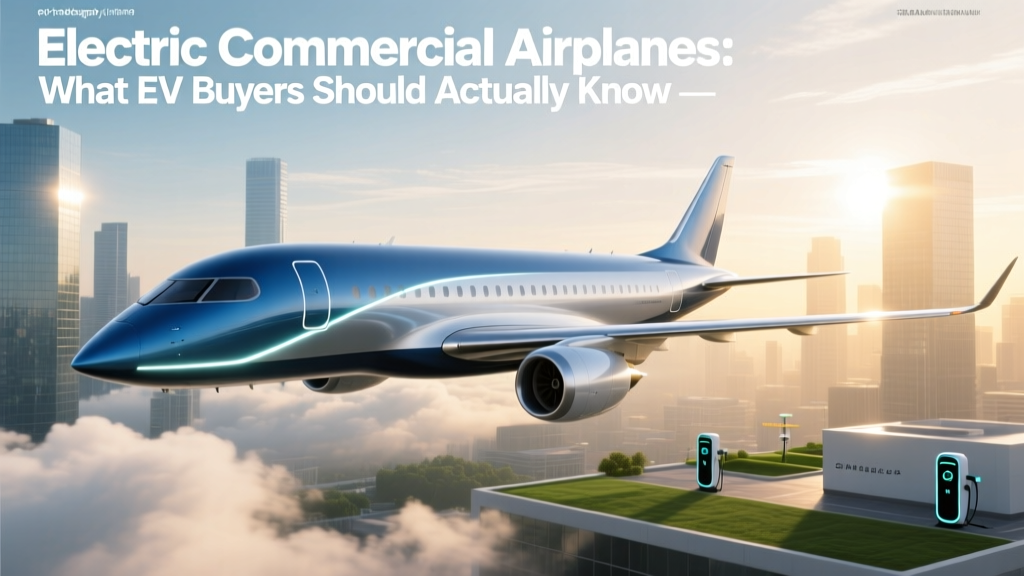
The Short Answer on Electric Commercial Airplanes
As of 2026, there are no battery-electric commercial airliners carrying fare-paying passengers on scheduled airline routes. The energy density of today's best lithium-ion battery packs (roughly 250–300 Wh/kg at the cell level) is roughly 40–50x lower than Jet-A kerosene (~12,000 Wh/kg usable). That physics gap means a 150-seat Boeing 737–class aircraft cannot carry enough battery energy to fly a typical 1,000-mile route without the batteries alone weighing more than the entire maximum takeoff weight of the conventional jet.
What does exist: small 2–9 seat electric trainer aircraft (such as the Pipistrel Velis Electro, EASA-certified in 2020), prototype electric/hydrogen-electric commuter concepts from Heart Aerospace, Eviation, and ZeroAvia, and hybrid-electric demonstrators. None are in mainstream scheduled airline service. For EV car buyers, the headline is simple: electric cars solved the energy-density problem on the ground decades ago; aviation has not.
Why the Keyword "Electric Commercial Airplane" Is Trending — and Misleading
Searches for electric commercial airplane spike whenever a startup posts a PR-friendly video or an airline signs a non-binding letter of intent for "up to X aircraft." Those announcements are real contracts, but they are conditional on certification, funding, and battery breakthroughs. As someone who has tracked EV launches from the Tesla Roadster through the Rivian R1T and Hyundai Ioniq 5, I've seen the same pattern in cars: announced MSRP and range almost never match production reality. Aviation is worse, because the certification bar under FAA Part 23 / Part 25 is years longer than any NHTSA crash-test cycle.
The Physics Problem: Batteries vs. Jet Fuel
Everything in aviation comes back to specific energy — how much energy you can store per kilogram. Here is the honest comparison, the same way I'd compare kWh/100mi between two EVs:
| Energy Source | Specific Energy (Wh/kg) | Round-Trip Efficiency | Usable per kg (Wh) |
|---|---|---|---|
| Jet-A kerosene + turbofan | ~12,000 | ~35% | ~4,200 |
| 2026 best Li-ion pack (NMC, system-level) | ~250 | ~90% | ~225 |
| LFP pack (e.g., Tesla Model 3 RWD) | ~170 | ~92% | ~156 |
| Hydrogen fuel cell (ZeroAvia approach) | ~800 (system) | ~50% | ~400 |
Even after accounting for the electric motor's superior efficiency, jet fuel still delivers roughly 10–15x more usable energy per kilogram than the best current battery pack. That's why an Eviation Alice (9-seat, announced) targets ~250 nautical miles of range on a ~3,700 kg battery, while a turboprop King Air 350 flies 1,800 nm on a fuel load weighing a fraction of that.
Where Electric Aviation Actually Exists Today
There are three real categories, and conflating them is where most coverage goes wrong:
1. Certified Electric Trainer Aircraft (Real, Flying, Small)
The Pipistrel Velis Electro is the only EASA-certified production electric airplane. Specs: 34.5 kWh battery, ~50 minutes of usable flight time plus VFR reserves, cruise ~100 mph, max takeoff weight 600 kg. It is a legitimate two-seat trainer replacing Cessna 152s at European flight schools. This is not "commercial airline" service — it is flight instruction.
2. Prototype Commuter Concepts (Announced, Not Certified)
- Heart Aerospace ES-30: 30-seat hybrid-electric regional, targeting 200 km all-electric range with a reserve fuel generator. SAS and Widerøe have signed LOIs. Certification targeted ~2028–2029. Unreleased.
- Eviation Alice: 9-seat, ~460 nm target range. Prototype flew in 2022; production timeline has slipped multiple times. Unreleased.
- Beta Technologies Alia: 6-seat eVTOL/conventional cargo aircraft being trialed by UPS. Cargo-only, limited routes. Pre-certification.
3. Hydrogen-Electric Retrofit Programs
ZeroAvia is retrofitting Dornier 228 and Dash 8 airframes with hydrogen fuel cells. This is closer to practical for 20–50 seat regional hops, but hydrogen infrastructure at airports does not yet exist at scale.
Electric Car vs. Electric Airplane: Why Cars Won First
If you're shopping for a Tesla Model Y, Hyundai Ioniq 5, or Ford Mustang Mach-E, it's worth understanding why your car works and your next flight won't be electric. The comparison to a gas car is direct:
| Factor | Electric Car (e.g., Ioniq 5 AWD) | Electric Airplane (Concept Class) |
|---|---|---|
| Energy required per mile | ~0.30 kWh/mi (110 MPGe) | ~3–8 kWh/mi per seat |
| Battery mass penalty | 1,000 kg pack in 2,000 kg car — manageable | Battery mass compounds: heavier plane needs more lift, which needs more energy |
| Refueling / recharge | Level 2 home overnight; 10–80% DC in ~18 min at 240 kW | Airport turnaround must be <30 min for airline economics |
| Cold-weather impact | ~20–30% range loss at 20°F | Battery mass + cold = potentially unflyable reserves |
| Regulatory path | FMVSS crash certification, 2–4 years | FAA Part 23/25, 6–10 years, zero-failure tolerance |
| Current consumer availability | Dozens of models, $30k–$100k | Zero certified airliners for sale |
The cruel physics: a car can carry a 77 kWh pack (Ioniq 5) or 100+ kWh pack (F-150 Lightning) because rolling resistance is low and regenerative braking recovers energy. An airplane at cruise altitude cannot regenerate, and every kilogram of battery requires additional lift, which requires more energy, which requires more battery — a vicious spiral the car simply doesn't face.
Cost Reality: What an Electric Airliner Would Have to Beat
Airlines buy on cost per available seat mile (CASM). For context, a Southwest-style 737 MAX 8 burns ~5,000 lbs of fuel per hour at roughly $2.50/gal in 2026, or ~$850/hr in direct fuel cost, carrying 175 passengers. An electric equivalent would need:
- Battery replacement every ~1,500–3,000 cycles (like LFP traction packs in high-duty commercial vehicles)
- Turnaround fast-charging at 1–2 MW per aircraft (for context, a Tesla Supercharger V4 peaks at 250 kW — you'd need 4–8 stalls worth of power for one plane)
- Airport grid upgrades rivaling a small data center
For the EV car buyer, this is the same calculus as a 350 kW DC fast charger installation requiring a new utility transformer — just scaled 100x. Home charging for your EV is a $500–$2,000 Level 2 install. Airport megawatt charging for aircraft is a multi-million-dollar infrastructure project per gate.
| Cost Element | Conventional Turboprop (e.g., Beech 1900) | Electric Concept (Heart ES-19 class, announced) |
|---|---|---|
| Fuel / electricity per flight hour | ~$600 | ~$150 (claimed) |
| Maintenance per hour | ~$400 | ~$150 (claimed, fewer moving parts) |
| Battery / engine reserve per hour | ~$250 (engine overhaul reserve) | ~$400 (battery replacement reserve) |
| Certification cost (amortized) | Paid off decades ago | $500M–$1B+ program |
| Aircraft purchase | $2–4M used | $8–12M estimated new |
The per-hour operating cost may eventually favor electric on short hops — but only after the capital cost of the aircraft, batteries, and charging infrastructure is amortized over many years. This is identical to the EV-vs-gas-car total-cost-of-ownership debate, where high upfront price is recovered over 5–7 years of lower fuel and maintenance.
Common Misconceptions, With Facts
| Myth | Fact |
|---|---|
| "Airlines have ordered hundreds of electric planes." | Most are non-binding LOIs with delivery conditions, similar to EV startup reservation deposits. Few convert to firm orders. |
| "Solar-powered planes will replace jets." | Solar Impulse 2 circumnavigated the globe in 2016 — with one pilot, averaging ~45 mph, over 16 months. Not commercially scalable. |
| "Hydrogen is the same as electric aviation." | Hydrogen fuel cells are electric propulsion, but hydrogen storage at altitude requires cryogenic tanks and entirely new airport infrastructure. It is a different problem than battery-electric. |
| "Once batteries improve, electric airliners will arrive quickly." | Even a 2x improvement in battery specific energy (to ~500 Wh/kg, which solid-state may eventually deliver) still leaves a 6–8x gap vs. jet fuel. Certification alone adds 6–10 years after a viable prototype. |
| "EVs proved skeptics wrong, so electric planes will too." | Cars need ~0.3 kWh/mi and carry heavy batteries on wheels. Aircraft need continuous lift against gravity with no regen. Different physics, different timeline. |
Decision Framework: Should This Affect Your EV Car Purchase?
If you're researching electric aviation, here's what to actually do:
- If you're a frequent flyer hoping for greener flights: Book on newer, more efficient aircraft (787, A350, A220) today. Sustainable aviation fuel (SAF) is the real near-term decarbonization lever, not battery-electric.
- If you're an investor eyeing eVTOL or electric aviation startups: Treat timelines skeptically. Joby, Archer, and Lilium have all slipped certification targets. Budget for 3–5 years of delay from any announced date.
- If you're an EV car buyer wondering if this changes your purchase: It doesn't. Your Ioniq 5, Model Y, or Equinox EV is a solved engineering problem with mature charging networks, EPA-rated range, and §30D tax credit eligibility. Aviation is a different category, decades behind.
- If you're a pilot or flight student: Electric trainers (Velis Electro) are real and worth considering for initial training in Europe. In the US, FAA acceptance is still limited and the fleet is tiny.
What This Means for EV Owners and Buyers in 2026
The honest takeaway: electric cars are mainstream; electric commercial airplanes are not. The battery technology in your 2026 EV — whether it's the 77.4 kWh NMC pack in an Ioniq 5, the 82 kWh pack in a Tesla Model 3 Long Range, or the LFP pack in a base Model 3 RWD — represents the current practical ceiling of lithium-ion energy density. Aviation needs roughly an order of magnitude more before a 100-seat airliner is plausible.
For your own EV decision, focus on what's real and measurable today:
- EPA range and real-world highway/cold-weather derating (expect 15–30% loss in freezing temps, 10–15% at sustained 75+ mph)
- Peak DC fast-charge kW and 10–80% time (e.g., Hyundai/Kia E-G2 platforms at ~240 kW peak, 10–80% in ~18 min)
- Home Level 2 feasibility — a 48A / 11.5 kW charger on a 60A circuit adds ~30–40 miles per hour of charging; installation typically $800–$2,000 if no panel upgrade is needed
- §30D federal tax credit eligibility — current-year rules include MSRP caps ($55k cars, $80k SUVs/trucks), buyer AGI limits ($150k/$225k/$300k), and critical-mineral/battery-sourcing requirements. Verify on irs.gov and with a tax professional; point-of-sale transfer is available at participating dealers.
FAQ: Electric Commercial Airplane Questions
Are there any electric commercial airplanes flying passengers today?
No battery-electric airliners are in scheduled passenger service as of 2026. The only certified electric airplane in production is the two-seat Pipistrel Velis Electro, used for flight training in Europe.
When will electric commercial airplanes be available?
Small 9–30 seat hybrid-electric or battery-electric regional aircraft may enter limited service around 2028–2032, pending certification. Large 100+ seat airliners on routes over 500 miles are not plausible with any announced battery technology and are realistically a 2040+ discussion, if ever.
Why can't we just put bigger batteries in airplanes like we do in EVs?
Every kilogram of battery in an aircraft requires additional lift, which requires additional energy, which requires more battery — a compounding penalty that cars don't face. A Tesla Model S Plaid carries ~680 kg of battery to move a 2,300 kg car. A 150-seat electric airliner would need a battery pack heavier than the entire takeoff weight of a conventional 737.
Is hydrogen a better path than batteries for electric aviation?
Hydrogen fuel cells offer roughly 2–3x the system-level specific energy of batteries, making them more viable for 20–50 seat regional aircraft. The tradeoff is that hydrogen requires cryogenic storage, new airport fueling infrastructure, and has its own safety and certification challenges. Companies like ZeroAvia are pursuing this path, but no certified commercial hydrogen-electric airliner is in service.
Should I wait for electric airplanes before buying carbon offsets for flights?
No. Sustainable aviation fuel (SAF) and newer, more efficient aircraft (A220, 787, A350) are the realistic near-term levers. Electric airliners will not be a factor in your travel carbon footprint within the next decade.
Does electric aviation technology trickle down to EV cars?
Indirectly. High-density cell research (silicon anodes, solid-state electrolytes) funded by aviation and defense may eventually reach automotive packs, but automotive already drives the vast majority of battery R&D spending due to market size. Your next EV will benefit more from Tesla, CATL, and LG Chem's automotive programs than from aviation startups.
Sources referenced: FAA airworthiness certification guidance, IRS §30D new clean vehicle credit, and fueleconomy.gov for EV efficiency baselines.