The Short Answer
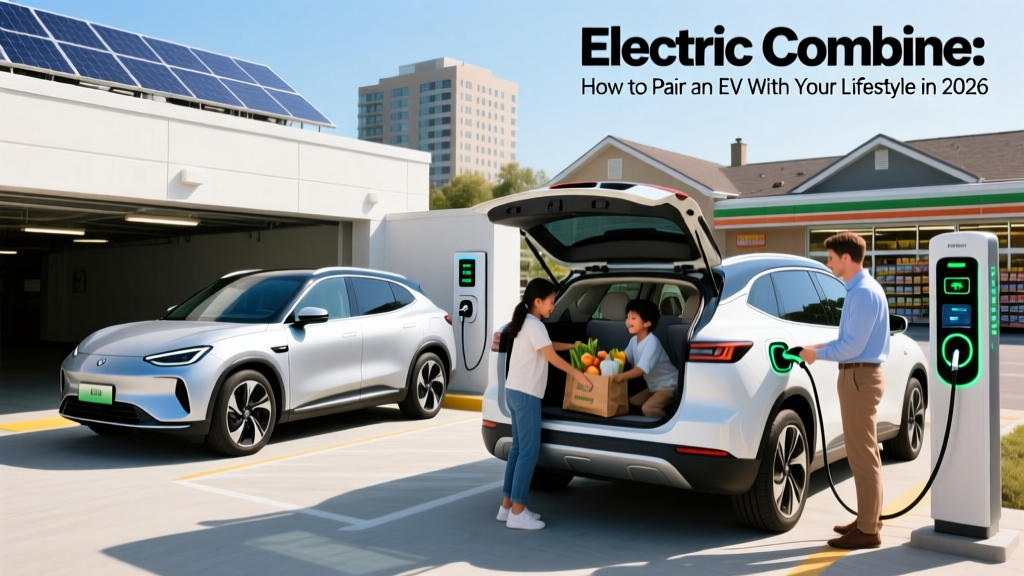
An electric combine means matching a battery-electric vehicle (BEV) to your specific driving patterns, home electrical capacity, climate, and budget so that ownership saves money and adds convenience rather than friction. For most US drivers covering under 40 miles per day with access to Level 2 home charging, a modern EV with 250+ miles of EPA range and a 250 kW DC fast-charging capability delivers lower per-mile fuel costs ($0.04–$0.06/mile vs. $0.12–$0.16/mile for gas), fewer maintenance visits, and eligibility for up to $7,500 in federal tax credits under IRS §30D. The combine fails if you lack reliable home or workplace charging, regularly tow heavy loads in sub-freezing weather, or need a sub-$30,000 purchase price today.
What "Electric Combine" Actually Means for Buyers
The phrase electric combine has gained traction among EV shoppers searching for a holistic purchase framework rather than a single spec. It asks: does an electric vehicle combine well with my commute length, my electrical panel, my winter climate, and my household's second or third car? Answering that requires looking past the sticker and into the ownership math.
A successful combine rests on four pillars:
- Range buffer: Your daily round-trip miles should consume no more than 40–50% of the vehicle's real-world range, leaving margin for detours, climate control, and battery degradation over time.
- Charging access: At least one reliable Level 2 (240V, 7–11 kW) location — home or workplace — where the car can replenish overnight or during the workday.
- Electrical readiness: A 200-amp main panel with at least two open breaker slots, or a budget of $1,500–$4,000 for a panel upgrade and dedicated 50-amp circuit.
- Financial alignment: A total cost of ownership (purchase price minus incentives, plus five years of energy, maintenance, and insurance) that undercuts or matches the gas or hybrid alternative you'd otherwise buy.
EV vs Gas vs Hybrid: The Numbers Side by Side
Before committing to a full electric combine, compare the three powertrains across the metrics that actually affect your wallet. The table below uses a midsize crossover baseline — a 2026 Hyundai Ioniq 5 (BEV), a 2026 Toyota RAV4 Hybrid (HEV), and a 2026 Mazda CX-5 (gas) — all popular in the $35,000–$45,000 segment.
| Metric | 2026 Ioniq 5 SE (BEV) | 2026 RAV4 Hybrid (HEV) | 2026 CX-5 Turbo (Gas) |
|---|---|---|---|
| Base MSRP | $42,600 | $33,500 | $38,950 |
| Federal Tax Credit (§30D) | Up to $7,500* | $0 | $0 |
| Effective Price After Credit | ~$35,100 | $33,500 | $38,950 |
| EPA Combined Efficiency | 114 MPGe / 30 kWh/100mi | 39 MPG combined | 25 MPG combined |
| Annual Fuel/Energy (15k mi) | ~$540 (home L2 at $0.13/kWh) | ~$1,270 ($3.30/gal) | ~$1,980 ($3.30/gal) |
| 5-Year Fuel/Energy Total | ~$2,700 | ~$6,350 | ~$9,900 |
| 5-Year Maintenance Estimate | ~$1,800 | ~$3,200 | ~$4,100 |
| EPA Range / Tank | 303 mi (real-world ~260 highway) | 580 mi (14.5 gal) | 400 mi (16 gal) |
*§30D credit subject to MSRP caps, buyer income limits, and battery-sourcing requirements. Verify at IRS.gov before purchase. Point-of-sale transfer available at participating dealers.
The BEV's higher sticker price collapses once the $7,500 credit applies, and the energy savings widen every year you own the car. Over five years and 75,000 miles, the Ioniq 5 saves roughly $7,200 in fuel and maintenance versus the RAV4 Hybrid and $11,300 versus the gas CX-5. That's a real electric combine win — but only if the credit applies and you charge primarily at home.
Real Costs of the Electric Combine
Breaking down the total cost of ownership reveals where the EV wins and where it stings. Below is a five-year projection for a typical buyer driving 15,000 miles annually.
| Cost Category | BEV (Ioniq 5) | Hybrid (RAV4 HEV) | Gas (CX-5) |
|---|---|---|---|
| Purchase (after credit) | $35,100 | $33,500 | $38,950 |
| Home Charger Install (L2) | $1,200–$2,500 | $0 | $0 |
| 5-Year Energy/Fuel | $2,700 | $6,350 | $9,900 |
| 5-Year Maintenance | $1,800 | $3,200 | $4,100 |
| 5-Year Insurance (avg) | $9,500 | $7,800 | $7,500 |
| Estimated Depreciation | ~$14,000 | ~$11,000 | ~$13,500 |
| 5-Year Total Cost | ~$64,300–$65,600 | ~$61,850 | ~$73,950 |
Key takeaways from the numbers:
- Insurance runs 15–25% higher on EVs due to costlier collision repairs and specialized parts. Get quotes before signing.
- Depreciation has improved for mainstream EVs since 2023's price-war-driven value collapse, but luxury EVs still lose value faster than mainstream hybrids. Check fueleconomy.gov for current efficiency and range data by model.
- Maintenance savings are real: no oil changes, no spark plugs, no transmission fluid, and regenerative braking extends pad life to 80,000+ miles in typical driving.
- Home charger installation is a one-time cost of $1,200–$2,500 for a 48-amp hardwired Level 2 unit on an existing 200-amp panel. If your panel needs upgrading to 200A, add $2,000–$4,000.
When the Electric Combine Breaks Down
Honesty about limitations is what separates a successful EV ownership experience from a frustrating one. Here are the scenarios where a full BEV may not combine well with your life — and what to do instead.
You Rent and Can't Install a Charger
Without home Level 2, you're dependent on public infrastructure. DC fast charging at 150–350 kW adds 150–250 miles in 20–30 minutes, but costs $0.30–$0.48/kWh at networks like Electrify America or EVgo — erasing most of the per-mile savings versus gas. If your workplace offers free or subsidized Level 2 charging, that can substitute. Otherwise, a plug-in hybrid (PHEV) like the Toyota RAV4 Prime (42 miles electric-only, then 38 MPG on gas) may combine better.
You Live Where Winters Drop Below 20°F
Cold weather reduces EV range by 20–35% due to battery chemistry limitations and cabin heating demands. A 303-mile EPA-rated Ioniq 5 may deliver only 200–220 real-world miles at 10°F on the highway. Models with a heat pump (standard on most 2025+ Hyundai, Kia, Tesla, and BMW EVs) lose only 15–25%, which is meaningfully better. If your daily drive exceeds 80 miles round-trip in deep cold, size up to a 320+ mile EPA model or consider a PHEV.
You Tow Frequently
Towing a 3,000-pound trailer cuts EV range by 40–55%. An F-150 Lightning rated for 320 miles EPA drops to roughly 150–170 miles while towing at highway speed. For regular towing, a diesel or hybrid truck remains more practical today.
Common EV Myths vs. Facts
| Myth | Fact |
|---|---|
| "EV batteries need replacing every 5 years" | Federal law mandates 8-year/100,000-mile battery warranties. Real-world data shows 10–15% degradation over 150,000 miles for NMC packs; LFP packs degrade even less. Full replacements cost $8,000–$18,000 but are rarely needed. |
| "Charging takes too long" | Home Level 2 adds 25–40 miles per hour of charging — overnight replenishes any daily driving. DC fast charging delivers 10–80% in 18–35 minutes on modern 800V architectures (Ioniq 5, EV6, Taycan, Lucid). |
| "EVs are worse for the environment" | Even on coal-heavy US grids, an EV produces 60–70% fewer lifetime CO₂ emissions than a comparable gas car (EPA analysis). On cleaner grids, the advantage widens to 80%+. |
| "The grid can't handle EVs" | Most charging happens overnight during off-peak hours when grid capacity is underutilized. Smart chargers and utility time-of-use rates manage demand effectively. |
| "You'll be stranded by a dead battery" | Modern EVs provide accurate range prediction and extensive low-charge warnings. Roadside-assistance EV towing is now standard through AAA and most manufacturer programs. |
Decision Framework: Should You Electric Combine?
If X, Then Y
- If your daily drive is under 50 miles AND you can install Level 2 at home → a mainstream BEV (Ioniq 5, Tesla Model Y, Equinox EV) is an excellent combine. Target 250+ EPA miles for buffer.
- If your daily drive is under 50 miles BUT you can't charge at home → a PHEV (RAV4 Prime, Tucson PHEV, Wrangler 4xe) combines electric commuting with gas flexibility. Confirm workplace charging availability first.
- If your daily drive exceeds 100 miles AND you road-trip monthly → choose a BEV with 300+ EPA miles and 200+ kW DC fast charging (Ioniq 5, Model Y, EV6) OR a hybrid for zero charging dependency.
- If you live in a region with sub-20°F winters AND drive 60+ miles daily → prioritize a BEV with a heat pump and 320+ EPA miles, or choose a PHEV for cold-weather insurance.
- If your household budget caps at $30,000 → the used EV market (with up to $4,000 in §25E credit) or a conventional hybrid are the most realistic electric combines today.
- If you tow over 2,000 lbs regularly → an F-150 Lightning or Rivian R1T works for shorter towing routes; otherwise, a hybrid or diesel truck remains more practical.
Federal Tax Credit: What You Need to Know in 2026
The §30D clean vehicle credit can reduce your effective purchase price by up to $7,500, but eligibility is not automatic. Here is the current checklist:
- MSRP caps: Vans, SUVs, and trucks must be under $80,000; sedans under $55,000.
- Buyer income caps: Modified adjusted gross income must not exceed $300,000 (joint), $225,000 (head of household), or $150,000 (single).
- Battery sourcing: Increasing percentages of critical minerals and battery components must be sourced from the US or free-trade-agreement partners. This requirement tightens annually, disqualifying some models.
- Point-of-sale transfer: You can transfer the credit to the dealer at purchase, reducing your out-of-pocket cost immediately rather than waiting for a tax refund.
- Final assembly: The vehicle must undergo final assembly in North America. Verify via the VIN at fueleconomy.gov.
Always confirm eligibility for your specific trim and build date — a model that qualifies in January may lose eligibility mid-year if its battery sourcing changes. Consult a tax professional for your individual situation.
First-Time EV Buyer Checklist
- Measure your real daily miles — not your worst-case road trip. Most Americans drive 30–40 miles per day.
- Get a home electrical assessment. A licensed electrician can confirm whether your panel supports a 50-amp circuit or needs an upgrade. Get this done before ordering the car.
- Test-charge before you buy. Download the PlugShare or ChargePoint app and visit a DC fast charger near your home. Understand the connector (NACS or CCS) your chosen EV uses and whether your local stations support it.
- Request insurance quotes for the exact trim you're considering — EV premiums vary widely by model and zip code.
- Verify tax credit eligibility for the specific VIN before signing the purchase agreement.
- Understand preconditioning. Most EVs warm or cool the battery before you arrive at a DC fast charger (triggered by navigating to the charger in the infotainment system). This can cut your 10–80% charge time by 5–10 minutes in cold weather.
- Plan for the 80% taper. DC fast charging speed peaks between 10–50% state of charge and slows significantly above 80%. On road trips, charge to 80% and go — the last 20% can take as long as the first 70%.
Frequently Asked Questions
How much does it cost to charge an EV at home per month?
At the US average residential rate of $0.16/kWh (2026), driving 1,250 miles per month in a vehicle consuming 30 kWh/100mi costs roughly $60. That compares to $165 in gasoline for a 25 MPG vehicle at $3.30/gallon. Savings widen if your utility offers off-peak EV rates of $0.08–$0.10/kWh.
What's the difference between kW and kWh?
kW (kilowatts) measures power — how fast energy flows, like the flow rate of a hose. kWh (kilowatt-hours) measures energy — the total amount stored or consumed, like gallons in a tank. A 77 kWh battery charged at 11 kW (Level 2) takes about 7 hours from empty to full. At a 250 kW DC fast charger, that same battery can go from 10–80% in roughly 18 minutes.
Do I need a Tesla to use Superchargers?
No. As of 2025–2026, Tesla has opened a growing portion of its Supercharger network to non-Tesla EVs equipped with the NACS (North American Charging Standard) connector. Most major automakers — Ford, GM, Rivian, Hyundai, Kia — have adopted NACS for 2025+ models. CCS-equipped vehicles can use Tesla Superchargers with a Tesla-approved adapter in many locations.
Will my EV battery need to be replaced?
Statistically, it's unlikely during typical ownership. Data from NHTSA-reported warranty claims and fleet studies shows most EV batteries retain 85–90% of original capacity at 150,000 miles. The 8-year/100,000-mile federal warranty covers capacity loss below 70%. LFP (lithium iron phosphate) batteries, now used in base trims of the Tesla Model 3, Ford Mustang Mach-E Select, and several Chinese-market models, offer even longer cycle life at the trade-off of lower energy density and reduced cold-weather range.
What if I live in an apartment without charging?
Look for workplace Level 2 charging, nearby public Level 2 locations (grocery stores, gyms, libraries increasingly offer them), or a DC fast-charging corridor near your commute. If none of these are practical, a plug-in hybrid gives you electric commuting on short days and gas flexibility when public charging isn't convenient. Some cities now require new multifamily construction to include EV-ready wiring — check your local building codes.
Is an EV actually cheaper than a hybrid over 5 years?
It depends on the credit and your charging setup. If you qualify for the full $7,500 §30D credit and charge at home, a mainstream BEV typically undercuts a comparable hybrid by $2,000–$5,000 over five years. Without the credit, or if you rely on expensive public DC fast charging, the hybrid often wins on total cost. Run your own numbers using the tables above with your local electricity and gas prices.