Quick Answer: Should You Buy an Electric Class 8 Truck?
An electric class 8 truck makes financial sense in 2026 if your fleet operates regional or drayage routes under 250 miles per day, has access to depot charging, and qualifies for federal and state incentives. Expect a purchase price of $250,000–$430,000 before incentives, with diesel fuel savings of $35,000–$55,000 annually per truck on high-utilization routes. For long-haul, irregular routes exceeding 400 miles daily without predictable charging, diesel remains the practical choice today.
The Electric Class 8 Truck Landscape in 2026
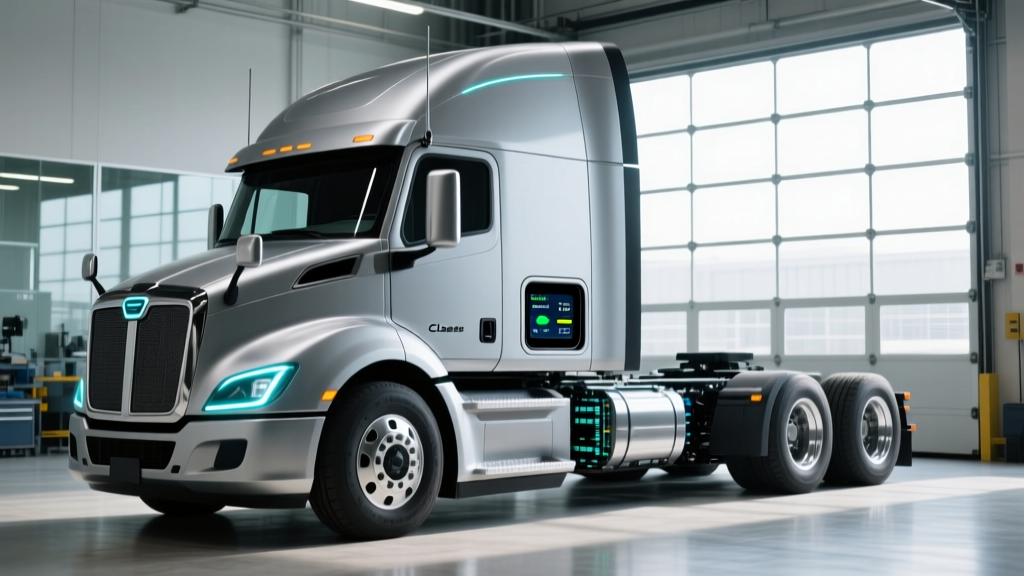
The heavy-duty trucking sector has crossed a threshold. Multiple OEMs now ship production electric class 8 semi trucks with batteries large enough for regional freight and charging speeds that keep depot turnaround under two hours. The U.S. Department of Energy tracks the expanding medium- and heavy-duty EV market, which grew substantially through IRA-driven fleet incentives and state-level voucher programs like California's HVIP.
But the decision to electrify a class 8 fleet is not a simple swap. It involves capital planning, depot electrical infrastructure, route analysis, and driver training. Here is a data-driven breakdown of what's available, what it costs, and where the math works.
2026 Electric Class 8 Truck Specifications Compared
| Specification | Tesla Semi (Dual Motor) | Freightliner eCascadia | Volvo VNR Electric | Peterbilt 579EV |
|---|---|---|---|---|
| Base MSRP (est.) | ~$250,000 (500 mi) / ~$180,000 (300 mi) | ~$300,000–$350,000 | ~$270,000–$320,000 | ~$290,000–$340,000 |
| Battery Capacity (usable) | ~900 kWh (500 mi) / ~500 kWh (300 mi) | 438 kWh | 375 kWh (5-battery pack) | 396 kWh |
| Battery Chemistry | NMC (nickel manganese cobalt) | NMC | NMC | NMC |
| EPA Estimated Range | 500 mi (loaded, 82,000 lb GVW) | 230 mi | 275 mi | 150–200 mi |
| Real-World Range (loaded, mixed) | ~380–430 mi | ~170–200 mi | ~210–245 mi | ~130–175 mi |
| Peak DC Charge Rate | ~1 MW (Megacharger) | ~250 kW (CCS1) | ~250 kW (CCS1) | ~250 kW (CCS1) |
| Charge Time (10–80%) | ~30 min (Megacharger) | ~90–120 min | ~70–90 min | ~80–110 min |
| Motor Power | ~1,000+ hp (dual motor AWD) | ~400 hp (eAxle) | ~455 hp | ~670 hp (tandem drive) |
| GVWR | 82,000 lb | 82,000 lb | 82,000 lb | 82,000 lb |
| Warranty (battery) | 8 yr / 1,000,000 mi | 5 yr / 300,000 mi | 5 yr / 300,000 mi | 5 yr / 300,000 mi |
Important range caveat: These figures assume a fully loaded 82,000 lb GCW on mixed terrain. Cold weather (below 32°F) reduces usable range by 15–30% depending on cab heating demand and battery preconditioning. Highway-only routes at 65+ mph also reduce range 10–20% versus the EPA combined cycle due to aerodynamic drag scaling with the square of velocity.
Total Cost of Ownership: Electric vs Diesel Class 8
The upfront cost of an electric class 8 semi is 2–4x that of a comparable diesel tractor ($130,000–$180,000 for a new diesel day cab). The break-even analysis depends entirely on utilization, fuel costs, and incentive stacking.
| Cost Category (5-Year / 500,000 mi) | Electric Class 8 (Regional) | Diesel Class 8 (Regional) |
|---|---|---|
| Vehicle Purchase | $300,000 | $155,000 |
| Federal Tax Credit (§45W Commercial) | –$40,000 | $0 |
| State/Utility Incentives (avg, varies by state) | –$50,000 to –$120,000 | $0 |
| Depot Charging Infrastructure (per truck share) | $40,000–$80,000 | $0 |
| Fuel / Electricity (5 yr) | $62,500 (at $0.12/kWh, 2 kWh/mi) | $225,000 (at $4.50/gal, 6.5 mpg) |
| Maintenance (5 yr) | $25,000 | $65,000 |
| Insurance (5 yr, est.) | $75,000 | $65,000 |
| Net 5-Year Cost (after incentives) | $292,500–$362,500 | $510,000 |
Key assumptions: 100,000 miles/year, regional routes averaging 180 miles/day, depot charging at commercial electricity rates. The IRS §45W Commercial Clean Vehicle Credit provides up to $40,000 for qualifying class 8 trucks — this is distinct from the consumer §30D credit and applies to business purchases. Consult a tax professional for eligibility specifics.
The inflection point is clear: at high utilization (80,000+ miles/year), the fuel and maintenance savings of electric class 8 trucks overcome the higher acquisition cost within 3–5 years in most incentive-rich states. Below 50,000 miles/year, the payback stretches beyond 7 years and diesel may remain more economical.
Charging Infrastructure: What Fleets Actually Need
Charging is the single largest operational barrier to electric class 8 adoption. Unlike passenger EVs that can rely on public networks, heavy-duty trucks require depot-based or corridor-specific high-power charging.
| Charging Level | Power (kW) | Miles Added per Hour | Use Case |
|---|---|---|---|
| Level 2 (AC, depot overnight) | 19.2–80 kW | 10–40 mi/hr | Overnight top-off, low-utilization trucks |
| DC Fast (CCS1 depot) | 120–250 kW | 60–130 mi/hr | Opportunity charging between shifts |
| Megawatt Charging (MCS/Tesla Megacharger) | 500–1,200 kW | 250–600 mi/hr | High-utilization corridor charging |
Depot installation reality: A single 250 kW DC fast charger for a class 8 truck requires a 480V three-phase supply, a dedicated transformer in many cases, and utility service upgrades that can cost $50,000–$200,000+ per site depending on existing capacity. Lead times for utility upgrades frequently run 12–18 months. Fleets should begin infrastructure planning 18–24 months before truck delivery.
For context on power vs. energy: a 438 kWh battery (Freightliner eCascadia) stores the energy. A 250 kW charger delivers power. At sustained 250 kW, a full charge would theoretically take 1.75 hours — but the charge curve tapers significantly above 80% State of Charge (SoC) to protect battery longevity. Real-world 10–80% charging at a 250 kW CCS1 station takes 90–120 minutes for a 400+ kWh pack.
Real-World Ownership Considerations
Route Matching Is Everything
Electric class 8 trucks thrive on predictable, repeatable routes under 250 miles. Drayage (port-to-warehouse), food distribution, and regional LTL (less-than-truckload) are ideal. If your routes regularly exceed 350 miles with no mid-route charging, the weight penalty of larger battery packs (adding 4,000–10,000 lb) erodes payload capacity and the downtime for charging cuts into delivery schedules.
Cold Weather Operations
Battery chemistry matters. NMC packs — standard across all current class 8 electrics — lose 15–30% of usable capacity in sustained sub-freezing temperatures. Cab heating draws 5–15 kW continuously, further reducing range. Fleets in Minnesota, Montana, or New England should plan routes at 60–70% of the EPA range rating in winter. Battery preconditioning (heating the pack before charging) is essential for maintaining charge speed in cold weather; trucks without active thermal management will see severely reduced DC fast-charge rates below 40°F.
Payload and Weight Distribution
Federal weight limits allow an additional 2,000 lb for electric powertrains under 23 U.S.C. §127 — bringing the maximum GCW to 82,000 lb vs. 80,000 lb for diesel. However, the Tesla Semi's 500-mile battery pack is estimated at 9,000+ lb, consuming much of this allowance. Freight density matters: hauling lightweight, high-cube freight (like empty packaging) is more feasible than dense commodities (steel, liquids) where every pound counts.
Driver Experience and Retention
An underreported advantage: drivers overwhelmingly prefer electric class 8 cabs. The absence of diesel vibration, engine noise, and exhaust smell, combined with instant torque and one-pedal regenerative braking, reduces fatigue on multi-shift routes. Several fleets report measurably lower driver turnover on electric-assigned routes.
Common Misconceptions About Electric Class 8 Trucks
| Myth | Fact |
|---|---|
| "Electric semis can't pull full loads." | All current class 8 EVs are rated to 82,000 lb GCW. The Tesla Semi has demonstrated 80,000+ lb hauls over Donner Pass. Torque delivery is instant, which aids gradeability. |
| "Batteries will need replacement at 300,000 miles." | NMC packs in heavy-duty applications are designed for 1,000,000+ mile lifespans with active thermal management. Tesla warranties its Semi battery to 1 million miles. Degradation to 80% State of Health (SoH) typically occurs at 500,000–800,000 miles under normal use. |
| "Charging takes too long for freight operations." | At 250 kW CCS1, a 400 kWh pack charges 10–80% in ~90 minutes — aligning with mandatory 30-minute driver rest breaks (plus buffer). Megawatt charging reduces this to 30–45 minutes. Opportunity charging during loading/unloading recaptures meaningful range. |
| "There are no incentives for commercial electric trucks." | The federal §45W credit provides up to $40,000. California HVIP offers $60,000–$120,000+ per truck. Utility make-ready programs often cover 50–100% of depot charging infrastructure. Total incentive stacking can reduce net acquisition cost by $100,000–$200,000+. |
| "The grid can't support fleet charging." | Depot charging is schedulable. Most fleets charge overnight during off-peak hours when grid capacity is abundant. Smart charging software can stagger truck start times to limit peak demand. The constraint is local distribution infrastructure, not generation. |
Decision Framework: Is an Electric Class 8 Truck Right for Your Fleet?
Choose Electric Class 8 If:
- Your daily routes are under 250 miles (or under 200 miles in cold climates)
- You operate from a fixed depot where charging infrastructure can be installed
- Your fleet runs 80,000+ miles per truck per year (maximizing fuel savings)
- You operate in a state with strong commercial EV incentives (CA, NY, NJ, CO, WA, OR)
- Your freight is weight-tolerant (you can absorb 4,000–8,000 lb of battery weight)
- Driver retention is a priority and cab comfort is a competitive advantage
Stick With Diesel (or Wait) If:
- Your routes regularly exceed 400 miles without predictable charging access
- You operate long-haul, irregular-route OTR with no fixed depot
- Your utility cannot provide adequate 480V three-phase service within 18 months
- Your freight is extremely weight-sensitive (e.g., bulk liquids, aggregates at max payload)
- Your annual mileage per truck is under 50,000 miles (payback extends beyond 7 years)
- You operate in extreme cold (sustained below 0°F) without adequate preconditioning infrastructure
What First-Time Electric Truck Buyers Must Know
Start with a pilot, not a fleet conversion. Order 2–5 trucks first, run them on your best-suited routes for 6–12 months, and measure actual energy consumption (kWh/mile), charge time, and driver feedback before scaling. Real-world energy consumption for a loaded class 8 EV typically runs 1.8–2.5 kWh/mile depending on terrain, speed, and climate — use 2.2 kWh/mile for conservative planning.
Engage your utility early. The single longest lead-time item is electrical service upgrade. Contact your utility's commercial EV team before placing a truck order. Many utilities offer make-ready programs that cover the cost of wiring, transformers, and switchgear to the meter.
Budget for software and telematics. Fleet management software that optimizes charge scheduling, monitors State of Health (SoH), and integrates with route planning is not optional — it's essential for maximizing battery life and operational efficiency. Budget $200–$500/month per truck for fleet EV management platforms.
Understand warranty structure. Battery warranties on class 8 EVs typically guarantee 70–80% capacity retention at 300,000–1,000,000 miles. The National Highway Traffic Safety Administration (NHTSA) regulates heavy-duty vehicle safety, but battery longevity claims are manufacturer-specific. Get warranty terms in writing, including what constitutes "normal use" and whether range degradation triggers coverage.
Frequently Asked Questions
What is the real-world range of a Tesla Semi with a full load?
Tesla claims 500 miles EPA at 82,000 lb GCW. Independent fleet testing and early operator reports suggest real-world range of 380–430 miles on mixed highway/regional routes at sustained 60–65 mph. In cold weather (below 32°F), expect 320–380 miles. Mountainous routes with significant grade climbing will reduce range further, though regenerative braking on descents recaptures 20–30% of climbing energy.
How much does it cost to install a depot charger for an electric class 8 truck?
A single 250 kW DC fast charger installation typically costs $80,000–$200,000 including the charger unit ($40,000–$70,000), electrical work, utility service upgrade, permitting, and concrete pad. Costs scale down per unit when installing multiple chargers simultaneously. Utility make-ready programs and IRS §30C Alternative Fuel Vehicle Refueling Property Credit (up to $100,000 per item of charging property for commercial use) can offset 30–70% of total installation cost.
Do electric class 8 trucks qualify for the $7,500 consumer EV tax credit?
No. The §30D consumer credit applies to light-duty vehicles under 14,000 lb GVWR. Class 8 trucks (33,001+ lb GVWR) qualify for the §45W Commercial Clean Vehicle Credit, which provides up to $40,000 per qualifying vehicle for business purchasers. Eligibility requires meeting battery component and critical mineral sourcing requirements. Always verify current-year rules on irs.gov and consult a tax professional.
How long do electric semi truck batteries last before replacement?
Current NMC battery packs in class 8 trucks are engineered for 1,000,000+ mile lifespans with active liquid thermal management. Degradation to 80% State of Health (SoH) — the typical warranty threshold — is expected at 500,000–800,000 miles depending on charge patterns (frequent 100% SoC charging accelerates degradation). Battery replacement cost, if needed, is estimated at $80,000–$150,000 for a full pack, though individual module replacement is possible on some platforms at lower cost.
Can electric class 8 trucks handle steep grades?
Yes. Electric motors deliver peak torque at zero RPM, which provides exceptional gradeability. The Tesla Semi has demonstrated hauling 82,000 lb over the 7% grade of Donner Pass. Regenerative braking on descents significantly reduces brake wear — a major maintenance savings on mountain routes. However, sustained climbing draws 3–5x normal energy consumption, so route planning must account for the range impact of significant elevation gain.